


The question should be why would or should you vote in political elections! The Guardian today, with the gloomy collage below, is predicting unprecedented losses for the Labour Party. Yet the current Labour Leader won power in his party by saying no party should promote any policy that would make it ‘unelectable’. It seems now that this ideology has created the least electable party of modern voting history. Is voting in political elections ever a matter of principle in politics?

We have yet to see the results. However, even now it seems that the votes of electorates in political elections are no longer easily predictable or provide data on which to build political principle or even plan success regardless of principle. The paper estimates of that of falls in local government councilors representing the party in national government will be, if predictions are correct, greater than for any standing prime minister in their own time. Here is how they show this graphically:
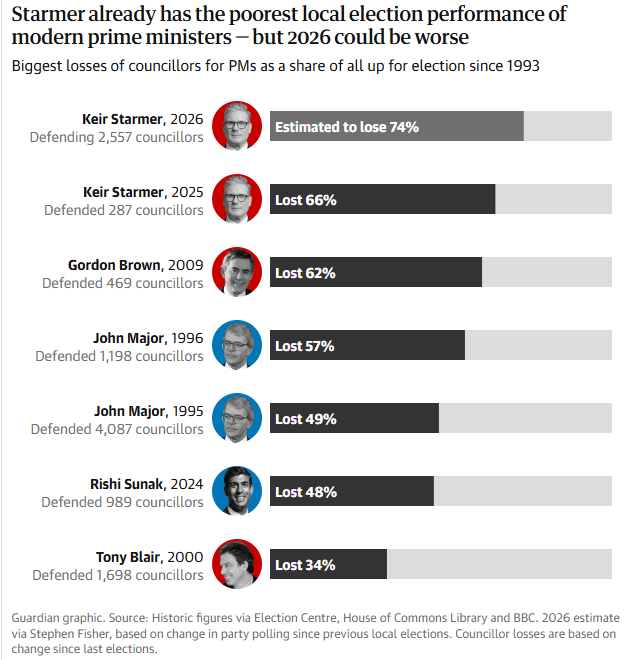
This is also shown in the conventional graphs shown below, with a special place for the expected losses in the devolved governments of Wales and Scotland.
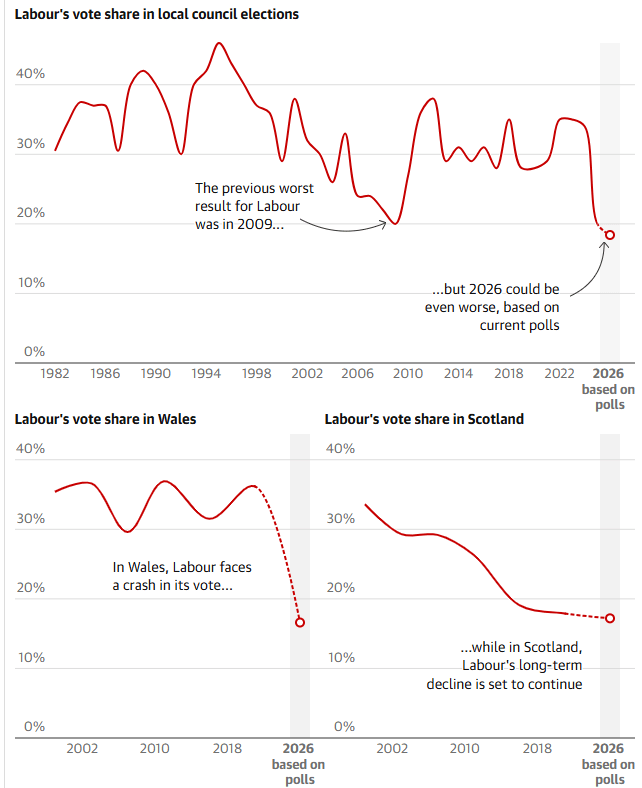
It is worth gazing at these predictions – noting of course that is all they are – the drops based on that ‘grey area’ in them that represents predicted results based on voting opinion polls alone. This grey are matters most in Wales for the fall is more recent and not predictable as a trend as it is in Scotland. Yet Starmer, in one of the few positions, because abstract, that he held to guide him into and within government, fought for the Labour leadership by calling parties governed by principle alone mere sounding boards, where a few radicals spoke only to their mirror reflections. To win one needed mass support and flexible centrist positioning in government. Of course then he said that was aligned with ‘common ownership’ of public utilities, a position he was not prepared to hold for long, seeing change of part membership conditions as his main plank of popularity and establishment of a populism of the political centre in which he believed. That belief meant he could say anything then and change his view once his electoral base in the Party was reshaped in the image he favoured. The important thing he hammered into members was being ‘electable’.
His assumption here was that he knew the electorate and how it would react to decisive leadership from the centre that he and the Party’s right wing pretended to imagine to exist. Yet here we are with, if polls are right, the least electable prime minister of modern political history. moreover, he is now a prime minister who no longer cares about being elelectable and prefers mantras of stability and continuity of national direction. What this stability and consistent direction look like is much as they always hve – knee jerk reactions to the actions of the might is right global political leadership and the ‘markets’.
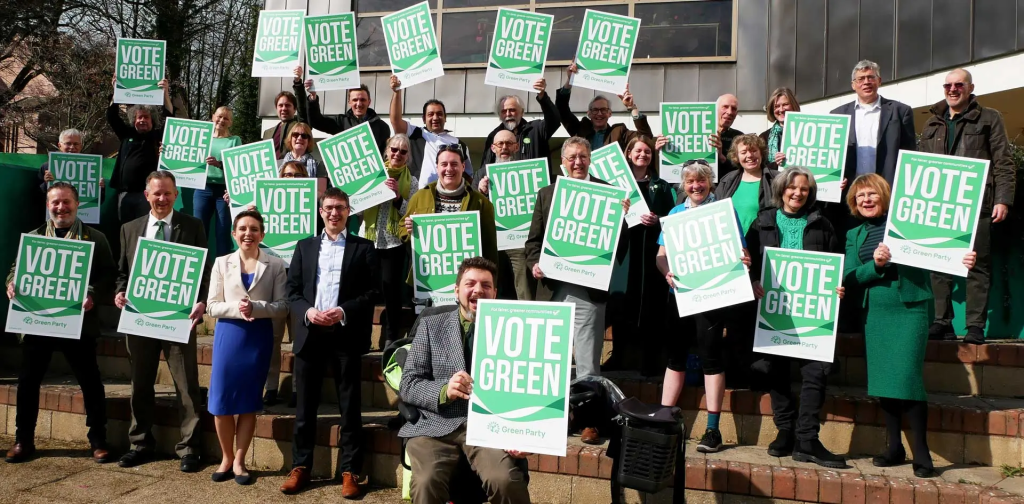
If a leader who prided himself on being electable is so clearly failing to predict electoral behaviour and plan on it gets it so wrong, it should make us think why we vote in political elections, and what determines our vote. I still do vote and on principle because nothing else makes voting matter. The Starmer mantras are based on the most conservative principles of all – to fear anything that actually challenges the status quo rather than tinker with its mechanisms. I will vote Green because that is the only repository of hope when votes for fascist parties are seen as acceptable, a phenomenon not seen in Britain since the 1930s in any serious way. Don’t pretend that the important thing is to keep a sinking raft, poorly constructed from the start with only the interests in mind of those who were in the first class areas of an already sunken Titanic. Strangely even those who will vote Reform will see themselves as in protest against Starmerism – they do not get that what they vote for will so sour the politics of our nations, if Reform is not held back by green hope, that they will not be allowed to vote for much longer.
With green love
Steven xxxxxxxxxxxxx

