


‘Where do you see yourself in ten years?’: This stock question in job interviews is at the root of a society that has no other standards than narcissism and magical thinking.
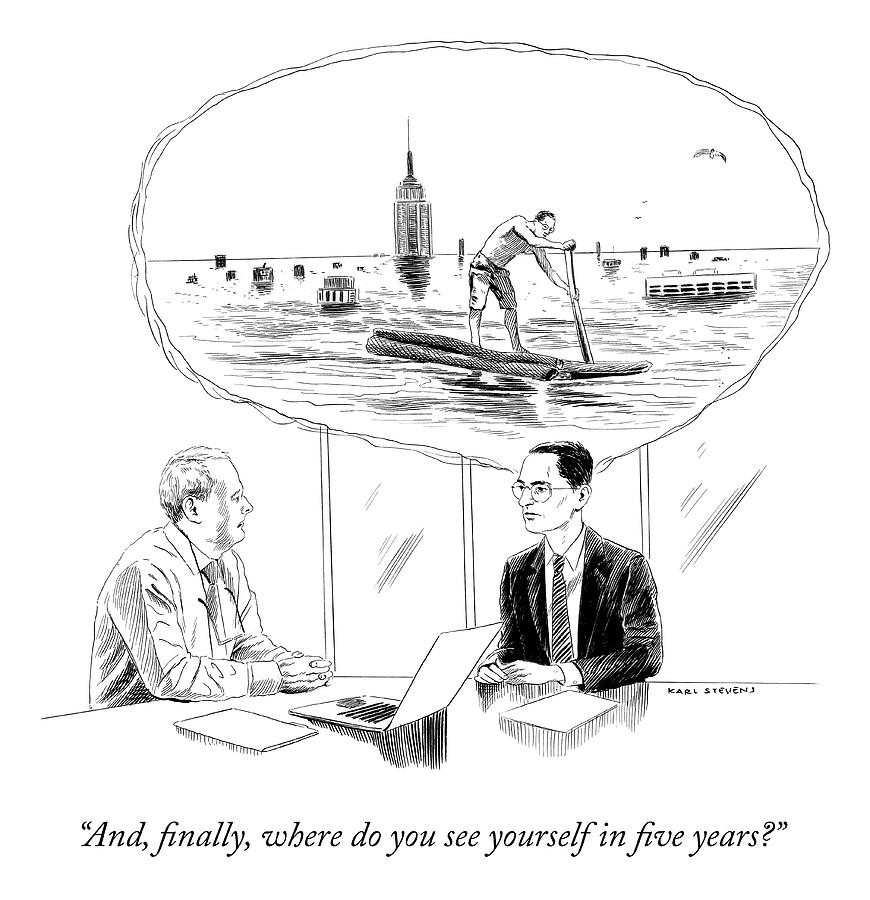
Karl Stevens’ response above to imagining the stock job interview questionin our prompt – though the version he uses features a shorter duration of five years (presumably aimed at quick movers up the employment scale) – is telling. It is an illusion of our society of narcissists (and ‘positive thinkers’) that we are in control of our future, or should at least believe in our self-efficacy in this domain. However, in this version the interviewee thinks, but does not say, – ‘if the policy of wanton growth in capitalist economies continues the future may be in the control of neither of us but in our luck in finding some debris suitable for sailing to hope of safety over a flooded New York’. What brought about that disaster – climate change or a new form of war involving control of sea levels? Who knows? Nevertheless, we continue to test people in interviews for self-centred ideas of agency, an idea of being in control of our futures, or at least aiming to be so:

Time is an asset in such visions; an opportunity for improvement based on capitalisation of present assets in the aim of ‘seeing yourself now’ as that future self you wish to be. However, there is no doubt that work and present sacrifice might be needed to aid what we see as healthy growth into our aspirations, although the degree to which our goal is healthy is probably up for more scrutiny than we think. Some dreams are the cause of our current environmental crisis, which might pip us to the post in achieving its natural goal – the destruction of any and all assets or their foundations for growth. In simple terms, time is both an asset and a cost – it must take from us, even if it gives somewhat in return:

Age and death are time-bound processes that admittedly are open to interpretive control and responsive action – though some skin manipulations seem the opposite of health – and happy old age need not be a myth. But to think that we are both in control rather than being an agent of mitigation of our fate, and unaware that some forms of supposed mitigation are anything but, is clearly magical thinking of the worst sort, its victim often or not being mainly the magical thinker themselves. Nevertheless, we think of ‘improvement’ as always relevant, always a card in our hand. No wonder that bipolar is the mental health disorder diagnosis of our age – it being the case that there is somewhat of mania in the visions of future perfectibility and imagination of our control of it and depression in our realisation of our actual lack of overall agency.
The rot started in the eighteenth century with debates about asset improvement (mainly land improvement by those few in possession of it) and human responsibility for it, but became universalized in the necessary myths of capitalism – the eighteenth century Robinsades so brilliantly analysed by Karl Marx, in his work entitled the Grundrisse – that any individual can both accumulate and improve and control their future.
I have mentioned in passing in an earlier blog about how Jane Austen used the idea of land improvement to test the maturity of fanciful narcissism in Catherine Morland (see the argument in a part of the blog at this link!). However, her greatest novel on the moral responsibility of the landed gentry for the economic future of their estates and common wealth of nations (the status quo is built on people believing that the wealth of nations is based on the actions of the current alliance of ruling classes, and that they themselves adopt that responsibility) is in her brilliant Mansfield Park. In this novel, a gentleman of the name Bertram, whose wealth is based in colonial adventure and slavery, must be forced to see his responsibilities on the home front – for family (including the lack of moral fibre of his wife and consequent poor management of his daughters’ marriage prospects), local governance of the economy and the entire future of English politics that still required landed interests to play a role).
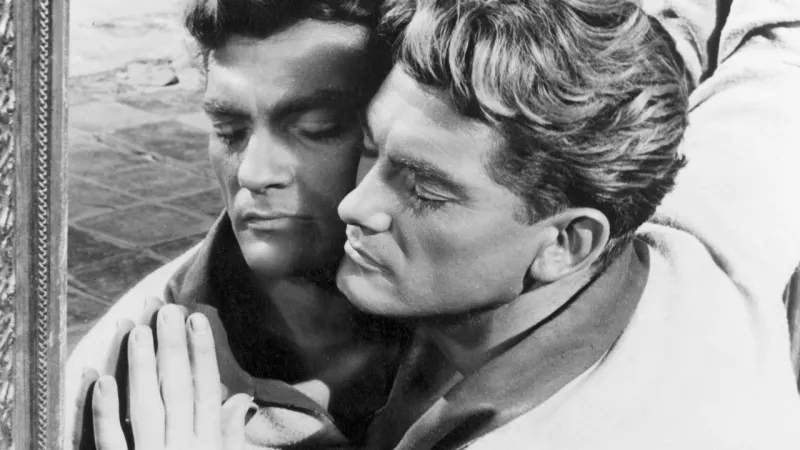
The moral focus of Jane Austen is often on vanity and its wider forms – the terrible need to assess self in a mirror and to see the thing assessed as impervious to time and in that desirable. Of course, the baronet Sir Walter Elliott in Persuasion is the best example, of whom vanity is the ‘beginning and the end’. Vanity is the moral lever accusation that she aims at narcissism throughout her work, often situating all hope in icons of visible humility and quiet inward reflection where strategy must mature real opportunity, not just use all of time as representative of its inevitable victory over time. Hence the invention of the quiet, patient, and watchful person of Fanny Price for Mansfield Park. However, invisible virtue needs its visible foil to be seen at all. Hence, it is hard to see Fanny fully except when she is in the company of the narcissist, Mary Crawford. We see that both know their real chance of improvement in life, in five or ten years, is marriage, and perhaps to the same man, an i.possibility for both. Mary, of course, needs Edmund to see himself in five or ten years time in a much more rich light than his current aspiration as a country parson.
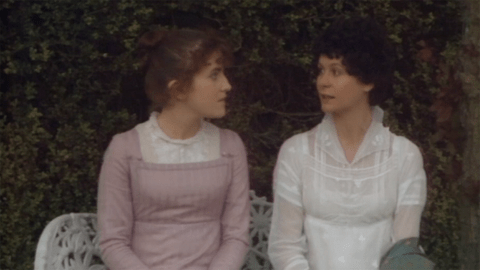
Chapter XXII has always been one of my favoured reads from this novel, because it addresses all the themes, fortuitously those of this blog. Below is the settings of the chapter’s scene from a TV version: Fanny sits with Mary in Mrs Grants’ new shrubbery, an improvement in garden landscape designed by the Grants.
Here is a long extract from Chapter XXII.
… they sauntered about together many an half-hour in Mrs. Grant’s shrubbery, the weather being unusually mild for the time of year, and venturing sometimes even to sit down on one of the benches now comparatively unsheltered, remaining there perhaps till, in the midst of some tender ejaculation of Fanny’s on the sweets of so protracted an autumn, they were forced, by the sudden swell of a cold gust shaking down the last few yellow leaves about them, to jump up and walk for warmth.
“This is pretty, very pretty,” said Fanny, looking around her as they were thus sitting together one day; “every time I come into this shrubbery I am more struck with its growth and beauty. Three years ago, this was nothing but a rough hedgerow along the upper side of the field, never thought of as anything, or capable of becoming anything; and now it is converted into a walk, and it would be difficult to say whether most valuable as a convenience or an ornament; and perhaps, in another three years, we may be forgetting—almost forgetting what it was before. How wonderful, how very wonderful the operations of time, and the changes of the human mind!” And following the latter train of thought, she soon afterwards added: “If any one faculty of our nature may be called more wonderful than the rest, I do think it is memory. There seems something more speakingly incomprehensible in the powers, the failures, the inequalities of memory, than in any other of our intelligences. The memory is sometimes so retentive, so serviceable, so obedient; at others, so bewildered and so weak; and at others again, so tyrannic, so beyond control! We are, to be sure, a miracle every way; but our powers of recollecting and of forgetting do seem peculiarly past finding out.”
Miss Crawford, untouched and inattentive, had nothing to say; and Fanny, perceiving it, brought back her own mind to what she thought must interest.
“It may seem impertinent in me to praise, but I must admire the taste Mrs. Grant has shewn in all this. There is such a quiet simplicity in the plan of the walk! Not too much attempted!”
“Yes,” replied Miss Crawford carelessly, “it does very well for a place of this sort. One does not think of extent here; and between ourselves, till I came to Mansfield, I had not imagined a country parson ever aspired to a shrubbery, or anything of the kind.”
“I am so glad to see the evergreens thrive!” said Fanny, in reply. “My uncle’s gardener always says the soil here is better than his own, and so it appears from the growth of the laurels and evergreens in general. The evergreen! How beautiful, how welcome, how wonderful the evergreen! When one thinks of it, how astonishing a variety of nature! In some countries we know the tree that sheds its leaf is the variety, but that does not make it less amazing that the same soil and the same sun should nurture plants differing in the first rule and law of their existence. You will think me rhapsodising; but when I am out of doors, especially when I am sitting out of doors, I am very apt to get into this sort of wondering strain. One cannot fix one’s eyes on the commonest natural production without finding food for a rambling fancy.”
“To say the truth,” replied Miss Crawford, “I am something like the famous Doge at the court of Lewis XIV.; and may declare that I see no wonder in this shrubbery equal to seeing myself in it. If anybody had told me a year ago that this place would be my home, that I should be spending month after month here, as I have done, I certainly should not have believed them. I have now been here nearly five months; and, moreover, the quietest five months I ever passed.”
“Too quiet for you, I believe.”
“I should have thought so theoretically myself, but,” and her eyes brightened as she spoke, “take it all and all, I never spent so happy a summer. But then,” with a more thoughtful air and lowered voice, “there is no saying what it may lead to.”
Fanny’s heart beat quick, and she felt quite unequal to surmising or soliciting anything more. Miss Crawford, however, with renewed animation, soon went on—
“I am conscious of being far better reconciled to a country residence than I had ever expected to be. I can even suppose it pleasant to spend half the year in the country, under certain circumstances, very pleasant. An elegant, moderate-sized house in the centre of family connexions; continual engagements among them; commanding the first society in the neighbourhood; looked up to, perhaps, as leading it even more than those of larger fortune, and turning from the cheerful round of such amusements to nothing worse than a tête-à-tête with the person one feels most agreeable in the world. There is nothing frightful in such a picture, is there, Miss Price? One need not envy the new Mrs. Rushworth with such a home as that.”
“Envy Mrs. Rushworth!” was all that Fanny attempted to say. “Come, come, it would be very un-handsome in us to be severe on Mrs. Rushworth, for I look forward to our owing her a great many gay, brilliant, happy hours. I expect we shall be all very much at Sotherton another year. Such a match as Miss Bertram has made is a public blessing; for the first pleasures of Mr. Rushworth’s wife must be to fill her house, and give the best balls in the country.”
Fanny was silent, and Miss Crawford relapsed into thoughtfulness, till suddenly looking up at the end of a few minutes, she exclaimed, “Ah! here he is.” It was not Mr. Rushworth, however, but Edmund, who then appeared walking towards them with Mrs. Grant. “My sister and Mr. Bertram. I am so glad your eldest cousin is gone, that he may be Mr. Bertram again. There is something in the sound of Mr. Edmund Bertram so formal, so pitiful, so younger-brother-like, that I detest it.”
“How differently we feel!” cried Fanny. “To me, the sound of Mr. Bertram is so cold and nothing-meaning, so entirely without warmth or character! It just stands for a gentleman, and that’s all. But there is nobleness in the name of Edmund. It is a name of heroism and renown; of kings, princes, and knights; and seems to breathe the spirit of chivalry and warm affections.”
“I grant you the name is good in itself, and Lord Edmund or Sir Edmund sound delightfully; but sink it under the chill, the annihilation of a Mr., and Mr. Edmund is no more than Mr. John or Mr. Thomas. Well, shall we join and disappoint them of half their lecture upon sitting down out of doors at this time of year, by being up before they can begin?”
Dominating this passage for me is that moment in which Mary Crawford gives away the magnitude of her narcissism in terms of the social roles used in her metaphors. Not for her local thoughts on a shrubbery but imagination of herself as the seventeenth century Doge of Venice taking stock of the Versailles gardens of tne Sun King, Louis XIV. The choice of phrase from that historical account of sorts is that she ‘may declare that I see no wonder in this shrubbery equal to seeing myself in it’. Neither Doges nor Mary say things; they ‘declare them, in every aspect of their behaviour outwardly reflecting themselves in a mirror, indeed turning the world into a mirror so they can ‘see’ themselves ‘in it’ as the paragon of perceived wonders.
Yet the master of literary nuance that is Austen isn’t here using the narcissising mirror metaphor as a simple emblem of vanity, for it is merely a verbal reflection that is involved, and though reflections inevitably suggest mirrors, the master of using them in the comparison of these two young women is Fanny. Yet therein lies the point, for Fanny reflects differently. She does not, overtly at least, use reflections about time and nature to talk about herself but about external and internal nature, about nature as a space adaptable for human life and the inner nature of all human beings, in short their psychological apprehension of time:
every time I come into this shrubbery I am more struck with its growth and beauty. Three years ago, this was nothing but a rough hedgerow along the upper side of the field, never thought of as anything, or capable of becoming anything; and now it is converted into a walk, and it would be difficult to say whether most valuable as a convenience or an ornament; and perhaps, in another three years, we may be forgetting—almost forgetting what it was before. How wonderful, how very wonderful the operations of time, and the changes of the human mind.
And does she not covertly also see herself in these mental reflections as does Mary. The difference is she does it without observable self-consciousness. For is not her story about the ‘rough hedgerow’ about which no-one thought it ‘capable of becoming anything’ actually, if an easily deniable reading, actually about herself as the daughter of a woman who chose love and downward mobility and hence class displacement for her children, escaping those rough conditions and becoming something. Some readers will be revolted by this idea for it would make Fanny aware that, like the hedgerow, she sees herself as no longer being thought ‘capable of nothing’ and hence becoming a match for a well chosen son of the Bertram family. But Fanny is innocent they say: though undoubtedly Mary Crawford does realise she is ‘fanny‘ for sale to highest and most well off male buyer, Fanny herself cannot think that mercenary thought.
And yet Fanny’s discourse on the nature of inner psychology is precisely about how, once a thing looks as if it has changed its nature, such as a rough hedgerow that has metamorphosed into an elegant shrubbery, people generally act as if ‘almost forgetting what it was before‘ and no longer query the means by which it rose into improved status and the ethics of this methodology, as we know definitely would be the case for Mary. The whole point about Fanny’s reflections of that idea is that they do not appear to be like those in a mirror or those of a narcissist like Mary. Instead, if seen at all, they are in ‘a glass darkly’ as a deniable phenomenon, perhaps the figment of an over-reader’s imagination (an accusation as a reader I have often received, particularly over Jane Austen).
In time Fanny’s ‘career’ is a ‘wonder’ of ‘growth and beauty’ too. She could answer the question how do you see yourself in , in this case, three years time, but for the fact her discourse makes her seem no more responsible for narcissistic dreams than is a transplanted hedgerow, both being the product of the action of others and organic ‘nature’. Of course, cynic that you may think me, Austen knew that sex/gender divided society such that by the early nineteenth century no-one could thrive who did not seek to do so by capitalisation of assets and labour, preferably someone else’s labour,and this made life especially difficult for women. To escape accusation of being ‘scheming’ or a ‘gold-digger’, a woman must be or appear unconscious of her own appearance in a mirror or its sale value (its ‘Price’ so to speak).
Jane Austen’s brilliance was to negotiate this conundrum so that she could allow intelligent beautiful women to survive without bad reputation, but there is no doubt that they were competing in the same sexualised marketplace as men, and perhaps with no greater moral stature underneath the veneer. I believe this true of my favourite Austen character even, Anne Elliott in Persuasion. But the point is hard to make without some culpable misogyny being possible to see in its proposer, especially if that proposer identifies as male. At University I earned the ire of Eva Figes (then a visiting lecturer at UCL) in a Jane Austen seminar, who translated my point about the sexualised landscape seen by Elizabeth Bennet at Pemberley, Darcy’s estate, prior to her acceptance of his proposal; “What you mean”, she said angrily, “is that Elizabeth just needed a good fuck and she’d be alright!”. It wasn’t what I meant but I took the ridicule pointed at me, and learned I hope to modify the way I said things where time for elaboration was never going to be made available. Such can be education!
The adoption of male narcissism as a necessary adaptation for women, while hiding it under ‘reserve’, was my point. But now interviews nearly always end by making people turn their career aspirations and dreams of a bigger self into something they see as reflected back by ten years, (or five) acting as a mirror of that aspiration. I think we got lost as a society at that point – in a necessary bipolarity (a ‘manic’ bigging up of feelings about the self whilst knowing that reflection to be ‘depressingly’ untrue).
All for now
With love
Steven xxxxxxxxxxxxxxxxxxxxxx
 Steve_Bamlett_blog