


You’re in Denial!’… ‘I’m not!’ … ‘Now you’re denying you’re in Denial!’ With apologies to ‘The Golden Girls‘ from which this exchange comes, let’s think about the struggle involved in learning always to ‘know’; things one ought to know. And make the decision I did: ‘Do not always trust denials, but do not always disbelieve them. trust evidence.

Make the decision I did: ‘Do not always trust denials, but do not always disbelieve them. Trust evidence.
Last night I dreamed of denial and the result was ominous. I had the 2001 book by Stanley Cohen States of Denial: Knowing About Atrocities and Suffering, by my bedside. It will be my reading in places where I cannot carry the lengthy volume of Nicholas Boggs’ biography of James Baldwin, which I am savouring slowly but can’t carry around with me in order to make delicious progress. I am reading it prior to seeing All My Sons, having read After The Fall and A View From the Bridge again as promised to myself in the initial preparatory blog on that play (read it at this link), in preparation for the National Theatre streaming on Friday. That blog was on the word ‘know’ in the play, pointing to the many instances in Miller’s writing for he stage where what we know and how we know it about ourselves and others is often occulted, sometimes from the knower themselves, in the form of one of the many forms of repression defence of the thing we cannot allow ourselves to ‘know’ fully or in certain forms, one of which is denial. Of course knowing is not only meaningful in terms of psycho-dynamic defence systems, it the stuff of metaphysics, wherein it shifts between matters of ontology (querying whether the thing you posit exists ,or whether it exists despite your denial of it, in order to be known) and epistemology (querying how we know a thing that exists and in what form)./ The classic arguments regarding ontology in philosophical history being first about God (Duns Scotus and all that), and later, especially from the eighteenth century Enlightenment about ‘reality’. Bishop Berkeley insisted that nothing existed autonomously in the world – its appearance of being so only the transcription of a representational picture in the individual, although he fell back on this position by saying there was a ‘reality’ independent of individual perception, the things of the world as seen in the mind of God. Doctor Johnson was said to have kicked a stone in the road once, and while brandishing his bruised foot and cradling it against pain, saying: “Thus Berkeley, I refute thee’, or words and actions to that effect. Berkeley, Johnson seems to be demonstrating, is in terrible denial of reality.
Between ontology and epistemology, the issue of denial plays its parts with or without the idea of psychological defences coming into play or the kind of magical thinking that wishes something did, or did not exist, and producing a result from that. These things revolved around my head. My ominous dream involved painful fantasies, somewhere based in memories I am sure but not clearly, of my parents, especially my mother and was wrapped in the denial of things by others and of others that was hard o locate in any character, least of all myself who escaped psychic torture of a kind by a semi-naked flight from the pressing pain of knowing what was passing, though (in the dream and this is unusual) aided by my husband, who too seemed under attack. What kinds of ‘knowing’, if any – although the current psychological evidence now seems turning back to Freud’s view that meaningful things are involved – dreams involve remains unclear. The existence of things seen seen, felt or sensed in dreams remains unsure (sometimes queried in the dream itself and not only in lucid dreams) in relation to the ontology (some still argue that meaning in dreams is epiphenomenal) of what is asserted in them and complicates the knowing of the things within them with pre-cognitive material such as wishes. What we know, is after all only what we can retell after the event, even that ‘it felt so real’ – which is why dreams fade I believe.
In Miller characters are in psychological denial – perhaps Chris in All My Sons more than all because other characters, in various forms, merely lie about what, in some other form they ‘know’ – of the death or otherwise of Larry, the airman son, brother and lover of respective others – or of knowledge of producing faulty F-20 undercarriage parts that led to a number of young deaths, or of its cover-up and the scapegoating of another, either for selfish reasons or just to let ‘sleeping dogs lie’. Eddie Carbone denies his sexual attraction to his stepdaughter, Catherine, whilst Quentin and many others in After The Fall deny so many things, including responsibility for the psychological minimisation of the crimes of the Holocaust, or secretly wanted affairs.
Most people choose, when they want to ridicule Freud, his ideas on Negation. All of these ideas are pertinent to all of Miller’s plays, even of the John Proctor in The Crucible, whose sexual fantasies get played out in the girls who accuse him. The Golden Girls joke (see it here) was the most perfect expression of this. If what is most likely to be the knowable truth is that which you negate, or in denial about, then consciousness fails us and we should attempt to know the world only through that which we deny to be the truth in it. But these ideas matter. Everyday Zionist apologists say that accusations of Israeli genocide against Palestinians, despite huge and massive evidence and the authority of world institutions, is a version of the medieval antisemitic tropes against Jews, especially the ‘blood libel’.
They insist that to accuse a powerful military state with a vast secret service (Mossad) and army (IDF) and nuclear and other armaments is is to blame Jews for crimes they would not commit. But Israel is not and never will be the only voice of world Jews, and visible wars, fought viciously against civilian targets as well as military ones) are not invented lies. If antisemitism is as strong as it is, which I truly think it is, then Israel benefits from that turning that belief into a cover for breaking international law and calling those who name its breaches ‘blood libelers’ (antisemitic blood libels are however a real phenomena in Christian history).
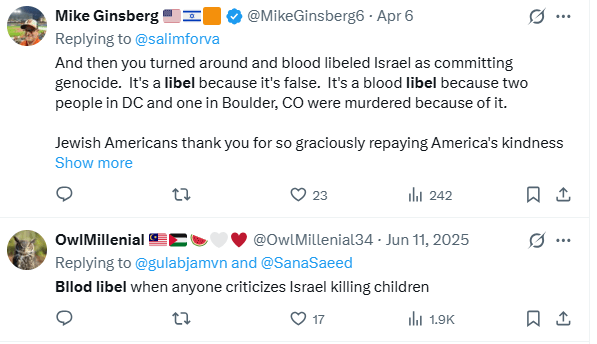
Denial takes many forms. Knowing remains difficult. People still say that things do not exist or have happened that do and did respectively. People say, when a thing is proven, that is ‘known’ in the wrong way or misrepresented and our knowledge systems of perception and report are faulty (why Israel bans media not under its control from reporting).
But that fine Jewish scholar Stanley Cohen, from a tradition of world truth-tellers, awaits. Read him I will. He has proven his evidence-based methods in the past and will I think again. Make the decision I did: ‘Do not always trust denials, but do not always disbelieve them. Trust evidence.
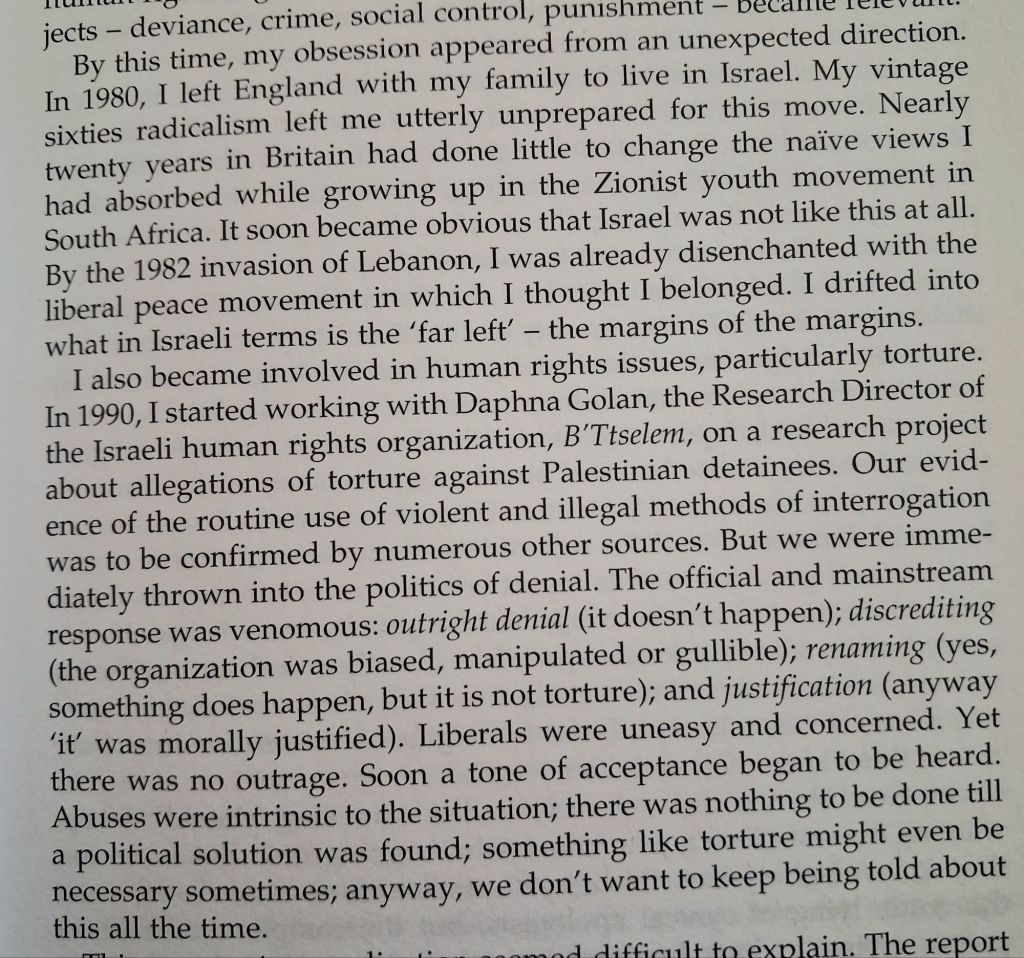
Here is Cohen’s story that explains how early beliefs fostered in the Zionist youth movement in South Africa fared when he himself became an Israeli Jew, learning about the use of torture specifically on Palestinians in the 1980s Lebanon War. It is as far as I have got with the book yet.
With love
Steven xxxxxxxxxx
 Steve_Bamlett_blog