


Domestication or anthropomorphism: do people ‘make the worst pets’? Some thoughts derived from Thomas Gray’s ‘Ode on the Death of a Favorite Cat, Drowned in a Tub of Gold Fishes’.
Do you know the poem I refer to in my title? It is by Thomas Gray (he of the infamous Elegy in a Country Churchyard), though now a much lesser known poem than that, if any poem will survive our current culture, Ode on the Death of a Favorite Cat, Drowned in a Tub of Gold Fishes. An exercise in mock-heroic, written for the rich and queer friend, Horace Walpole, by the more humble queer poet and friend, Gray, it told the story of a vain cat (anthropomorphised, because vanity is hardly a feline quality even if projected as such) and the fate to which her initial vanity led her. Pretending to morality, being a caution against both vanity and the greed to which, in the poem it becomes allied, it is really little more than a piece of misogyny dressed up in a moral and epic coat. Gray called the ‘favourite’ cat, presumably the favourite of the children Tom and Susan who are in the poem only in that they neglected to care for Selima as they should and thence might be though ‘cruel’. Yet Gray spends much more time in picturing Selima not as an animal per se but as a symbol of her sex/gender, and the exemplar of the ‘frailties’ of that sex/gender classification. Selima finds in this poem that her desires over-reach her caution in a dangerous situation and she dies as a result, not so much pitied and mourned as ridiculed. Here is the poem:
Ode on the Death of a Favorite Cat, Drowned in a Tub of Gold Fishes

'Twas on a lofty vase's side,
Where China's gayest art had dyed
The azure flowers, that blow;
Demurest of the tabby kind,
The pensive Selima reclined,
Gazed on the lake below.

Her conscious tail her joy declared;
The fair round face, the snowy beard,
The velvet of her paws,
Her coat, that with the tortoise vies,
Her ears of jet, and emerald eyes,
She saw; and purred applause.

Still had she gazed; but 'midst the tide
Two angel forms were seen to glide,
The genii of the stream:
Their scaly armour's Tyrian hue
Through richest purple to the view
Betrayed a golden gleam.

The hapless nymph with wonder saw:
A whisker first and then a claw,
With many an ardent wish,
She stretched in vain to reach the prize.
What female heart can gold despise?
What cat's averse to fish?

Presumptuous maid! with looks intent
Again she stretched, again she bent,
Nor knew the gulf between.
(Malignant Fate sat by, and smiled)
The slippery verge her feet beguiled,
She tumbled headlong in.

Eight times emerging from the flood
She mewed to every watery god,
Some speedy aid to send.
No dolphin came, no Nereid stirred;
Nor cruel Tom, nor Susan heard.
A favourite has no friend!

From hence, ye beauties, undeceived,
Know, one false step is ne'er retrieved,
And be with caution bold.
Not all that tempts your wandering eyes
And heedless hearts, is lawful prize;
Nor all that glisters gold.
However, I use the poem here because it is also a poem that gives away some of the attitudes betrayed in the human desire to own pets (the ways in which they view and use ‘pets’ in their life) and the function(s) they serve for humans that makes them into ‘pets’ rather than just domesticated animals. Though our prompt question almost certainly wants us to elect a candidate from the available animals that can be considered to make good or bad pets (in the sense that are well adapted or not, or even just strongly preferred by us to fulfill the ‘pet’ role or not). I will be driven by a different motive. I am using the verb ‘make’ in a different way to the usage in the last sentence, to say ‘pets’ are what the humans that keep them make them into. We are considering into what pets are made into, regardless of the animal they were.
My assumption here is that humans make animals into ‘pets’ and thus define what a pet is in those acts of making. And those acts of making differ between cultures through vectors of time and space via cultural, social and other factors. For instance, I found a few oil paintings of the nineteenth century that celebrate the poet of the eighteenth century, through his theme. I say his theme because the cat and fish reflect contemporary nineteenth ideas about pet-keeping rather than those of the eighteemth century if the details of the poem are taken seriously. In the example below the cat can.only access the bowl by standing upon a large (and obviously antique) volume of Gray’s poems, of which the title of the relevant Gray Ode is clearly visible, in eighteenth÷century mock-Gothic typeface on the book’s open face.
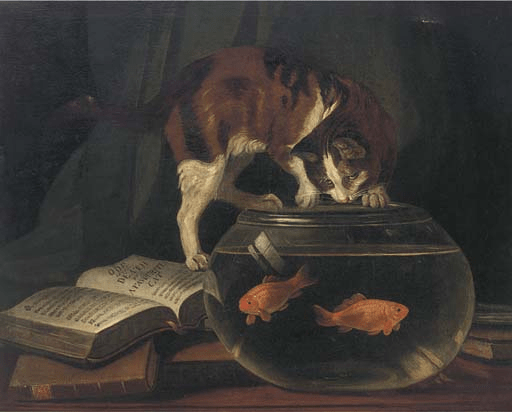
The goldfish are gold but the picture does not validate any part of Gray’s poem other than the phrase: ‘what cat’s averse to fish’. After all they are ‘gold’ only by convention of naming them. They are in the picture, as often commonly now, a kind of browny-orange. Though the European reputation of the golden mutation (actually first selectively bred first in that colour in China) and motive for having them, as recorded in Wikipedia, as a symbolic wish to add to and maintain a family’s wealth in gold is not referenced in this nineteenth century picture, and after all, even Gray rather undercuts that myth – the fish are a reminder that all that ‘glisters is not gold’.
In the nineteenth-century picture, the appetite of the cat is the motive that causes danger to their lives throughout, that part of Gray’s meaning that animals are thought to have specialised tastes that drives Gray’s line: ‘ What cat’s averse to fish?’, though that line is used as an analogy for the liking of gold by the ‘female heart’. No such ‘moral analogy is in the painting. The fish are what they are, kept to be seen through the transparent glass of a ‘goldfish bowl’, far too small for the care of a fish whose maintenance needs have throughout their popularity been very wrongly and cruelly underestimated. Humans make ‘pets’ in order to exhibit their own taste, entirely cut off from care. They are good pets because they give of their apopearance and can ask for, and therefore get nothing in return, not even a suitable habitat.
In the eighteenth century a ‘goldfish’ was valued clearly for more than its colour association to gold. The fish favoured in the eighteenth century were as often those where selective breeding also favoured exotically part-coloured examples, as might be inferred from this section of The London Magazine of 1765, from this internet source.
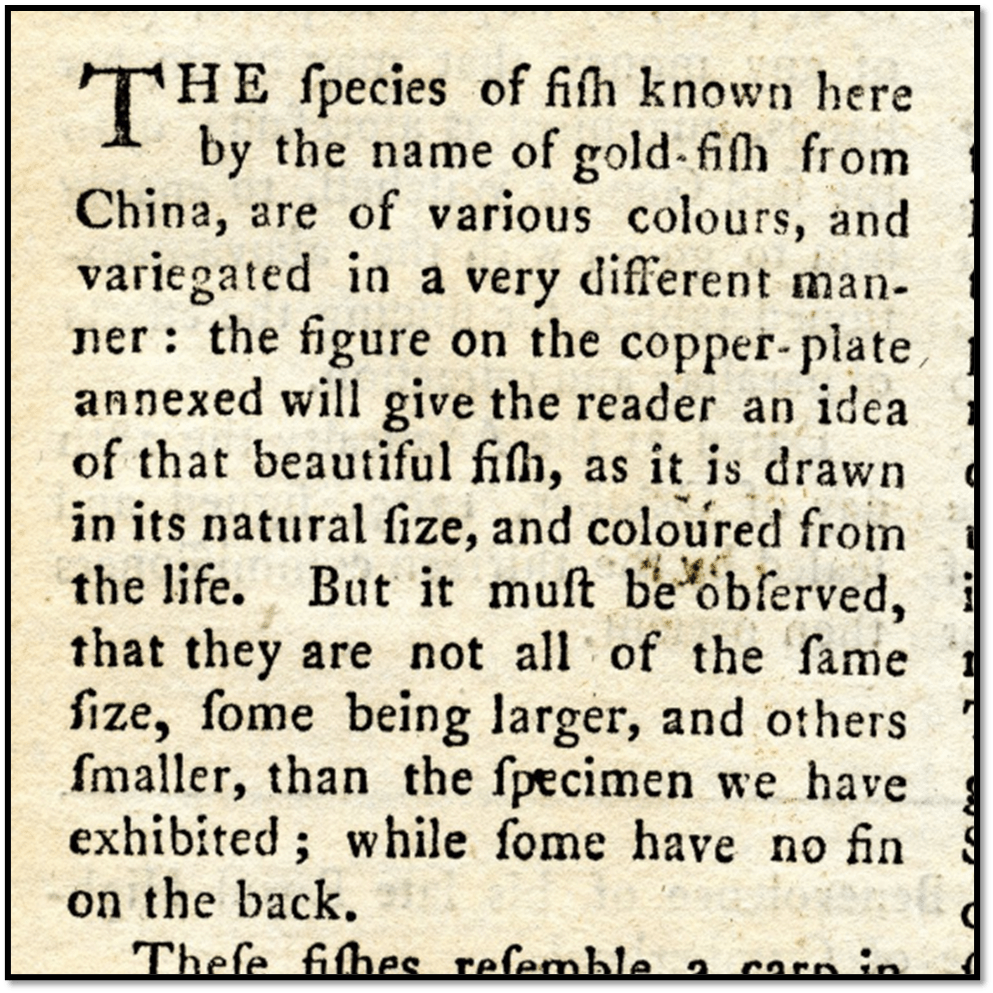
In the Gray poem the colour ‘gold’ is only espied as a ‘gleam’ by Selima on closer look at the fascinating multi-colour and fabulously finned form of the fish. When we see them first they are purple-red (a ‘Tyrian hue’ refers to the famously expensive Tyrian-colour derived from sea shells fished off the coast of Tyre and associated by the Greeks, Romans and the Byzantines with empire and power) referred to in Aeschylus’ Agamemnon.
Their scaly armour's Tyrian hue
Through richest purple to the view
Betrayed a golden gleam.
Moreover, these fish have been bred to be fabulously finned such that they look almost supernaturally numinous, winged or having other magical traits such that they seem ‘angel forms’ that ‘were seen to glide’ or like ‘The genii of the stream’. There is clearly a sociocultural issue, this one of considering, and evaluating between best or worst, what we make our pets into, with historical variation implied. Consider the painting again. The fish are standardized to bourgeois tastes, those described by Gray are not.
Written at a time when goldfish were considered as both pets and ornamentation (without much difference being seen between the two except that the animal has colouring that changes through the dynamism of the animal’s mobility. Bred in exotic Oriental colour variation, this fish is kept not in a glass bowl but in a China porcelain ‘vase’ (which must be that variation of vase known as a ‘bowl-vase’) decorated on its opaque sides. They were either imported from China or copied by English manufacturers with motifs that caused the pieces to be described as chinoiserie. Both the fish and ‘China’ vase (the transformation of the word into one that finally came to be generic name for porcelain ceramics was underway here) are a blend of the kind of exotica beloved in the period, less an animal in its carer-provided home than an advertisement for the expensive and exotic taste of their human owner.
This is important because we should note that Selima (the originally Semitic (Jewish and Arabic) name means peace, being harmonious, and protected by God – sometimes ‘helmet of God) cannot see the fish at first but only the Asiatic patterns, of flowers and vegetation on the ‘vase’ side, and the surface of a ‘lake’ on the side of which she sits seeing her reflection in the surface water:
'Twas on a lofty vase's side,
Where China's gayest art had dyed
The azure flowers, that blow;
Demurest of the tabby kind,
The pensive Selima reclined,
Gazed on the lake below.

Her conscious tail her joy declared;
The fair round face, the snowy beard,
The velvet of her paws,
Her coat, that with the tortoise vies,
Her ears of jet, and emerald eyes,
She saw; and purred applause.
An imported version it might be, since they were often multi-coloured, but ‘China’s gayest art’ may still apply to the kind of art used to decorate porcelain, and English-made chinoisierie vases might especially have an ‘azure’ flower. for they use patterns of blue and white. The point is that this vase and the fish are showy, advertising the riches and taste of the family. Art is at the service of human vanity here, whether it be looking as if could be alive and ‘blow’ (blossom) or whether it was the live exotic fish accompanying it as a sign of the whole effect of ‘art’.
This is, I think why Selima is portrayed not as entranced by the fish and their colour but of her mirrored reflection. And yet again what she sees in herself is full of expense (of gemstones like jet and emerald and tortoise shell colouring), even if having a ’round face’ and a ‘snowy beard’ may not be to everyone’s taste in beauty, although here again I sense a ‘camp’ joke. There is something quite camp in the description – Walpole must have been rocking with laughter at Strawberry Hill, where art and life were analogous. For Selima, her face too is art, and demands ‘applause’ from its audience.
The terrible thing in the poem is that one kind of ‘pet’ is and must be the death of the other. In this case Selima is drowned because she has no conception that water has depth and that there is a ‘gulf between’ what she sees and the means of getting at it, without exposing her own vulnerability. The end of the poem is addressed entirely to ‘ye beauties’, at which some of the guys at Walpole’s parties must have raised an eye, especially when Gray gave especial advice to them, as it may seem:
Know, one false step is ne'er retrieved,
And be with caution bold.
Not all that tempts your wandering eyes
And heedless hearts, is lawful prize;
Nor all that glisters gold.
Since Anthony Delaney researched the Strawberry Hill clique (see my blog on his book at this link), including Gray, we are more than ever aware that the cheekily outrageous nature of their behaviour in each other’s company was not acceptable outside their element of a safe queer society fenced by caution, just as Selima is unsafe outside her element and yet is now in the water, with no supernatural or human help from those who ‘pet’ her. No-one comes to rescue.
The moral warnings here hardly apply to the females at which they were directed, who, anyway, had no right or capacity to take the initiative in openly seeking glistering prizes. But note this letter from Gray to the more openly queer John Chute quoted by Delaney. Gray laughs like the Boys he mentions at his own vanity while sexualising it as a sort of self-advertisement of ambiguity (‘the immensity of my Bag and length of my Sword’ are clearly not literally meant) that is over-bold but is then touched with ‘caution bold’ at tempting his ‘wandering eyes’ and ‘heedless heart’ in the company of those he might want to attract. Yet everything he says is not only guarded but encoded (would fuller pockets lead him to approach the ‘Boys’):
The Boys laugh at the depth of my Ruffles, the immensity of my Bag, & the length of my Sword. If my pockets had anything in them, I should be afraid of everybody I met’. [1]
When Blake illustrates Gray’s poem, he seems to make it about sexual threat. The goldfish souls canoodle (heterosexually) at the bottom of the water, and then flee him like angels still carrying their ‘arrows of desire’, when he falls into their element like Lucifer, especially as Blake drew him, thrown into it by some divine authority. I think Blake knew their was more to this poem than meets the eye.
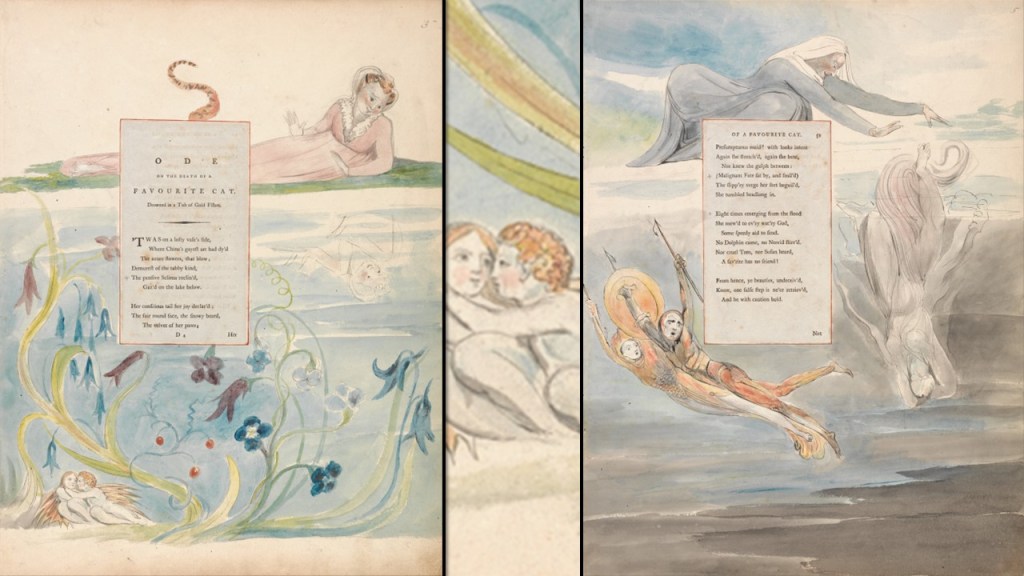
But, as for ‘pets’, it is clear that if we keep fish for our own vanity as ‘pets’ regardless of their safety, we will do the same with those we make our ‘favourites’ – those pets that we rather like the look of but ignore otherwise. Gray knew that the ‘favourites’ of many kings were both their pets and lovers, like Piers Gaveston in Marlowe’s Edward II. But when the threat is greatest ‘a favourite has no friend’. And neither do pets who humans use as disposable containers that give and receive love until too inconvenient to keep.
Make of that what you will
With love Steven xxxxxxxxxxxxx
_____________
[1] Anthony Delaney (2025: 116) Queer Georgians London, Doubleday, Penguin Random Hous
 Steve_Bamlett_blog