


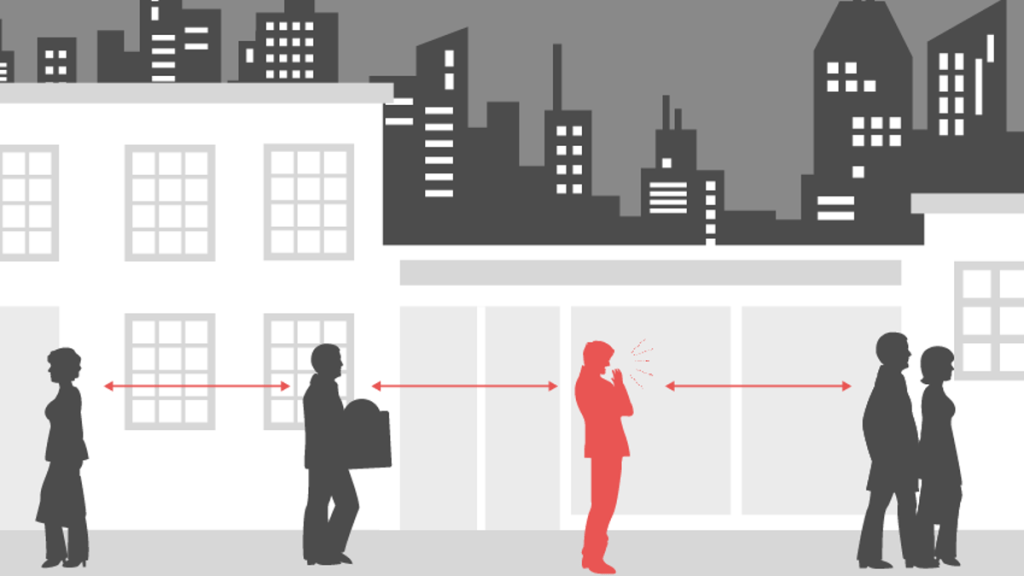
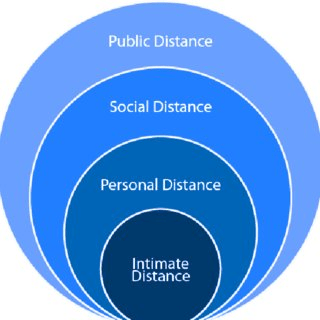
The two terms in my title are near enough in appearance. However Wikipedia defines and discusses them separately. Social distancing is the name given to a public health measure, called for by government or other authority to prevent the spread of air-borne communicable diseases, practiced widely during the Covid-19 pandemic. Social distance is a descriptive concept, usually used in the social sciences, but also popularly as a means of determining and policing the interaction of people. The kind of distancing varies as the diagram above assumes, in forms wherein we regulate according to the name we give to the relationship between the people interacting (intimate, personal, social and public are one possible set of such names but they aren’t consistent – some sexual relationships are intimate in a confined space of definition but utilize different spacing in non-sexual contact. Moreover we can still talk of a non-intimate sexual relationship where physical distance between bodies is at variance from felt emotional distance.
Wikipedia calls ‘social distance’ the ‘measure of nearness or intimacy that an individual or group feels towards another individual or group in a social network or the level of trust one group has for another and the extent of perceived likeness of beliefs’. All definitions are full of problematic areas as we know. In the latter one, I might query the meaning of the word ‘measure’ for it begs the question of whether the measuring in question is quantitative, as it had to be in public health where the distance between people must be measured in units of distance of some kind, even if with intuitive tools, or in terms of perceived subjective measures which can vary in kind, with each kind varying in interpretation – things like walls, fences, boundaries and border for instance, or signifiers like the type of clothing worn and its effect on the accessibility of means or type of socialising. For instance, of the latter, discussions of the wearing of the burkha in Western cultures have often contained assumptions about their agency in cutting off means of social knowing of the other, by the wearer and person interacting with wearer respectively. The relation of measurable physical distance is not essential to the latter concept, though it is to the former. I would also question the word ‘feels’ in the relationship, in terms of how we think of the relationship between felling, thought and behaviour.
The introduction of social distancing in fact raised lots of interaction between the concepts. Though social distancing called for universal distancing from individuals varied only the constancy of proximity with each other of people over unbroken time periods, for you need only distance yourself from people who have been exposed, in a manner you were not, to others who might pass on the virus, regardless of relationship but must in any other case. For many this particularly related to problems in relation to inter-family contact. That you had family proximity to someone did not mean that physical differences in the spaces you lived did not create risk factors between you, likewise with domestic partners, where one was more socially or otherwise gregarious than the other: so too with emotionally close people for that too does not become a factor in transmission unlike it also means that the physical distance between them did not vary. People felt divided in Covid-19 regulation of social distancing from family members, some of them emotionally close but not all where that was not the issue and where another factor like duty was, in care facilities in particular. It took regulation (as advice but then enforceable by institutions like care facilities who worried about being perceived as neglectful, or legally culpable. Did the state, some wondered, have the right even to make such bonds change in ways that they or intermediate agencies controlled rather than people in the relationship themselves.
In issues were apartheid laws regulate relations between groups, as was the case in White-ruled South Africa, and is still the case in Israel, many people can see the problem of state regulation of relationship, but especially those on which they act to limit access to social resources or spaces. In Covid-19 some politicisation of social regulation also occurred largely from the perspective of hose against any social regulation that applied to the majority. Right wing groups saw in it an issue because it applied to hegemonic groups, they used to represent a ‘nation’ which they characterised by race, ethnicity, length of residence (the latter usually s a compromise or means of not being called ‘racist’. People who claimed racial admixture a bad thing could not face a ban in which any admixture, even within groups limited by a common self-definition to be limited. Right wing groups have used this to describe practice in social distancing to be an imposition, but only in as much as it affected their normative interactions which they considered inviolable by the state or other authority.
Now social distancing is rarely practiced as a public health measure, except by the vulnerable to the effects of flu, Covid and the like, who are marked by mask-wearing (unlike say the issue in Japan). People remember regulations that related to the distance of tables from each other in restaurants, though mainly as a past instance of a restraint on trade in hospitality businesses. The memory hangs on in current debates on public houses (‘pubs’) in the UK, irrespective of other causes for their decline. To right-wing political parties the assault, as they see it, on the pub is an assault on a national institution, as they see it. At the base of this is the possible feeling that pubs were also means of regulating social distance in terms of the types of groups that they included and excluded, by direct or indirect means. Reform see the pub as a bastion for things they see as threatened with extinction like rural community, on one hand, and white working-class heteronormative community on the other. Both are threatened thy argue by the culture of the ‘woke’, which they identify with the over-thinking of multicultural ideals of the white articulate middle-classes and the self-interest of ‘alien’ communities they set out to make people mistrust as much as possible – as predatory of ‘our’ space and ‘our’ values, including ‘our’ women and children (irrespective of the sex/gender of the reform member). For them some social distances are natural, others are enforced and artificial. They try to colonise internal space for this reason, by raising St George flags where no-one wanted or requested them, and by policing attitudes based entirely on subjective but conventionally established practice, on Twitter for instance.
For me I am left with a feeling that social distance is often more of a concern when its practitioners (that is all persons) see themselves as acting naturally, varying it by effect of folk knowledge or practice rather than by the impulse to meet across distances irrespective of the original difference and distance of our symbolic or other distance from each other). I am reading James Baldwin’s Another Country at the moment. It is a very relevant novel. The prompts to ‘distance’, often allied to disgust reactions at their worst (or other entrained habitual ‘feelings and sensations – as in class prejudice where people feared the touch, smell and feel of other ‘lower’ classes or more ‘common people’.All need to be understood, none are as objective a measure as they are used in order to be. We often fear strangers, an speak of ‘stranger danger’ and ignore the majority of cases of abuse that are instead issues within our own close intimacies and relationships. We resist being educated about these facts – hence the persistence of child and other family abuse.We can only learn the fictive nature of these mechanisms by experience AND re–cognition (including reevaluating our sensations and feelings in spaces free of unthinking, and unfeeling, guiding cultural prejudice).
With love
Steven xxxxx
 Steve_Bamlett_blog