


The threat of involuntary laughter – a release of tension or a weapon.
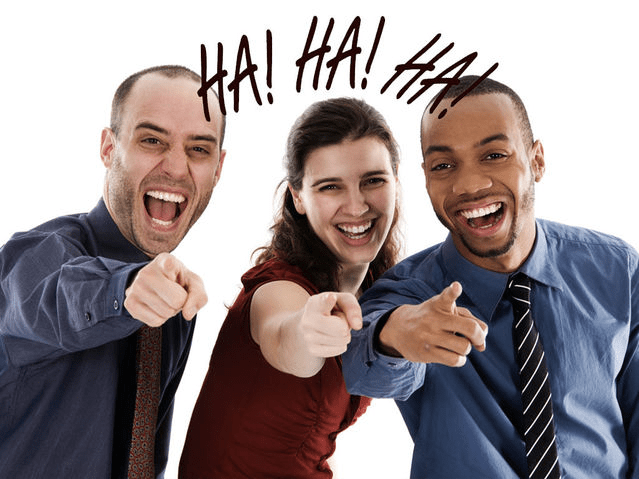
Asked to define the issue in which a person laughs AT another person, or type of person, my AI Co-Pilot comes up with two categories, one a symptom of mental disturbance (katagelasticism) , the other a supposedly common emotional strategy for managing response to people in difficult situations in social or personal dynamics (schadenfraude). Its brief summation of these reads:
Laughing at people can be a reflection of deeper psychological traits and social dynamics. While humor can be a bonding experience, it is essential to recognize the potential harm in mocking others and to cultivate empathy in social interactions. Understanding the motivations behind such behavior can help individuals navigate their responses to humor and laughter in a more constructive manner.
Although laughter can sometimes be a release of uncontainable contradictions, as Sigmund Freud suggested in his analysis of jokes, it remains also a powerful weapon exposing others to ridicule who fail to meet or contradict, consciously or unconsciously on their part, the norms of a society. Whilst it is at its cruellest when directed AT those who inflate their own entitlement or right to be different, sometimes an empowered response o being laughed at can assert that right is the best weapon used against ridicule by otherwise marginalised people, especially when it invokes the power of a group. This is often the case in the situation of the formerly vulnerable and disempowered by virtue of sex/gender, race, disability, class or sexuality. In some of these cases difference from norms is not a choice but a condition of their being as a result of genetics, accident of circumstances or both, and the norms applied are those of a hegemonic norm, such as those applied by powerful white races over colonised ‘races’. However, it applies to chosen differences and styles of living or its characteristic appearances. We might come back to this, for response to differences can still occasion laughter that is defined as laughing with others to celebrate difference rather than laughing at those different to a norm that is held by a powerful group, either as a ‘majority’ or as the only validated characteristic for inclusion in a group.
In The New Humanist Magazine, a 2023 review of a National Gallery exhibition on Beauty and Satire (the review is called ‘Laughing at old ladies‘) by Christopher Shrimpton focuses on one of the most favoured pictures of that Gallery, even before the exhibition, for people out to find something to ‘make them laugh’. Clearly, laughing at female elders is not a pleasant thing, although often the stereotypes used to ‘make’ you laugh (an thus make you feel it is an involuntary thing) make it uncertain what is laughed at – which might include disfiguration, perceived ugliness, being fat, poor coiture or dress-sense, or other trait. But the chosen central picture draws people to it like a magnet. Stand there in front of it and you will see tne variations of how audience members are ‘made to laugh‘, some outwardly and without embarrassment, others somewhat ashamed at finding matters of individual difference a laughing matter. Shrimpton writes of Quinten Massys painting, The Ugly Duchess (c.1513 – see below):
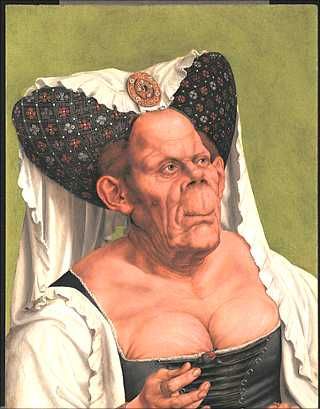
It is said that the ancient Greek painter Zeuxis died while laughing at his completed likeness of an ugly old woman. The Flemish artist Quinten Massys survived the painting of “The Ugly Duchess” (about 1513), but it might have been a close shave. Certainly plenty of people have at least smirked at her in the years since.
This is because, and there is no getting around it, she appears ridiculous: bulging forehead, protruding ears, puckered mouth, hairy mole on her cheek, huge horned headdress and shrivelled bosom. She looks beseechingly upwards, clutching a tiny withered rosebud. When the painting was put up for auction in 1920, the New York Times advertised the sale of a “portrait which is generally accepted as being the ugliest one in the world”. But why is she ugly? And how are we meant to respond?
A new exhibition at the National Gallery in London called “The Ugly Duchess: Beauty and Satire in the Renaissance” successfully answers these questions. It traces the influences on and atmosphere around the conception of “The Ugly Duchess” – religious, artistic, misogynistic – and convincingly places her within a long tradition of negative portrayals of women. There are witches, crones and hags; the incredible grotesques of Leonardo da Vinci; and the creepy John Tenniel illustrations for the 1865 edition of Lewis Carroll’s Alice in Wonderland. All either influences on, or influenced by, Massys’ duchess. It is to the considerable credit of this exhibition that it hasn’t dampened the fun of these artworks, while brilliantly elucidating the sinister threads that run through them.
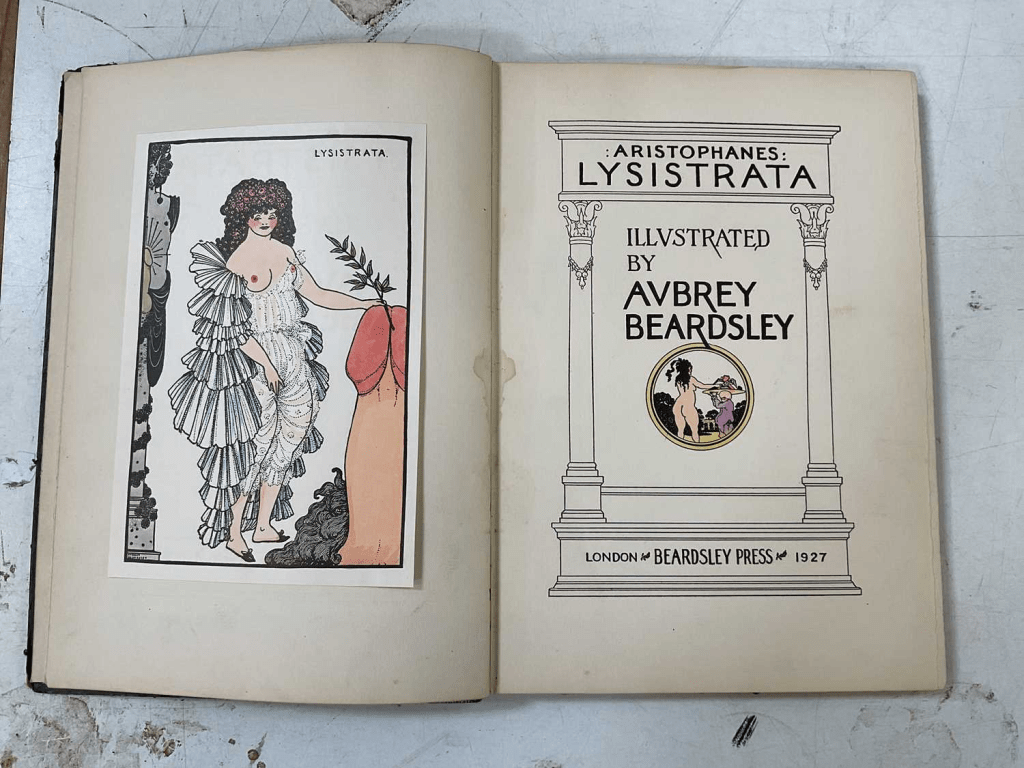
Whether we feel Zeuxis got his just desserts for laughing at old women (a favoured occupation of Greek artists – witness Aristophanes), the case of Aristophanes shows that sometimes women travestied for comedy sometimes get their own back on men, who become the butt of their joke, as in Lysistrata, of course, as so brilliantly captured by Aubrey Beardsley’s pointed humour at the ridiculousness of the power attached to the phallus in Greece..
In art criticism the matter of the weaponisation of laughter is debated too. In Zola’s novel L’Œuvre (The Masterpiece) (1886). crowds in the Salon des Refusés gather around a painting that is described as if it were Manet’s Le déjeuner sur l’herbe , though in the novel attributed to its mocked hero, Claude Lantier (whom Cézanne took to be a disguised portrait of him and which caused his estrangement from erstwhile old schoolfriend) and laugh out loud in supposed derision of it. They laugh as a means of displaying disgust or embarrassment. In his book on Manet, Zola writes:
The Luncheon on the Grass is the greatest work of Édouard Manet, one in which he realizes the dream of all painters: to place figures of natural grandeur in a landscape. We know the power with which he vanquished this difficulty. There are some leaves, some tree trunks, and, in the background, a river in which a chemise-wearing woman bathes; in the foreground, two young men are seated across from a second woman who has just exited the water and who dries her naked skin in the open air. This nude woman has scandalized the public, who see only her in the canvas. My God! What indecency: a woman without the slightest covering between two clothed men! That has never been seen. And this belief is a gross error, for in the Louvre there are more than fifty paintings in which are found mixes of persons clothed and nude. But no one goes to the Louvre to be scandalized. The crowd has kept itself moreover from judging The Luncheon on the Grass like a veritable work of art should be judged; they see in it only some people who are having a picnic, finishing bathing, and they believed that the artist had placed an obscene intent in the disposition of the subject, …. (cited https://en.wikipedia.org/wiki/Salon_des_Refus%C3%A9s)
Outrage, as Zola described it here, is expressed in laughter in the fictional account, and is sorely hurtful to Lantier, driving him to new experiments in composition en plein air, which, in Zola’s view, ruin him and drive him to his death. Yet Zola is sure that these crowds are themselves vulgar, unable to see that it is ‘the dream of all painters: to place figures of natural grandeur’ (by which he means classically proportioned female nudes) ‘in a landscape’, that they would know that if they examined the tradition of painting in the Louvre with circumspection as it should be examined, rather than conventional attitudes. Instead they pretend disgust and outrage, starting with laughter at the absurdity of the painter’s subject.
‘Don’t make me laugh’, is a phrase likewise uses as a taunt. The English Club gloss the phrase as interpreted conversationally thus:
You can say this after someone’s said something you think is impossible or ridiculous.
For example
“I’m going be the best footballer in the world one day.”
“You? The best in the world? Don’t make me laugh!“
“She said she wrote the essay herself.”
“Don’t make me laugh! She can’t even write a proper email in English.“
Impossible, ridiculous, abnormal or queer, as used as a slur, ‘don’t make me laugh’ is most often used as a threat that the effect your saying, appearance or attempt to do something that is obviously a challenge to the person attempting it will cause involuntary laughter – laughter that will happen despite its lack of propriety or appropriateness by any standard of decency. It is aggressive because it assumes that no-one wishes to be laughed AT. The classical mythical expression is the story of Hans Christian Anderson’s The Emperor’s New Clothes, where the bubble of a powerful fashionista is pricked by persuading him to walk naked, or in underclothes in the nineteenth-century Bowdlerized illustrations, through a city in the belief that he is dressed impeccably and suitably to the standards to which he pretends. See the cover of the Ladybird version of the Hans Christian Anderson telling of the supposed folk tale.
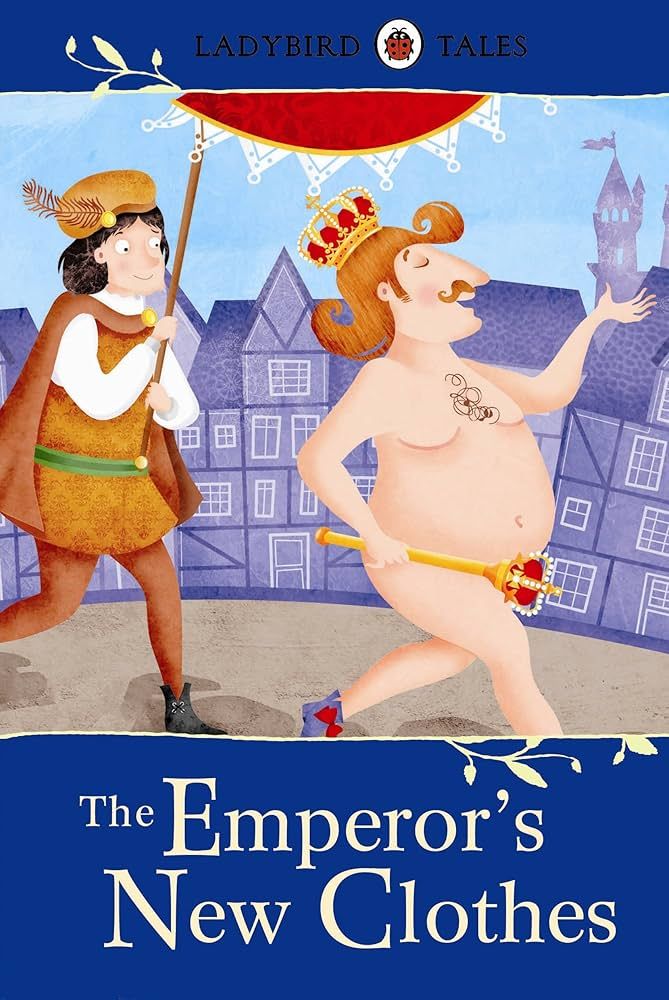
That Ladybird illustration, intended for children, is an interesting example. Clearly the source of the ridicule lies in an inversion of expectations of respectful thoughts from the hoi polloi to be owed to a ruler by virtue of their superior class or other status, as in the exaggerated Roman, and turned-up, nose of the Emperor as well as other status markets like a crown and royal mace; the latter also used to hid his genitals from sight at the picture angle chosen. And the presence of a servant holding a canopy over him. Our delight in seeing and ridiculing the Emperor however is shared in the smirk we identify with in the plucky waiting attendant, who bears a smirk on his face invisible to his master, and whose laughter cannot be heard either by the master – because it is internal to him and hence silent.
Not so, however, to the intended audience who use signs like the latter to be feel ‘made’ to laugh outwardly at the Emperor. But herein lies a problem. The class basis of the ridicule is perhaps less important out of the nineteenth century where middle class radicalism took public tilt at the idea of, as well as the persons representing, aristocracies. but does the audience of young children get invited to single out other characteristics of the Emperor; ones current in the contemporary folklore of outsiders, which young people all got encouraged to call ‘gay’ as an insult to those not considered ‘normal’ once by Tik Tok. The Emperor is typed as ‘gay’ or ‘camp’, is laughable, in the kind of exploratory manner of kidspeak as ‘fat’. That is, the modern Ladybird reader is urged to be ‘made to laugh’ by other supposed pretension of the pictured victim of our laughter, his feminised and infantilised appearance is marked in his outward curling hair-style, unlike that of his retainer, the sparsity of his masculine chest hair and limpness of wrist. If anything the effect is far from radical, it is aimed at the supposed ‘abnormality’ and ‘queerness’ of the man not the absurdity of the false association of high social class with good taste in fashion.Likewise, the Duchess above is laughed at not just because she is abstractly ugly, but because of her age, her pretension to sexy clothing where she is, by the norms, not sexy at all and ‘her’ manliness. All that is emphasised even if we don’t know the painting was one of a pair showing an unlikely and over-shadowed weak husband. Indeed there was a Northern Renaissance genre of such paintings.
Jeremy E. Sherman, an academic psychologist, says in a Psychology Today article online called ‘Real Friends Laugh at Each Other, with Each Other‘:
All of my friends laugh at me – with me.
And vice versa.
Which means we have to do the serious work it takes to get to where we can laugh at ourselves. And not nervous laughter, a calmfident chuckle at the bozos on the bus we really are.
I don’t mind the work though I mind it plenty. Laughing at me is good for me even though I take life very seriously – just not too seriously I hope, or it just wouldn’t be funny.
Life is funny. If all the world’s a stage, it’s one playing out in tragicomedy or epic slapstick.
….
Laughing at ourselves doesn’t come naturally to people. The tendency instead is self-aggrandizement, a kind of blind pride, or personal patriotism, especially when push comes to shove as it does for all of us eventually.
…
Here’s some personal slapstick: To sustain my mojo, I need a margin of unjustifiable confidence. I’m at my most productive best when I think I’m better than I really am. That’s something to laugh at about me with me.
If I didn’t laugh, I’d start to believe that, no really, I’m better than I really am. I’d slip over into blind pride and personal patriotism. the kind that would have me saying, “No I must be right. I’ve checked with myself three times and every time I’ve agreed!”
When I was at primary school I was told that this was the real meaning of The Emperor’s New Clothes, but I doubted it then and doubt it now. The meaning if I did believe it would be that the Emperor merely needs to see himself as funny and laugh at himself with his populace and all will be okay. But even children know that real life isn’t like that. Power is real and kings don’t survive forever as a figure of fun, and oft turn nasty in response – note Donald Trump responding to the Epstein files with mass war. Likewise gay people who laughed at themselves during a period of real oppression, characterised by fictional figures like those invented by Larry Grayson and John Inman, together with BBC writers, were still ‘despised’ (too strong a word for me, in 2017 by queer activists, as I was at the same time as he -if not celebrated as such, like Peter Tatchell. Being laughed at and then identifying to laugh at yourself as heteronormative society demanded of us was not a solution, although collective pride was – a pride that did not exclude self-directed humour but did avoid its marginalising effects by mass visibility.
We can and should laugh. The ruses we use to maintain self-confidence, self-efficacy and appropriate pride are funny – ludicrous sometimes – but they need not be undermined. We just need to remember we all use such pretensions – in the sense of fictions – to maintain ourselves as agents in a difficult world. That kind of laughter unites because it does not presume or create relative power over people by deflating the most vulnerable to ridicule.
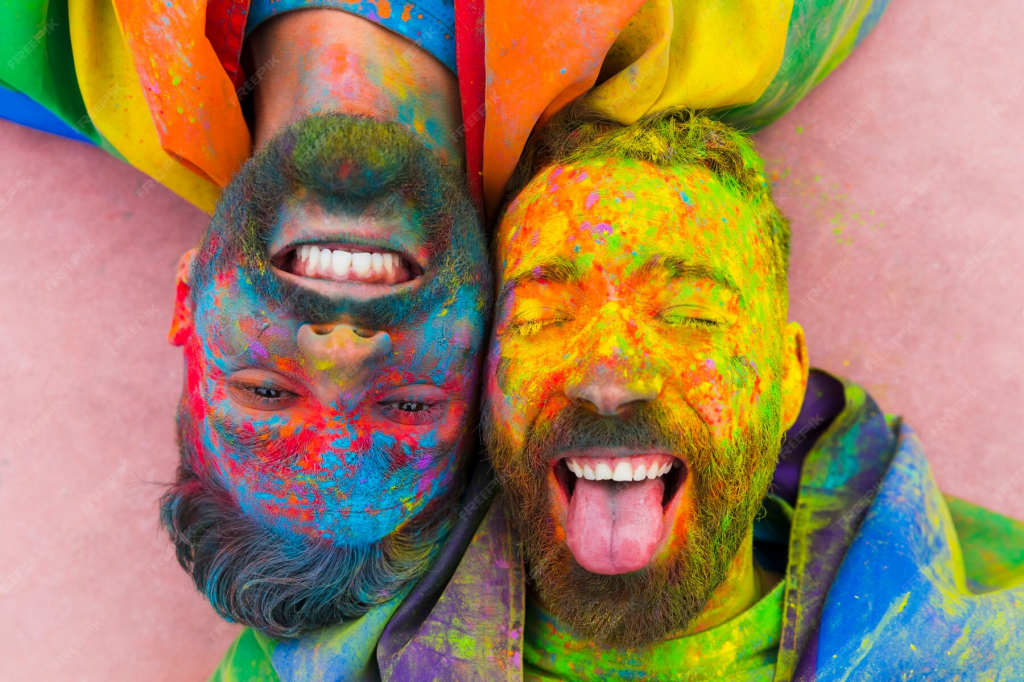
That is what is despicable about the current tendency to the disunion of LGBTQI+ communities into divisions fueled by power and regressive ideology, like that of biological sex as an absolute determination. To hear the LGB Alliance, and ask their appalling followers for laughter like the cracked sort proceeding from J.K. Rowling, speak of ‘tranny-fags’ makes me cringe and should them – but people like acceptance in norms and the recently oppressed do not have a track history that helps us to think that oppression once diminished on its own changes society to more just and inclusive responses to each other.
But there’s hope – I think. Laugh Out Loud! Don’t make me Laugh!
With love
Steven xxxxxxxxx
 Steve_Bamlett_blog