


The meaning of the weather depends on what its changes mean to you, your community, your present and your future! This blog is about seeing the Opera North production of ‘Peter Grimes’ at the Theatre Royal Newcastle at 7.00 p.m Friday 20th March 2026.
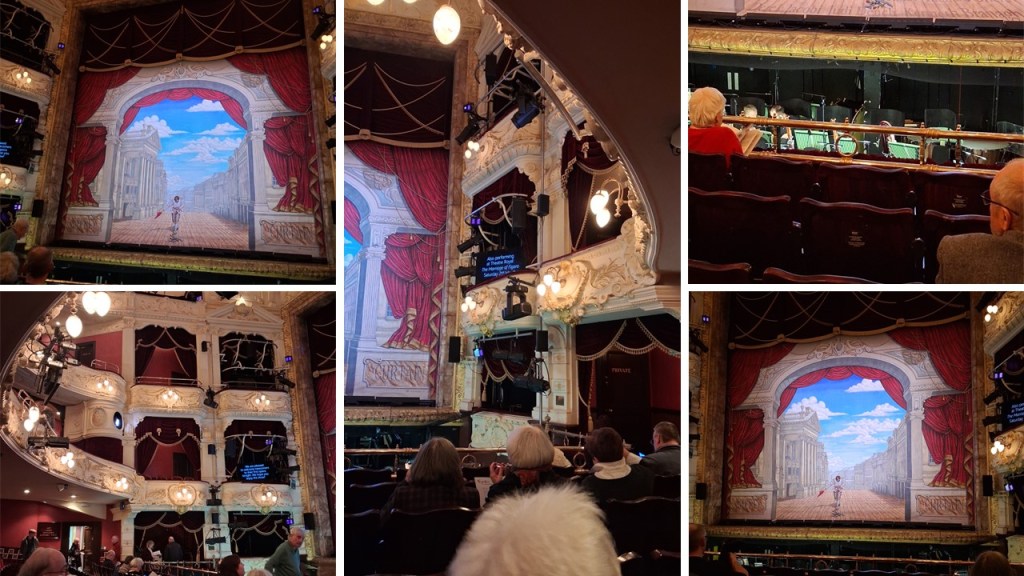
Theatre Royal. Awaiting the performance
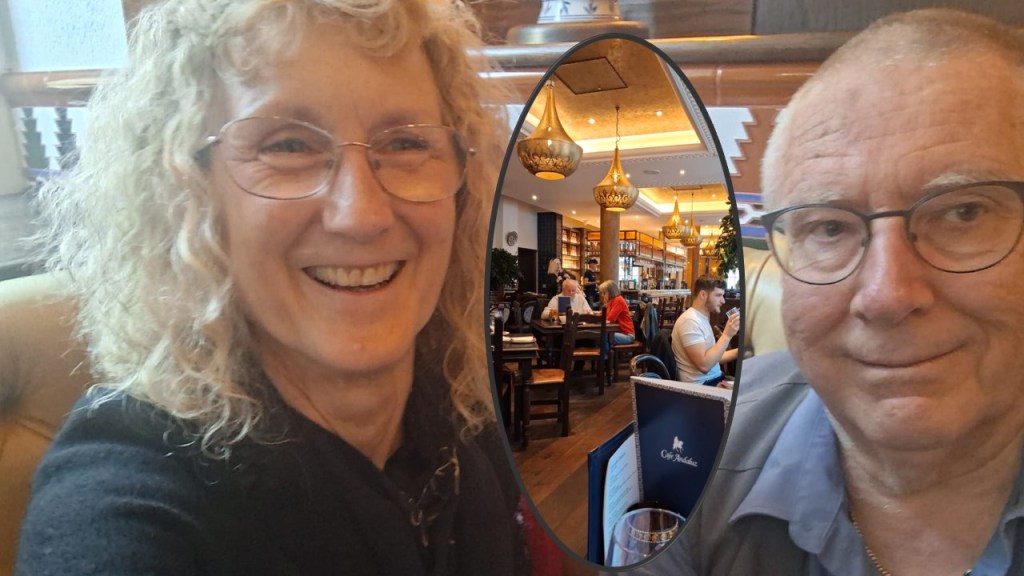
I prepared myself as always to see the already acclaimed production of Benjamin’ Britten’s Peter Grimes by Opera North, which played for one night last night at the Theatre Royal, Newcastle with a blog on reading George Crabbe’s story (Crabbe has a silent role in the opera – referred to and addressed but never singing back in reply) from The Borough (read it at this link if you wish). and on seeing a DVD production from Zurich but focused on the tradition of ‘queer’ reading of the opera (also readable – at this link). This blog follows seeing the piece with my wonderful friend, Catherine (here with me enjoying the tapas supper she bought me in Cafe Andaluz for inviting her to use my reluctant hubby’s ticket).
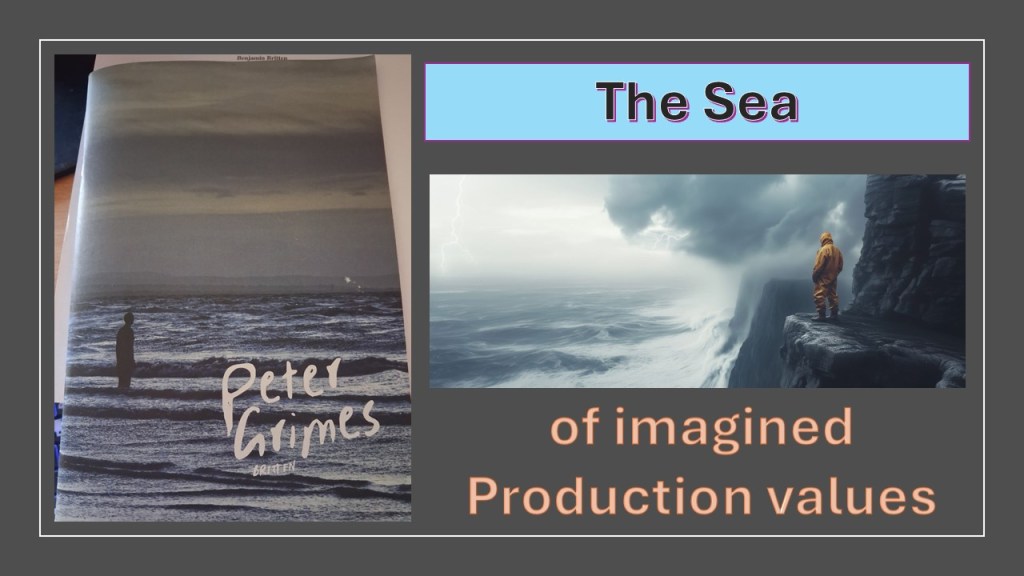
One issue I didn’t discuss in the previous blogs by the way was the role of the representations of the sea in past productions, despite the fact that I heard, nut don’t remember where, that this production was strongest in its capacity to use the se as both setting and symbol. It is emphasised however not only in the programme cover showing one man and the sea (possibly the man is a figure by Anthony Gormley in its natural setting) and the publicity photographs showing cliffs and a watching man in a fishing sou’wester facing off that sea (both shown in the collaged photographs below).
However, also I found this stress on the symbolism of the sea in a short programme piece by Garry Walker, the conductor (or musical director) of the production, which is worth seeing in full: [1]
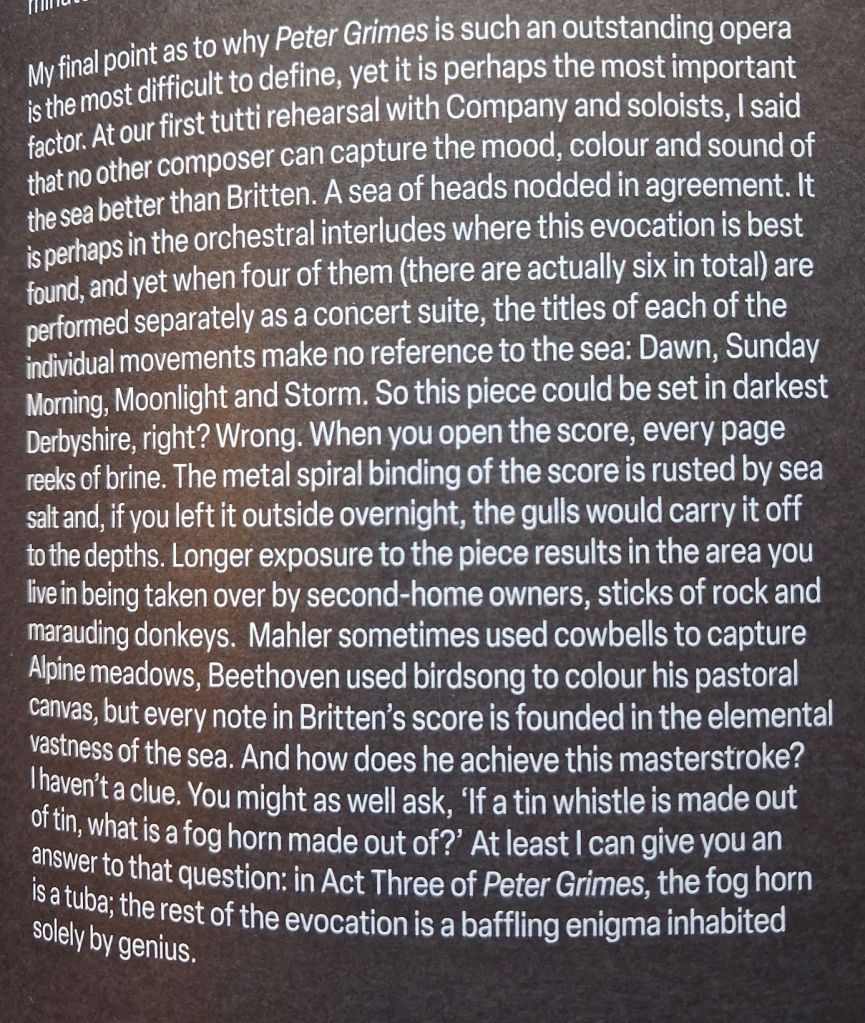
Let’s stay with Walker’s thoughts a little for they are so lucid and so honest, especially in hinting at the mysterious way in which musical ‘genius’ (not a term I am comfortable with but fine here) suggests ideas, feelings and imagery. However, I think one mystery that Walker raises is not such a mystery. He points to the fact that the titles of the musical movements (also the acts and scenes in part) ‘are not’make no reference to the sea’.
Strangely enough I had discovered earlier that the significance of the sea in the opera became enough of a controversy early on in its production history for Britten to feel he had to comment on it. Philip Brett in an essay on the changing production values emphasised in earliest productions of the opera points to how Tyrone Guthrie, directing the opera for the Covent Garden Opera House in 1947-8 determined to reverse the tendency to naturalist or social-realist of a community – in recognisable shouses and houses by the sea to one in which the sea was symbolic rather than a feature of social-economic communal life. This is how he describes his and the set designer’s work, together with a study design of the set painting used:
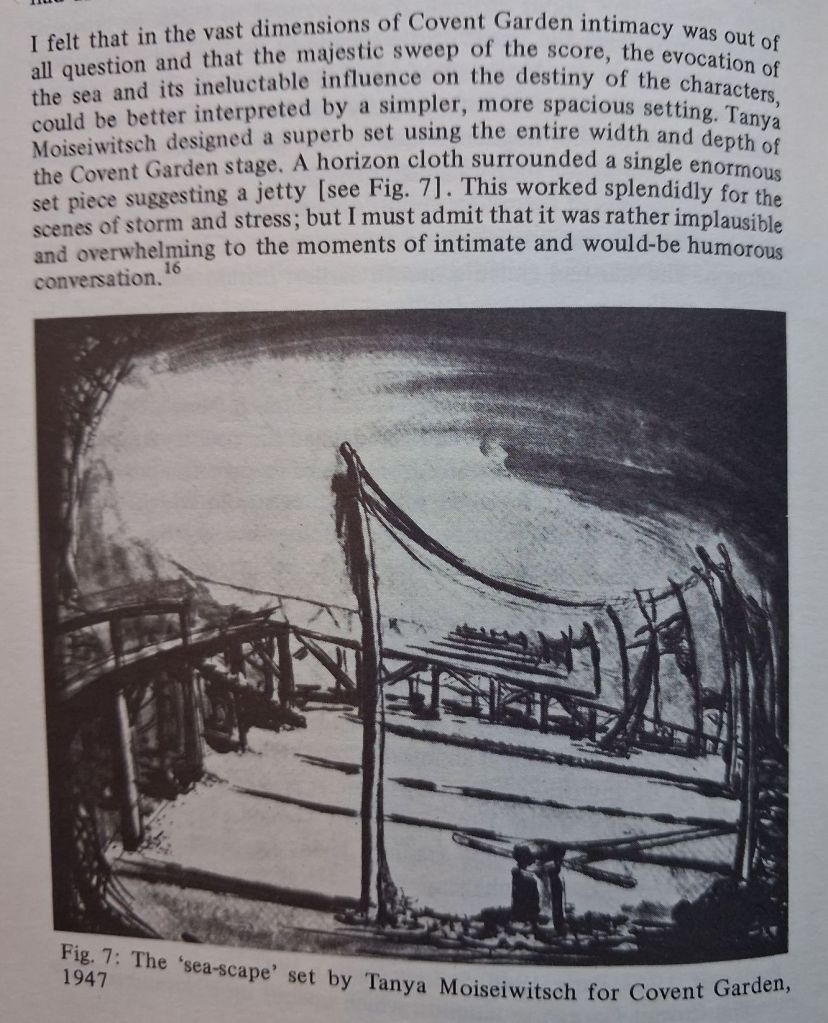
Brett goes to show that Guthrie was so convinced of the rightness of his conception of the opera that he thought those bits of it that didn’t fare well in his and his set designer’s conception were errors in Britten’s art with its inappropriate desire for ‘naturalistic staging’ and ‘scores of conversational scenes’. Britten clearly wanted to differ, and specifically picked out, according to an account by director Ande Anderson of Covent Garden, who heard of it whilst later directing Billy Budd with similar issues in mind, his dislike of Guthrie’s treatment of the sea as symbol only: {2]
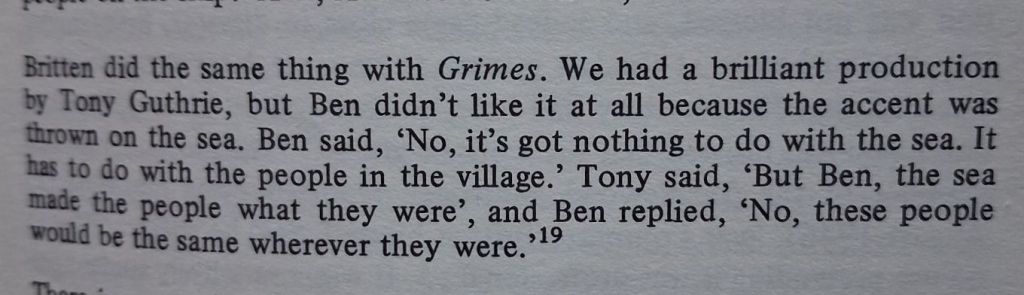
Nothing could be clearer than that Britten felt his ‘naturalism’ as an artist, was, as in Zola perhaps, an insistence that dramas are primarily about people, not symbols. Hence some modern productions still use the sea as a part of the social realism.or naturalism of the productions, as Zola uses the coal mines and coal towns in Germinal , and as in the stripped down naturalism of the Brussels of the Grimes production shown below, where tne sea is represented as linked to work and social congregation and economicpurpose:
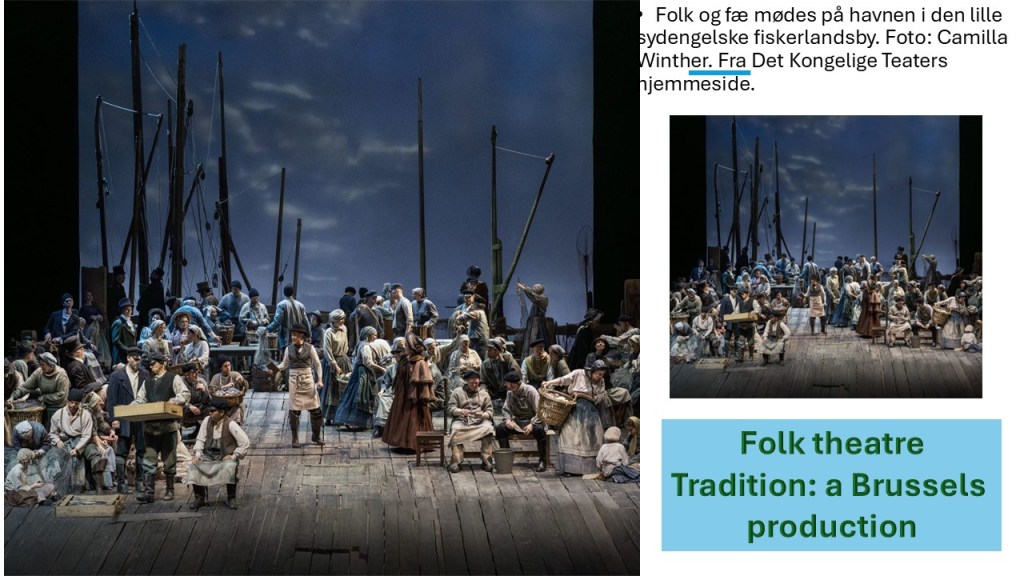
But as Walker says above, that does not mean the sea is irrelevant or a mere contingent setting. It can also be a symbol interpreted in terms of a naturalistic psychology in which all the natural and social elements of place play a part defining the space in or against which characters interact and as sources of imagery that are analogous to human mood in groups and individuals. The latter psychological traits can be used to define place too. Note the fact that Walker uses the titles of the musical movements, working alongside naturalistic settings, to indicate the absence of single-minded reference to the sea.
These titles are Dawn, Sunday Morning, Moonlight and Storm. But these titles indicate most of all how those who labour on the sea divide its meanings,based on practice and expectations of their success, to them, whether they be human or regular or irregular functions of nature as named and allotted meaning by human communities. All the things signified by the titles are functions that regulate a community’s human labour in ways appropriate to settings that also form their circumstances of seeking and maintaining a living.
For instance, on Sunday mornings, in theory, humans rest, though it is the root of the main tragic event of this story that Grimes does not rest at all, and forces his boy to labour too, because he claims to have a more economically refined individualised perception of the sea as resources for tapping (‘I can see / The shoals to which the rest are blind‘) and the right to regulate his time as he sees fit and not by any command divine or human (‘ELLEN: This is a Sunday, his day of rest. PETER: This is whatever day I say it is!).
Those titles then emphasise not only the sea but also all other markers of the ways in which the meaning of the sea changes for that community – most notably the times of preparation for work, work on the sea itself, and rest from work, including the unregulated facts of changes in light conditions, weather or tidal variations in the sea.
Storm is moreover not just a title. It is a recurrent fact in the story’s onward movements and delays therein – it occasions the delay of John the orphan’s arrival to the Borough, as well as the delayed laudanum to feed Mrs Sedley’s not-so-secret-as-she-thinks habit. Both facts involving delay play part in the developments and interactions of the stories the opera tells – one in furthering the haunted provision of Grimes nemesis, the other in highlighting the psychosis of the scapegoating of Grimes by the likes of Sedley, whom Ned Keene the quack appthecary, wonderfully played in this production as a leather-jacketed wide boy, predicts will end in Bedlam as a result of her addiction.
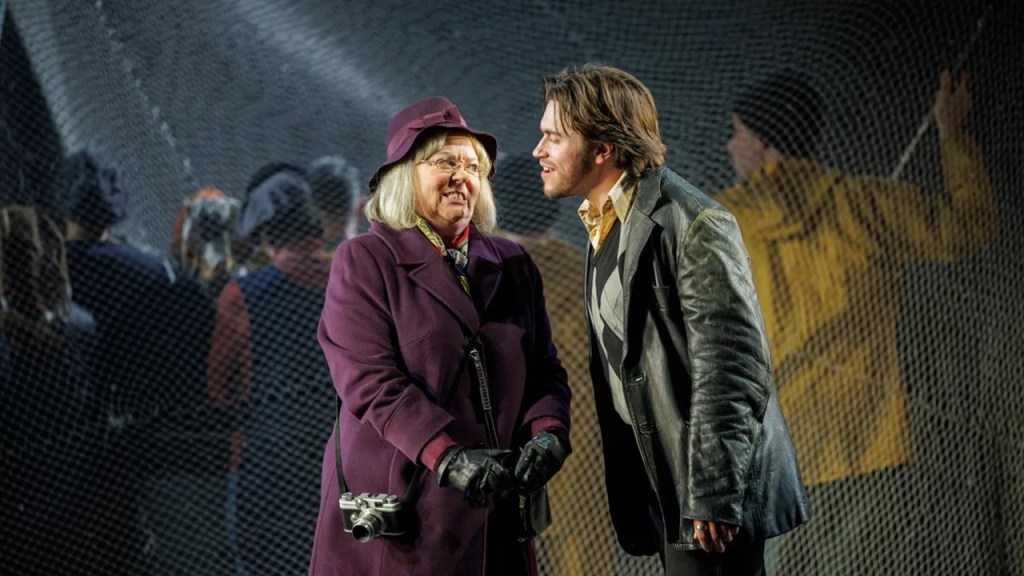
Mrs Sedley brilliantly played by Claire Pascoe and, my own unashamedm favourite as sexy rough Ned Keene, Johannes More. The netted community are behind them.
Stormy weather, is an index of both political and mental disorder, in drama since its beginnings in England – in Shakespearean tragedy (King Lear or Macbeth) for instance, but in Peter Grimes, its meanings are tied to the needs of individuals and the sea- work that drives the economies of their places, that in itself gets tied to the danger created by storms of passion in both community and individual. The opera depends on the hope that storm is predictable and its contradiction in the truth that it is largely not. That is the point of Grimes first wonderful’aria’ if that is the word for soliloqy in this modern genre of opera, that I discuss in my earlier blog. Here are its lyrics again:
(No-one answers. Silence is broken by Peter, as if thinking aloud.)
Peter: Now the great Bear and Pleiades
where earth moves
Are drawing up the clouds
of human grief
Breathing solemnity in the deep night.
Who can decipher
In storm or starlight
The written character
of a friendly fate –
As the sky turns, the world for us to change?
But if the horoscope's bewildering
Like a flashing turmoil
of a shoal of herring,
Who can turn skies back and begin again?
Grimes sings of tbe unpredictability of calm that affords starlight and the darkly obscuring effect of storm, and in doing so proclaims that no-one is in control of their ‘fate’, friendly or otherwise; a lesson it takes a blinding for Oedipus to learn. We are what the inexorability of the determinants of the weather make us, bound up in our peculiar relation to life mediated by the economically detrrmined society we are born into. Unsurprisingly, the control of his destiny is bound up in the impossibility of reading what makes a shoal of herring your prize or not as a fisherman
What matters to communities focused on the economic exploitation of the sea’s resources is how the weather, tidal variation or the group psychology of a herring shoal impact their routines and necessities of life, especially set against human expectations of time. For storm and its sequelae, flood, regulates their lives over and above the regulations set there by human custom or supernatural revelation. Think of the meaning of the ‘fog horn’, for instance – it seeks to compensate for a barrier to human processes on the sea set up by changes in weather. Much as we like to see time apportioned by human need, the weather re-apportions it (hence the relevance of this opera to my choice of prompt question). Humans, in choric statements, tend to see time in terms of ordered rhythmic and cyclical slots for human activity – hence the first chorus, which already contains a gendered split in how even natural cycles of the sea (its tides that vary against how human ‘biological clocks’ operate:
Chorus: Oh hang at open doors the net, the cork,
While squalid sea-dames at their mending work
Welcome the hour when fishing through the tide
The weary husband throws his freight aside.
Fishermen: O cold and wet and driven by the tide,
Beat your tired arms against your tarry side.
Find rest in public bars where fiery gin
Will aid the warmth that languishes within.
However much both the whole community appears to be driven and regulated by the tide, their are variations in how the lower bourgeois classes grasp the meaning of that community – of women working for and then awaiting their husbands’ economic function, in fetching home ‘freight’ – and what the men do with their rest time on return, as determined by the tide’s cycles. For what the Fishermen do is not to return to their wives but to turn regularly to public houses and secondary homes, run by Aunty and populated by Nieces (another family) where both gin and their own inner needs of warmth want, aided by the gin, add to.its quality as another version of home.
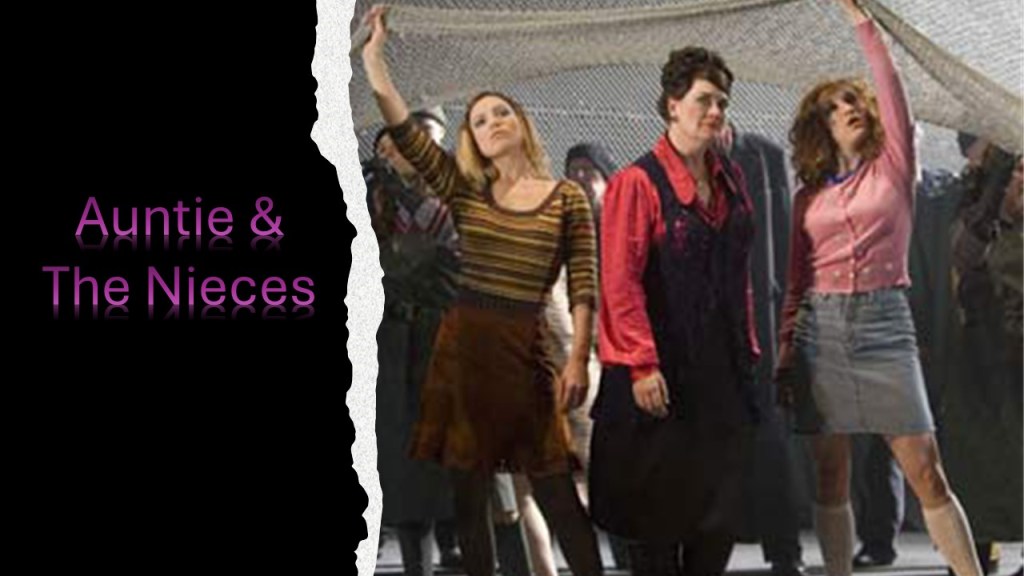
From L to R: Nazan Fikret, Hilary Summers (a formidable Madam) and in our production Ava Dodd (not the person pictured above)
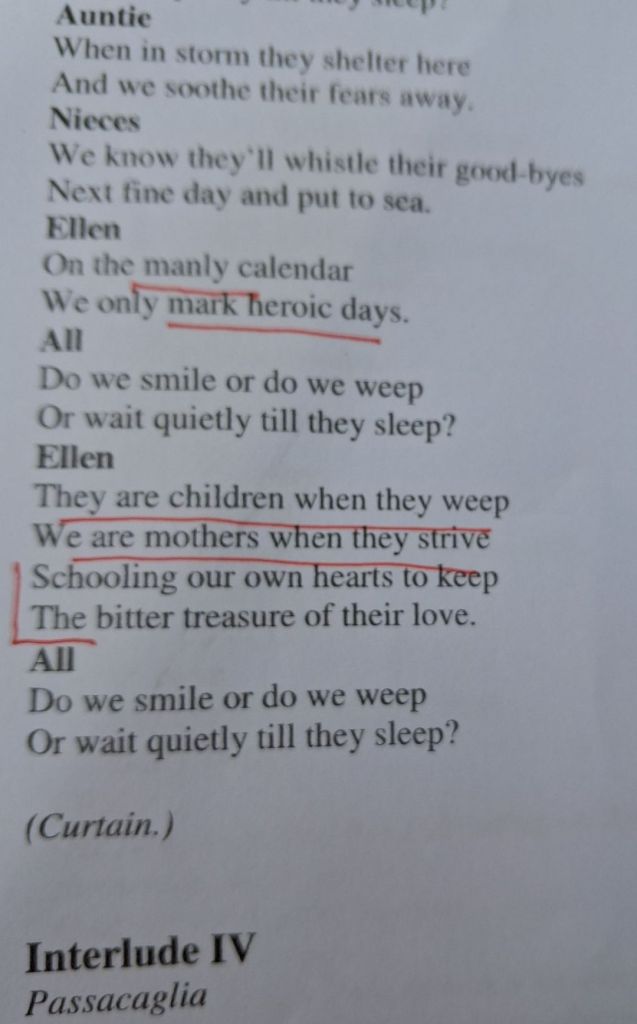
Thus sneaks into the opera the role of prostitutes in communities, allowing the husband to expend the inner warmth pf their being, that was merely languishing when it was confined to their wives or ‘squalid dames’. All of this is about people, being as they are socially constructed and their agency in colluding with that construction, not about simple symbols. That means that although tides and weather ‘(or the starry sphere) may appear to determine people’s fate, in fact, people with their own agency turn to ‘other’ means of shaping their lives to their own desires. In doing so, they tend to consult their self-interest in showing how those determinations are practically interpreted and what they should turn a blind eye to consciously or unconsciously, even the most reverend of them: Reverend Adams, for instance, who never quite gets the hang of how his colleague middle-aged middle-class professional men use the pub The Boar and its ‘young women’.
Alexandra Coghlan, writing for The Critics’ Circle certainly describes the first stage setting of the Borough as a ‘place’ in this revived production (The Opera North production is 20 years on from its first inception). Since she sees Peter Grimes as ‘an opera of place above all things’ (the photograph below does not show the painted set and it main uses when lit fully that she describes well, nor the uses of those versatile wooden pallets, but does show in part the role of the ‘giant fishing net’ used on stage:
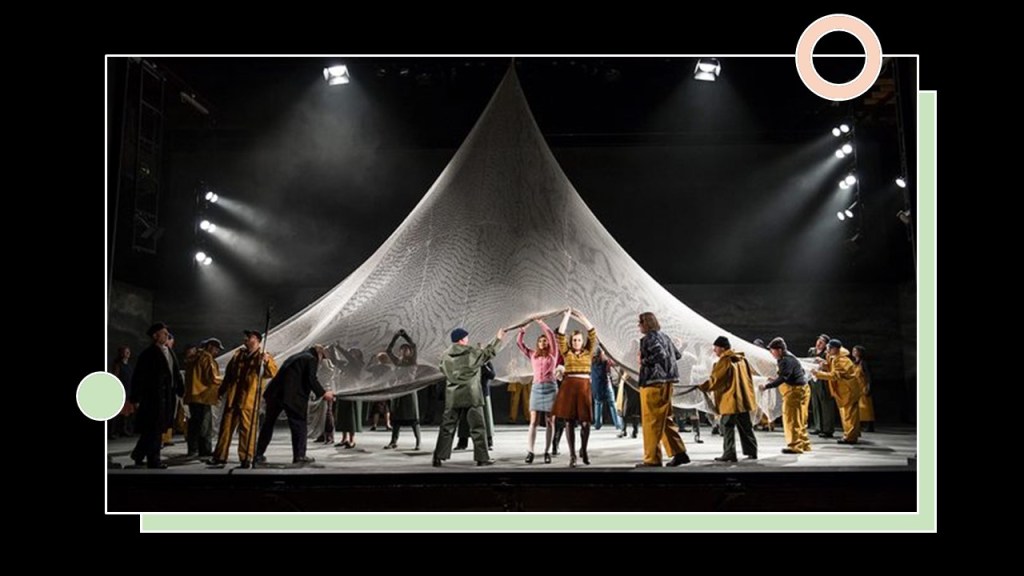
Anthony Ward’s set – a grey-blue seascape, melting sky into sea, deftly lit by Paule Constable – encloses the action on three sides, trapping the chorus in a crude, makeshift world of wooden pallets (that must supply pub, hut, church and Moot Hall) and a giant fishing net. Raised by a central pulley, it engulfs The Borough’s citizens in a strange embrace – blinding and binding them under its mesh, a totem of belonging. Once we’ve seen it, the opening tableau – Grimes’ naked body washed up wrapped in a net – takes on a more sinister significance. [3]
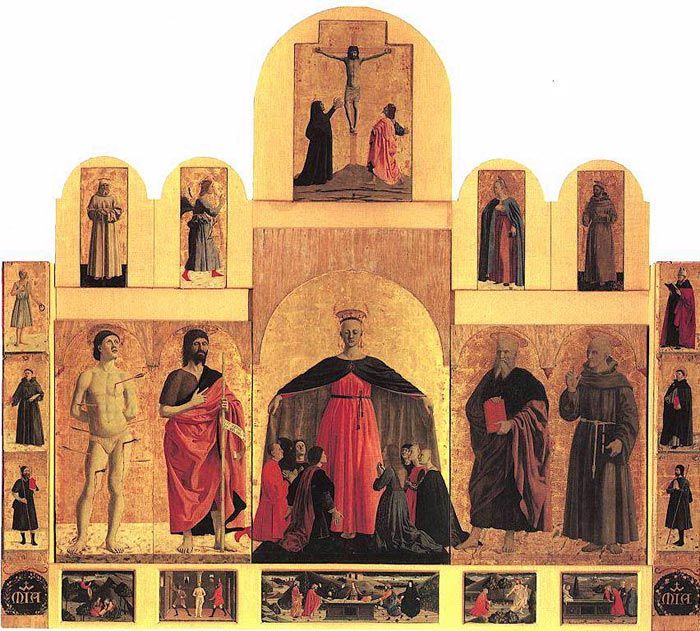
The description of the net on the stage is accurately as if it meant a kind of mantle of defences that contain communities in a ‘totem of belonging’, both in the sense of holding them in an embrace and trapping them for their own security, like the mantle of the Virgin Mary representing the Church in the centre of the famed Piero de la Francesca screen:
The first time we see the net is when behind, and within it, we see the ‘squalid dames’ of the community (that is its poverty-stricken married women) mending it. Soon however its connection to the tasks of fishing communities is less about the practices of sea industries and more about finding a symbol for how a tight community works and why to hold itself togethervand limit its contents to those ready to follow its norms. That is, it offers security at the price of accepting its limitations and prohibitions of access and egress. That net returns at the end of the opera representing the community but with its margins held within it in the repetitive motion of a wave-like sway, as if the cycles of the sea are represented in the monotonous but often beautiful actions of breaking waves on a shore or the flow of the tides back and forth in regulated sequence. But that notion that the sea is a thing of regularities is itself a lie. Hence Britten was right to say that the people would have been the same ethically and in character wherever they lived and in whatever unfair allocation of resources – for that went beyond the economy of fishing communities.
In the picture of the net in the production above, a portal to its semi-obscured interior is created at the front of the fishing-net-cum-mantle-of-community that is like the entrance and exit from a tent. However, that portal is supported mainly by the arms of the ‘nieces’, the prostitutes who serve under the madam of The Boar public house known as ‘Aunty’. Often we feel the community – especially those of its working (and professional) men of the Borough is held together by the caring ministrations of women, including sexual ministrations. It is no accident that both Helen Orford and the nieces sing together one of the most haunting if semi-light-hearted group so musical highlights, to me at least, of this production about the burden involved for women in alleviating the dreadful heaviness of male despondency about their work and sense of responsibility, real or otherwise, for they only want themselves reflected in the mirror of their ‘heroic days’ only.
That men are only children emotionally is what Ellen already knows and yet she has striven to put a boy child of the most vulnerable kind into the care of a man living alone. In all spaces Ellen knows that women, where as the affianced, a wife, a mother or a prostitute paid to warm up the inward man, and listen to his groans. But Ellen is no simplistic character. Though kind to John, the second workhouse-origin apprentice, he is schooled by her to remain with Peter, and could never have been brought to him without her collusion. In this the Borough’s instincts are right. Orford reminds me of other tragic women in male literature, like The Lady of Shallot who weave the net of their own capture, although we most often see her netting the fate of others in relation to John (see below):
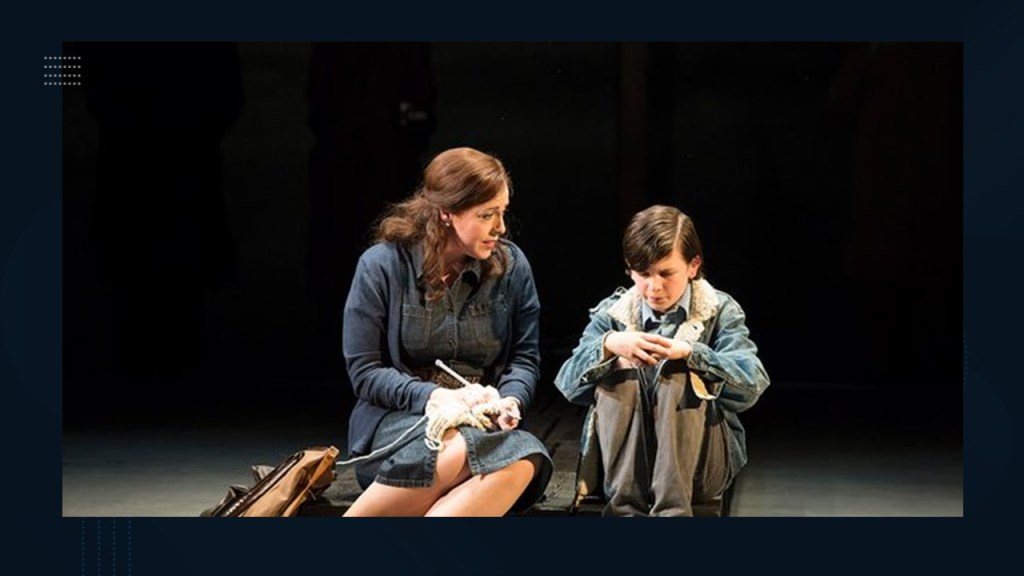
Ellen Orford (Philippa Bayle) and John (Toby Dray – not the one pictured here)
Moreover, this knitting (or netting) is potentially tragic and not only for her. Her finest production is a seaman’s jumper knitted for John, and found of evidence of his possible fate of drowning, even though we know he died from a forty foot fall from Peter’s hut on a sea cliff that could have been avoided had Peter cared enough to attend to him. She and retired Captain Balstrode find the ganzy (the name it would have in North East fishing communities whatever Wiktionary says) – see below,
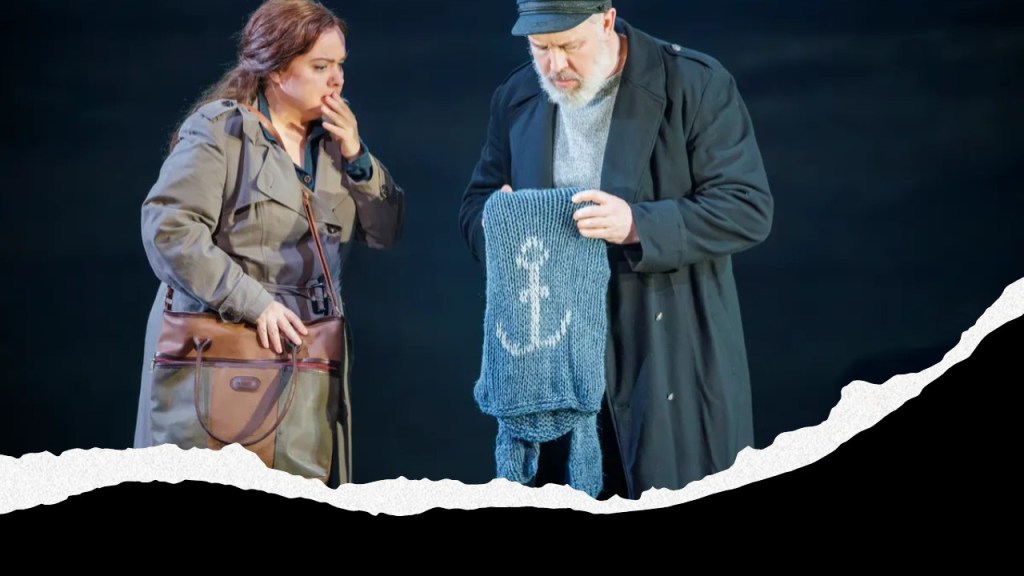
Philippa Bayle and Simon Bailey (the latter as Captain Balstrode)
She speaks of her horror at finding something, though born of ‘a luxury of idleness’ for her, was fed by dreams of fine marriage, which even that to Peter might be, that is now ‘clue’ to something ‘whose meaning we avoid’. She means on the surface her fear that John is dead but underneath, perhaps she also refersto her complicity in it, for again on that the Borough, though cruel in pointing the finger, may not be so wrong:
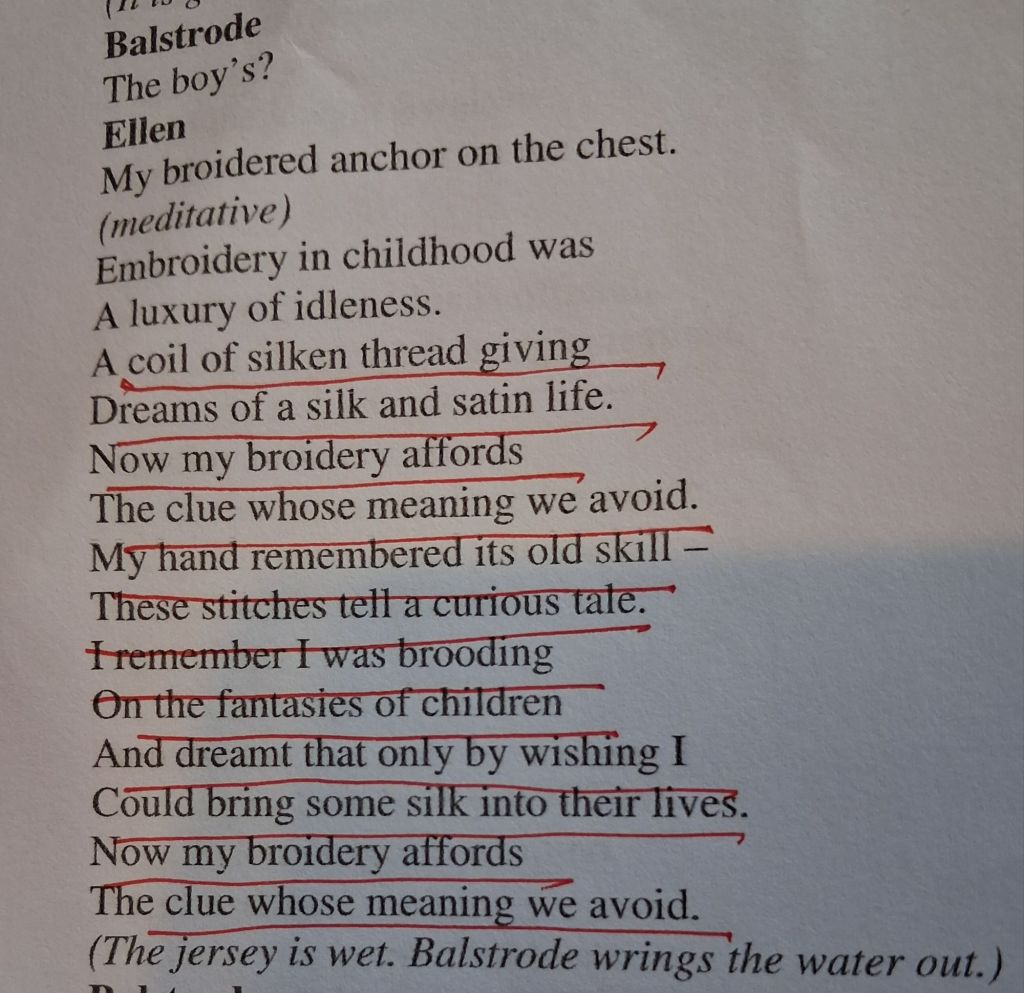
The role of place is not like the sea as a symbol and setting as Tyrone Guthrie would have it,although it renders a space for male heroism – and tragedy (as in the water wrung out of the jersey) to flourish at least in appearance, when they leave women behind them. No wonder Grimes fears the memory of his first apprentice’s eyes for NOT caring for him, whilst at the very moment that he is projecting his current return to unpopularity in the community to the gaze of his new apprentice boy, John, and to Ellen (now termed a ‘bitch’) gossiping about him and breaking into his hard-polished shell:
Wait! You have been talking.
You and and that bitch were gossiping.
What lies have you been telling?
...
You sit there watching me
And you're the cause of everything
Your eyes, like his are watching me
With an idiot's drooling gaze.
I sometimes wonder at the readings of this opera that see grandeur alone in Grimes where it is clear there is such a paranoid-schizoid disturbance of the ability to care for others, it infects everyone he might care about including himself. And most of all it destroys the chances of building a ‘home’ or a ‘community’ that cares rather than competes, locked into its personal interests. This is why the word ‘home’ resonates in this opera, where the name of a family space, a local community and all it stands for, including the sea, or suicide at sea, in Davy Jones’ locker, the predicted and actual real fate of Grimes at the end. Home includes within it associations of all that makes men in particular feel secure to someone who knows it well and works like a magic word in the network of communal words in this opera signifies.
Women service homes or induce feelings of being at home, if only in the warmth induced in male bodies by gin and sex, or laudanum in widowed female bodies like Mrs Sedley. Yet some men would prefer a home defined by nothing other than their male lonesomeness, or if by anybody a boy to shape into oneself. See this in the first visit this production makes to Grime’s hut, which in this production is a raised platform on a wooden structure actually constructed on the stage.
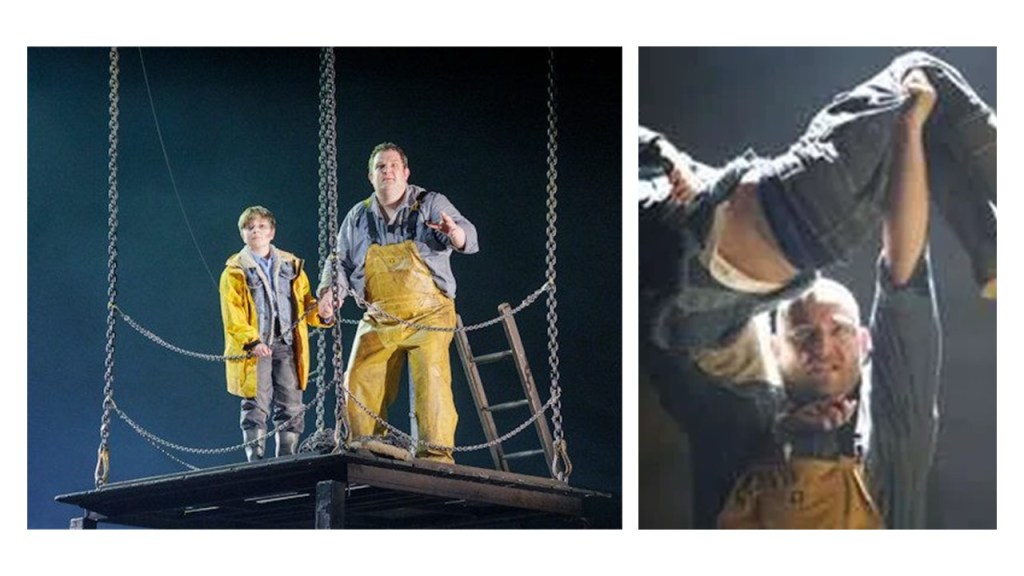
Sometimes Peter has a visionary feel about his responsibility for the boy. The picture left in the collage above is one such moment. But this is not the whole picture. Though soon the community will break into this hut – in this production by climbing the ladder to the raised platform, they are like poor and reluctant social workers on an assessment visit and find in it nought but an acceptably ‘neat and empty hut’. They fail to assess the way Grimes constructs what he calls ‘home’ in dreams, as below, wherein an idealised song follows a visible act of violence against a vulnerable child:
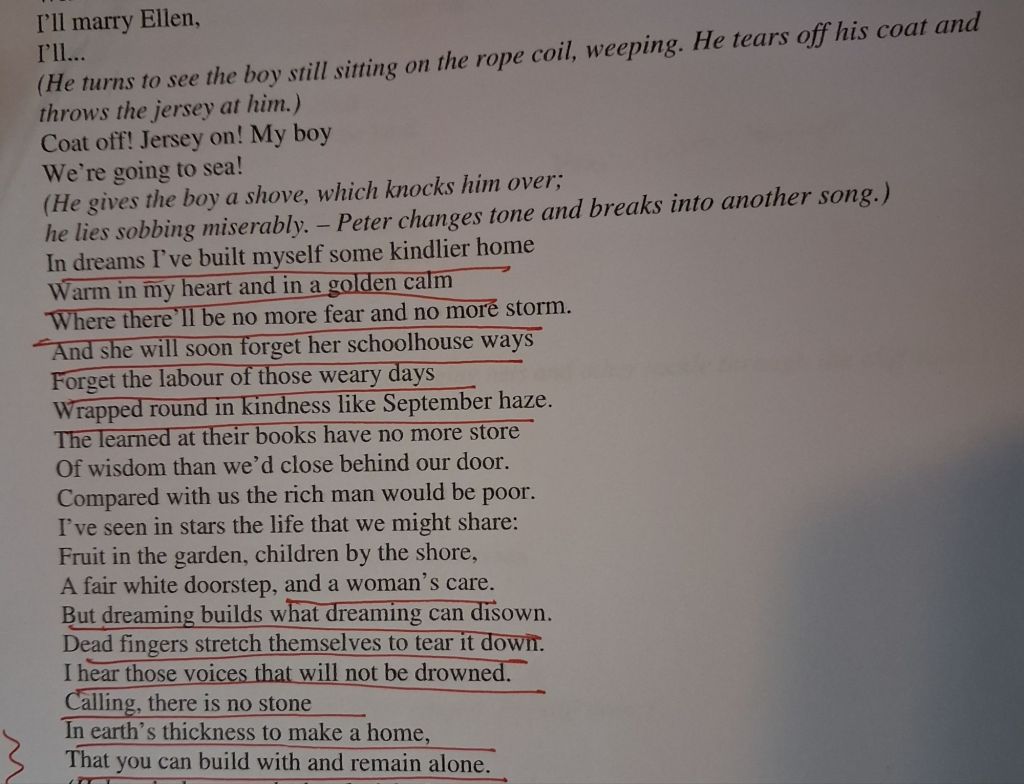
I think we know he will never fulfill his intention of marrying Helen Orford when he speaks of what more than the stone is required to build a home. Stone and alone rhyme grimly but ‘home’ is a kind of half-rhyme to both in the the three complex lines of Montagu Slater’s at the end of this extract. Peter’s tragic isolation is, as in Oedipus, a tragic flaw, a wish never to be defined by anyone, even himself, whilst having nothing but very normative dreams to work upon – those expressed in his intention of marrying Ellen Orford. This production even creates a mime of the dream of the marriage attended by the Borough community who in reality are his detractors. Mrs Sedley, for instance, takes the primary wedding photograph. That dream, if not in that detail, is referred to in the libretto above but not written up in the stage directions as a thing to be performed. But that emotional flaw (or trait if you prefer) in Peter starts off in no more nor less than the truth that for working men tied to their local space, the main form of home as understood by persons can be reducible to the usual available routines, varied between work, literal home for living in, and the pub for stimulation.
Sometimes, in Grimes, it is reduced to merely what is known and know able that makes no.psychological demands on him to care for them in return. That is place par excellence and it is defined thus by Coghlan and is attributed in this Opera North production to the staging of the piece:
We don’t need to question what holds the loner-fisherman Grimes on the bleak Suffolk coast – he tells us: “Familiar fields, marsh and sand, ordinary streets, prevailing winds”. The genius of Phyllida Lloyd’s 2006 staging is its genius loci. With the sparest of gestures and sets the director summons not the place but its essence: the salt-skin on every surface, the rot of seaweed in the damp air, the pervasive poverty, a community huddled together like a shoal and just as suspicious of any movement beyond their borders. [3]
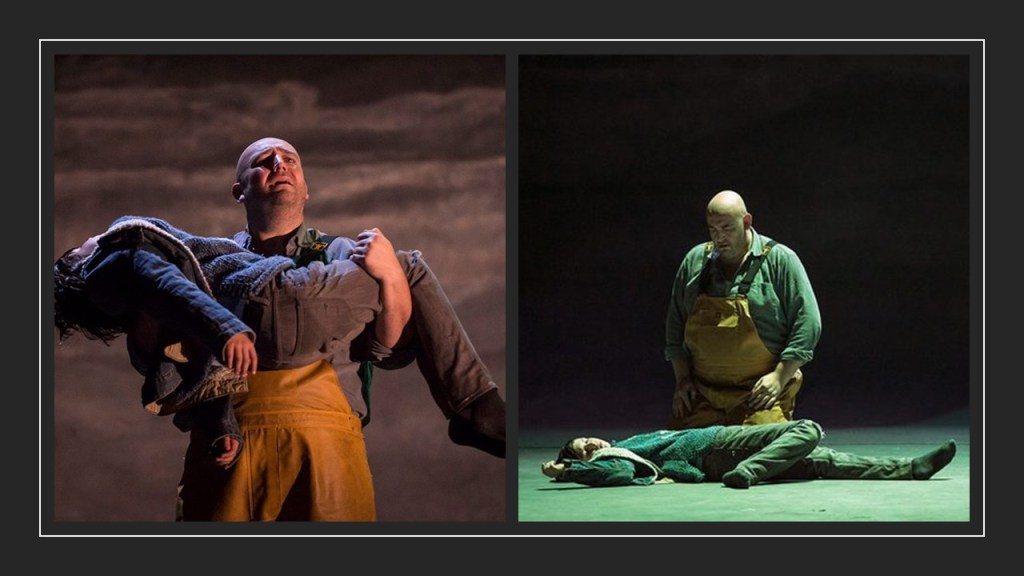
Some of the items in the list given above truly lie in Coghlan’s mind alone, such as the feel of surfaces and smells in the air – art rarely serves these senses literally.However, this is not the case with ‘shoal’ evoked to represent that the community’s life hangs around herring shoals and is not unlike one itself in its variation between crowding and dispersing, However, the sense of the ‘huddled together’ can be created with theatrical proxemics and stage-space management, and is, in many ways, by staging in sets, properties and proxemics in the Opera North production, from moments of tragic isolation, like Peter reducing himself to the nakedness of his birth in order to kill himself, to the moments where he appears like Frankenstein’s creature holding aloft a child killed by ‘accidental circumstances’. See some moments below:
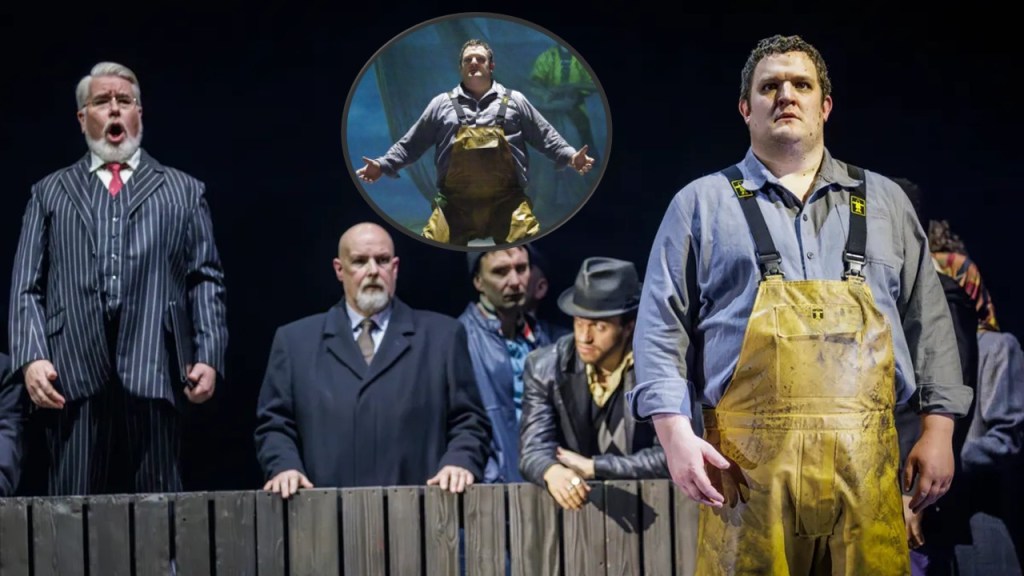
Other kinds of absence are truly those of the outsider created by community scapegoating; perhaps both elements that make both Peter and Ellen what they are – desperate to be anything but alone. Peter longs for communal acceptance and absorption but is always outside of it – as pointed out in the prologue court scene, where Findon makes him non-plussed at his lack of a voice. Inset in the collage below though is also a moment where he defiantly embraces his enforced loneliness and will reinforce it.
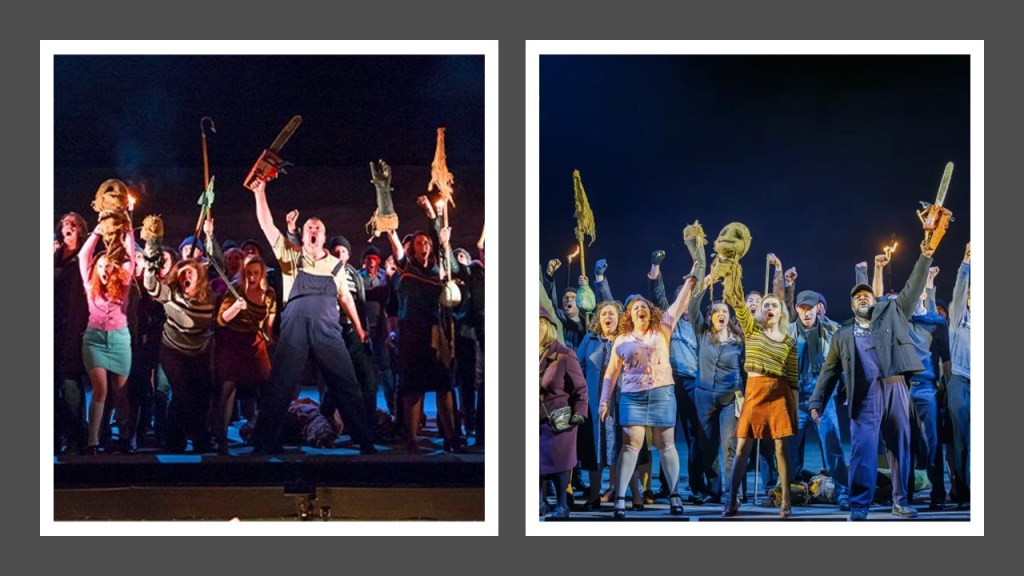
But this is a tragedy in which scapegoating too plays a part and, in this, the management of crowd scenes is spectacular, but especially in relation to functions of weather – the cold and wet driving people behind barriers of differing symbolic opacity and transparency, or into small sub-spaces on the stage, whilst the calm spreads the community out. Congregations occur in reaction to events or supposed events turning into processions of vigilantes or organised riot – the most frightening of which is a riot in which an effigy of Grimes is torn.limb from limb, using crude mechanical hand tools or hands alone – a kind of modern Orphic dismemberment of a visionary loner.
However, as in my last blog – link here again – in which I thought a queer reading of the work too specific, unnecessarily too focused on only one way of being ‘outside’ a defined community, and too vulnerable to be a means of blaming the victim for their emphasis on their sexuality. For the point of Peter is that he is culpable as I have tried to show and as the tenor singing Peter, John Findon, shows brilliantly in this production.
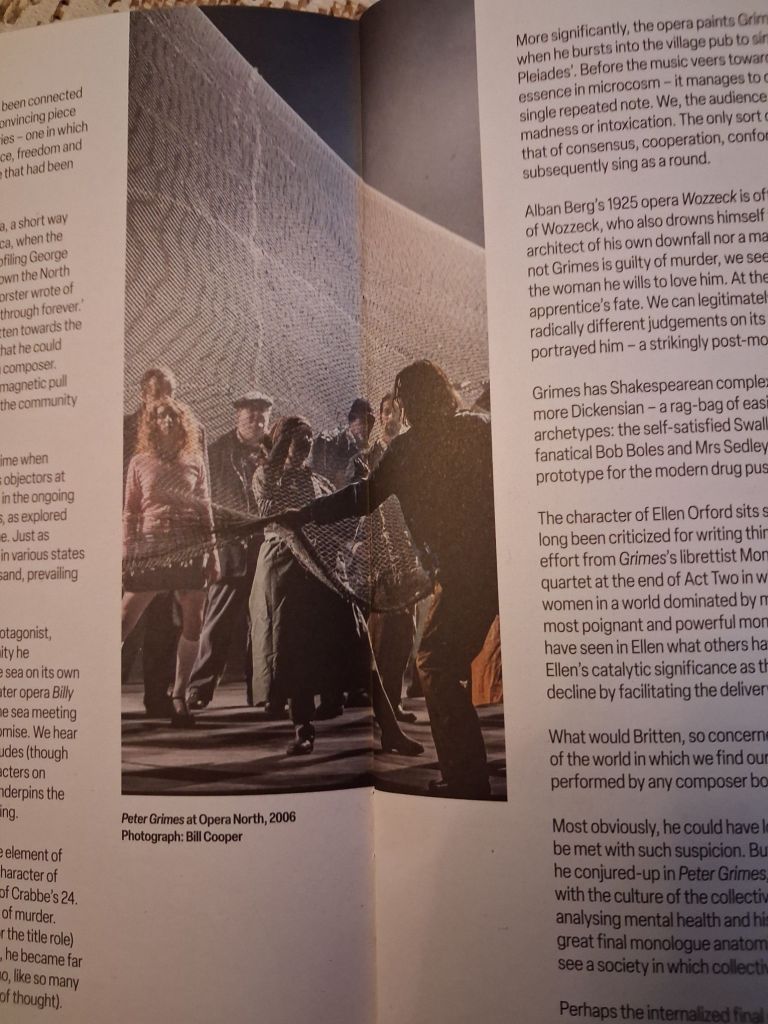
A page opening (20f.) from the Opera North programme with the picture showing the finale where the hanging cone of betting that contains the community is swayed from the outside resembling tne sea.
In an essay in the programme by Andrew Mellor, entitled Peter Grimes: An Opera for the English (see the page fold above) Mellor says something definitive about the debate on the opera and the role of the sea, cited below: [4]
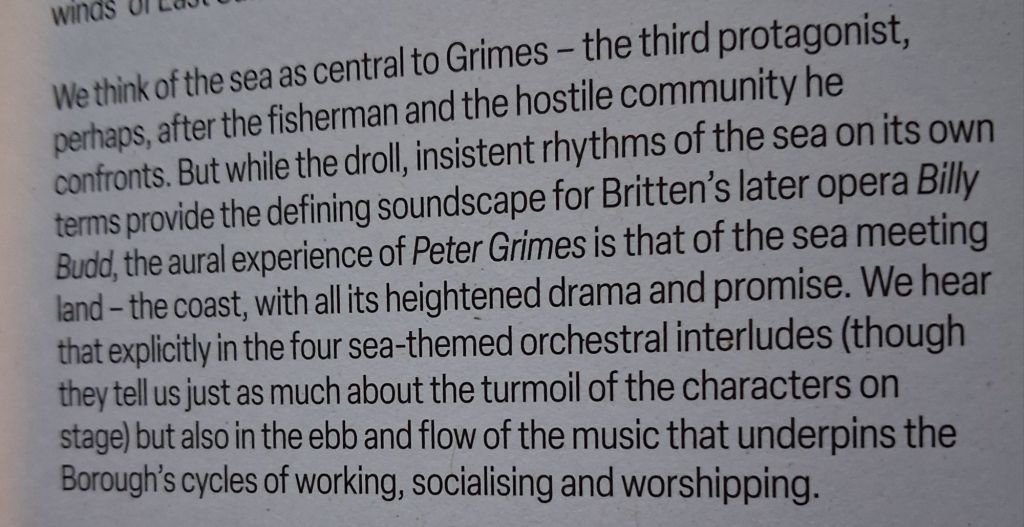
Whilst the opening sentences rather shockingly omit all the female roles in the play, other than as part of the ‘community’, this I think is a very pleasing way of shifting attention from the sea alone to the rasping encounter between sea and land, and the figures which characterise each. It is indeed about ‘cycles of working, socialising and worshipping’, but that misses the fact that it is mainly about the disruption of cycles by storm, whose relationship to these cycles is not necessarily as predictable as desired. And this is because, this passage misses a trick I want to correct – that the piece is about changes in weather too, not exclusively ny more than one can say the sea is an exclusive third character, but enough to show that, as in my title: ‘The meaning of the weather depends on what its changes mean to you, your community, your present and your future‘.
Nevertheless the excuse for this write-up on Grimes is not about the issues of weather hange but my ‘favourite type of weather. How can you favour an instance of such a thing, for each and every condition of weather is bound into our social and circumstantial psychology. Weather is as weather does to us and how we allow it to inhabit us. Bye for now.
With love
Steven xxxxxxxxxx
____________________________________
[1] Garry Walker (2026: 9) ‘To Hear and Sea {sic.]: a personal reflection on Peter Grimes’ Programme for current tour (pictured in opening collage), pages 6 – 9
[2] Both photographic citations are from Philip Brett (1983: 96f.) ‘Breaking the ice for British opera: Peter Grimes on stage’ in Philip Brett (ed.) Benjamin Britten: Peter Grimes: Cambridge Opera Handbooks Cambridge, Cambridge University Press. 88 – 104.
[3] Alexandra Coghlan (2026) ‘A classic revived: Opera North’s Peter Grimes‘ in The Critic’s Circle (online) [Feb 15, 2026] available at https://www.theartsdesk.com/opera/peter-grimes-opera-north-review-jewel-shines-again
[4] Andrew Mellor, entitled Per Grimes: An Opera for the English Programme for current tour (pictured in opening collage), pages 18 – 21
 Steve_Bamlett_blog