


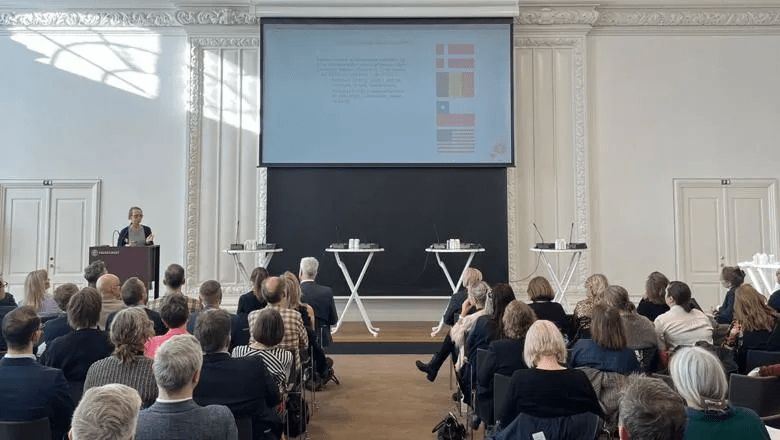
Professor Anne Rasmussen at Kings College London
Professor Anne Rasmussen wrote a blog on the Kings College London website in July 2025 summarising the results of a study by herself with Tobias Heide-Jorgensen and Gregory Eady (University of Copenhagen), using AI generated models of online post types that had qualities deemed to ‘more productive’ of reasoned and better debate, to test whether a certain kind of post type increased qualities of ‘communication’, when they were defined by sharing of evidence-based, respectful’ communication styles, ‘and compromise-seeking counterarguments’.
In their study, researchers used innovative AI large language models to engage participants on political issues that mattered most to them. More than 3,000 people in the UK and US were asked to write a social media post on their favoured issued before being shown a counterargument generated by AI that varied in tone, justification type, political affiliation, and willingness to compromise.
It found that maintaining a respectful tone and showing a willingness to compromise can double the likelihood of receiving a high-quality response – defined as providing a reasoned justification while avoiding toxic language or partisan political attacks.
I have to say that I find the argument rather circular – that post that employ ‘evidence-based, respectful’ communication styles, ‘and compromise-seeking counterarguments’ tend to promote answers in like style. It is one of those conclusions that tend to make people tire of the rsults of complex experimental designs in the social sciences that produce something rather obvious to anyone with or without such ‘evidence’. Rasmussen’s development of her conclusions could be examined in that light. She says:
“We show how using large language models allows us to systematically test and demonstrate that evidence-based justifications, respectful tone, and signals of willingness to compromise produce exceptionally large improvements in the quality of online political discussion.
“Our findings also reveal important spillover effects: suggesting compromise reduces incivility, while providing justifications increases the likelihood of suggesting a compromise, illustrating how different elements of dialogue shape one another.”
In a social scientist the use of the (at least) double meaning of the word ‘quality’ in everyday discourse rings bells for me. The Oxford Learners Dictionary gives several meanings of the term as a noun, but these can be reduced to two clusters of meaning that an AI bot writes thus:
qual·ity [ˈkwɒlɪti], noun
- the standard of something as measured against other things of a similar kind; the degree of excellence of something:“an improvement in product quality””these colleges provide a better quality of education”Similar:
- a distinctive attribute or characteristic possessed by someone or something:“he shows strong leadership qualities””the plant’s aphrodisiac qualities”.
What Rasmussen means when she use ‘quality’ in her phrase ‘the quality of online political discussion’, she references a standard that can be ‘improved’ in some way along some kind of numerical scale from lower to higher quality. Yet you assess such standards by ‘qualities’ (in the sense of variable attributes of online discourse’) that are and can only be assessed qualitatively not quantitatively, usin appropriate types of data, methods,and focus (as illustrated in the useful tool below:
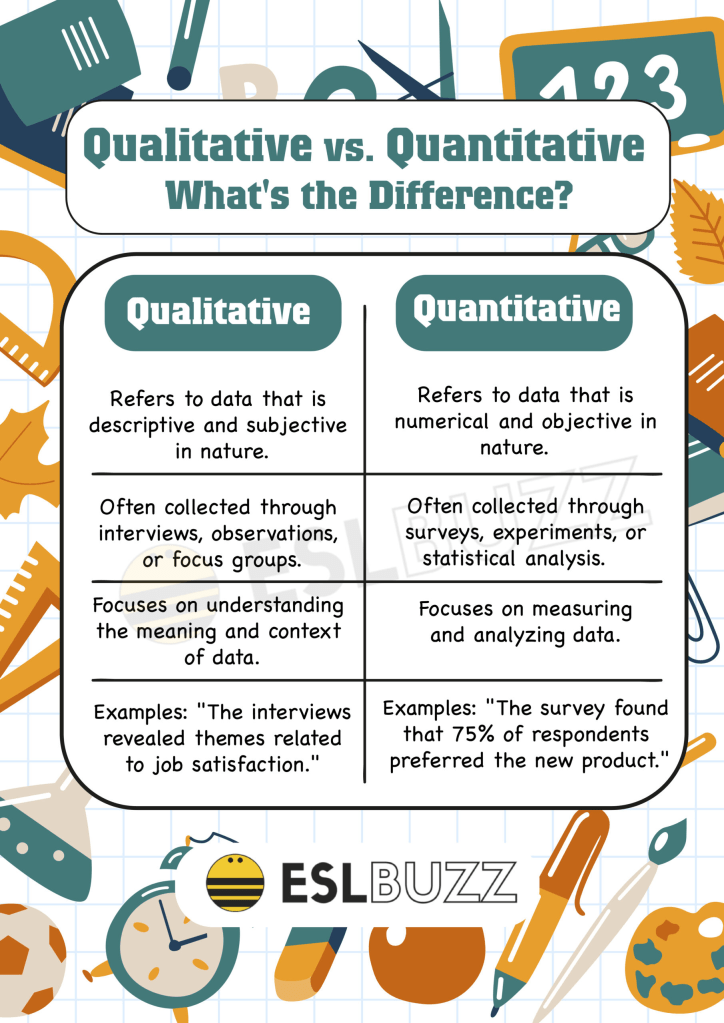
Source: https://eslbuzz.com/qualitative-vs-quantitative/
To me Rasmussen is at least confusing, at the most a rather biased, proponent of a certain kind of discourse validated by authority, and rooted in notions of ‘compromise’ rather than truth values, about which I feel rather queasy. Let’s take a proposition that might require to be advanced by compromise. It is taken from Peter Oborne’s brilliant book, Complicit (see my blog on it at this link). Oborne cites the novelist Dan Jacobson, who wrote thus in The Observer (6th October 2024) of the ‘ hurt, anger and the fear that Jewish people’ feel when ‘night after night our televisions have told the story of a war in Gaza through the death of Palestinian children’. He goes on to locate these stories in the medieval ‘blood libels’ (lies intended to make all Jews seem to be child-murderers and hence worthy of hate) : [1]
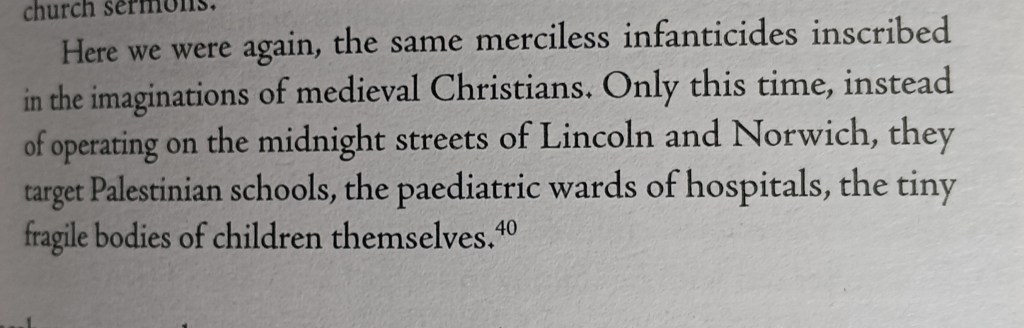
Dan Jacobson cited Peter Oborne (2025: 209.) Complicit: Britain’s Role in the Destruction of Gaza New York & London, OR Books
Now, this argument is utilised to persuade us that it was wrong of anyone in the media to report attacks on ‘Palestinian schools; and ‘paediatric wards of hospitals’ night after night even when there was clear evidence that such events were happening day after day that proceeded those night after nights. Yet it is a logical fallacy that because medieval Christians, or those with power and interest in defaming Jews in general (consider Ferdinand and Isabella of Spain who had direct political interest stated in war aims in fostering the myth of such infanticides) did this, the BBC and Channel 4 were in direct collusion with this persistent ideology. Oborne provides plentiful evidence and reasoned argument against the assumptions in Jacobson’s article (showing that reports under-estimated such attacks and numbers killed, whilst still promoting a myth of infanticides related to the Hamas October attack, which claimed totally incorrectly that Jewish babies were baked alive in ovens).
Jacobson’s point that the deaths were merely aspects of the collateral ‘savagery of war’ are also dismantled. For instance he instances the non-reported ‘Where’s Daddy’ attacks on known Hamas members, in which the IDF ‘tracked and targeted individuals but waited, using AI technology thus instructed, to carry out bombings until they got home’ (hence the horror in the naming of the operation). In another example, the BBC used the usual suppression of IDF agency in its headline ‘Hind Rajab, 6, Found Dead in Gaza after Phone Calls for Help’ by using passive tenses. In fact, the BBC knew the IDF had killed Hind’s family by firing on their family car. Hind had contact the Red Crescent society for help. Both she and the Red Crescent operatives were murdered by the IDF, although the corpses were only discovered 2 weeks later. [2]
I hesitate to look for compromise between Jacobson and people aware of the facts of genocide, even though I admit that dealing with the evidence by avoiding toxic language is best avoided. Genocide though in this case is not toxic language and no longer in dispute, as Trump allies set out the renewal of Gaza as a resort for the rich, pleading for the further diaspora of the current Palestinian population. Quality of debate cannot be gauged by the existence of two or more opinions but the dialectical process through use, using evidence, we seek he truth. Does Rasmussen’s research really help us to do that? I try to communicate online with that in mind – that sometimes we need to be aware of the obfuscations of equating bias with evidenced fact cogently argued. I will go to Peter Oborne for that.
[1] Cited Peter Oborne (2025: 209.) Complicit: Britain’s Role in the Destruction of Gaza New York & London, OR Books
[2] ibid: 211 and footnote ibid: 327
 Steve_Bamlett_blog