



The 1990s were a problematic period of our history, in which technocratic governance began to see the best one could hope for in an expression of group goals: The Blair ‘New Labour’ government’s lauding of the ‘principle’ (for such they thought it was being bereft of any other which they labelled usually as ‘Old Labour’ ) of ‘Best Value’ became the order of the day – conceived as an amalgam of concern for monetary value in the provision of public services tinged by the value system which assessed what ‘best’ met human need – a system not entirely governed by monetary value was the aim, akin to the values of globalism that assumed the coexistence of global human rights. It was always an illusion. People power would be exercised by consumer choice. The political paradigm we now correctly label Blatcherism, because of the vast acknowledged debt of New Labour to Thatcherism, the name given to the programme of privatisation aimed at the reduction of the role of the state in public provision or working alongside such provision. The aim was to adopt the supposed values of business models and business studies to the administration of enterprises public and private. It is an ideology that allowed for some relative prosperity during the up-cycled of global capitalism of the period, but is one bereft of value in the sad resurrection of those relatively unprincipled values in public life by the labour Government of today, that has few ruling principles that were not those of the Blair Foundation.

One of the flagships of the ideology was the business plan, headed by a ‘mission statement’, and this model was thrust not only on private businesses through its own sponsored business education institutions but by the Blair government wherever it had influence or control – most significantly in the NHS and social-care organisation, although control of the latter (financed by local government) was lesser – but in all cases control was exercised only through law and statutory guidance – the latter not having the teeth of the law that created duties for councils as well as giving new powers to more more forward thinking administrations. Alongside privatisation in these areas at many levels (the most destructive being the Public Finance Initiative (PFI) that created huge future debt for public services to ‘private’ sources and the money markets.
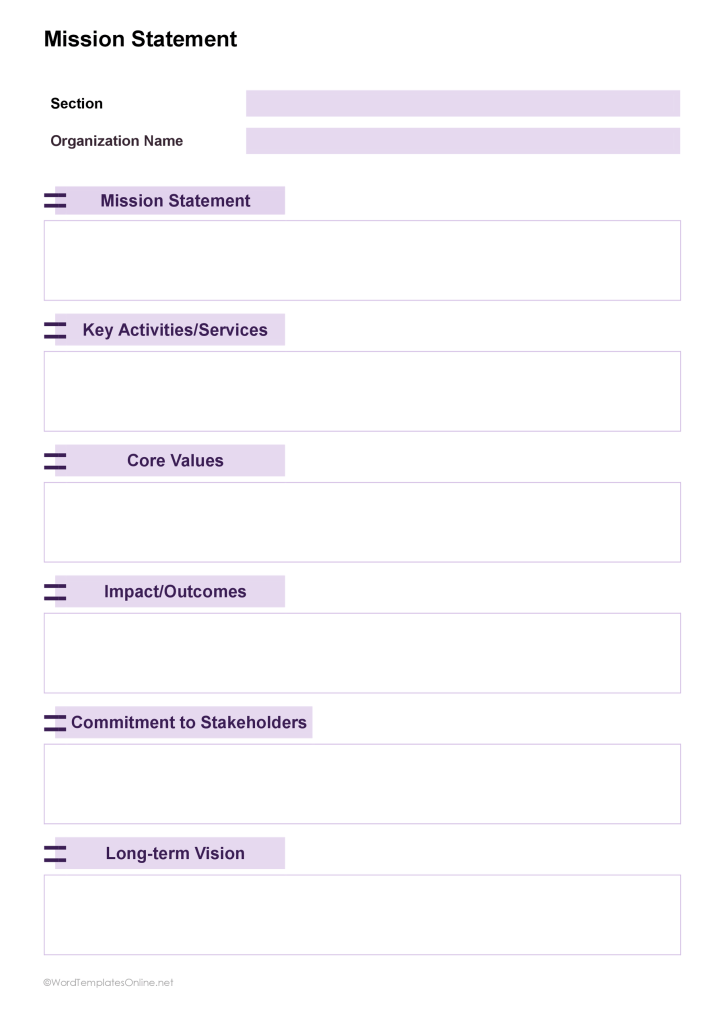
Mission statements became necessary to the business plans of not-for-profit and charitable organisations in health and social care, and other areas, and usually were sold as the part of a business plan were values led (rather than profit-led) institutions showed their difference from those private companies, who, whatrever they may say about their values, used them in real terms to commoditise values as an ehancement to sales. Here is one of the better templates business schools offered for ‘mission statements’; better because it is easier to see that the language of values is demanded in response to items like: ‘Core Values’, Commitment to Stakeholders – note not only ‘shareholders’ (shareholding investors) but people who have a stake in other ways like consumers and staff, and, of course ‘Vision’.
The term ‘mission statement’ of course takes its background meaning from the use of the word ‘mission’ from the period of global imperialist expansion, led by Portugal, Spain and the Netherlands (under the Hapsburg and thereafter) in the sixteenth and seventeenth century but matched by attempts to follow by the United Kingdom. The Catholic Imperialist countries made much of religiious values in justifying what was nevertheless a thoroughly mercantile system of exploitation. We talk of mission and missionaries from this time because a mission is rather different from the work of the Apostles. Nevertheless, the work ‘missionary’ ought to be similar to the word ‘apostle because both come from words in different languages for being ‘sent off’ in order to do something. Apostle derives from Greek, Mission from Latin (the information from etymonline.com is below).
- Apostle: Old English apostol “messenger,”
- especially the twelve witnesses sent forth by Jesus to preach his Gospel (Luke vi.13), from Late Latin apostolus, from Greek apostolos “messenger, envoy,” literally “person sent forth,” from apostellein “send away, send forth,” from apo “off, away from” (see apo-) + stellein in its secondary sense of “to send” (from suffixed form of PIE root *stel- “to put, stand, put in order,” with derivatives referring to a standing object or place).
- Missionary: 1590s, “a sending abroad” (as an agent),
- originally of Jesuits, from Latin missionem (nominative missio) “act of sending, a dispatching; a release, a setting at liberty; discharge from service, dismissal,” noun of action from past-participle stem of mittere “to release, let go; send, throw,” which de Vaan traces to a PIE *m(e)ith- “to exchange, remove,” also source of Sanskrit methete, mimetha “to become hostile, quarrel,” Gothic in-maidjan “to change;” he writes, “From original ‘exchange’, the meaning developed to ‘give, bestow’ … and ‘let go, send’.”
- Meaning “an organized effort for the spread of religion or for enlightenment of a community” is by 1640s; that of “a missionary post or station” is by 1769. The diplomatic sense of “body of persons sent to a foreign land on commercial or political business” is from 1620s; in American English, sometimes “a foreign legation or embassy, the office of a foreign envoy” (1805).
- General sense of “that for which one is sent or commissioned” is from 1670s;
When I asked the Bing AI to differentiate ‘apostolic’ from ‘missionary’ activity, it came up with a relatively innocent differentiation sourced from this linked webpage with an avowed Christian educational function. It insisted that missions were holistic events of long-term duration that are committed to work with communities in ways not necessarily covered by their task as religious news (gospel) givers and spreaders. But that is too innocent historically. The mission of Jesuits cannot historically be divorced from the aim and mission of Spanish Imperialism – bringing to bear in ‘benighted’ lands a sense of Christian order and ways of doing things (even the term ‘missionary position’ to describe sex in which the man is always on top and ‘bearing down’ in sex comes, it is said, from missionary advice to sexually more adventure indigenous populations in South America). This was not the aim of Paul, you might say or Peter as Apostles.
Let’s not pretend however that the Jesuits only went to the Spanish colonies to subjugate non-Spanish peoples to a culture and values they may not have wanted. Many would believe they came delivering eternal salvation, but it is of the nature of Mission Statements to cover over many activities not consistent with the values stated in them, I believe, and always will, that Missions do, and will always, describe the ideological justification for practices that in reality are not as beneficent as the values describing them sound, or not at least to the recipients of a mission imposed on them. They covered over their unpopularity once with brute military force in historical South America. Now, since for decades capitalism has sought to maintain inequality at the choice of its victims, it attempts to make these recipients believe that they are ‘stakeholders‘ (we are all in this together) in an enterprise that never really took their interests into account, at least where they conflicted with those of the enterprises need for power and profit yielded by the enterprise.

David Cameron was probably very influential in posing the issues that are now the manner of a Labour Government. And this is why we have Reform UK.
I would never set myself a ‘mission’. If I did it would certainly be at the cost of somebody else but me whatever the sacrifices I boasted I made to develop and maintain this mission and its purposes. Missions are blinkered by necessity – for if they weren’t the main aim would never be achieved, because it would change by virtue of hearing, and acting upon, input from those it impacted in terms they articulated and lose its contact with the self-interest that lay behind the mission. In truth this happened – hence the various form of Christianity worldwide that derived from missions, each bearing material from older rituals serving other Gods – but only in a framework that ensured that Church and State remained hegemonic over the will of the many.
The 1990s was never the ‘Age of Choice’ and ‘individual’ power it branded itself. It has yielded as it always would to a new and upcoming age of oppression. And my fear is that the many are buying into that age for they have seen through politicians with mission statements and not democratic principles and values. One of the ironies of the rise of the Reform Party is that it, without any democratic values or principles, will eventually impose its sway using those words (‘democratic principles and values’) without substance, because supposed ‘centrist’ prevarication has been exposed as a belief in the necessity of lying. The New Right just lie, and then lie again later, with different words, that were they were always saying the same thing. That is what we do when we believe in static missions – they have to be vague enough to be interpreted in any way we choose that meets our interest at the time of speaking and sounds plausible and insists on its popularity.

This (Farage) is what we are likely to get from mission politics of our day. Let’s not have a mission. Heh! Let’s restart belief in critical and aspirational education that cuts through missions.
With love
Steven xxxxxxxxx

