The role of expert and intellectual in the politics of social change and trust in the concept of a leadership that achieves the sense of stability conducive to effective change.
The role of expert and intellectual in the politics of social change and trust in the concept of a leadership that achieves the sense of stability conducive to effective change.
As I opined about Elon Musk yesterday, I wondered whether I was oversimplifying the phenomenon he represented – a man keen to assert his origins in the ranks of the ‘ordinary’ , that characteristic of a collective people governed, as it sees itself by common sense values. In such a society, Musk is not only a milti- billionaire but considered because of his accumulated wealth to represent the face of human intelligence, a man of ‘The People’ made good and still bearing, as he and his followers see it, the mark of the ordinary person who merely wants to ‘get on’ in life as an individual and /or guardian of a family, perhaps even a dynasty. The chief exponent but not, nevertheless at all the same as Musk, is Donald Trump.
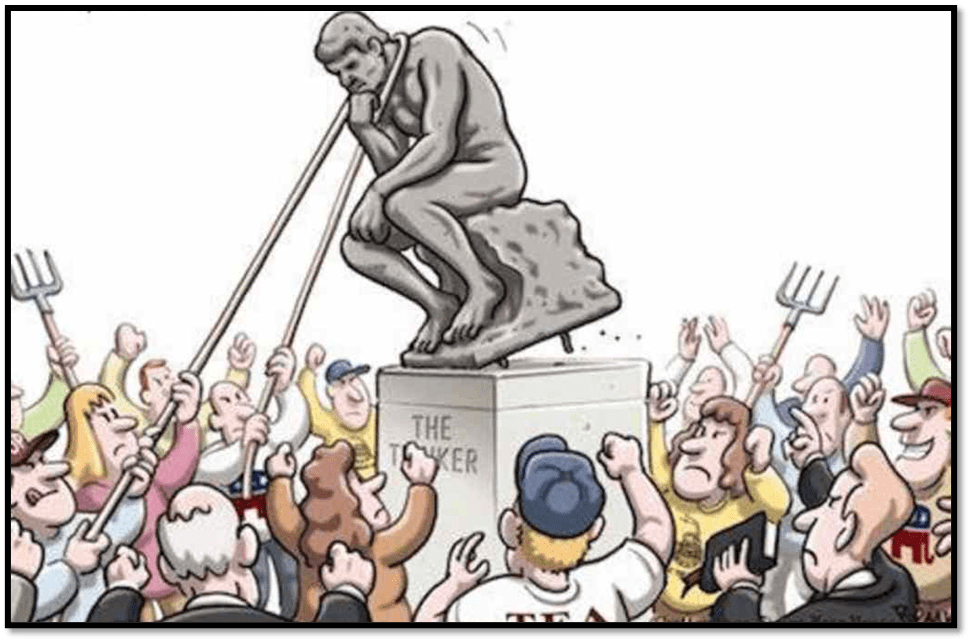
The cartoon representing The Republican Revolt perhaps best encapsulates my theme: the reception of a sense of The People, but as a conservative force feeling misled, and sometimes representing a whole class of past leaders which has already (mis)led the People, against its better judgement had it been asked, by force of possession of elite knowledge, skills and values – sometimes called ‘expertise’. The Thinker toppled represents a failure of thought that has wrongly felt a pull to practical questions which by virtue of its elite status it is unqualified to know about.
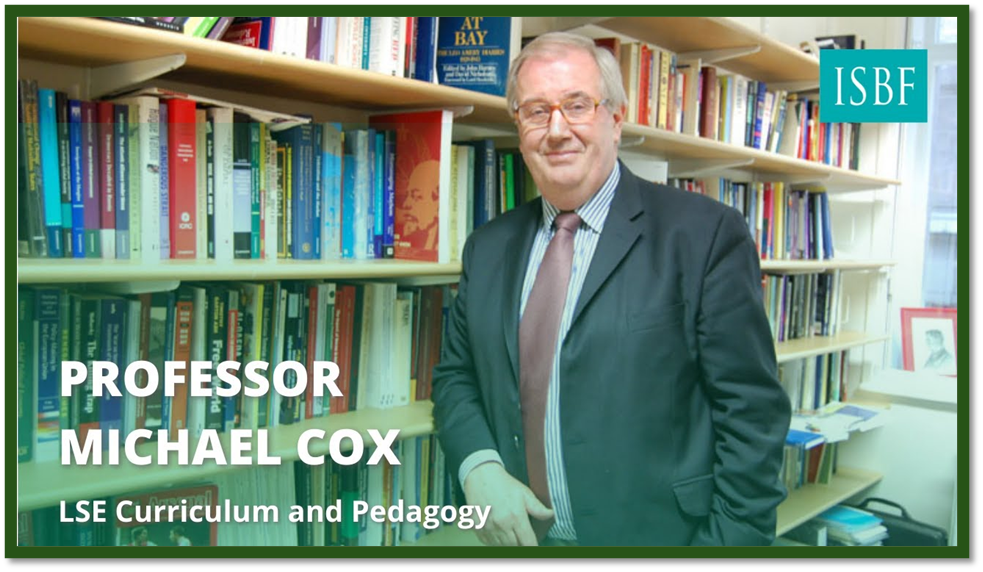
How have we got there? Professor Michael Cox, Founding Director of LSE IDEAS, Emeritus Professor of International Relations (to quote his very full title – the kind of thing that used to validate ‘expertise’, in 2018 offered a full explanation in his LSE Ideas Update referring to a time well before the worst excesses of current rightist populism internationally. However, I want to concentrate on one of the causes that Cox suggests for the rise of right-wing populism which is the sense of powerlessness endemic to developments of modern governance, or apparent non-governance. He expresses it thus under the subtitle ‘Powerlessness‘, as he moves from the causes in the changes of economic systems globally in the twenty-first century:
Powerlessness
But it is more than just about economics. I would argue that populism is very much an expression in the West of a sense of powerlessness: the powerlessness of ordinary citizens when faced with massive changes going on all round them; but the powerlessness too of western leaders and politicians who really do not seem to have an answer to the many challenges facing the West right now. Many ordinary people might feel they have no control and express this by supporting populist movements and parties who promise to restore control to them. But in reality it is the established political parties, the established politicians and the established structures of power as well which are equally powerless. Powerless to stop the flow of migrants from the Middle East and Africa. Powerless to control the borders of their own nation state. Powerless when faced with a terrorist threat. Powerless to prevent off-shoring and tax avoidance. And powerless to reduce unemployment to any significant degree across most of the Eurozone. Now this might have been finessed but for two other factors: one, quite clearly was the 2008 financial crisis. As suggested above, this not only delivered a major blow to western economies, the EU in particular; it also undermined faith in the competence of the establishment from the bankers to the economists at the LSE. Who after 2008 would ever believe the experts again? Or think they might be on your side. The other factor here was a series of major setbacks in the field of foreign policy ranging from Iraq to Libya. These not only did enormous damage to the Middle East but exposed the West and western leaders to the charge of being incompetent and lacking in strategic nous. It was no coincidence of course that one of the themes Trump returned to time and again was the Iraq war – a clear demonstration in his view that the ‘establishment’ simply could not be trusted with America’s security. [1]
We should see in this how pertinent to his own role, the intellectual academic, that fact validated by his job role in the London School of Economics (LSE) in his reference to how ‘the 2008 financial crisis’ had ‘undermined faith in the competence of the establishment from the bankers to the economists at the LSE’. Intellectuals at universities have throughout the time of the existence of the university as a place of enlightenment, let’s say in Europe from the eighteenth century have long been blamed for shouting from the sidelines, ensconced in ‘ivory towers’ like useless decorative items in society. by people who felt themselves to the leaders in practice in society, such as the avant-garde of capitalism in the industrial bourgeoisie – those people brought to life in novels by Dickens (Dombey, Bounderby and Gradgrind for instance) and Elizabeth Gaskell, but their role as having a say in the understanding of the ‘bigger picture’ has not been questioned.
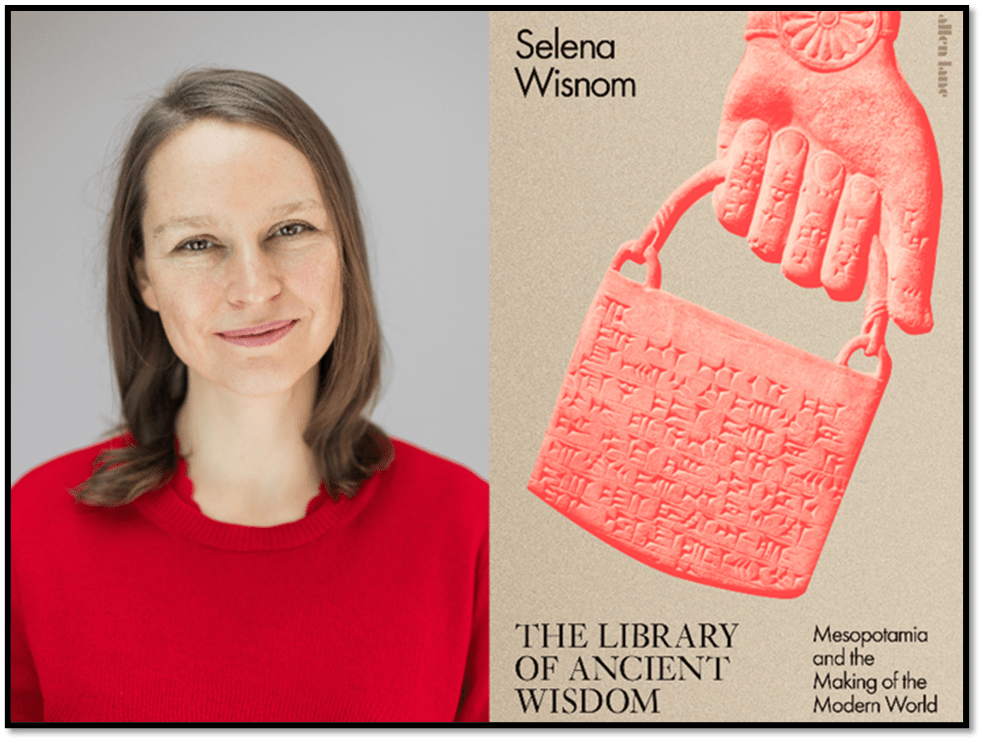
Some readings of the modern academy and the role of universities have blamed the final decline of the university on what they see, and some saw at the time, as the influence of Jacques Derrida and other French intellectual post-modernists, perhaps Michel Foucault being the best known. Here was a theory of knowledge that seemed exclusively complex and unable to give a ‘straight’ account of a world of knowable norms – instead they opened up the world and its concepts as if they were a text. Why over-complicate the world anti-intellectualism suggests when all we need is a working knowledge of how the world works in the simplest and most precise terms – and terms without themselves requiring an expansive vocabulary different from that used by the working world? However, other accounts suggest that this way of knowing the world, as post-modernism shows it must be know (as open to endless re-knowing), is nor peculiar to the twentieth-century onwards. Selena Wisnom in her great book on the intellectual culture of Ancient Mesopotamia finds there a source of world knowledge in the great libraries of the East – down in fact to that in Alexandria – from the time of the novel one created by Ashurbanipal:
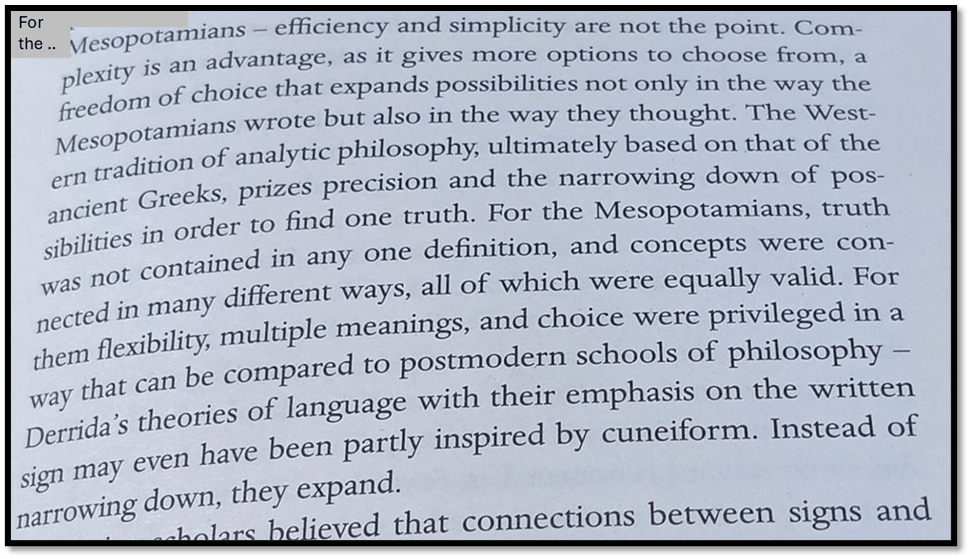
Her account of the library of Ashurbanipal and the role of its intellectuals – at one level ‘scribes’ of ancient text worth preserving, at another advisors both religious, social, and political – argues that the intellect and the complexities it forced to the attention of the powerful, and sifted to the people was just as complex as Derrida’s view of how to reward the world as text:
From Selena Wisnom [2025: 9] ‘The Library of Ancient Wisdom: Mesopotamia and the Making of History’, Penguin Books
In a sense though, we are not dealing with ‘experts’ and the role of intellectuals in governance or advising on governance in Ancient Mesopotamia, though in Hellenic Greece onwards we do see the growth of groupings of intellectual leadership in specific areas – specialised knowledge bases in the law, ecumenical organisation, liturgy and religion and the management of government in a system centred on a court or palace, that could, almost as institutions, be at odds with each and this trend continues and becomes more significant in the Middle Ages and Early Modern period. Of course I speak too generally, but from the nineteenth century I sense that there is a sense in which the role of an intellectual class becomes difficult to place and in crisis. The poet Samuel Taylor Coleridge, thinking about to his early radical politics began to elaborate the notion of the role of an intellectual class that needed funding in the role of standing up against an over-practical and materialist idea of state governance, that wasn’t quite what the role of the Church had been but was clearly based based on its relation to the state from medieval times onwards. Murray J. Evans in 2019 summarises it thus:
Coleridge’s idea of the “clerisy” or National Church in On the Constitution of the Church and State (1829, C&S): a diverse intelligentsia to counterpoise the expediency of the state. The clerisy provides a strong remedy for British socioeconomic ills, …. Coleridge uses illustrations of Ideas working in events that most substantially manifest them. Coleridge’s long illustration of the “nationalty,” the financial reserve to support the clerisy, is an important example.
The Clerisy supported has a role in introducing an almost Platonic idea of the world of Ideas into the World of material fact, that material fact is so aware of that it funds it. This feels very like how Cardinal Newman saw the role of the University, as a place that located ideas – those in particular in relation Catholic faith – at the heart of both the practical subjects and the liberal arts combined.
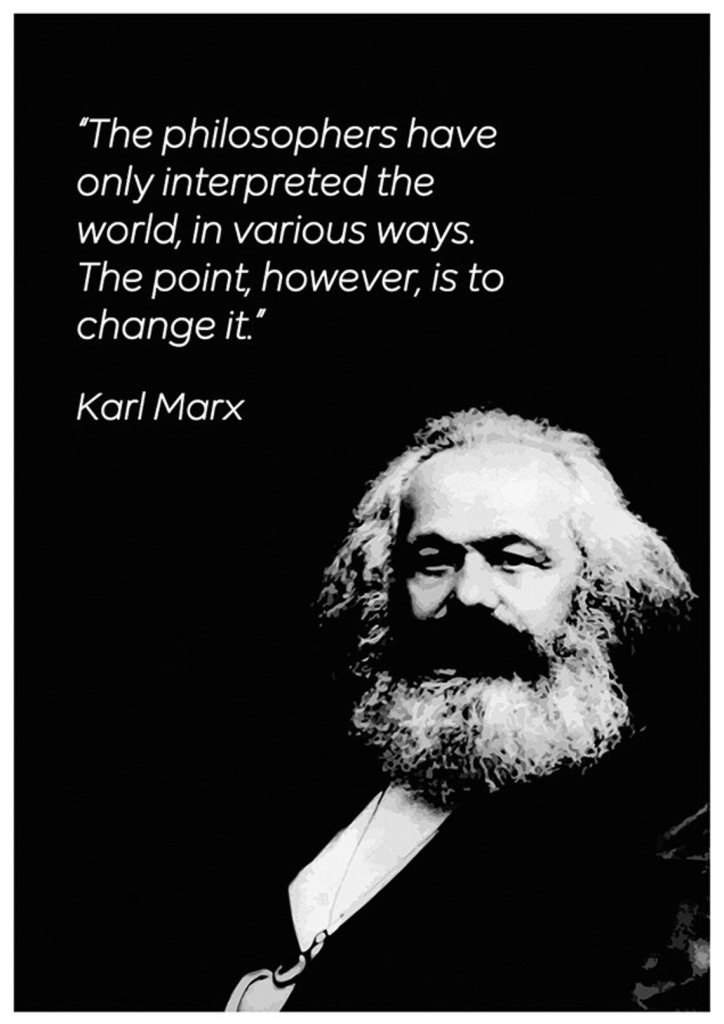
These idea sustained culture from Philistinism, in Mathew Arnold’s more secular version in Culture and Anarchy, which still owes a lot to Newman. But materialist philosophy may have seen some of this as moonshine, as in Marx’s Theses on Feuerbach and the famous statement:
Developed by Lenin, and betrayed by Stalin, this turned into an over-reliance on the Communist Party as the sole source of both practical governance and intellectual influence. The Italian Communist Gramsci however refined all this by seeing a need for the role of the ‘intellettuale’, the Italian word for “intellectual” in social change, arguing that it was ‘intellettuali organici’, the phrase for “organic intellectuals”, that described those who gave social groupings “homogeneity and an awareness of its function”. Such a group happily involved ‘abstract philosophers’ such as Gramsci himself was but engaged with and transform the “common sense” of their social group. The pluralist nature of change in Gramsci’s ‘Philosophy of Praxis’ still meant there was debate between intellectual positions as part of the dialectical process of change and could include a wide social and cultural repertoire of bases, including famously in Italy (‘Red Bologna’ in particular), the Catholic Church. All this is too sketchy but it marks what I feel is the high point from which we descend into Elon Musk’s Anarchy, in which the intellectual has proven themselves merely by having made more money than others and so is considered just because of that the more intelligent.
We are in a sorry mess. I would be delighted to get hopeful contradiction in feedback that found hope in the world. I am still keen to support Zack Polanski and the Green Party, whose ideas seem to me Gramscian but I wonder what might occur in this sorry world hereafter.
 Steve_Bamlett_blog