


Why not ‘Muffin the Mule‘ because ‘we love Muffin …’: TV was so different then: Received Pronunciation and Puppets on Visible Strings
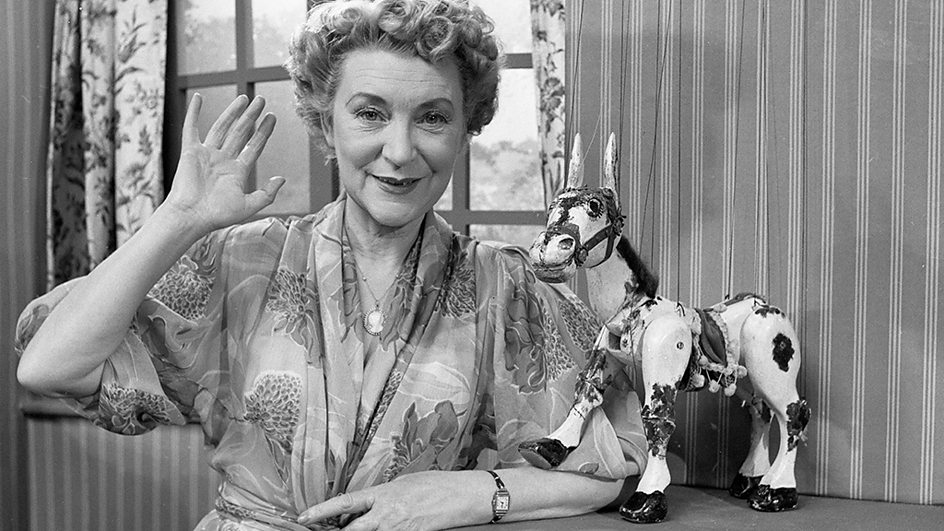
BBC: Annette Mills and Muffin the Mule in For the Children, 1952. Muffin was the first Children’s TV superstar, clopping along to his theme tune ‘Here comes Muffin’! Available: https://www.bbc.co.uk/historyofthebbc/bbc-100/100-faces/muffin-the-mule/
Here comes Muffin, Muffin the mule
Dear old Muffin, playing the fool
Here comes Muffin, everybody sing
Here comes Muffin the mule.
Annette Mills, Muffin the Mule’s unlikely friend and the plummy actor John Mills’ sister, was as archaic as he was – a highly cosmetically manufactured face and the sculpted vowels of classic BBC English – using what was known as Received Pronunciation, a deliberate strategy to model to all children, from wherever they hailed and whatever their accent or dialect, how to ‘speak proper English’. It never became prescribed pronunciation and it failed to grasp the world of phonetics as thoroughly then as did standard forms of grammatical rules – born of the need to make English the equivalent of the Latin of classically educated English gentlemen (as a language with a prescribed grammar and spelling) and was the standard implied in ‘grammar schools’ in the class-based structure of education. Even the latter was an illusion fostered by elites but RP sought to pretend that the English of the South of England middle classes was and must be that of an entire nation – to include even Scotland, Wales and Northern Ireland. It was hard enough in the North of England where grammar and pronunciation were often at variance to that received. It was a great boon to discover that the English Shakespeare and his actors spoke was more likely to be like a mix of what we think of as ‘regional’ accents, perhaps with a bias to the West Country, though some profound thinker (Barry Rutter) in a Northern Broadsides’ Theatre of King Lear I saw in Scarborough claims it was as near to Yorkshire dialect (and Goneril did it justice) Northern than Southern English
Here is the BBC on the matter of ‘original pronunciation’ saying this about how the plays of Shakespeare were believed to be spoken:
… we can come close to this thanks to “original pronunciation” which is a system of speech that replicates how the Elizabethans are believed to have spoken. Today it sounds like a West Country accent, with echoes of other parts of the country. When we apply this to Shakespeare’s dialogue, rhymes and puns that are not heard in modern English are suddenly revealed.
Further evidence of “original pronunciation” comes from contemporary writers such as Ben Jonson, who recorded pronunciations at the time. This is how we know that the Elizabethans pronounced “r” after vowels.
So through Shakespeare’s plays we can find out a great deal about how people really spoke. His dialogue was on the whole representative of the language of the time and area and now provides us with invaluable insight into a lost language.
Muffin’s biography is a relatively short post-war period, as here:
Partnered by Annette Mills (sister of actor John Mills) Muffin The Mule started life on 30 October 1946 on For The Children and was really the first television character in Britain to capture the hearts of children.
Muffin – a marionette puppet – used to clank around energetically on a piano top while Annette played the music.
He was worked by Ann Hogarth (she bought him for 15s 0d from a travelling showman and was rescued from the anonymity of a workshop shelf by Annette Mills), who stood on the piano behind a partition screen.
…
Muffin bowed out on 2 January 1955, and the following week, on 10 January, Annette Mills died at the age of 61 after an operation. [1]
I have only just discovered about Mills death (which happened when I was 4 months of age) and a sort of sadness creeps over me even now. But note I was not born until 1954 so you can see that most of what I was fed on TV was a diet from post-war austerity, that by the 1960s was decidedly ‘old hat’, as potentially too nearing a living death. There was a major fracture between the world created by Annette Mills and that shown on the news as the world of ‘swinging Britain’ with increasingly relaxed view of the representation of regional and class diversity on TV.
In the 2020s, Received Pronunciation, which even in primary school I knew to be called RP, is another lost language. Muffin, having a rather ‘workerist’ (Muffin sounds like a working class character from Dickens, and ‘mules’ were the classic symbol of the oppressed animal – even more so than donkeys) tradition behind him never spoke in the series being narrated by the plummy vowels of Annette Mills.He just ‘clanked around’ as work horses do!
The remnants of RP can be found in people like David and Richard Attenborough, Gyles Brandreth and Stephen Fry according to Wikipedia – but in each case issues of class now predominate in the reception of those voices not issues of a model of ‘how I should speak’ or ‘as ONE should speak’ it would be more likely to be said in RP. There is something rather comic in hearing RP, and even then Nicholas Parsons used to play the role of the unworldly man who lacked common sense together with the vowels of the ‘common’ – those lacking class privilege. Brandreth and Fry use their accent often used to play the upper class buffoon, lacking applied everyday intelligence in practical situations in the period after a TV dominated by RP.
Children’s TV brought me to RP in Annette Mills, and though she patronised him, I think most working class children rather identified with Muffin’s cautious resistance to her dominance over him (and I certainly gave up being impressed by teachers who pushed RP – and there were some even in the West Riding of Yorkshire, preferring the ‘common’ twang of the woolen mills spoken by my grandmother Elsie with her salacious stories, There was Muffin kicking back with his hind legs and doing funny things that had their own value of rebellion however much Mills tried to soften them into playfulness. We knew he had strings but we hoped that the will of Muffin ‘playing the fool’ spoke through his handler, Anne Hogarth, not the unctuousness of Annette primly at her ‘piano’ and calling him ‘dear old Muffin’, at which we know he winced. But had Hogarth spoke there is no doubt she would be the twin of Mills.
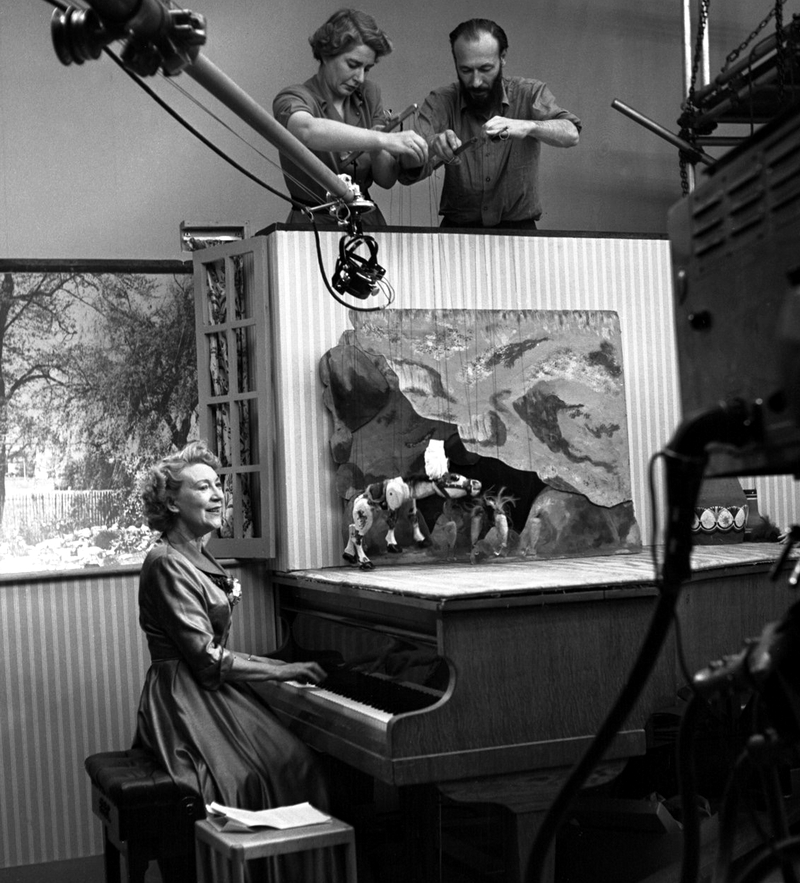
From: https://nostalgiacentral.com/television/tv-by-decade/tv-shows-1950s/muffin-mule/
And when Muffin kissed Anne Mills, i’m sure he winced at the smell of face powder, as children oft did:

With love
Steven xxxxxxxxxxxx
[1] https://nostalgiacentral.com/television/tv-by-decade/tv-shows-1950s/muffin-mule/
 Steve_Bamlett_blog
Annette also created Prudence and Primrose cats, who I prefered to Muiffin
LikeLike
I had read that Sam but never saw it. The idea of a kitten called Prudence chills me – but I never saw that cool cat. x
LikeLike