


Is patience is the name given by Stoics and Christians to ‘the time we waste in waiting and longing for change’ so that it seems to be of the greatest value of all things? “It’s very dree work, waiting,” says ‘Old Alice’ in Elizabeth Gaskell’s Mary Barton of waiting for news of her lost sailor son. Or, in the context T.S. Eliot preferred from Wagner: ‘Oed’ und leer das Meer’ {‘Empty and desolate the sea}.
PS: I had already started this blog before the point of no return before I noticed I have already responded to this prompt but in a different way. That blog can be accessed at this link.

Patience, engraving by Hans Sebald Beham, 1540
Did Hans Sebald Beham see his allegoric drawing Pacientia as something that, had they been a person rather than a hermaphrodite representative of a virtue, would have been as a person rather a drag to be with. Sitting cross-legged cuddling a pet-lamb, however much you insist that this isn’t only a lamb but the sacrificial Agnus Dei, might seem a terrible ‘waste of time’ to many. Pacientia must have thought so for they deliberately look down to, and inward into, symbols. The attitude is emphasised in the first part of Wikipedia’s definition of the term in this context and dramatised in The Old Testament in the story of the Patience of Job.
Patience, or forbearance, is the ability to endure difficult or undesired long-term circumstances. Patience involves perseverance or tolerance in the face of delay, provocation, or stress without responding negatively, such as reacting with disrespect or anger. Patience is also used to refer to the character trait of being disciplined and steadfast. Antonyms of patience include impatience, hastiness, and impetuousness.
The rest of us, impatient to get on with things, are represented by the rather devilish compound hernaphroditic animal by Pacientia’s side but being ignored by them. Perhaps Patientia thinks: ‘Never mind them, always in a rush, always on the go – even their clod-hopping feet are nearly there in the next place they have to go towards, rather than resting’.
Of course, to the Northern Renaissance artists, as to their medieval forebears, patience was a Christian virtue and betokened willingness to wait on the will of God rather than to seize self-centred opportunities for gain and/or pleasure. It is the same thing that King Lear realises he needs if he is not to go mad, when his daughters argue that they know better than he how an old and redundant king should spend his time and energy.
Older people – or those forced into any kind of temporary redundancy to present needs (consider the line in Othello: ‘Othello’s occupation’s gone!’) – get used to be thought to be time-wasters: too slow, too indulgent, too much given to relaxing into the time they know they have. No wonder then that many a daughter (or son) will act towards their ageing relatives as Goneril and Regan do, without intending harm or upset. But men in particular hate being ‘reduced’ to the state that is (in their patriarchally and hierarchically ordered minds) comparable to that of a child – or worse: a woman!
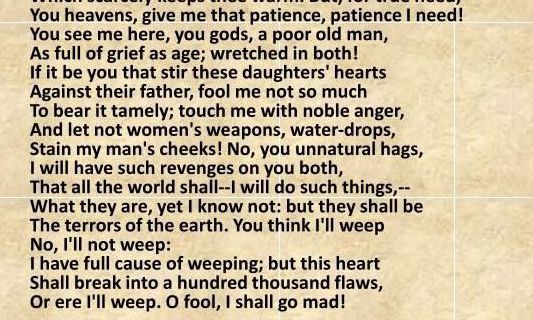
Like Lear, men thus challenged invent ‘terrors of the earth’ that reflect the power that they think is being taken from them – for a contemporary mime production that emphasised this in King Lear see the blog at this link. Every act, gesture or stutter in their speech speaks of power apparently lost, or inverted from its ‘natural’ order.
The point is they might ask for Christian patience but, in fact, fear that they are fragmented, besmirched, and stained. And that may be because in Jacobean England, the idea of wasted time was already undergoing revision in the social order. Impatience was no longer an insult to God as much as seen as a drain of commercial or mercantile efficiency and economy, and a stain on the man (and sometimes woman) accused of failing to match up the ideology of work. Lear, a man used to being an iconic symbol for a job-role, can’t quite get his head around the fact that young people now determine what his needs should be and they can’t be assumed, unless he work to justify them being met by acting ‘tame’ (the role that justifies any pet being kept rather than abandoned).
For Lear, the issue hangs around the failure of his role as KING and FATHER being considered enough to justify his leisure, luxury and excess – without need to prove his worth. Even in the sixteenth and seventeenth-century however, the notion of self-value as thing one had to work to achieve, whatever your class, was already becoming established – if in its infancy in plays like Shakespeare’s The Merchant of Venice. Women have, though, this experience and continued to have Lear’s misogynistic objections to them used to reduce their worth in their own eyes and that of society. Women had no right to ‘noble anger’, and their tears were seen as inadequate forms of power-grabbing – weapons that ought not to work.
This is because women were seen as symbolic of ‘wasted time’, of non-working domestic idleness. It is an ideology brought back into political discourse by recent Tory, and now even more harmfully by a Labour Government, that the value of people as individuals was in the fact they worked: Labour governments now talk about ‘working families’ to avoid speaking of the dynamics of economic power that created a ‘working class’ many as subordinate to the few who owned and controlled resources.
Strangely this idea can be seen in that great novel of 1848 – the year of European Revolutions – Elizabeth Gaskell’s Mary Barton. In this novel women and children have value in the eyes of the few, represented by the Manchester entrepreneur, Carson, because they work. And yet some are too old and weak to work and they must wait to be provided for – usually by men, who must also be convinced of their superior worth by those women by a show of ‘patience’ in the latter.
In chapter 12 of the novel, an old working class character, Alice, is both destitute and sorrowful – the reason being that, having lost her husband and now too old to work and with no children available to work in the factories for her, she faces uncertainty in knowing that she might have lost her adult son – a sailor now involved in European wars. This section of the chapter is beautiful. Mary Barton and Mrs Wilson are attending on a family who are sick and ‘clemming’ (a dialect word for ‘starving hungry’). But these tender female hearts have compassion for Alice’s singular plight as a mother:
“No letters?” said Mrs. Wilson.
“No, none! I must just wait another day to hear fra’ my lad. It’s very dree work, waiting,” said Alice.
Margaret’s words came into Mary’s mind. Every one has their time and kind of waiting.
“If I but knew he were safe, and not drowned!” spoke Alice. “If I but knew he WERE drowned, I would ask grace to say, Thy will be done. It’s the waiting.”
“It’s hard work to be patient to all of us,” said Mary; “I know I find it so, but I did not know one so good as you did, Alice; I shall not think so badly of myself for being a bit impatient, now I’ve heard you say you find it difficult.”
The idea of reproach to Alice was the last in Mary’s mind; and Alice knew it was. Nevertheless, she said–
“Then, my dear, I beg your pardon, and God’s pardon, too, if I’ve weakened your faith, by showing you how feeble mine was. Half our life’s spent in waiting, and it ill becomes one like me, wi’ so many mercies, to grumble. I’ll try and put a bridle o’er my tongue, and my thoughts too.” She spoke in a humble and gentle voice, like one asking forgiveness.
“Come, Alice,” interposed Mrs. Wilson, “don’t fret yoursel for e’er a trifle wrong said here or there. See! I’ve put th’ kettle on, and you and Mary shall ha’ a dish o’ tea in no time.”
So she bustled about, and brought out a comfortable-looking substantial loaf, and set Mary to cut bread and butter, while she rattled out the tea-cups–always a cheerful sound. (* my emphases)
This is rich isn’t it. Mary invokes ‘patience’ as a Christian category in sympathy and agreement with the view that all human beings must learn to ‘wait’. However, she (and Gaskell) know this is only half the story because the ‘work’ of ‘waiting’ is peculiarly in this novel – and reflective of nineteenth-century society – the work of women. That wonen ‘wait’ is the rationale of believing women expert only in the passive arts.
Women are claimed by patriarchal ideology to be by nature passive characters, for whom ‘waiting patiently’ is easier than for the men of the novel – whether industrialists or workers/trade unionists. The passage rounds off with women engaged in that work characterised as the acme of patient acceptance – going into the kitchen space and making a ‘dish o’ tea in no time’. Women’s work, you see, must always be presented if it was not like the labour that men do nor take precious time. It is a way of passing time without presenting that time as ‘wasted’.
When men feel locked in wasted time they present it more dramatically – perhaps even melodramatically (or for the elite, in the manner of a Wagner opera). When T. S. Eliot wrote The Waste Land in 1922, the wasted landscape was not only a Paysage Moralisé (a ‘Moral Landscape’ so popular in French art and also poeticised later by W.H. Auden) but a time-space that was as much about our attitudes to the passage of time as of the waste of land-space that the poem was often read to be about – with its imagery of battle-scarred land and waste piles of things, words and images.
What are the roots that clutch, what branches grow
Out of this stony rubbish? Son of man,
You cannot say, or guess, for you know only
A heap of broken images, where the sun beats,
And the dead tree gives no shelter, the cricket no relief,
And the dry stone no sound of water. Only
There is shadow under this red rock,
(Come in under the shadow of this red rock),
And I will show you something different from either
Your shadow at morning striding behind you
Or your shadow at evening rising to meet you;
I will show you fear in a handful of dust.
                      Frisch weht der Wind
                      Der Heimat zu
                      Mein Irisch Kind,
                      Wo weilest du?
‘You gave me hyacinths first a year ago;
‘They called me the hyacinth girl.’
—Yet when we came back, late, from the Hyacinth garden,
Your arms full, and your hair wet, I could not
Speak, and my eyes failed, I was neither
Living nor dead, and I knew nothing,
Looking into the heart of light, the silence.
Oed’ und leer das Meer.
Land laid waste is dry AND cluttered, sterile, unsupportive of life and death-laden. No wonder people saw this as a poem about the depredation of the world by capitalism, imperialism and the death of religion, such that the phrase ‘dust to dust’ from the Common Prayer Book funeral service rings through it, with ‘fear’ not ‘hope’ in the ‘Son of Man’ (one of the names of the Christian Redeemer).
However, the context that exercised people when I was a young thing was the use of two German quotations in this passage from Richard Wagner’s Tristan und Isolde. Both quotations refer to the Breton king Mark waiting for his princess from Ireland (Mein Irisch Kind) being borne by ship under the guard of the knight, Sir Tristan. Mark is to be disappointed – Tristan and Isolde fall into a love so deep they prefer mutual suicide to parting. The context is that in which a man is forced to ‘wait’, a ‘wasted’ man, and finding it like Alice ‘dree work’. Eliot fuelled speculation that his poem was about the wasted landscape of hopeless waiting (of which the sea seems to a symbol in the term ‘Oed’ und leer das Meer {bleak and empty the sea}) of a love match. Eliot is forced to waste time in fruitless waiting, like a woman. He said:

If the ‘relief of a personal and wholly insignificant grouse’ why not one that recorded a past passion wasted. When I was studying the poem, taught by Stephen Spender at University College London, the latter poet spoke of the fact that many interpreted the lines about the ‘hyacinth’ lovers (Hyacinth of course was the doomed dead lover of Apollo, for whom the latter pined) as a reference to Eliot’s coded disclosure of his love for his friend Jean Jules Verdenal, killed at war leaving Eliot devastated. That empty waste that the sea is imagined to be is also a land of ‘Memory’ and ‘Desire’. This queer reading has been rubbished in the latest biography of Eliot by Robert Crawford, though I find the reasoning flawed by the wishful thinking of the typical heteronormative male. But for a while, entertain the view that what later he called ‘rhythmical grumbling’ is in fact coded deep frustration at waste represented by lost time in which all one can do is wait without without hope. That through loss, and patience in accepting it, we find salvation is a Christian message, but surely the poem really shows us that men who wait must find it difficult not to see themselves as men who are wasted.
Unreal City
Under the brown fog of a winter noon
Mr. Eugenides, the Smyrna merchant
Unshaven, with a pocket full of currants
C.i.f. London: documents at sight,
Asked me in demotic French
To luncheon at the Cannon Street Hotel
Followed by a weekend at the Metropole.
The Metropole, Spender used to say, was notorious place for rich entrepreneurs to take the young men they picked up in London for an short-lived affair, a weekend perhaps. Mr Eugenides is probably the most vile of created images in the poem, together with ‘rat’s alley’ where ‘dead men find their bones’, of homophobic disgust. But none of this , even if there, is on the surface of the poem. What is there are images of waiting, waiting, waiting …. with no hope.
A woman drew her long black hair out tight
And fiddled whisper music on those strings
And bats with baby faces in the violet light
Whistled, and beat their wings
And crawled head downward down a blackened wall
And upside down in air were towers
Tolling reminiscent bells, that kept the hours
And voices singing out of empty cisterns and exhausted wells.
What ‘kept the hours’ here from fruition but the fact that the voices we hear sing out of ’empty cisterns and exhausted wells’ – dry containers that once did the work of holding for distribution, and then distributing, life-sustaining water (the stuff of love). I always wish I could hate Eliot for his self-imposed conversion therapy, but I can’t – his poetry is too beautiful – but I can dislike the ‘hollow men’ who create such poetry (converted to dead religions like Eliot was) with nothing of value to justify their homophobic grasp of public heteronormativity.
All my love
Steven xxxxxxxxxxxxxxxx
_____________________________________________
(*) Elizabeth Cleghorn Gaskell Mary Barton Chapter XII, ‘Old Alice’s Bairn’ For full text see: https://www.fulltextarchive.com/book/Mary-Barton/
 Steve_Bamlett_blog