


The one thing I cannot live without is theatre – however raw its raw materials. Uncluttering the classic stage: ‘Lear’, a production of The National Theatre of Scotland at the Traverse Theatre seen 2.30-3.30 p.m. Saturday 7th June 2025.
Bcck in the old days at Honley Grammar School, my friend Ann will remember that we sat earnestly in talk about the theatre, inspired by a favourite teacher, Geoff Mountfield, whom Anne recently told me had died. There was sadness in the news. It was he that led me to read Peter Brook’s The Empty Space, and it was this book to led me further and further into that feeling that the stage ideally is aa a ‘poor splace’ rather than a place enriched by.vulgar superfluous. Did not Geoff invoke that as we studied King Lear for A level as he unpacked meaning from Lear’s speech to Goneril despising the richness of her apparel and the absence of genuine emition such shows covered up,thus defining for ever the existential ‘bad actor’, they of mauvaise foi.[1]
... Thou art a lady;
If only to go warm were gorgeous,
Why, nature needs not what thou gorgeous wear’st,
Which scarcely keeps thee warm.
[Act 2, Scene 4, 307ff.]
Thus, the play King Lear plays with the signifiers warm and cold, making them reach towards commentary on the notion of emotional integrity and good faith, ‘authenticity ‘ as had learned to call it, after Lionel Trilling’s book Sincerity and Authenticity. No doubt, at the time, I would have invoked Jerzy Grotowski’s Towards A Poor Theatre, as if I already had read it itself (as Ann – the more assiduous scholar probably had) and known its asssociation to the Arte Povera movement.
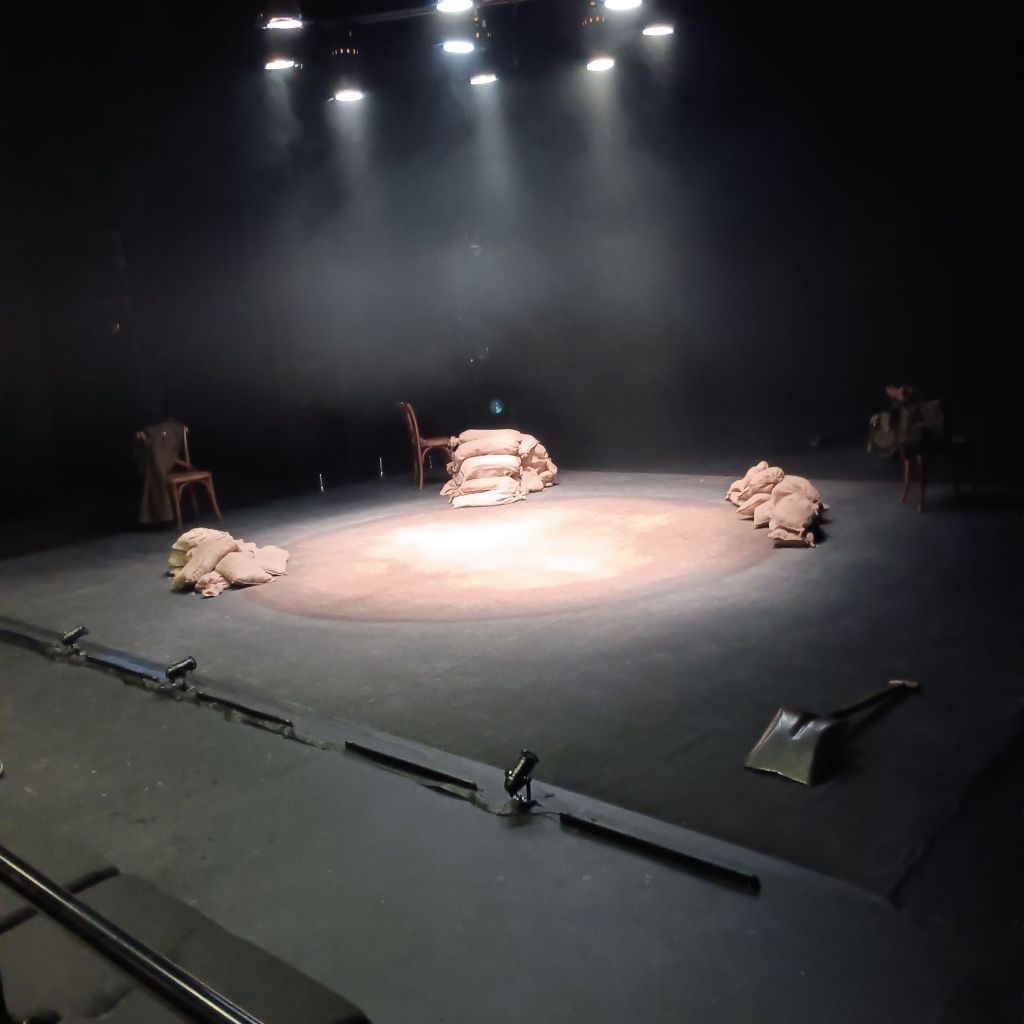
In Poor Theatre, there is, at the extreme, only the actors’s space, and actors dressed as simply as possible so that what they seemed to need to wear was itself imagined. Entering the Traverse Theatre’s heavily raked auditorium for Lear, based on but importantly NOT Shakespeare’s play with its double plot of fathers betrayed or redeemed by their children, we might see a stage reminiscent of poor theatre.
Moreover, by now and befire the action happened, I was aware that the production I was to see would be in a mix of dance and mime, without words except for three – in a crisis the daughters ask their father in a shout prwternatuural in its volune and intensity: “WHO ARE YOU?”
But it is not poor theatre exactly, just a nearly empty space but for three simple chairs, perhaps from a ‘sixties’ dining suite, and three substantial piles of what we imagine to be sandbags, given the yellowish hue cast around them. When the stage darkens, there are sounds variously of storm and war, a plume of thick smoke, like the Bristol of a dragon [‘Come not between the dragon snd his wrath’ sounds in my memory from the play] seems to belch from behind one of the piles of bags. And smoke and lighting effects as strong as those in ths play can not be called elements of ‘poor’ theatre, iather for they emphasise the very illusions that make theatre a rich experience.
When the smoke abates, rising luxuriously and richly to the theatre roof we see there, behind where it once was opaque but is now semi-transparent, a man standing. Around the stage stand three women, an elder one dressed in violet, the youngest in sky-blue, and the miđdle one in scarlet. Their dynamic in movement and dance prognosticates and esblushes conflict. When we first see them, they fit uneasily in the image of three daughters, but rather in their statuesque pose seem to the three Norns, or Destinies or dome other mystic three – the Grace’s even – though in the context of the sounds of raging storm-cum-war perhaps the Wierd Sisters in Macbeth.
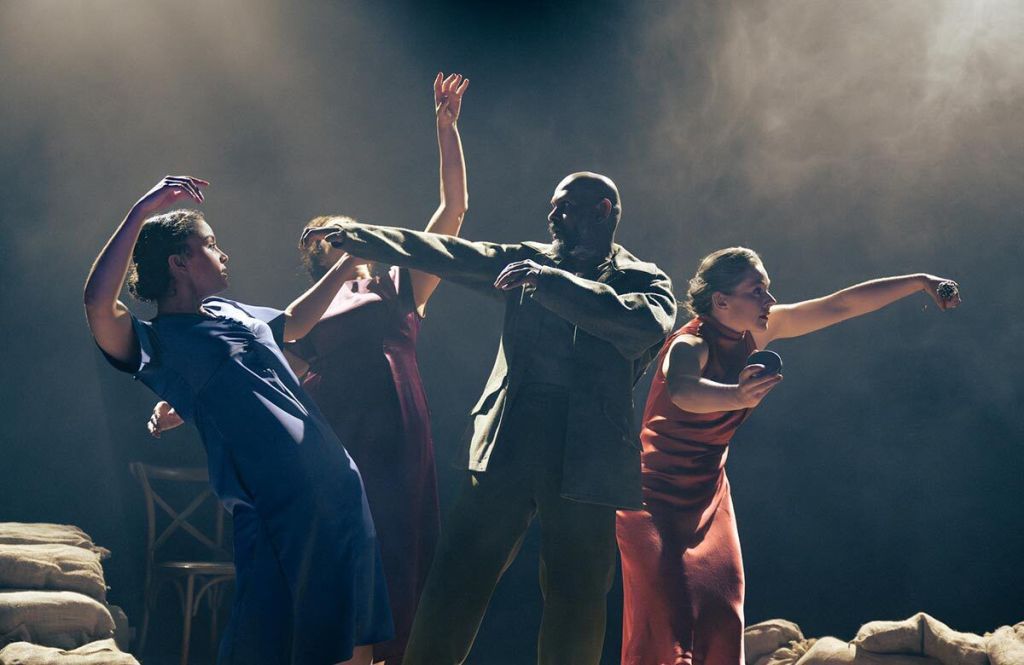
The women are played immaculately by Nicole Cooper, Draya Maria, and Amy Kennedy, but I distrust my ability to translate their actor’s agency pictures on the website to the roles they played though I have some guesses I won’t share. They are meticulously a team, co-ordinated even when at their most differentiated, their team name being Raw Material – apt really when we take inro account rhe brilliant focal point of the team, Ramesh Meyyappan. In one scene, the ‘sisters’ watch from behind their father kneeling in front of a pile of bags. The brilliance of this shot is in the total lack of effective exchange of the gazes of each on their objects and in the certain awareness that what each see is not what we see and almost certainly that each sees what they see differently.

Always conscious of his alienation in a house of women, who in their various ways, profess their care for him, he takes the audience into his confidence in order to show his superiority to such a feminisation of his life in domesticity:

And here I think the analogy of Lear and the King of the same name has its end and we need to insist that it is positively unhelpful to see this Lear as a version of King Lear, for it shares only some parts of the story in a sequence often at ends with the older play, although using the play as a source frankly of telling stereotypes, of male authority, madness, the idea of the fool and of family dynamics, especially that between sisters where fathers play an unquestionably dominant role, at least in theory, it tells an entirely different story and nuances the characters. For instance. The older daughter in violet, to people who know the play, holds the apparently imperious characteristics of Goneril, the daughter in scarlet the wiles of Regan and the daughter in sky-blue the resilient refusal to fold to her father’s nonsense whilst loving him ‘best’ of Cordelia. But this play is not a straightforward retelling, nor are the characters modern versions of Shakespeare’s. Whilst admiring Shakespeare’s play more than any other, there is no doubt that is extremely misogynistic and that one tool of its misogyny, taken to the extremes in Lear’s madness, is the unbearable bifurcation of the trio of sisters into two, both bad – if in their own way – and one perfect daughter, too good to live, but even as she is thought to live by her father whist stone dead, subject to male superiority of presence, and even of voice:
Cordelia, Cordelia, stay a little. Ha!
What is ’t thou sayst?—Her voice was ever soft,
Gentle, and low, an excellent thing in woman.
(Act 5 Scene 3, 327ff.)
The other sisters are feral: sexually libidinous and competitively so. Goneril poisons Regan, before Regan has chance to steal Edmund from her. Some remnant of this characterisation remains in the sisters in Lear – perhaps not least in their colour of their clothing being shaded from the Whore of Babylon, but though the daughter in Violet is as authoritative as Goneril and as competitive – seeking larger gifts (in the form of a crown or tiara that is mimed being put on her head, far larger than her sister’s – and socially false, she protects not kills her sister in scarlet, and both of these elder sisters clearly attempt to protect their younger sibling in sky-blue: at least until it is too late and she falls prey to the toxic man-games gone wrong in her father, who cuts her throat with a cut-throat razor that has played itspart from the moment we see Lear winding the soapbrush from his shaving set round and round a bowl to make sufficient later.
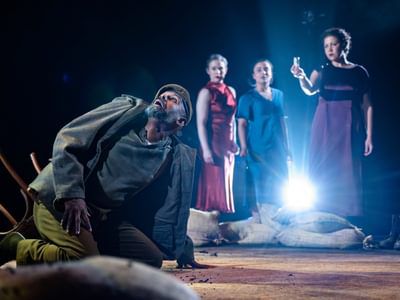
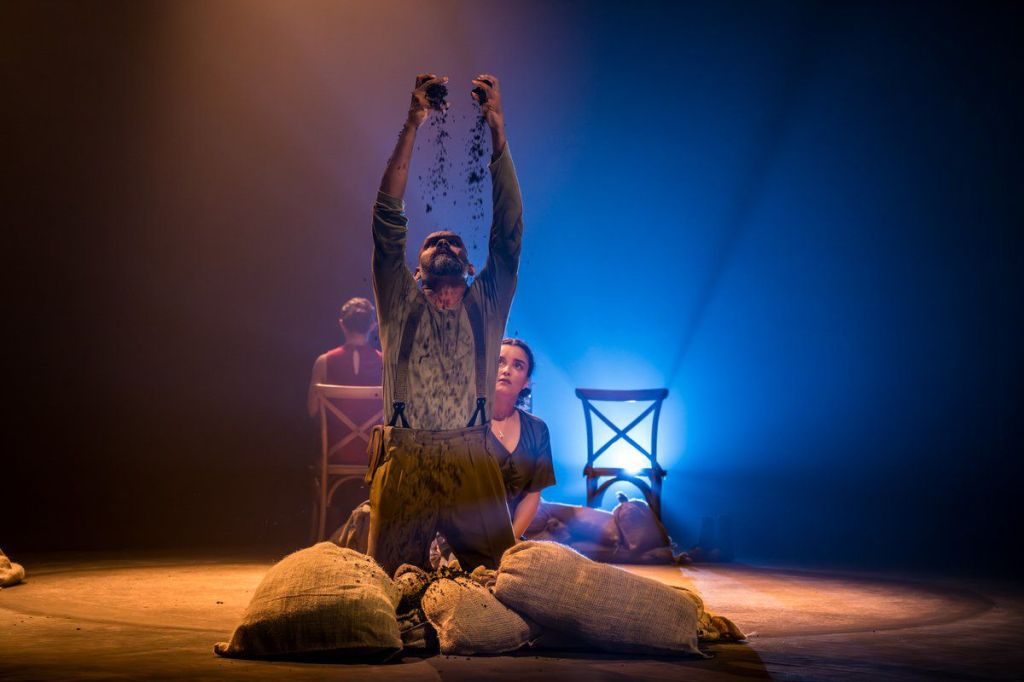
The Lear at Lear‘s centre is a soldier, his fate to fall prey to storms, that may be also a metaphor of the wars in which he proves his mettle as a man – in a trench coat and beret – only to return to his daughters not only aging and infirm but also shell-shocked – indeed the earlier features seem more a product of the latter than of nature. At the end the murder of Cordelia in a fit of childish sword play with his razor (a feature of his earlier man-games that prove him a man to his own imagination) follows resistance on being ‘reduced’ to being shaved by his daughters. Before that his collapse (the line : ‘Old fools are babes again’ in Goneril running in one’s mind) has led him to offer his trousers to his own two elder daughters, even play with making available to them the only key to the house door, in which naturally they show interest. But women who want from redress from enforced powerless are not the evil hags Shakespeare paints them as, and thus it is with the daughters in violet and scarlet respectively. When Lear is at his weakest, they discover this by finding his bottle of pills brought home from war, or perhaps a field psychiatric hospital. In the still below, the daughter in violet holds up this bottle, as if ready to simplify her father into his condition, but the actor never allows this reading of her to prevail as the dominant one. She is a poor nurse, especially in pill administration but not a wicked one. Her two younger siblings in this still clearly accept, and indeed desire, her to be in control given their father’s scrabbling through piles of ash, dust and earth.
At the height of his ‘madness’ Lear, finds in the heaps of muck in the ‘sand’ bags a tartan beret and he wears it as a means of maintaining some control over his more controlling daughters, by being the jester, as if in the joy he elicits from the audience (oft acknowledged) he can still win one over their only way of reacting to the change in him – by reversing to some degree the power relations in the family.
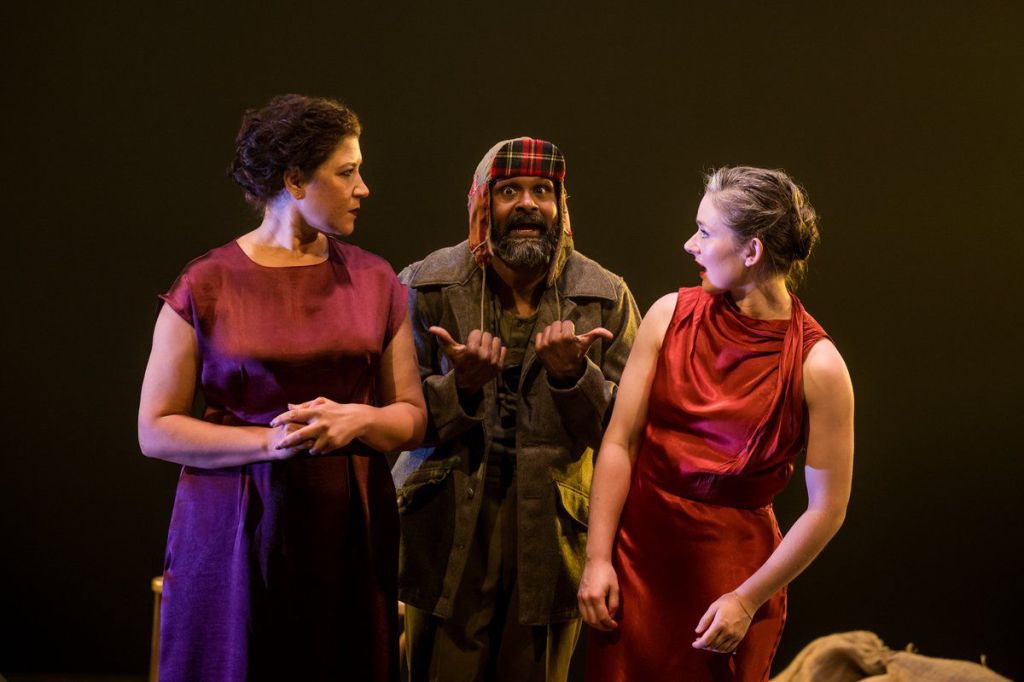
Lear may still feel he can gain our sympathy by grand gestures and attempts to render his old manly authority a reason for believing he has a special relationship to the Gods – and a right to be rescued from a loss of power multi-faceted in its origins. He still raises his hands in supplication, in a way his daughters find, frankly, unrealistic, and which makes them (the older ones) patronise their father to escape censure from the neighbours – who is to them the audience of the play.

But look again at that still. Supplicant gestures there are but Lear is showering himself with ashes and dirt – the substance which is found in the ‘sand’ bags, litters the floor and sometimes rains, or precipitates like snow, from the sky. Men revel in dirt that their daughters abhor, just as – as a jester miming offering his pants to his daughter, he swings a huge imagined dick to the audience to yet again show his superiority to their conventionality. Playing with dirt and ash is what old men do, whilst the love of the daughter in sky-blue looks on in understanding and hope of recovery and reparation later.
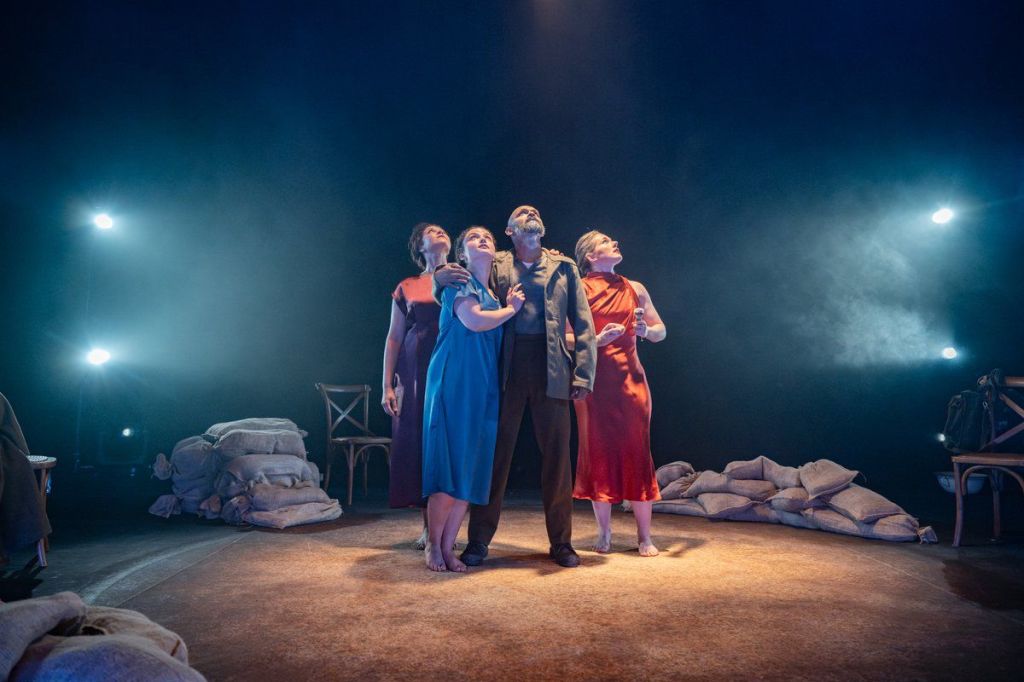
In truth all is not askew in this Lear’s family. His daughters, in their own ways, attempt to hold the circumstances of their father’s decline, together, though only the one in sky-blue (who does least that is practical and in the end is a willful victim to her father) is given a clean moral state free from ridicule. But we would be wrong to ridicule the daughters as Lear does – understand his frustration at their conventionality as we may, and I do. The scene below shows an image nuanced by strength and cohesion – that might have been possible had Lear not been a father so controlling and as prey to seeking achievement by appearances as the elder daughters, although he, being male, is not ridiculed: not, at least until an old man playing the wretch and/or fool,m when men then become fair game like women.
In writing to my friend, Joanne, on the train, I told her that the play was in mime and she asked if thatdid not render an audience’s reaction less emotional and more cerebral. I replied (I have tidied the reply up):
I don’t think it is cerebral and don’t think, knowing a little about your responses to art, that you would have found it so. I think if anything mime and sign language appeals straight to the emotions without having to cross barriers set up by language, except that language that moved involuntarily through my mind from the original play. In one scene, the father figure crawls towards his youngest daughter and i hear in my head King Lear say ‘While we unburdened crawl towards death’. Then the crawl turns into a more paced thing, the man’s face distorted by sneer and hate – that become a low guttural growling: in King Lear’s speech: ‘Come not between the dragon and his wrath’. The young daughter pulls her arms around her own body in fear and self-soothing ‘
Whether that be the case or no, do see this play, for it may change you as it changed me. And, of course, the one thing I cannot live without is theatre – however raw its raw materials.
All my love
Steven xxxxxxxxxxxxx
___________________
[11] https://en.m.wikipedia.org/wiki/Bad_faith_(existentialism)
 Steve_Bamlett_blog
One thought on “The one thing I cannot live without is art – however raw its raw materials. Uncluttering the classic stage: Lear, a production of The National Theatre of Scotland at the Traverse Theatre seen 2.30-3.30 p.m. Saturday 7th June 2025.”