I am still cataloguing books, clearing away rejects as I go and re-reading when I feel the curiosity. I placed the 2826th book for keeping on the catalogue I am making tonight (the rest boxed for various Fates) and then sat down to read that little book through again and reflect. It was a volume representing a 2011 exhibition of the work of Ron Mueck at National Gallery of Victoria. Each work selected from the catalogue is written up by a viewer with an interest in it. As I gazed through them, I remembered the tremulous experience of seeing some of them – In exhibitions in Hull and York. It was tremulous because so many of them resist the gaze you give them, even, instead seem to see you and not favourably – particularly the work called Two Women, for these ladies look away from your intrusion (for intrusion they make it feel to you) however you position yourself:

Some sculpted works of Mueck seem bored of being made to be looked at and for so long (a duration in which as sculptural ideas they have aged – even when the basic idea of them is of something or someone young). Angel is resless to leave (his wings are outspread) but he cannot do so, and thence looks down to the floor, like a petulant child grounded. but incapable of doing anything more positive like leaving.
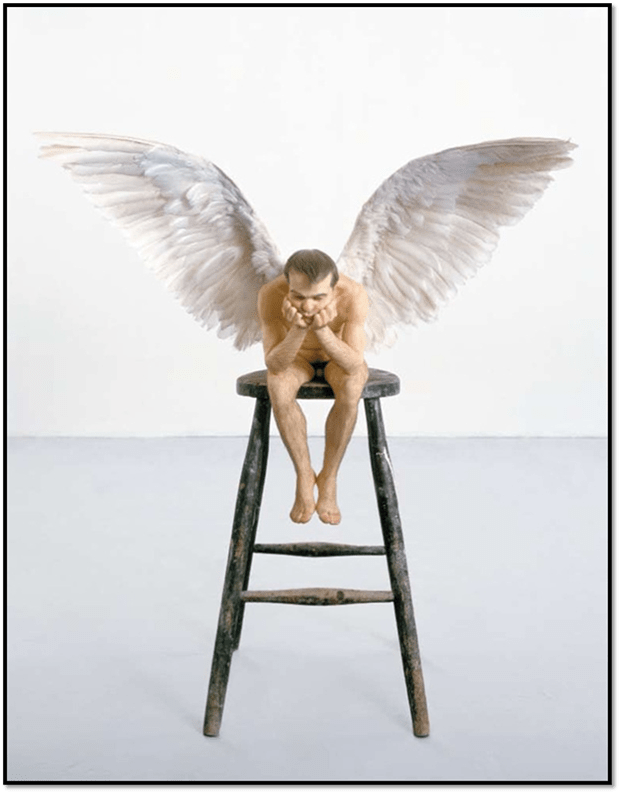
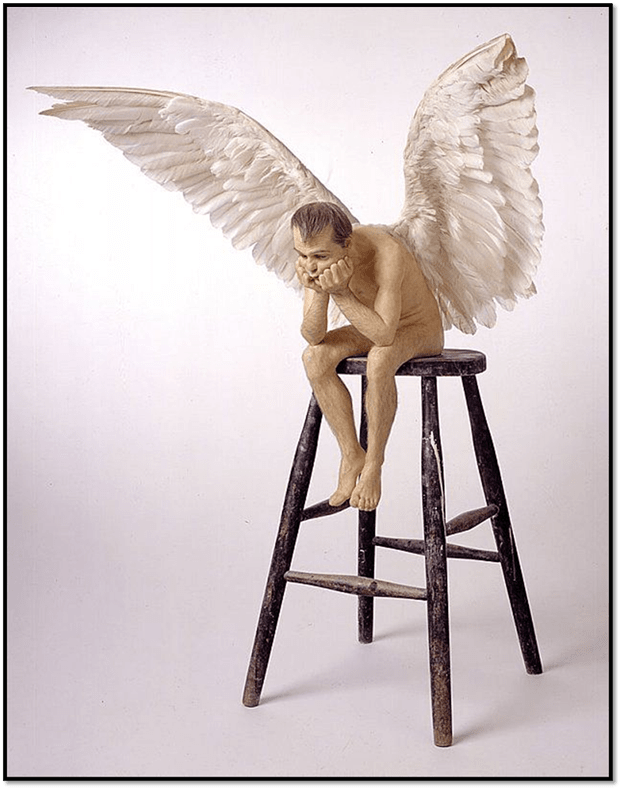
I am other to that you think I am or with which I have been labelled. These sculptures seem to think back to us. Just because I sit on the naughty stool does not mean you know me for what I am, even though I petulantly comply with your insistence that I be seen not heard!
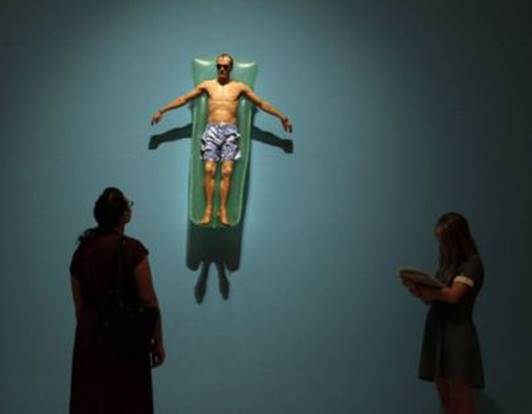
Reading the book reinforced this, though many of the witnesses look elsewhere for meaning – to symbolism or analogy, often with religious myth It’s a game Mueck complies with – in Angel obviously, but also that other angel, the pool drifter in Drift, hanging from the wall half-way between angel in ascent or descent (with a lilo for compressed wings) and a blasphemous model of the Crucifixion.
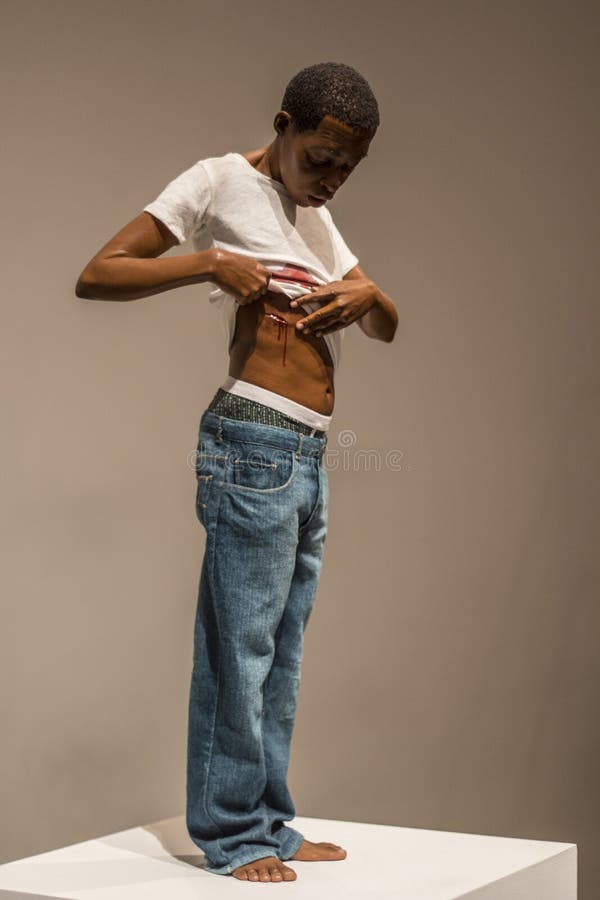
And of course, Youth, with its recall of the stigmata in the discovery by a teenage boy that a knife wound was worse than thought:
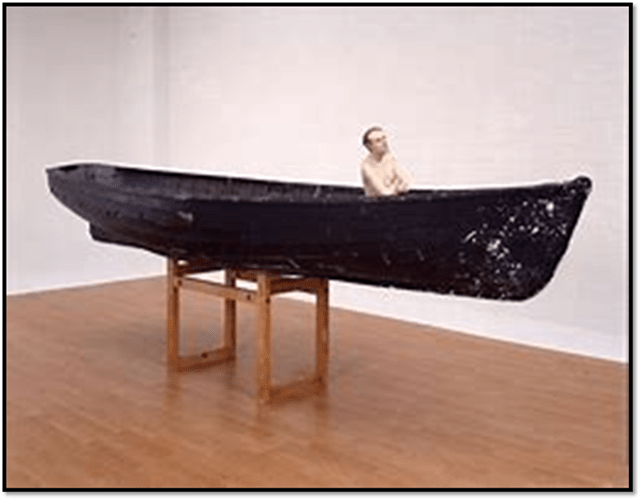
But my book made itself precious in my eyes again by introducing me to Craig Raine, the poet, and his take on Man in A Boat. Of course he goes through all the symbolic possibilities – the boat is a vagina in which a naked man is lost or ignore (‘man in a boat’ being slang he insists for the clitoris), the mussel in a shell awaiting consumption raw, a helpless victim set adrift in the open sea without skill or tools to drive himself. Yet all of these he dismisses, eventually finding the diminutive figure in a boat, sat at its prow in order to ignore as much as possible the space in the boat behind him.
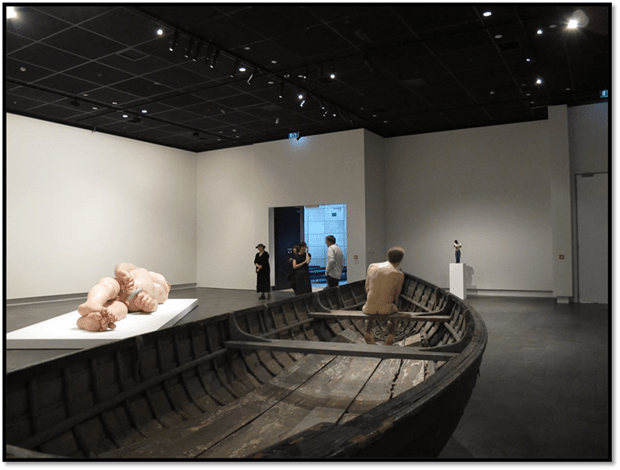

He is a self-conscious focus for the discomfort of being seen, being interpreted and being unsupported, but nevertheless critiqued. Raine goes ass far as to say, that he is ‘watchful, wary of being watched. His right eyebrow is cocked and curious. He is the opposite of a representative figure, a symbolic figure’.[1]
In the end Mueck seems to me to turn the history of sculpture on its head, such that the figures represented resist being the figures they are overdetermined into being, by making the viewer conscious of their gaze, and making it embarrassing or difficult to resolve into meaning, without taking into account oneself – the viewer and their drives – scopophilic as in sexual voyeurism (or sublimated in art) or theatre of symbolic ritual. As a result, the figure is discomforting in the search of its gaze in other places than the eyes of its viewer.
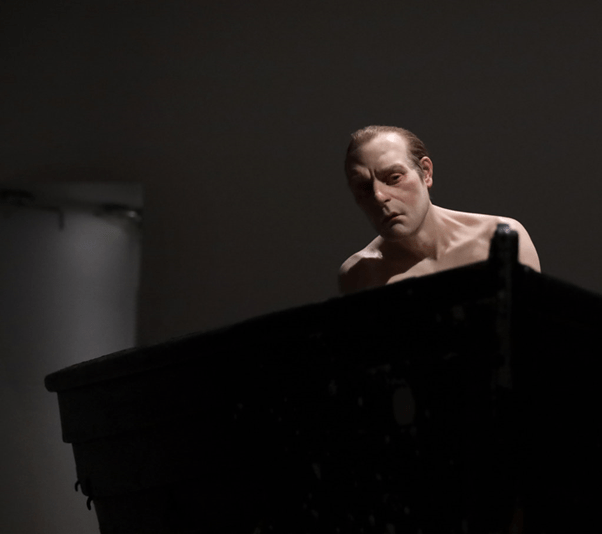
Raine even disputes Anthony d’Offay (Mueck’s agent) in his view that the figures are the inhabitatants of the artist’s dreams, for they work, he insists only in as much as they recall basic dream imagery of obvious meaning – enactments of the fear of being seen or discovered, since being so inevitably (we seem to have programmed into us) means being diminished in the eyes of others – however large we are (Mueck is the poet of size, volume and fulfilment in space). What we have here is, he says:
‘… a classic dream image – inexplicable nakedness in a public place and a rowing boat that clearly belongs to someone else. The enigma of total exposure. Nothing hidden. Nothing disclosed’ [2]
And note we are especially fearful because it is awful to be seen, disclosed to others, but equally awful to be ‘hidden’ and unseen, or viewed as false or artificial. This piece is one I have never seen ‘in the flesh’, but that deficiency can be somewhat mitigated if you watch Colin Clarke, Mueck’s assistant, speak of the piece (in a video available at this link or at the footnote).[3]
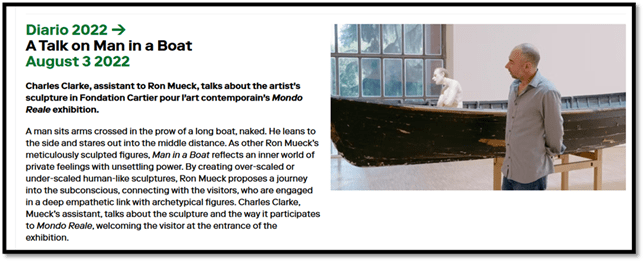
The point is less clear when we see the work in isolation, even without the comparator body of a viewer to scale it as a figure – the boat itself lacking that power of scaling on its own.
But when you see it, you also note the embarrassment of looking often in the absence of such embarrassment in others. People look into the boat, not only to capture sight of the lower torso but the figure’s realistic, if miniscule (even though to scale) genitals.
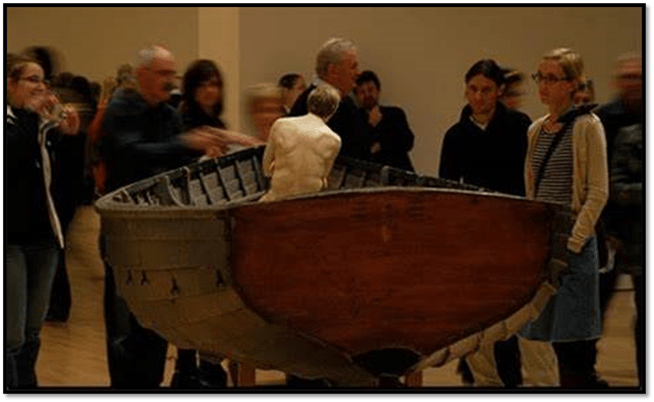
They stare into a gaze too that is obviously made to gesture as if it was avoiding theirs.
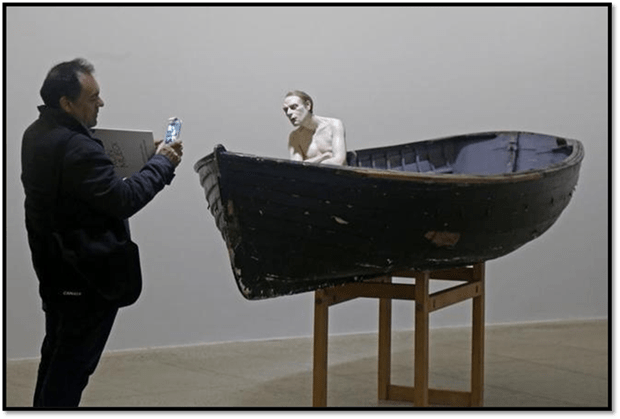
Perspective and gaze can change the figures scale to the sight but they can’t rid of a body that is self-conscious in being seen, even by the eye of a smartphone.
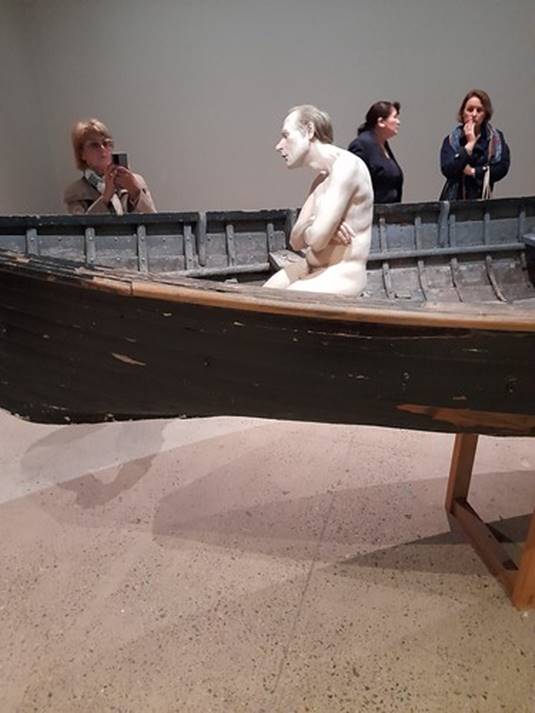
And yet nothing tells me more about the piece than the photograph below, as it challenges a young man not to just walk on by, as he seems intent on doing.
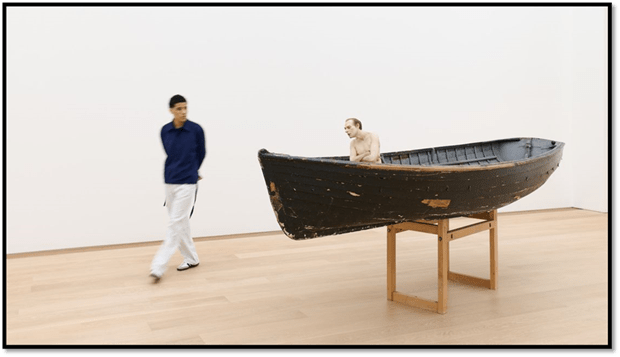
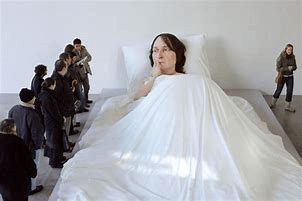
It emphasises to Mueck’s fascination with the fascination of others (his witnesses) in comparative scale – small things that challenge their diminution (Dead Dad of course) , just as the huge scale of some things we think of and bless as small – like babies, or women who think out why we gaze at their attempt to be in a place where they think out for themselves. if thus allowed, their place in things:
Busy day today, so books will stay unsorted into blessed sheep and reluctant goats kicked out to the hills.
With love
Steven xxxxxxx
[1] Craig Raine (2011: 65) ‘ Invitation Au Voyage’ in David Hurlston (Ed) Ron Mueck National Gallery of Victoria & Yale University Press. 60 – 65
[2] Ibid: 64
[3] A Talk on Man in a Boat | Triennale Milano https://triennale.org/en/magazine/talk-man-boat-clarke
 Steve_Bamlett_blog