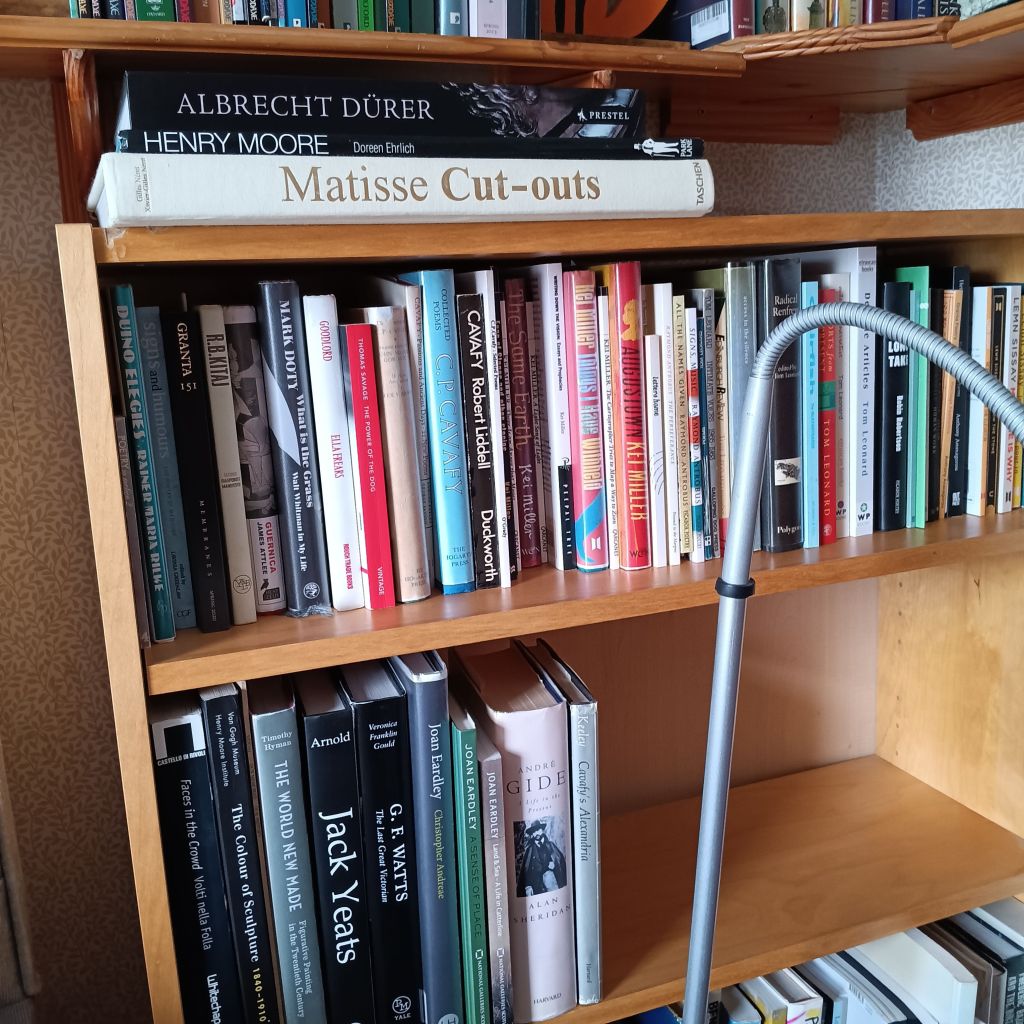
Before you turn off completely in fear that the poem I found was actually found inside me and written out in my usual sadly mechanical verse style, I need to say that this poem, typed (clearly on a typewriter) and on flimsy looking but actually quite tough semi-transparent parchment paper (or at least this is my guess) was found between the pages of a book of mine. The book is one that, as with most of my library, I bought second-hand. I am browsing my book collection as part of a cataloguing exercise using a piece of software called ‘Handy Library’. The last book catalogued was one I still am waiting to read, and where I found the poem amidst the pages of a chapter called ‘The Sensual City’ . It is catalogued as my 2,13oth book (several rooms of them yet to go). It was published in July 1976 about the time I first became aware of Cavafy by one of his translators of the period, the Princeton Professor Edmund Keeley. The book is Cavafy’s Alexandria: Study of A Myth in Progress.
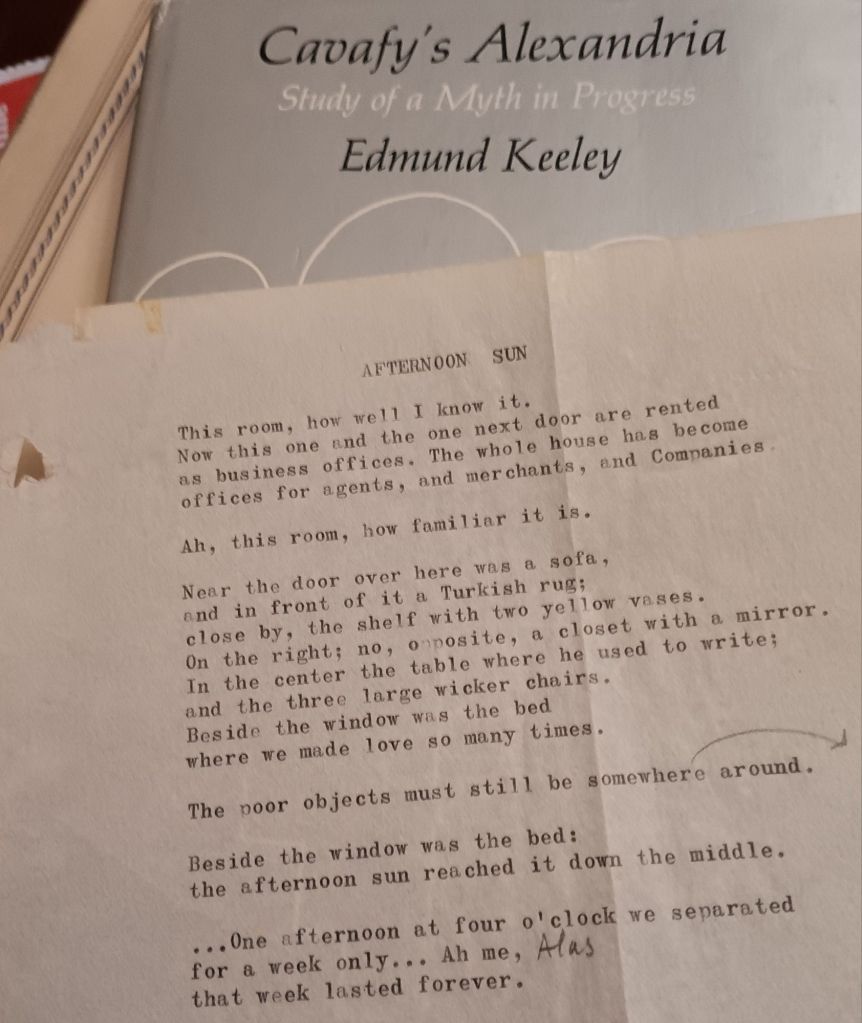
In 1976, amidst the still heavy persecution of queer people in London by a corrupt Metropolitan police force, institutionally racist, sexist and homophobic except in the imagined mind of its defenders-despite-the-evidence, this book would be one of the rays of light in the private life of queer men, exploring Cavafy’s search for love or just sex amongst the working men of Alexandria. Was this I wondered an original poem by a man who reads Cavafy. I have read all of Cavafy in the Mavrogdato, and then the Keeley and Sherrard, translations but could not remember finding it there for it was published as early as 1975 in Keeley and Sherrards first edition of the verse publised by Hogarth Press, the copy I have. Here is their translation – they know the poem as The Afternoon Sun. Here it is as copied from the Poetry Foundation online.
The Afternoon Sun  By C. P. Cavafy

This room, how well I know it.
Now they’re renting it, and the one next to it,
as offices. The whole house has become
an office building for agents, businessmen, companies.

This room, how familiar it is.

The couch was here, near the door,
a Turkish carpet in front of it.
Close by, the shelf with two yellow vases.
On the right—no, opposite—a wardrobe with a mirror.
In the middle the table where he wrote,
and the three big wicker chairs.
Beside the window the bed
where we made love so many times.

They must still be around somewhere, those old things.

Beside the window the bed;
the afternoon sun used to touch half of it.

. . . One afternoon at four o’clock we separated
for a week only. . . And then—
that week became forever.

Copyright Credit: C. P. Cavafy, "The City" from C.P. Cavafy: Collected Poems. Translated by Edmund Keeley and Philip Sherrard. Translation Copyright © 1975, 1992 by Edmund Keeley and Philip Sherrard. Reproduced with permission of Princeton University Press.
I have tasted re-translations and the additional unpublished, and unfinished poems, in the latest translation, the magisterial one by the poet Daniel Mendelsohn.
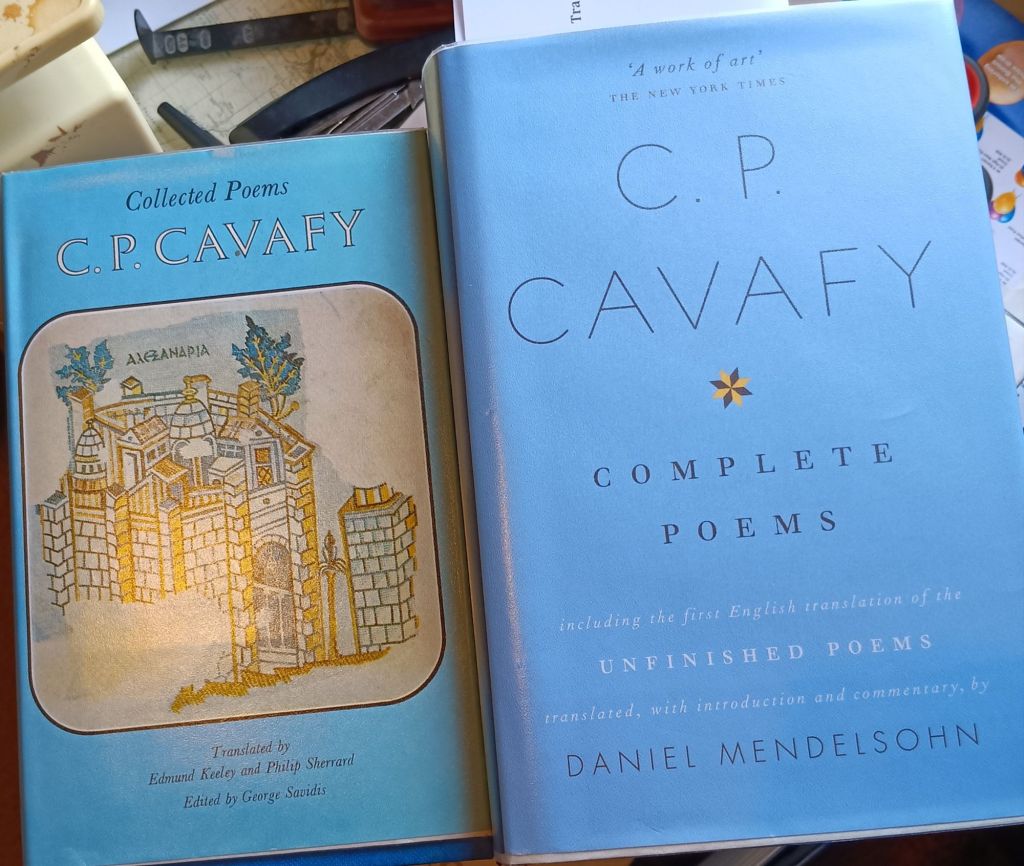
I checked the index of Mendelsohn’s volume. And there was his translation of the poem, accidentally in my photograph shaded over the saddest part:
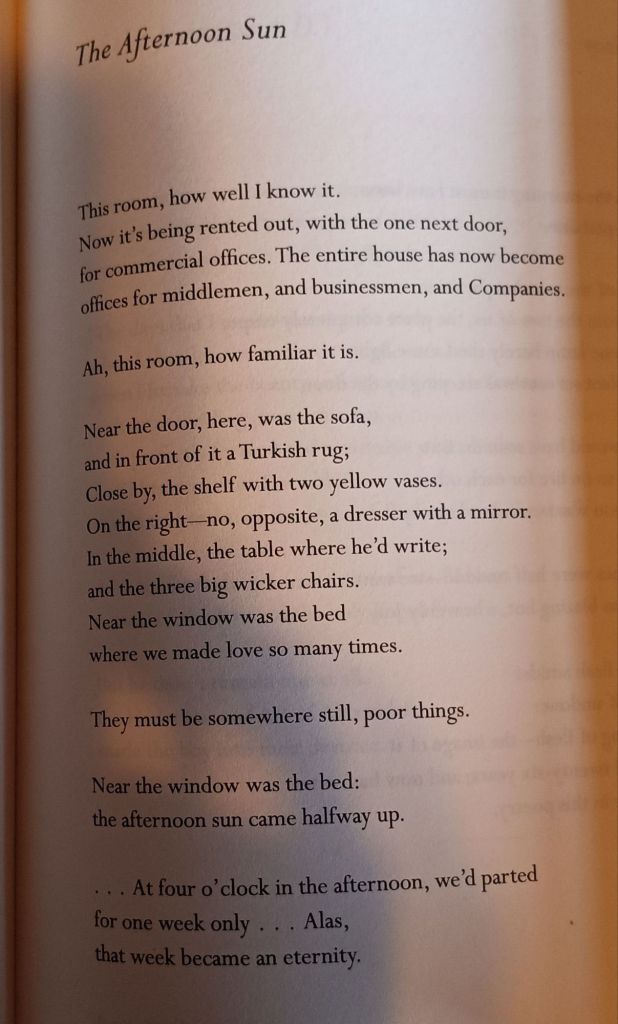
I had to admit that my dream of finding an original poem about the loss of a lover by a reader of Cavafy dissipated quickly – together with the onset of burden on me that I had not remembered reading that paticular poem in a poet I love – indeed adore! And here is the poem (bless the internet) in manuscript in Cavafy’s hand from the Onassis archive:

My sadness now complete and shame, now I have admitted my ignorance and /or poor memory, I perked a little. Perhaps the poem I found is an attempted translation of the original from Greek. There are suggestion that this might be so. The poet chooses to omit the definite article from the title from sure reason to certain effect, and one not done by the two formal translators. There is a power in entitling the poem just Afternoon Sun that generalises the topic more and emphasises the lament of the recurrent ending. In Greek one has to use the article – not so in English so the difference is credible, but let’s look at the typescript with manuscript emendations again:
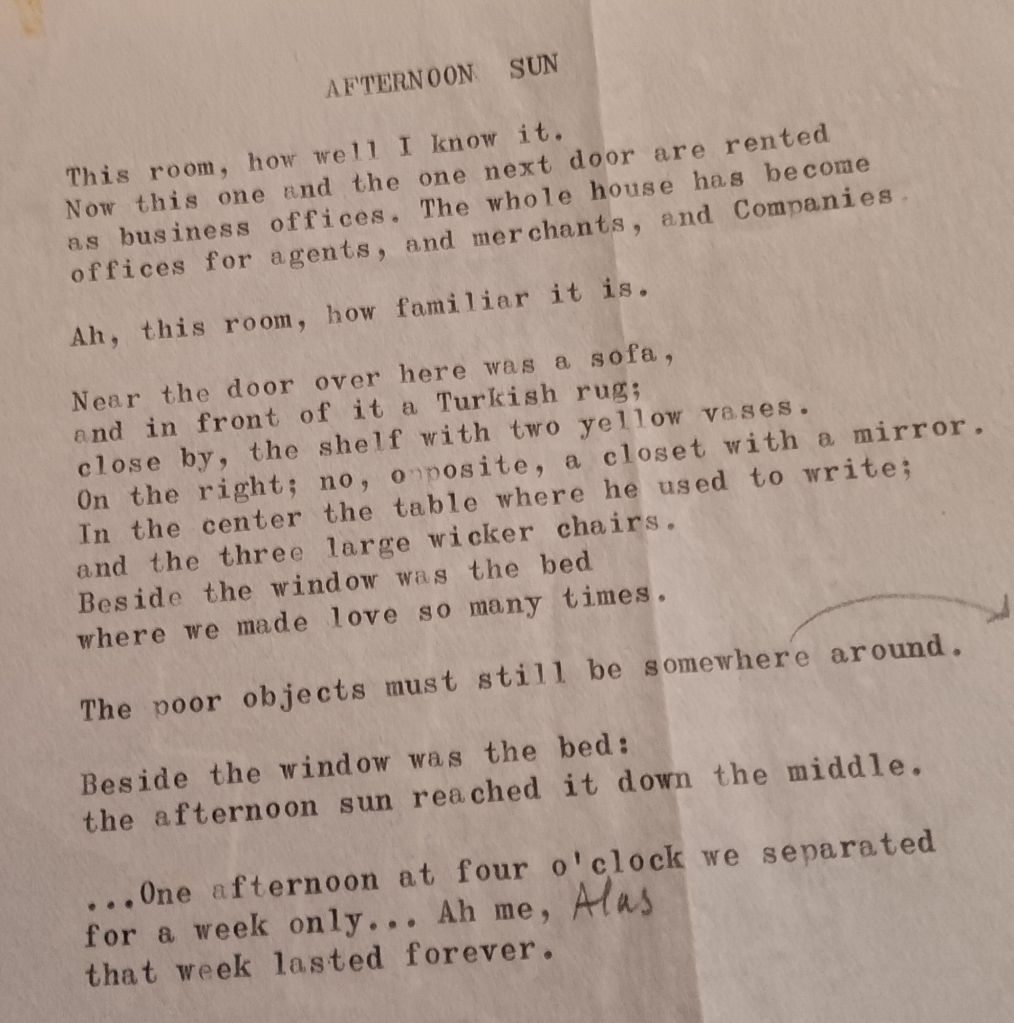
Here is someone struggling with the expression of the Greek, the meaning, feeling, or, even, look of the poem. Look at the query, for instance, on where you might place the word ‘somewhere’ in the line, or the doubt expressed as to whether to place the word ‘Alas’ or instead of ‘Ah me’, to.indicate formal expression of self-pity. In fact, the formal translators struggled thus, too:
| My found poem | Keeley & Sherrard | Mendelsohn |
| The poor objects must still be somewhere around OR The poor objects must still be around somewhere | They must still be around somewhere, those old things. | They must be somewhere still, poor things |
| … One afternoon at four o’clock we separated: / for a week only … Ah me. Alas | . . . One afternoon at four o’clock we separated / for a week only. . . And then— | … At four o’clock in the afternoon, we’d parted / for a week only. . . Alas |
So many choices that are valid in the Greek or its associations in use, rather than literally: poor / old as adjectives, the virtue of using the qualifier ‘around’ and its order of phrasing if used, the specificity placed on the noun ‘afternoon’ – is it one of many or just a placing of the time of day, parted / separated, the role of formal idioms for grief (‘Ah me, Alas, or assumed in words and elisions of words as in Keeley Sherrard).
Do mt found poem is not a man mourning the loss of his male lover to death, or some other ending, but is definitively a translation by somebody for some rewason – perhaps even the reaon I intuited for the created poem. And yet I had also found in an unintende or intended other meaning. Look at these alternative lines:
| My found poem | Keeley & Sherrard | Mendelsohn |
| On the right; no, opposite, a closet with a mirror. / In the center the table where he used to write; | On the right—no, opposite—a wardrobe with a mirror. / In the middle the table where he wrote, | On the right—no, opposite—a dresser with a mirror. In the middle the table where he’d write, |
The found poem might just prefer the word ‘closet’ though by the 1970s it was obsolete because of its use to indicate a queer man attempting to ‘pass’ unperceived as a ‘straight’ one and ‘in the closet’. I rather like the association, together with the formality of ‘used to write’, for the formality of that phrase indicates to me writing of greater significance – perhaps the poetry of a Cavafy – rather than the nonchalance of ‘where he wrote’or ‘where he’d write’ lesser things. It opens up the possibility that the man lost here is the writer Cavafy leaving behind him another man – a spare businessman, a Cavafy as he was in mercantile middle-class Alexandria.Of course this line gives away that the translator was American – since ‘center’ was not even available as an English word for ‘centre’ then. Was it Mendelsohn before he tightened up and made more chatty his lines? Probably not. But it certainly was someone who cared about queer poetry.
Back to the cataloguing.
With love
Steven xxxxxxxxx
 Steve_Bamlett_blog
One thought on “Today I found a poem.”