


Choose to be around people who make you wonder. ‘How beauteous mankind is! O, brave new world / That has such people in’t’ When one’s untutored eyes are opened the world is full of potential. Is that only because ‘’Tis new to’ us? The Royal Shakespeare Company (RSC) is aiming to bring young people into ‘First Encounters’ with Shakespeare’s drama and spoken poetry. How did they fare with that resistant play The Tempest in Bishop Auckland Town Hall?
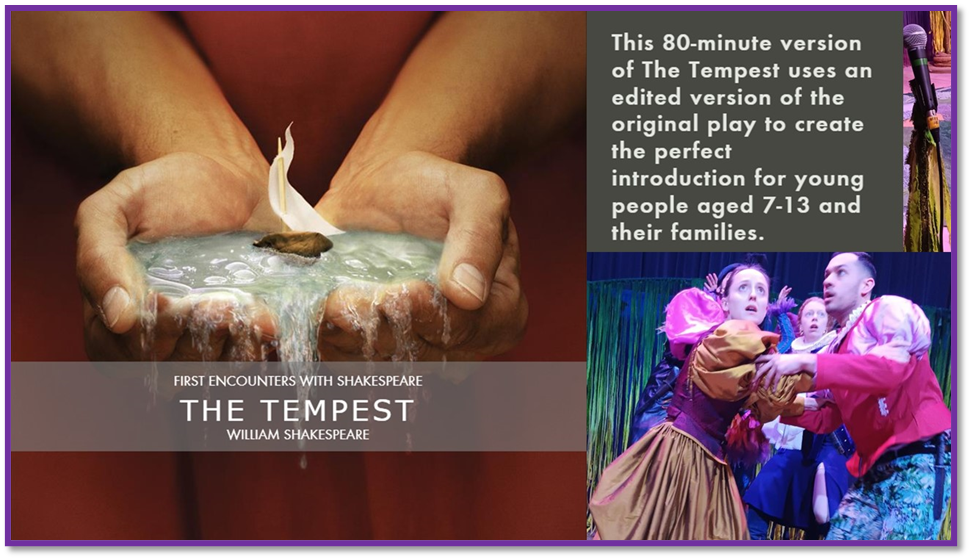
Choose to be around people who make you wonder, like Miranda in The Tempest. Seeing people from a world beyond the island on which she was reared,; a world populated only by her father, the lascivious son of the witch Sycorax (who once ruled the island) and unembodied spirits, Miranda says:
How beauteous mankind is! O, brave new world
That has such people in ’t!
Prospero, her father, says to her: “’Tis new to thee”. Is he here semi-contradicting his daughter’s perception – warning here that the world does not seem so beautiful when it loses its novelty in your eyes? Or is he merely helping her to deal with a ‘wonder’ that must eventually be enjoyed with an eye still open to the human realities that lie behind the facades of brave-looking people.
The same problem must face an institution as long in the tooth as the Royal Shakespeare Company. How do you open the eyes of 7 to 13 years old children who may never have seen Shakespeare before, and perhaps never been to the theatre, without disguising the real world they must face eventually beneath the glamorous and pleasing face it presents to you.
In effect, you allow it be voiced correctly (the long term achievement of the RSC is to emphasise that the spoken voice by speaking clearly the music of the verse makes sense of it: however ‘difficult’ you are accustomed to believe Shakespeare’s language to be. But you also link theatre back to ‘play’, to the joy of extraordinary performance using embodied capacities for fun. But you don’t do it by renouncing the issues of which children are very aware – that freedom, for instance, is more praised than practiced and that authority too often works by making emotional bonds, or ones that potentially could be that, into bondage and enslavement.
That is, after all, the adult world of Prospero’s island, as of Milan and Naples from which the pretend island is an escape. If Sycorax bound people by ‘rough magic’ then Prospero does the same – to the slave he needs to do the dirty work that he and his daughter are too elevated to do, the spirits of the free air that he contains within invisible cells and with bonds that he will not break – yet. And thus do fathers bind their daughters, though good daughters, like Miranda make excuses for their father.
This production may, in a very severely cut text and with minimal theatrical resources (by RSC standards at least) aim to draw in young people to whom the experience is ‘new to thee’ actually made its metaphors of bondage and liberation more real than in many a bigger and more lavish production The moment when Ferdinand is freed to then propose love to Miranda is a liberatory music rising to crescendo when after Prospero frees Ariel – that spirit of light and air – from a very visible chain-like bond that they have worn throughout – Ariel frees Caliban from the same metaphoric but truly more irksome wage-less-slavery.
Theatre is about a constraining reality given relative freedom to play and hence this production starts with brilliant Ariel (played by Carla Garret) enacting the Tempest at sea that they have roused on Prospero’s command – by wearing a sailing ship on their head and tossing it with that head through imagined elements of which Ariel allows their voice to copy. How to better this – that to run amidst your audience of – 13 ages encouraging them to invent noises fit to the chaotic subject and then copy them, asking them to repeat back in return. It sounds like pantomime – but it was so only in as much as pantomime too engages the self in free play.
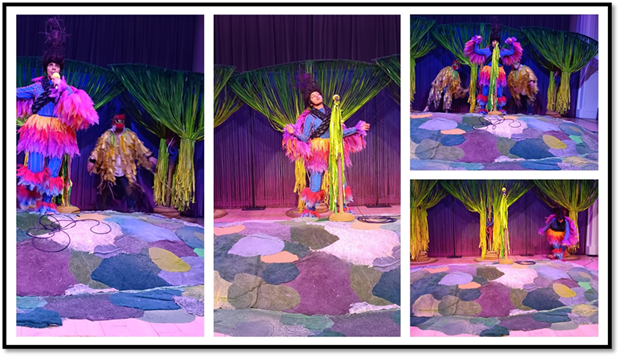
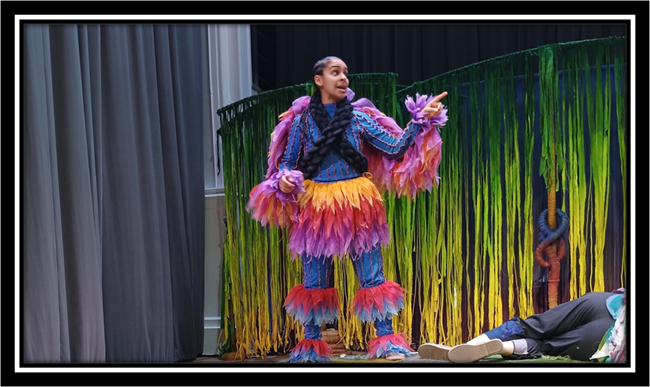
And then allow the cast to enact the animals of the island – masked and cloaked in colours as the set is made up of natural colours turned both patchwork gaudy and full of the freedom we pretend to in our crafting (and sometimes, as a result, genuinely feel).
This production demands with some exceptions that the cast play many roles. Here is that cast:

From top let clockwise: Prospero Peter Moreton, Ariel Carla Garratt, Caliban/Gonzalo Shakeel Haakim, Alonso/Trinculo Isabella Marshall, Sebastian/Stephano Kiren Kebaili-Dwyer, Antonio Rachel Winters, Ferdinand Garon Akbar Clark, Miranda Scout Worsley
Some characters are bonded to one role – others go free. Sex / gender boundaries are crossed freely – Alonso may become a mother to Ferdinand – making a mess of the alliteration in ‘Full fathom five thy father lies’ when it becomes ‘Full fathom five thy mother lies’ but is oft allowed to remain referred to as ‘he’ and ‘Sir’ : likewise other cross-gendering characters like Antonio – Prospero’s brother become a treacherous sister. Carla Garret plays Ariel as non-binary as must Ariel be. From hopeless slave to loyal courtier Shakeel Haakim rang all the changes of what ‘service’ means to great ones and authorities. Prospero himself is played as a man who binds people, souls (and daughters) too tight until he learns that he must step down and renounce even the power of his voice in verse.
 Weak masters though you be, I have bedimmed
 The noontide sun, called forth the mutinous winds,
 And ’twixt the green sea and the azured vault
Set roaring war; to the dread rattling thunder
 Have I given fire, and rifted Jove’s stout oak
(55) With his own bolt; the strong-based promontory
 Have I made shake, and by the spurs plucked up
 The pine and cedar; graves at my command
 Have waked their sleepers, oped, and let ’em forth
 By my so potent art. But this rough magic
I here abjure, and when I have required
 Some heavenly music, which even now I do,
⌜Prospero gestures with his staff.⌝
 To work mine end upon their senses that
 This airy charm is for, I’ll break my staff,
 Bury it certain fathoms in the earth,
(65) And deeper than did ever plummet sound
 I’ll drown my book.
Bookish people like myself – as well; as finding this blank verse the most satisfying of any example – weep at the beauty and pathos of Prospero promising to ;drown my book’. Do children learn these things as they hear them. I don’t know. I dare not imagine the fragile growing defensive structures and the desire for freedom looking as if it might soon be lost in the head of a 7 – 13 year old. The point is the text in this play was not edited other than in the cutting of a number of scenes and part-scenes but its verse (apart from the sibling cross-gendering I mentioned above) is left in all its grandeur. Who dare say that no 7 – 13 year old felt its power. And all 7-13 year olds know of parents who while pretending to embrace communality, still ‘ave required’ an extra service ‘to work mine end’ on their children.
This Prospero is magnificent:

Above he walks with magic staff and the multi-coloured cloak. Even in the very early scenes he pretends to slew off the ideological authority his magic gives him, but he is poor at giving up power at lest until the play of the world eventually ends. See him here with Miranda in Act 1 Scene 2, line 27, with the magic garment cast aside (what child has not experienced this in a more sombre reality):
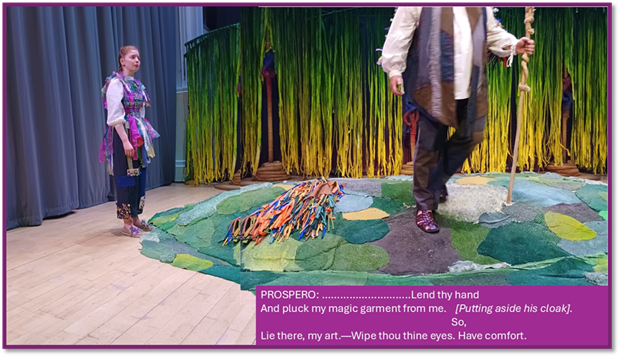
Prospero gives comfort like he gives his magic – ‘rough comfort’ is a walking away moment like abjured ‘rough magic’. It is the way of traditional masculinity. Men and Dads know how to powerfully walk away from their daughters (or sons), leaving them unsure how much they are still bound.
But imagine all this delivered in bishop Auckland – a town more declined than many others – but still bearing that bit of civic grandeur the presence of a medieval institution – the Prince Bishops of the North – a vast mining wealth could give it to ape French civic grandeur in Gothic town-hall. Of course ot has a nice theatre-cum-cinema. The Assistant Director Layla Madanat had had 45 minutes to direct the setting-up of scenario still saw it she told us (we were in the theatre early, as a ‘great space’.

This is the space as Geoff and I saw it set up before the performance – a mix of subtle-cum-gaudy colour and deliberate rough magic, with a greenery that in its artificiality still looked like nature intruding on art (and perhaps vice-versa,

Editing the text allowed the company to emphasis in a more intimate space the sense of jostle and pace of people tossed about by real-cum-emotional storms. The movement design was a glory of this production – hard to capture in photos I shouldn’t have been taking anyway – however out of sight.

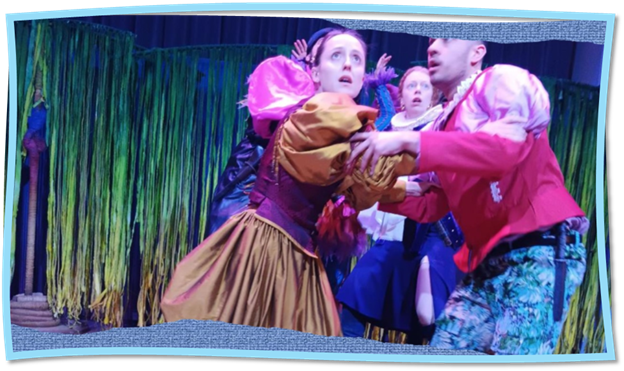
Such tempestuous motion turns families into new knowledge of their bonds – of their fragility as well as their strength, their tedium as well as their comfort. See this example of son, Prince Ferdinand tossed into the care of a ruthless mother, Alonso, with the head of the ruthless Sister, Antonio, in the gap between them. What a wondrous thing is a theatre of proxemics like this.
I no longer dared photographs once that was seen so I cannot show you how wondrously the ‘strange bedfellows’ brought about by misfortune was played by Caliban, Trinculo and Stephano – who played a drunken trio as if they were indeed that. Instead gaze again on the non-binary image the brilliant claire garret created of Ariel – with ‘rough magic’ of their own enough to make men sleep when they had not thought it likely and to wish for freedom of putting such gifts to the ends dreamed up by men and women obsessed with power. And how they look to each other and giving freedom to things that ought always to have been free anyway. When Ariel asked Prospero in Act 1 Scene 2 for freedom he reminds them of their imprisonment in a ‘pine’ by Sycorax, and threatens that should Ariel not continue to complain – for the extent of the play anyway – he will act as the witch Sycorax did:
If thou more murmur’st, I will rend an oak
[350] And peg thee in his knotty entrails till
 Thou hast howled away twelve winters.
ARIEL   Pardon, master.
 I will be correspondent to command
 And do my spriting gently.
Can you see this tour? Don’t be put off by the fact that the room contains school groups – for I learned that they can be enchanted – and not by their teacher shouting at them beforehand – “Remember you are representing the school, and Shut up”. And you think 7-13 olds do not know rough authority pretending to be skilful magic when they see it! LOL.
I started this prompt blog with – “Choose to be around people who make you wonder, like Miranda in The Tempest“. But Shakespear’s knowledge of family dynamics was a powerful one in its ability to unearth contradictions. And then remember that Miranda did not choose this world to explore – it was chosen by her father, who then remained in control of it – for the length of a 80 minute edited version of the play.
With love
Steven xxxxxxxxxxxxxxx
 Steve_Bamlett_blog