Now hubby Geoff is so unexpectedly well so soon, I am off comprehensive culture -seeking in London again on the 26th-27th February. It’s a return that promises to make me feel the Baroque and Roll of the Classical Drama and Leigh Bowery over two days.
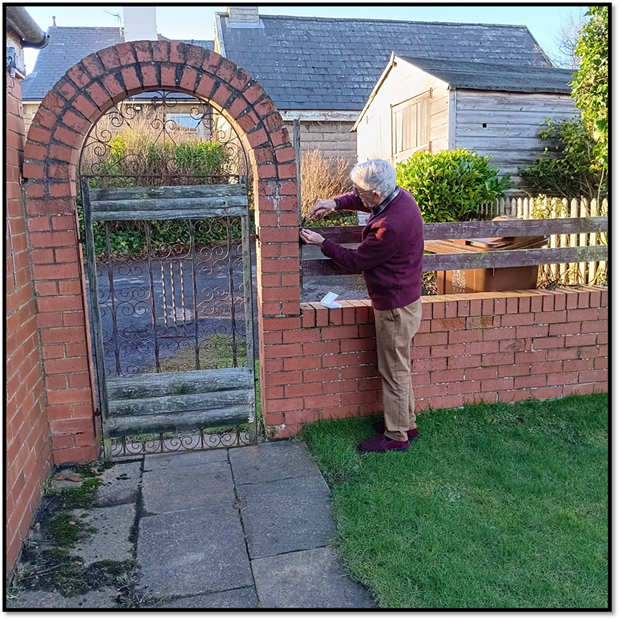
Hubby Geoff now so well he is finding fault with my safekeeping oof the garden & knocking nails into fences. Love ya, Geoffee
Yay! Geoff feels well. The bed I got him for downstairs use is now disposed of, and all aids for indoor use gone except for the wonderful banister rail they installed and I varnished. I like that anyway. He still uses a stick for outdoors and has an outdoor walker for the bad days and wheelchair (thanks to our wonderful friend, Joanne) for the worse-than-the-former days. But here is is knocking nails into wood. He gets very exhausted and though he said no to accompanying me on my trip to London for the culturally needy, he wants me to go and feels that he can now drive to the station and back and, moreiover, ook after himself at home. He is even cooking now.
The motivation for my trip id dual. First I feel culturally deprived and I had especially felt deprived at not seeing the production of Sophocles’ Oedipus to a playscript and direction by Robert Icke with Mark Strong as Oedipus and Lesley Manville as Jocasta. This has been described as a monumental production and revision of the play. It finished in late January but Charlotte Higgins in The Guardian (on January 25th) on its demise. She says of Icke’s production retrospectively:

In Icke’s version, we find ourselves rooting for Oedipus even as he is revealed as a killer and an unwitting committer of incest. As the writer-director pointed out at an event at the Freud Museum in London recently, one of the questions the play asks is: “Is incest that bad, in all circumstances?” That’s an almost shameful question to ask in our culture; it’s almost unaskable. These plays go deep into the realms of the unsayable and unthinkable. They reach into the darkest places of the human heart. Which is one of the many reasons we still need them.
It is probable that this summary applies to every version of Oedipus, perhaps Sophocles’ drama as a whole Higgins admits but this is especially so in Icke’s version because he robs the text of a ‘chorus’ representing a kind of communal consciousness of what is thought moral or immoral, worthy or unworthy of the actions of individual actors. Higgins piece though is not about Icke’s version per se. Her theme is that Sophoclean dramas are ‘storming the West End’. Asked why, she says: ‘Because in our extreme times, his plays say the unsayable’.[1]
Hence, I felt better. I could catch the other two Sophocles in available – Oedipus at The Old Vic with Remi Malik as Oedipus and Indira Vharma as Jocasta in a new version by Ella Hickson, and Elektra at The Duke of York’s Theatre with Brie Larson as Elektra and in a new version by feminist poet and classicist, Ann Carson, on whose works I have blogged before for I love her work – see links here to (for the Trojan Women Comic Book Version, Norma Jeane Baker of Troy (spoof of Euripides’ spoof Helen) H of H [a free version of Hercules}. So nothing missed! I don’t know.
But what I did not know was mainly that the Icke version of the play I missed was not an original production, except as acted in English, for it, as Higgins says, ‘originated at International Theater Amsterdam and has been seen in the UK before, at the 2019 Edinburgh festival, with a Dutch cast’. For that reason alone I felt better that it was this production I missed of the three Sophocles playing back to back in London now, since it meant I had missed it twice so perhaps that was meant to be. But the mode as this version is also less to my taste in the abstract. Higgins says that Icke ‘went through the Greek text in great detail and then made an adaptation – very free, bringing in new characters and scenes – that was based on an intense relationship with the original text. This idea is fascinating, if not (for me) compelling.
Higgins says less about the other productions although she has seen Elekta’s preview performance at Brighton, where she notes that the play may not solve the confusions raised by needing to know its backstory and its dependency, as Higgins saw it, on an analogy with Elekta as a female Hamlet.

Higgins says: ‘Larson paces the stage moodily, as if a tormented teenager, contemplating her loathing for her mother, who has murdered her father’. This statement feels full of scorn without owning it and I hate this in a critic for it minimises the play to one person’s understanding, and one that seems anyway unsympathetic to the play, which I have seen acted by Kristin Scott-Thomas, so delicately that the meaned hummed with clarity.
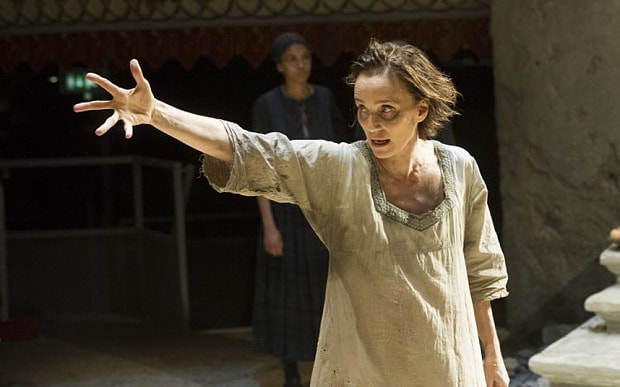
Kristin Scott-Thomas at the Old Vic in the version I saw.
Anyway, since Elektra gave (or had imposed on her by another father-and-mother-obsessed personality, the psychodynamic and mythical thinker Carl Jung) her name to a psychological ‘complex’; we might expect the play to be very introjected and more complex than is the reductive concept the Electra complex – which Freud, ‘the better maker’, eventually had no time for.
Carson has translated this play for the stage before. Her second versions always turn out more radical and I cannot wait. In her introduction to her early translation, she says, setting out a feminist prospectus I am looking out for in this production:
…; “alektra” in Greek means ”bedless, unbed, unmarriageable.”. Her life is a stopped and stranded thing, just a glitch in other people’s plans. Her function and meaning as a human have been reduced to one activity – saying no to everything around her.
Carson feels then there is a reason for Elektra’s inaction (as there is for Hamlet but that is always posited differently in male characters, as a neurosis), that lies in her traditional role as the daughter of Agamemnon who though she has the same cause to hate her father (Pat Barker hints that she was sexually abused by her father in A Voyage Home – see my blog for that book’s context) as her brother Orestes is reduced to having:
…. only one thing she can do.
Make noise.
So Elekta talks, wails, argues, denounces, sings, chants and screams from one end of the play to the other. [3]
There is a lot here that makes me doubt that all we are to say is what Higgins saw in Larson’s enactment of the female condition: ‘a tormented teenager’, or if that one whose torment has been translated into noises at one remove from her pain. I have ordered the text. I am hoping for more than Higgins got from the production – -not hoping actually but quite sure I will.
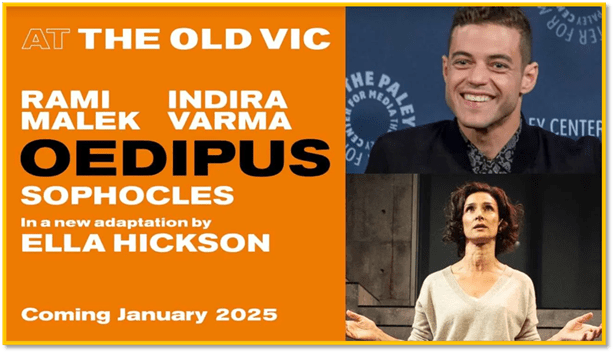
As for the Old Vic Oedipus (I see that at 2.30 on 26th February, the Elektra at 7.30 the same day), Higgins has not seen it but has interviewed its co-director and choreography team: Old Vic Artistic Director Matthew Warchus, director of the Olivier Award-winning Groundhog Day and the smash-hit festive favourite A Christmas Carol’ and ‘Artistic Director of the Hofesh Shechter Company , Hofesh Shechter OBE, an award-winning choreographer, composer and filmmaker’.[2]
Of this team Higgins says that:
For their production, they do use a chorus, albeit a wordless one: a group of dancers. Warchus told me that along the way he had thought about Dennis Potter’s The Singing Detective, in which a grim story is interspersed with song and dance; the chorus in his Oedipus, he hopes, “creates a voltage, a wave to surf on”.
Clearly a wordless chorus is still a move away from grounding the tragedy of individual characters in the language of communities, just as Icke sets out to do, but music and dance may do so much more than I can now imagine. I cannot wait to see this. Higgins clearly explained to Damielle Rhoda that that the graphic she should draw need to emphasise the modernity of the message of these plays, although I find her illustration rather over-literal in this sense (see below:
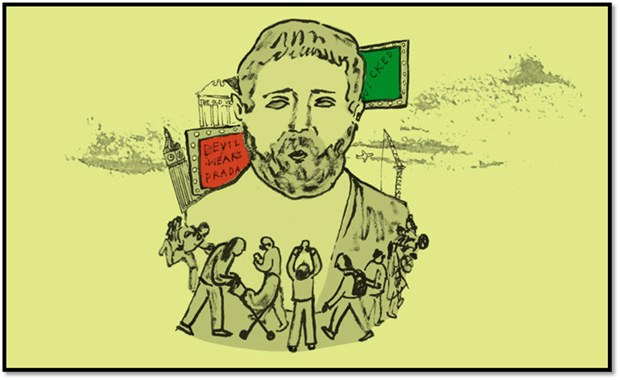
Illustration: Danielle Rhoda/The Guardian© Illustration: Danielle Rhoda/The Guardian
What I expect from these productions is a reconnection to the web of veins that carry the lifeblood of culture – one that is not the matter of entertainment but fear, awe and complexity of decision-making in action; something to battle the agony of mindlessness that a world dominated by politicians with no culture like Donald Trump and Keir Starmer really make me yearn the more for. And that complexity involves ones that cut generic boundaries and both the Sophocles productions will do that in ways I am not sure Icke would have intended with his ‘modernising of classics’ approach.
Afrter the play I stay over at the Fielding Hotel in Covent Garden. My train is not from Kings Cross until 2.30 so I have booked for a treat I did not know was available, for 27th February is the first day of an exhibition at Tate Modern on the wondrous Leigh Bowery – a boundary-breaker like no other, though the limit of my knowledge of him really is his AIDs work and the portraits made by Lucian Freud. The Tate Modern website gives an introduction. This is the first 3 paragraphs:
Leigh Bowery’s short but extraordinary life left a distinct, undeniable mark on the art world and beyond.
An artist, performer, model, TV personality, club promoter, fashion designer and musician, Bowery took on many different roles, all the while refusing to be limited by convention.
From his emergence in the nightlife of 1980s London through to his later daring and outrageous performances in galleries, theatres, and the street, Bowery fearlessly forged his own vibrant path. He reimagined clothing and makeup as forms of painting and sculpture, tested the limits of decorum, and celebrated the body as a shape-shifting tool with the power to challenge norms of aesthetics, sexuality and gender.

The modern queer Baroque is surely one that tests ‘the limits of decorum’ and celebrates ‘the body as a shape-shifting tool with the power to challenge norms of aesthetics, sexuality and gender’. In most of my blogs I peddle no other aesthetic than that. Theus, the Baroque and Roll I point to in my title regarding this weekend related a lot to the Bowery exhibition – I itch to see it – but in fact I think I expect it too from the breakdown of the myth of the idea of the classical into the grotesque ‘irrational’ complexities that underlie the classical form. The Baroque was alive and well at the level of the Furies, Bacchantes and the Dionysiac frenzy, bending forms and crossing multiple boundaries of body, art, art form and ordinary boundaries crossed by Bowery’ queer aesthetic like sex / gender and decorum.
What a lovely two days I will have. Watch this space for reports back.
With love
Steven xxxxxxxxxxxxxxxxxxxxxxxx
[1]Charlotte Higgins (2025) ‘Why is Sophocles is storming the West End?’ n The Guardian (Sat. 25th Jan) Available at: https://www.theguardian.com/commentisfree/2025/jan/25/sophocles-west-end-extreme-times-plays-say-unsayable
[2] https://www.oldvictheatre.com/stories/things-you-need-to-know-about-oedipus/
[3] Anne Carson (2009: 79) ‘Introduction to Elektra‘ in Anne Carson (Translator) An Oresteia: Agamemnon by Aiskhylos; Elektra by Sophocles; Orestes by Euripides. New York, Faber & Faber, 76 – 83.
 Steve_Bamlett_blog
3 thoughts on “Feeling the Baroque and Roll of the Classical Drama and Leigh Bowery over two days in London.”