


Is thinking differently, doing something differently? Or is thought a means of doing nothing?
Can thinking become its own object rather an an eternally self-reflecting subject seeing itself repeated infinitely in a Hall of Mirrors.

A Yayoi Kusama Infinity Mirror Room.
‘We are all of us born in moral stupidity, taking the world as an udder to feed our supreme selves’ says George Eliot in Middlemarch Book 1, Chapter XXI magisterially with perhaps this issue in mind. If we are born thus, the emergence of independent moral understanding is a necessarily painful one as a result, for in that emergence, we begin to know the otherness of others beneath the barriers set by our thick skins.
Yayoi Kusama, in her infinity rooms, works with the same existential situation upon which the great Victorian sages turned the authority of their belief in moral philosophy. The huge spaces are both physical and epiphenomenal, for essential to the illusions that mirrors is the illusion of epiphenomenal space. Out of the cognition of the body seeing itself in imagined spaces, Kusama’s art is born. That art feels an infinite distance away from the moral authority of George Eliot’s kind of art.
However, it is a difference of measurable degree than quality. In the end, both women create art out of images of isolation in endless space. If Eliot’s art differs from Kusama’s art regarding the representation of existential isolation, it is because it takes much more seriously the non-subjective other, the relative point of view of another consciousness. And, for this reason, it is a moral and ethical art rather than a surreal exploration of existential.aloneness without reparation.
Let’s read Eliot’s words again. Here is Chapter XXI (they can be read in full at this link – below I use edited excerpts). It is a study of moral learning about existential isolation and loneliness. This theme starts with an ironic view of an emotion that is shown when ‘securely alone’ and in that condition alone.
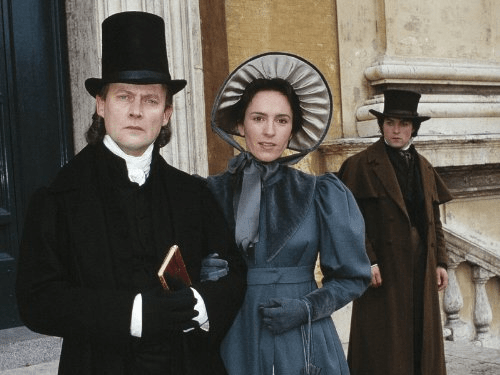
The older and ailing Mr Casaubon with his dutiful new young wife Dorothea (nee Brooke) looked upon by Casaubon’s young nephew, Ladislaw
It was in that way Dorothea came to be sobbing as soon as she was securely alone. But she was presently roused by a knock at the door, which made her hastily dry her eyes before saying, “Come in.” Tantripp had brought a card, and said that there was a gentleman waiting in the lobby. The courier had told him that only Mrs. Casaubon was at home, but he said he was a relation of Mr. Casaubon’s: would she see him?
“Yes,” said Dorothea, without pause; “show him into the salon.” Her chief impressions about young Ladislaw were that when she had seen him at Lowick she had been made aware of Mr. Casaubon’s generosity towards him, and also that she had been interested in his own hesitation about his career. She was alive to anything that gave her an opportunity for active sympathy, and at this moment it seemed as if the visit had come to shake her out of her self-absorbed discontent–to remind her of her husband’s goodness, and make her feel that she had now the right to be his helpmate in all kind deeds. She waited a minute or two, but when she passed into the next room there were just signs enough that she had been crying to make her open face look more youthful and appealing than usual. She met Ladislaw with that exquisite smile of good-will which is unmixed with vanity, and held out her hand to him. He was the elder by several years, but at that moment he looked much the younger, for his transparent complexion flushed suddenly, and he spoke with a shyness extremely unlike the ready indifference of his manner with his male companion, while Dorothea became all the calmer with a wondering desire to put him at ease.
This is prose of the finest in realist fiction. It works by engaging the reader at a critical level of discerning the potential of shifts of point of view of which the actual fictional holders of those points of view are only partly, if at all, aware. We are so used to reading realist fiction in this way, in Jane Austen’s fiction in particular, that we do not notice its subtlety. George Eliot wants us, as readers, to be aware that in this encounter, a younger woman becomes aware that sexual attraction created in her by a younger man might be something she is unprepared for, because she is absorbed by a model of human love for older more authoritative men that is only a degree away from moral duty.
Ladislaw’s flushed cheeks in the presence of a woman near his own age changes his appearance in Dorothea’s eyes (he looks attractively younger) and is already a token of the sexual flush that will characterise the adulterous, if unconsummated as such, passion that ensues. Moreover, the mode of Ladislaw’s engagement with Dorothea is changed in the discerning eyes of a good reader to something other than indifference.
Even that readers’s take on Dorothea’s ‘wondering desire’ is complex. Intended to signify a moral emotion, based on allowing a young man dependent on her elder husband’s financial goodwill to feel socially at ease, it ripens beneath a good reader’s eyes. That ‘good reader’ picks up that this very ‘wondering desire’ has the capacity to become, as in the novel it will, a full-blooded female desire for the young male that Ladislaw (Ladies law after all) is.
Dorothea learns that Ladislaw had not been aware of her and her husband’s presence in Rome. She continues, with Eliot’s irony running full kilter, to patronise him as if she were a powerful lady, which indeed she is, but one twice his age and with motherly pretensions: ‘with the quietude of a benignant matron’. Yet enacting the patronage of a ‘matron’ only to Ladislaw brings out the ‘signs of girlish sorrow in her face’, making them ‘only the more striking’.
Ladislaw, struck by Dorothea’s youthful beauty (although Dorothea is ignorant of that effect) begins to find that beneath his outward respect for his beneficent Uncle Casaubon, lies the contempt of young men for older men who steal young beauty from them. His contempt is aimed at Causabon’s learning, which he see as being as false as his possible sexual manhood: Casaubon is a ‘Bat of erudition’ . The idea mounts into the stuff of fantasy in the imagination of Ladislaw’s vicious pride of youth:
….the idea of this dried-up pedant, this elaborator of small explanations about as important as the surplus stock of false antiquities kept in a vendor’s back chamber, having first got this adorable young creature to marry him, and then passing his honeymoon away from her, groping after his mouldy futilities (Will was given to hyperbole)– this sudden picture stirred him with a sort of comic disgust: he was divided between the impulse to laugh aloud and the equally unseasonable impulse to burst into scornful invective.
Instead Ladislaw merely smiles. That the aged are sexually ludicrous is never far from Ladislaw’s unconscious invention here of a picture of a stale impotence that is as much about the body of a man now his rival. At some level of unacknowledged desire in both, he too stimulates semi-sexualised (if not to their consciousness of such) responses in Dorothea: ‘the smile was irresistible, and shone back from her face too’. His sexual smile is that of Shakespeare’s fairy-child, Ariel, the mischief maker of love-in-idleness as instructed by jealous old fairy Oberon, the icon of sexual fascination in A Midsummer Night’s Dream:
The next thing then she waking, looks upon
(Be it on lion, bear, or wolf, or bull,
On meddling monkey, or on busy ape)
She shall pursue it with the soul of love.
We feel the contagion of smiles as if it were the love juice of Oberon’s magic plant as applied, so wantonly by Ariel in the play. Here is Eliot’s description of those smilers in a fairy light, as the smile makes game with:
the transparent skin as well as the eyes, and playing about every curve and line as if some Ariel were touching them with a new charm, and banishing forever the traces of moodiness. The reflection of that smile could not but have a little merriment in it too, even under dark eyelashes still moist, as Dorothea said inquiringly, “Something amuses you?”
Dorothea’s innocence about the sexual play is part of the ironic game Eliot wants to make available for the reader, but not to Dorothea – still locked in appreciation of minor art (of the hand-screen sort’) only as Rome is beginning to show her. Yet, as she and Will discuss the qualities of art and those required of great artists, their conversation touches upon the nature of Casaubon’s assiduous scholarship, in contrast to Ladislaw’s self-confessed want of patience in perfecting his art.
The dialogue that follows is that of a master of the novelist’s art – showing so much more than it tells and than the characters who enact it know. Ladislaw is constantly made to show his disgust, a disgust he knows he needs to hide in his own interest and to avoid offending Casaubon’s new wife, and it is this that makes him reveal a fact that George Eliot knew only too well, that the German Higher Criticism of the Bible (like Strauss’s Das Leben Jesu which Eliot herself translated from German into English), made anything Casaubon had to say in his scholarship redundant.
“I have heard Mr. Casaubon say that he regrets your want of patience,” said Dorothea, gently. She was rather shocked at this mode of taking all life as a holiday.
“Yes, I know Mr. Casaubon’s opinion. He and I differ.”
The slight streak of contempt in this hasty reply offended Dorothea. She was all the more susceptible about Mr. Casaubon because of her morning’s trouble.
“Certainly you differ,” she said, rather proudly. “I did not think of comparing you: such power of persevering devoted labor as Mr. Casaubon’s is not common.”
Will saw that she was offended, but this only gave an additional impulse to the new irritation of his latent dislike towards Mr. Casaubon. It was too intolerable that Dorothea should be worshipping this husband: such weakness in a woman is pleasant to no man but the husband in question. Mortals are easily tempted to pinch the life out of their neighbor’s buzzing glory, and think that such killing is no murder.
“No, indeed,” he answered, promptly. “And therefore it is a pity that it should be thrown away, as so much English scholarship is, for want of knowing what is being done by the rest of the world. If Mr. Casaubon read German he would save himself a great deal of trouble.”
“I do not understand you,” said Dorothea, startled and anxious.
“I merely mean,” said Will, in an offhand way, “that the Germans have taken the lead in historical inquiries, and they laugh at results which are got by groping about in woods with a pocket-compass while they have made good roads. When I was with Mr. Casaubon I saw that he deafened himself in that direction: it was almost against his will that he read a Latin treatise written by a German. I was very sorry.”
Will only thought of giving a good pinch that would annihilate that vaunted laboriousness, and was unable to imagine the mode in which Dorothea would be wounded. Young Mr. Ladislaw was not at all deep himself in German writers; but very little achievement is required in order to pity another man’s shortcomings.
Poor Dorothea felt a pang at the thought that the labor of her husband’s life might be void, which left her no energy to spare for the question whether this young relative who was so much obliged to him ought not to have repressed his observation. She did not even speak, but sat looking at her hands, absorbed in the piteousness of that thought.
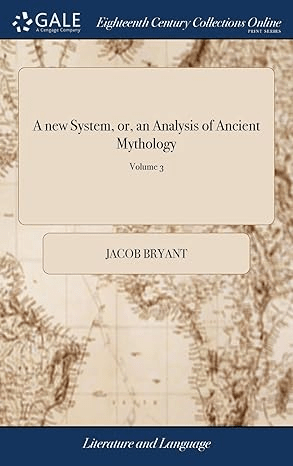
This exchange about German Biblical criticism and the staleness it showed in English models of the same must have amused Eliot. The whole is a kind of scholarly joke that she enjoys more than Ladislaw, for if Ladislaw was ‘not at all deep himself in German writers’, Eliot was very deep in the same, having translated not only Strauss but Feuerbach’s The Essence of Christianity.’ Eliot’s glances a little contemptuously at Ladislaw’s ignorance and moral shallowness when she adds authorially that ‘very little achievement is required in order to pity another man’s shortcomings’. Eliot based her idea of Casaubon’s life work, entitled by Casaubon The Key to All Mythologies since it referred all pagan narrative mythologies back to a true original linear story in the Bible, on Jacob Bryant’s massive 6 volumes of stale eighteenth-century English scholarship, A New System, or, an Analysis of Ancient Mythology. For her, Casaubon’s tragedy as a scholar is that what Bryant could just get away with at the end of the eighteenth-century, Casaubon could not in the 1830s at a time of radical reform, even in things intellectual and spiritual.
What Ladislaw sees in Dorothea is a woman who gives herself entirely to the flow of wind that might arise from the wings of a great man, and although he knows Casaubon is not one, he does not yet know that he might not be exactly that – if in political journalism rather than art or scholarship. That is why he sees Dorothea as an Aeolian Harp, the Romantic image of the passive Romantic consciousness being played upon by the winds of time. Men, even young ones, like that in a woman — as George Eliot (no passive harp to any man’s wind) knew to her cost, but the point is he still compares himself to Casaubon as a sexual rival – but one with the advantage of youth..
There was a new light, but still a mysterious light, for Will in Dorothea’s last words. The question how she had come to accept Mr. Casaubon–which he had dismissed when he first saw her by saying that she must be disagreeable in spite of appearances–was not now to be answered on any such short and easy method. Whatever else she might be, she was not disagreeable. She was not coldly clever and indirectly satirical, but adorably simple and full of feeling. She was an angel beguiled. It would be a unique delight to wait and watch for the melodious fragments in which her heart and soul came forth so directly and ingenuously. The Aeolian harp again came into his mind.
She must have made some original romance for herself in this marriage. And if Mr. Casaubon had been a dragon who had carried her off to his lair with his talons simply and without legal forms, it would have been an unavoidable feat of heroism to release her and fall at her feet. But he was something more unmanageable than a dragon: he was a benefactor with collective society at his back, and he was at that moment entering the room in all the unimpeachable correctness of his demeanor, while Dorothea was looking animated with a newly roused alarm and regret, and Will was looking animated with his admiring speculation about her feelings.
And then the stroke of a novelist’s genius. She introduces Casaubon’s point of view – that bat-like and gloomy vision – into the picture in order to show how relative are points of view and the interpretations (even of the physical looks of characters) they determine in their interaction.
In the three-way encounter of perspectives that follows, Casaubon is made to ‘look’ like the ‘rayless’ counterpoint to a harmonious genius (Apollo-like, such that he can ‘shake out light’) in the eyes of many onlookers. He looks so perhaps to Dorothea, who will see her dried-up, impotent old man Cadaunon as he is in the light of Ladislaw’s sexy youth. But to the reader? I think the reader is made to read more wisely – aware that what we see is is a relative effect of ‘metamorphosis’ based on the ‘uncertainty of’ the ‘changing expression’ which dramatic interactions put in all of our faces as a barying mask of emotions at play.
Mr. Casaubon felt a surprise which was quite unmixed with pleasure, but he did not swerve from his usual politeness of greeting, when Will rose and explained his presence. Mr. Casaubon was less happy than usual, and this perhaps made him look all the dimmer and more faded; else, the effect might easily have been produced by the contrast of his young cousin’s appearance. The first impression on seeing Will was one of sunny brightness, which added to the uncertainty of his changing expression. Surely, his very features changed their form, his jaw looked sometimes large and sometimes small; and the little ripple in his nose was a preparation for metamorphosis. When he turned his head quickly his hair seemed to shake out light, and some persons thought they saw decided genius in this coruscation. Mr. Casaubon, on the contrary, stood rayless.
As Dorothea’s eyes were turned anxiously on her husband she was perhaps not insensible to the contrast, but it was only mingled with other causes in making her more conscious of that new alarm on his behalf which was the first stirring of a pitying tenderness fed by the realities of his lot and not by her own dreams. ….
And then we have Eliot telling us that her novel has meant here to render a new way of seeing:
with the vividness with which we all remember epochs in our experience when some dear expectation dies, or some new motive is born. Today she had begun to see that she had been under a wild illusion in expecting a response to her feeling from Mr. Casaubon, and she had felt the waking of a presentiment that there might be a sad consciousness in his life which made as great a need on his side as on her own’.
Dorothea has learned that all people are other than either oneself and the pretensions they might enact in front of you. In the end this will apply to Ladislaw too who is a lesser man than his self-imagination would ideslise him to be, as are all men: particularly ‘men’, who feed off their mothers ‘udder’. Men make willing servant animals of their mothers, who sometimes gladly collude in playing the role of she who stuffs men with the milk of their self-importance.
We are all of us born in moral stupidity, taking the world as an udder to feed our supreme selves: Dorothea had early begun to emerge from that stupidity, but yet it had been easier to her to imagine how she would devote herself to Mr. Casaubon, and become wise and strong in his strength and wisdom, than to conceive with that distinctness which is no longer reflection but feeling– an idea wrought back to the directness of sense, like the solidity of objects–that he had an equivalent centre of self, whence the lights and shadows must always fall with a certain difference.
George Eliot Middlemarch Book 1, Chapter XXI available @ https://eliot.thefreelibrary.com/Middlemarch/21-1
Sympathy, as defined by the Enlightment Scottish philosopher Adam Smith, was the most active engine of moral philosophy. In a blog by Edward Harpham in 2021 (use the link to read in full) on Smith’s definition of this concept, the writer says, quoting latterly from The Theory of Moral Sentiments by Smith:
Smith believes that the operations of sympathy must be understood in the light of three observations about the human condition. First, we have no immediate experience of what others feel nor any direct entry into the subjective experience of others. All we have are our observations of their actions, expressions, behavior, and words. Note that for Smith sympathy does not provide fellow-feeling through a mechanism like the sympathetic vibrations of violin strings or a contagion-like spread of germs. How, then, is any fellow-feeling of sympathy possible? Smith’s second observation is that we use our imagination to conceive what others are feeling. Fellow-feeling through sympathy is not about directly experiencing the passions or emotions of another; rather, fellow-feeling is generated by imagining being in the situation of the other person and forming a conception of what their subjective experiences are. As Smith explains,
By the imagination we place ourselves in his situation, we conceive ourselves enduring all the same torments, we enter as it were into his body, and become in some measure the same person with him, and thence form some idea of his sensations, and even feel something which, though weaker in degree, is not altogether unlike them.
Nothing here is complex in terms of a moral philosophy but it is definitive of an association between imagination and accessing the thoughts, feeling and sensations of another as a different entity to oneself – but not only a ‘different entity’ but one unknowable but by such massive effort of feeling, thought and the senses. Because it involves the senses this knowing – those feelers which test the reality of objects in the external world and distinguishes them from the worlds that subsist entirely within the subjective, Eliot conveys it by forcing the reader’s imagination to feel it as an element of the world of the physical senses: ‘with that distinctness which is no longer reflection but feeling– an idea wrought back to the directness of sense, like the solidity of objects–that he had an equivalent centre of self, whence the lights and shadows must always fall with a certain difference’.
The solid thing imagined is this ‘equivalent centre of self’ that is defined by the fall around objects of light and shadow that both defines and depens with illusory depth – by the imagined object of design that painters call chiaroscuro in which the solid is conveyed by that which is not – light and its absence in interaction around objects.
It is possible that we can use sympathy (or empathy as we prefer to call it these days) in conjunction with imagination too much. Eliot sometimes writes (in the same novel and on the same set of subjects) of a distinctness of the conception of another – however lowly or ordinary – that might cause our death of ‘the roar which lies on the other side of silence’.
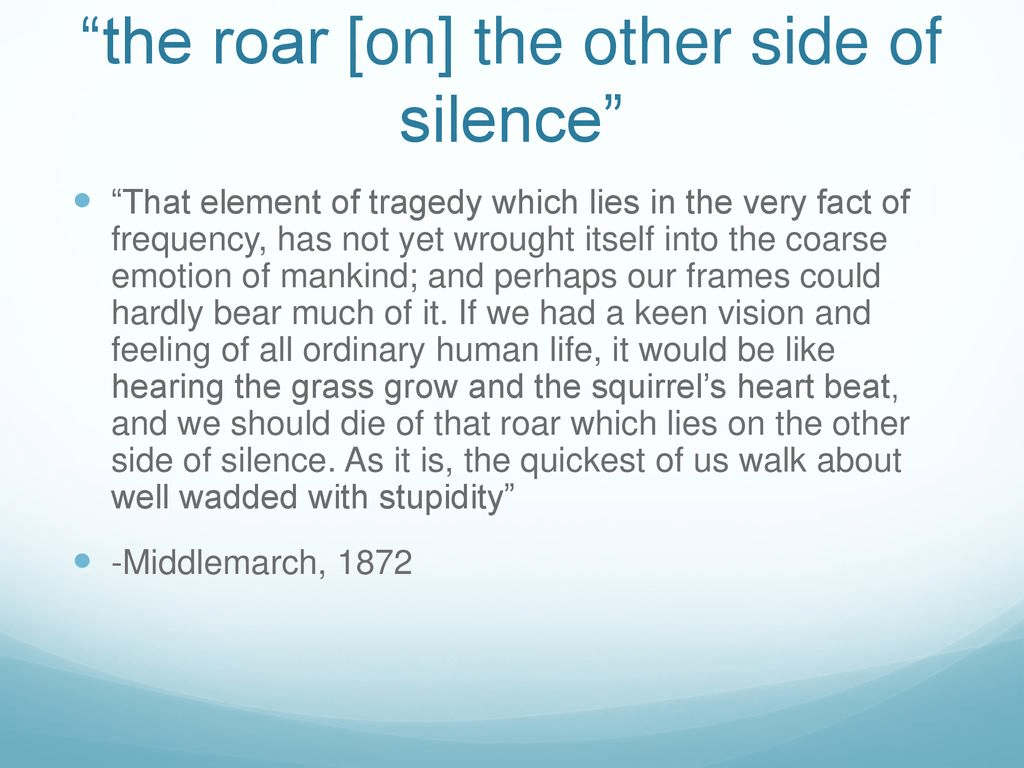
That is because otherness is an immense space full of regularities of sound and light that we can only fear, so lacking are they in boundaries. And so back to ‘Yayoi Kusama, in her infinity rooms’. I have written blogs on Kusama elsewhere, which might make the contrast exciting. They revolve around preparation to see her show in Manchester, seeing the show and then reflecting afterwards. See them at the links if you wish.

What then could I ‘do differently’? I could read for otherness and dare to face it.
With love
Steven
 Steve_Bamlett_blog