


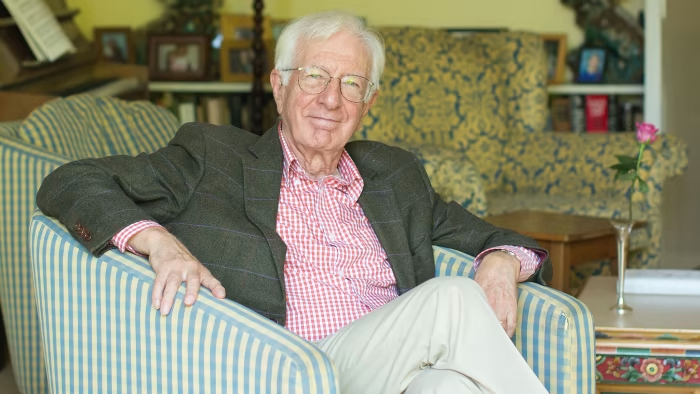
Photo by Rick Pushinsky of Richard Layard: the ‘happiness Tsar’ under the Tony Blair regime from Annie Maccoby Berglof article in ‘The Financial Times’ ( September 12 2014) available at: https://www.ft.com/content/b1d0b140-3386-11e4-85f1-00144feabdc0
We hear much less of ‘happiness’ since the termination of the Blair-Brown government but perhaps it will return under Keir Starmer, who needs an ideology to hang onto at the moment. It must be one that equates economic growth with well-being, with ‘happiness’. Layard wrote a book called Happiness: A New Science, and was co-author of the World Happiness Report, summarised thus by an Annie Maccoby Berglof article in ‘The Financial Times’ ( September 12 2014) :
which ranks countries according to how happy they are by taking into account factors such as gross domestic product, life expectancy, social support, freedom to make “life choices” and levels of corruption. Importantly, Layard has urged governments around the world to focus their economic policies on happiness and wellbeing rather than wealth.
(available at: https://www.ft.com/content/b1d0b140-3386-11e4-85f1-00144feabdc0 )
That all sounds rather hollow now when we know that economic growth without limit can never sustain the hope of a planet on which many species will not survive, let alone be happy. People don’t use the term ‘sustainable economic growth’ anymore, and less so do governments who edge their bets on political survival on raised living standards for ‘working families’. Raised living standards are seen to be limited by government regulation of enterprise and these governments assume (and they may be right, unfortunately) that people care more about their personal financial circumstances in whatever desert of public poverty we live than in the common good.
How did the Tsar define happiness? He said to Maccoby Berglof that happiness is ” leading a life which satisfies you and that is surely what economic policy should aim to provide.” He added ‘that some policy makers are warming to the idea of substituting happiness for the GNP as the gauge of economic performance’, and instanced Angela Merkel, the German Chancellor then, a voice of relative centrist decency now thoroughly forgotten. But when we put ‘happiness in the scales of public policy and make it a state responsibility, then surely alarm bells ring. Imagine a society where the aim of a political elite was to encourage only the expression of happy, or ‘positive’, thought, and any thought that was critical of the present was a crime. It need not be punished severely as a thoughtcrime in a Ministry of Love, as it is in Orwell’s 1984. It needs to be though considered anti-social or alien to stop people either feeling it (or hiding it) or being able to express it in public.
Phrases like ‘opium of the masses’ resound in your head when you think of this. Societies where ‘happiness is compulsory see contrary thought as ‘thoughtcrime’ (as it is called in Orwells’s 1984) because any feeling or thought that does not validate the status quo and shatters the idea of being happy with the present is a crime. Censored thus by being thought unthinkable, or anti-social, individuals would hide that they had such thoughts or feelings, even to themselves such that they claim they never have them, in order to fit in.
There may be no acceptable language for expressions of critical thought, for it would be branded as ‘negative’, or as ‘self-indulgent’ or unkind to others who manage to suppress or control such thoughts and are proud of doing so. We might invent a language that re-frames experience so that it is always interpreted as having a ‘bright side’ or having some ‘positives’ in it. We end up with ‘Newspeak’, a language in which the only words available are those with ‘positive’ associations.
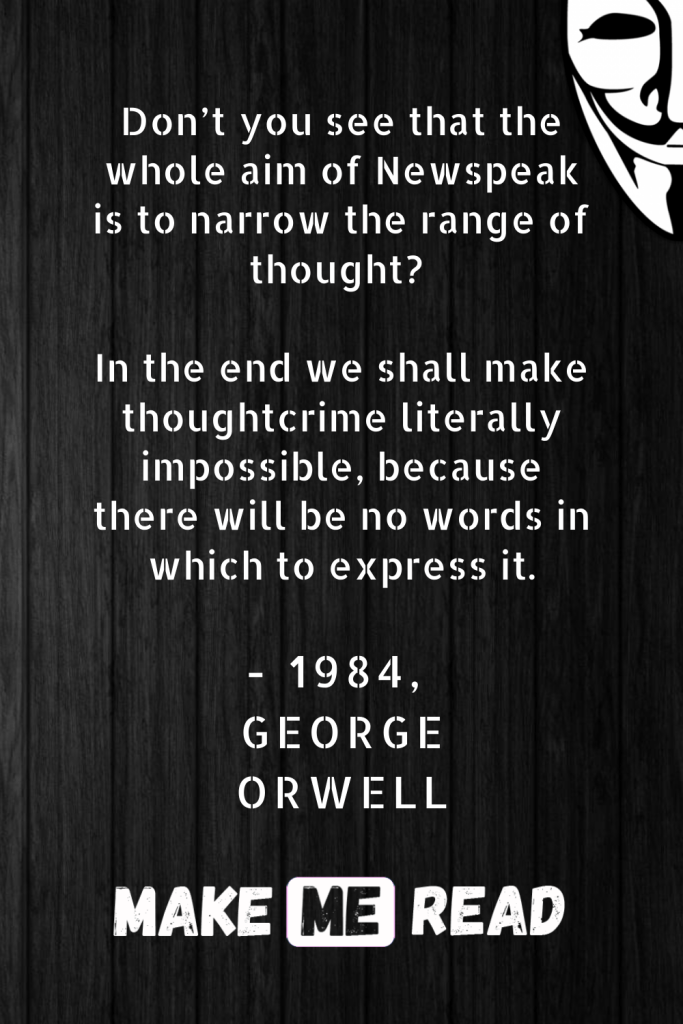
Sometimes I feel that to see the bleakness of the current political landscape and its constraints on divergent liberty of thought is to struggle with yourself and the repertoire of available language for use in public to speaknof it. We are becoming a society where to want genuine change in the status quo is to face the terror of wanting a thing that for which ‘you have no words to express it’. This is perhaps too what Marx means by calling religion the ‘opium of the masses’: it creates a newspeak in which hope is elsewhere – in some internal or transcendent realm – not in the present. But surely it is worse if you are convinced that you can be happy in whatever world you live now if you say, feel, think and act in an accordant script with the right words, emotions, thoughts, and behaviour .
One further issue with Layard was that he emphasised that feeling happy was a social issue but only in as much as society facilitated the willingness in people to be happy in word, feeling, thought and behaviour and his programme initiated in the UK and the USA a strong tendency to ensure people had opportunity and were educated, or brainwashed, to believe the answer for them was to regulate their mental health. The aim of good mental is moreover to get people back to work and reduce the cost of mental illness to social policy, and increase economic growth. It is terribly convenient for capitalist societies to frame happiness as an aim thus.
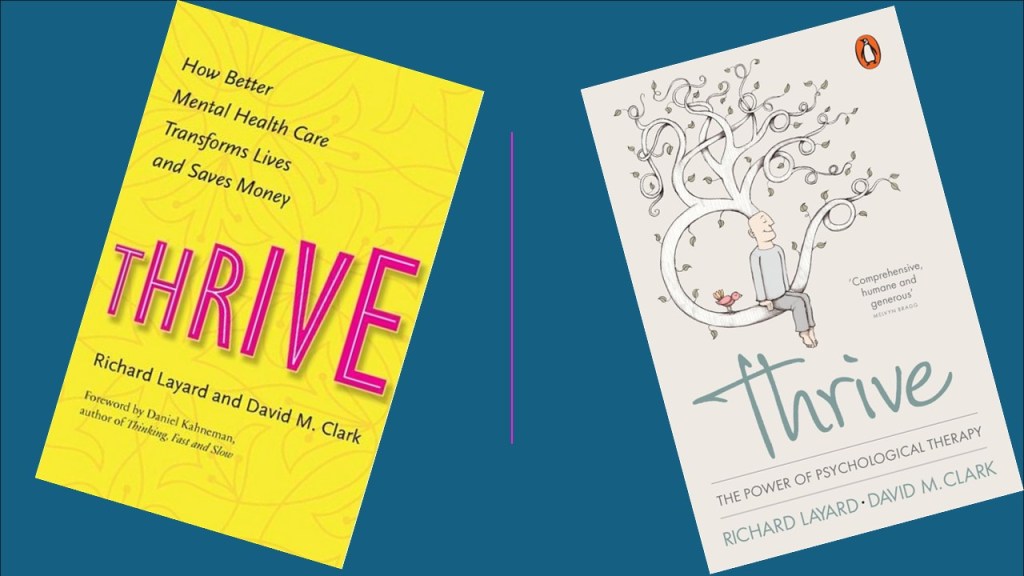
In his book Thrive, co-authored with David Clark, he promoted ‘new’ mass treatments ‘for anxiety and depression, CBT (cognitive behavioural therapy), that had been tested in randomised trials’. Maccoby Berglof continues the story thus:
In 2005, Layard and Clark pitched a new psychological service, Improving Access to Psychological Therapy (IAPT), to the UK government: “We proposed making evidence-based [talking] therapies, including CBT, available to all who need it,” says Layard. The pair even convinced the government to train 6,000 therapists across the country. “We’re treating 400,000 people and want to double that.”
I was one of those trained workers and my own experience makes me sceptical that anything but a fashion was started by this initiative in Primary Care, that soon settled back into the ‘same old’ service. It is no longer sustainable, for instance, to talk of the evidence for CBT’s superiority to other treatments and the enduring effects of the therapy are neither proven nor provable. The new Labour Government seems keen to revive it again as a pathway to increased employment by both the adult and youth unemployed population, together with mass responses to obesity, illness, disability and punitive approaches to resistance to engagement among those involved. We are in a strange time politically, as ‘growth’ is lauded and the real consequences of environmental and climate degradation ignore.
But my concern here is that we need to be aware that ‘Happiness’ is a problematic goal. Layard’s ideas boiled down sometimes feel to me no more valid a definition than the late Ken Dodd’s in his song lyrics, for ‘Happiness’. Dodd was a strange mix of sentimentality and playfiul ‘insanity’. It defines ‘happiness in its inane refrain as a gift, as something inherited but though it is not the creation of wealth, status or power it inheres in simple things – being in love, and equating that with the beauty of the natural world order:
Happiness, happiness, the greatest gift that I possess
I thank the Lord that I've been blessed
With more than my share of happiness.

To me this world is a wonderful place
I'm the luckiest human in the human race
I've got no silver and I've got no gold
But I've got happiness in my soul.

Happiness to me is an ocean tide
A sunset fading on a mountain side
A big old heaven full of stars up above
When I'm in the arms of the one I love.
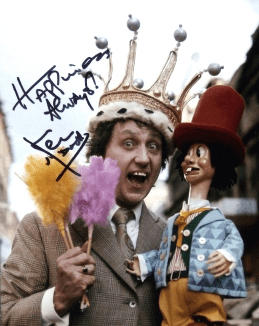
He even seems to have met Layard:
A wise old man told me one time
Happiness is a frame of mind
When you go to measuring my success
Don't count my money, count happiness.
And the effect of this meeting is to see that ‘happiness’ is ‘neither inherited gift nor innate divine blessing but a ‘state of mind’. He only need to learn that you have to work at that ‘state of mind’, enroll with IAPT (after a considerable time on a waiting list) and ignore the fact that other people have more than one and enjoy what you can, and ‘whistle while you work’ like any Diddy Man at the Knotty Ash jam-butty mines..
The etymology of the word ‘happy’, and other words with the same meaning of being in a state os satisfaction have all seemed to transformed from their roots, in this case ‘hap’, meaning an occasion of chance or fortune either good or bad, to have only a positive meaning of ‘good fortune’, or ‘good chance’, in short being ‘lucky’. See etymonline below:
happy (adj.): late 14c., “lucky, favored by fortune, being in advantageous circumstances, prosperous;” of events, “turning out well,” from hap (n.) “chance, fortune” + -y (2). Sense of “very glad” first recorded late 14c. Meaning “greatly pleased and content” is from 1520s. Old English had eadig (from ead “wealth, riches”) and gesælig, which has become silly. Old English bliðe “happy” survives as blithe. From Greek to Irish, a great majority of the European words for “happy” at first meant “lucky.” An exception is Welsh, where the word used first meant “wise.”
But the modern ‘happy’ is not a chance or stroke of fortune, but a duty – something that turns you into a productive working unit and a good citizen, happy with your lot where it can’t, apparently, be changed.This person avoids ‘triggers’ that mean we think outside the box which at least contains over emotions, thoughts, words and actions. When am I most ‘happy’? It’s a scalar measure that belongs to the those whose reach does not exceed their grasp. At the end of Layard’s interview cited above, he is asked if he is happy. His answer is predictable:
There is one final and obvious question: is Layard happy? “Most of the time but not always. Particularly if you’re trying to get things done, you’re not going to be happy all the time, are you?”
The first bit of this answer is somewhat of an unverifiable statement but the second is a truth: To be happy all the time, it implies, you must feel that you have nothing to achieve for self or others. I think it unlikely Layard is the definition of a happy man now, even though Starmer has revived his mode of action as a national goal.
All my love
Steven xxxxxx


2 thoughts on “The ‘happiness Tsar’: the ideology of well-being despite every circumstance.”