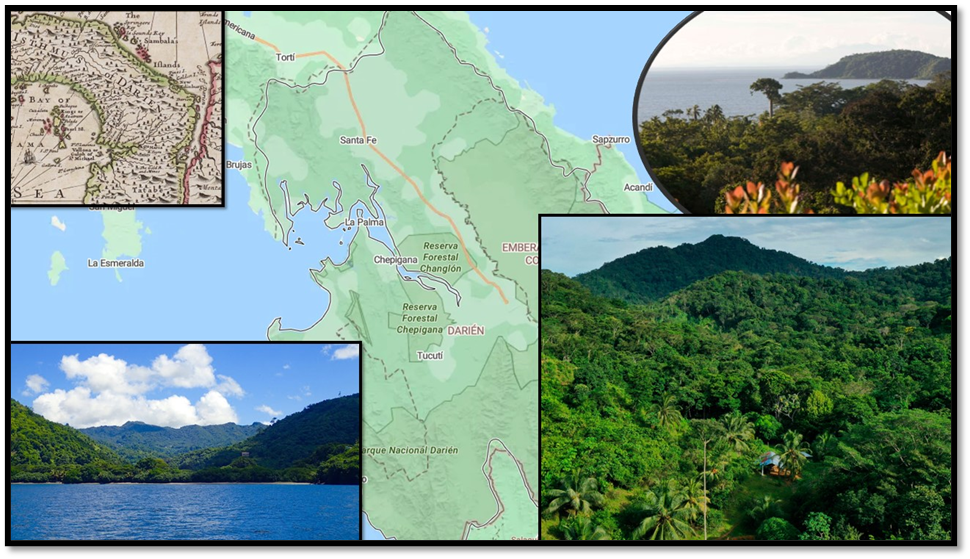
Let’s wait for a moment on a peak in Darién Province in Panama in South America. Why are we waiting? We got to Darién Province, not through its history of colonisation, though it is a fairly interesting story, having seen off the ill-fated Scottish mercantile project of subsuminf it to Scottish rule in the eighteenth century, and only conquered by Spain later. We got there through an eagle-eyed reading of John Keats’ On First Looking into Chapman’s Homer. And, having got there by this mode of imaginary travel, we are waiting to see the ghost of Hernándo Cortés stand ahead of us on this peak staring into the Pacific with wonder but also some of the eager hunting instinct of an eagle.
What Keats writes in this sonnet is:
Then felt I …. /… like stout Cortez when with eagle eyes / He star’d at the Pacific—and all his men / Look’d at each other with a wild surmise— / Silent, upon a peak in Darien.
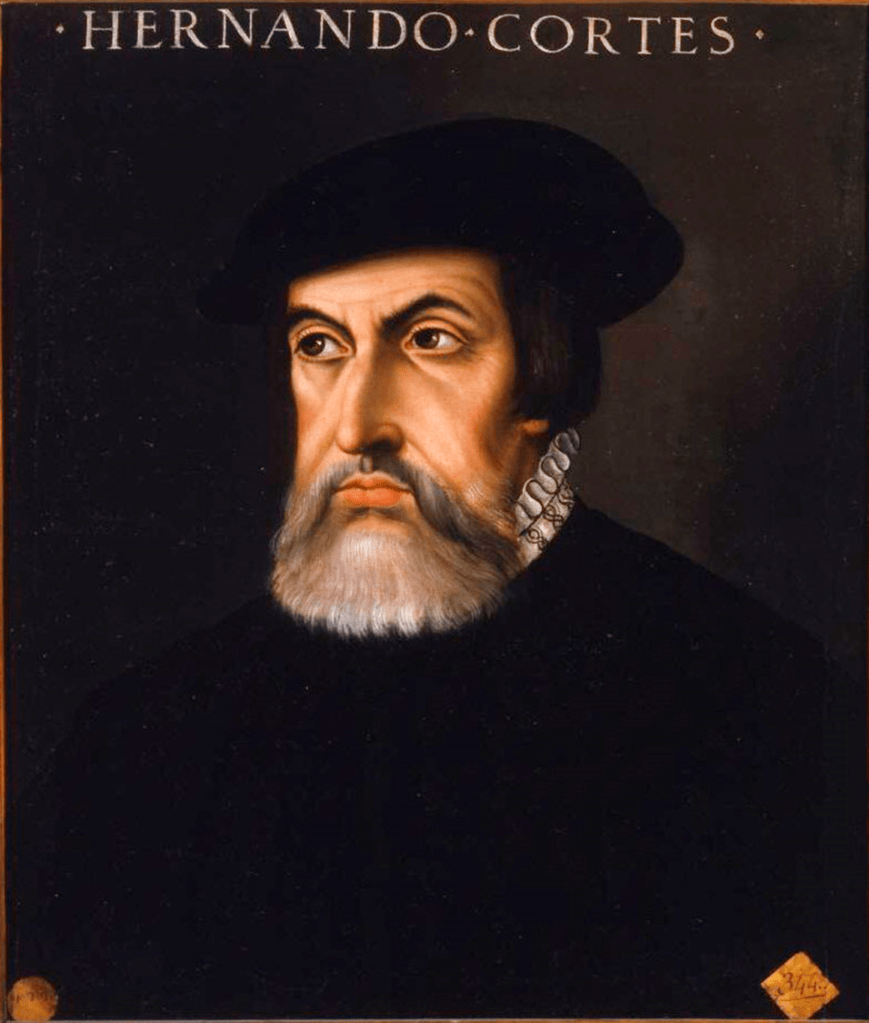
But the truth is Hernán Cortés never went to Darien, let alone stood there eyeing up the Pacific for reasons of wonder or, some kind of observation motivated as is the eagle, with the desire to find, seize and devour its prey. Keats first wrote of ‘Cortez’ [sic.] having ‘wond’ring eyes’, only later turning the phrase into ‘eagle eyes’.
We know, for Wikipedia tells us, that Keats source for these words were William Robertson’s History of America, but though Robertson speaks of both Darién and Cortés, he does not conflate the two in one story. Cortés plundered Mexico and the ‘Bay of California’ for Spain and Imperial Chritianity, enriching himself, the Spanish Crown and Spanish Catholic Church with the gold and subservience of indigenous Mexicans he sought there. Robrtson deals with Darién in his description of the adventurer, Vasco Núñez de Balboa, whose expedition , in Wikipedia’s words, ‘to see the eastern shore of the Pacific’ was in 1513. Here is how Balboa is cited by Robertson:
At length the Indians assured them, that from the top of the next mountain they should discover the ocean which was the object of their wishes. When, with infinite toil, they had climbed up the greater part of the steep ascent, Balboa commanded his men to halt, and advanced alone to the summit, that he might be the first who should enjoy a spectacle which he had so long desired. As soon as he beheld the South Sea stretching in endless prospect below him, he fell on his knees, and lifting up his hands to Heaven, returned thanks to God, who had conducted him to a discovery so beneficial to his country, and so honourable to himself. His followers, observing his transports of joy, rushed forward to join in his wonder, exultation, and gratitude. (Vol. III).
Balboa was no less avaricious of riches, power, and the blessing of the Spanish brokers of that power in Church and State, than was Cortés, but still Keats changed the man who sought to first see the Pacific in his poem. People assume he made an error based on a book he read some time ago, and from a library, but it is equally plausible that the name of Cortés was much more likely to convey the distaste for the Spanish brand of Imperialism the British intelligentsia so hated. It was also easier to fit into syllabic verse.
But the insistence on Cortés and his dreadful reputation for rapacity should make us read this poem a little more closely. Here it is in full:
Much have I travell'd in the realms of gold,
And many goodly states and kingdoms seen;
Round many western islands have I been
Which bards in fealty to Apollo hold.
Oft of one wide expanse had I been told
That deep-brow'd Homer ruled as his demesne;
Yet did I never breathe its pure serene
Till I heard Chapman speak out loud and bold:
Then felt I like some watcher of the skies
When a new planet swims into his ken;
Or like stout Cortez when with eagle eyes
He star'd at the Pacific—and all his men
Look'd at each other with a wild surmise—
Silent, upon a peak in Darien.
On First Looking into Chapman’s Homer by John Keats is generally read as a kind of dreamy appreciation of the power of translation into English, by a skilled poet, of one of the greatest achievements of the canon of Western literature. But, when we read of Cortés, we must beware of thinking of the ‘realms of gold’ as an innocent reference to excellence and rarity, for gold is also lucrative. The wealth of seventeenth century Spain, fabulous in the eyes of the then world, was a matter of raptor greed, backed by violent genocidal robbery. The eagle is such a raptor.
Chapman not only wrote a fine poem but found something grand and glorious in the past and robbed it. Translation is a kind of cultural appropriation, after all, and Chapman’s Homer is very much of this quality. A poem Englished in a metre not that of the original and stolen for ghe purposes of feeding into the ambition in England to write a great epic – a theme taken up by Edmund Spenser and later John Milton.
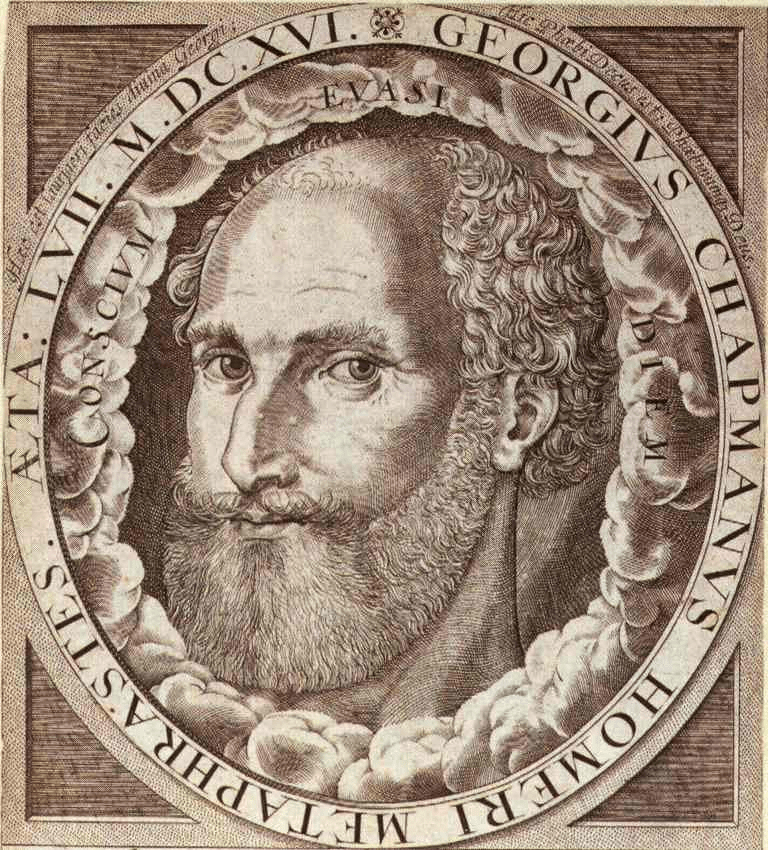
Chapman’s reputation must have interested Keats. He was poverty stricken for most of his life, though revered by other peers as dramatists and translators. The fortune of poets often depended upon their skill in finding a patron to support their ventures. The patrons chosen by Chapman were not luckily chosen: as Chapman’s Wikipedia entry attests: ‘Robert Devereux, Second Earl of Essex, and the Prince of Wales, Prince Henry both met their ends prematurely. The former was executed for treason by Elizabeth I in 1601, and the latter died of typhoid fever at the age of eighteen in 1612′. Chapman nevertheless must have looked eagerly (or eagle-eyed at them) to them as his proem in praise of Prince Henry attests, where he gives Homer to Prince Henry to compare his use of it as a conqueror of worlds and extender of the British Empire (a term introduced by Henry VIII from Byzantine models of Kingship). He aims to immortalise Henry:
And, with the princely sport of hawks you use,
Behold the kingly flight of his high muse,
And see how, like the phœnix, she renews
Her age and starry feathers in your sun,
Thousands of years attending ev’ry one
Blowing the holy fire, and throwing in
Their seasons, kingdoms, nations, that have been
Subverted in them; laws, religions, all
Offer’d to change and greedy funeral;
Yet still your Homer, lasting, living, reigning,
And proves how firm truth builds in poet’s feigning.

A prince’s statue, or in marble carv’d,
Or steel, or gold, and shrin’d, to be preserv’d,
Aloft on pillars or pyramides,
Time into lowest ruins may depress;
But drawn with all his virtues in learn’d verse,
Fame shall resound them on oblivion’s hearse,
Till graves gasp with her blasts, and dead men rise.
No gold can follow where true Poesy flies.

(Source: https://www.gutenberg.org/cache/epub/51355/pg51355-images.html)
The reference to poetry as in a different domain to ‘gold’ must reflect on Keats ‘realms of gold and ironically, as must the raptor imagery. What Keats appears to see is himself in the light of Chapman contrasting the greed for fame, power and gold with the true aim of poetry, the immortal. But though Chapman too appears to say this, we know he lusted for gold too, as much perhaps as did Cortés. Homer is cheapened by those who appropriate him to find ‘gold’ whether as the emblem of wealth, power or fame, but to be without the means to live is a sorry thing for a poet.
This is where then Keats’ sonnet lives – it is full of fame-seekers, even the reference to ‘the recent discovery of Uranus with a telescope in 1781 by William Herschel, Court Astronomer’ to George III, for: ‘Herschel was not the first person to have seen Uranus, but he was the person to have it recognised by the world as a planet’ (Wikipedia). If Cortés had looked for the Pacific, he is certain that he and his .men’ would have wished to capitalise on it as a source of colonies, wealth and trade that benefited only the European Western mercantile capitalists, and the state and church that fed off them. The ‘wild surmise’ about the Pacific is that we can make money out of this vast expanse, entitled a thing of PEACE. Homer’s “pure serene” is a pacific thing. The mercantile motivation of European imperialism and discovery in the interests of personal fame was not.
Read the poem again: it is a richer attack on the replacement of things of the ‘soul’ and ‘spirit’ for worldly wealth than you have ever read – it underlies the irony of Keats’ life and death in relative poverty like Chapman’s life and death in equally relative poverty.
Much have I travell'd in the realms of gold,
And many goodly states and kingdoms seen;
Round many western islands have I been
Which bards in fealty to Apollo hold.
Oft of one wide expanse had I been told
That deep-brow'd Homer ruled as his demesne;
Yet did I never breathe its pure serene
Till I heard Chapman speak out loud and bold:
Then felt I like some watcher of the skies
When a new planet swims into his ken;
Or like stout Cortez when with eagle eyes
He star'd at the Pacific—and all his men
Look'd at each other with a wild surmise—
Silent, upon a peak in Darien.
And read it before you buy a world cruise in order to stand on a peak in Darién Province .
With love
Steven xxxxxxxxxxxx
 Steve_Bamlett_blog