


The Parade website contains a page (use that link to see it yourself) listing 75 potential ‘pet peeves’/ It defines this strange concept thus:
“What is a “pet peeve”?
Dictionary.com defines a pet peeve as “a particular and often continual annoyance; personal bugbear: This train service is one of my pet peeves.”
They tend to be behaviours done by others that ‘get on your nerves’: creating, that is, a kind of involuntary unreasonable response in you, like someone cracking their knuckles in public. Note the last two words – it isn’t the behaviour that annoys it’s the implied right of the person to behave in front of other (most importantly in front of you) without considering your feelings about the matter. In the end it seems based on a desire to control others,
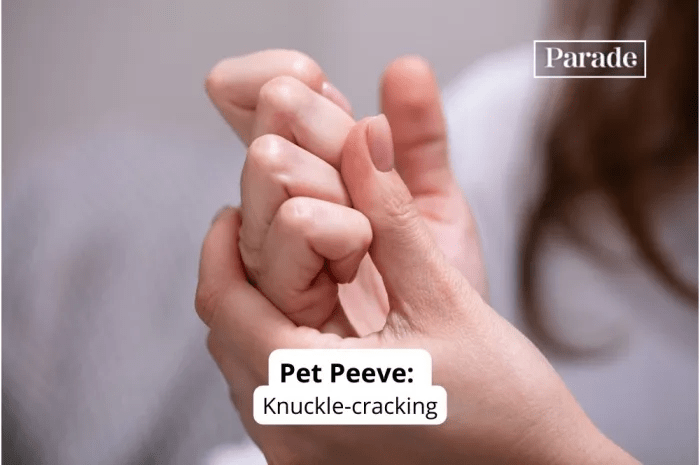
I find the word ‘pet’ interesting. It is as a if this peevish response was something you rather liked and considered your own to posses, a self-defining trait you love and take with you everywhere, like a lapdog. Etymononline sees its use thus:
pet (adj.)
1580s, of an animal, “fondled and indulged,” from pet (n.1). Of a thing, material or immaterial, “favored, favorite,” by 1826.
But the words are interestingly protected too like me we protect those or that we ‘pet’. I expect most word rather not extend the noun ‘peeve’ into the descriptive adjective I just used, ‘PEEVISH’, for we tend to think peevish people are people rather selfishly inclined to dislike others, though according to Etymononline ‘peeve’ is a back formation (a later word created from an older world) from peevish, with the form ‘pet peeve’ being a softening of ironic use od a word that harshly describes either ‘”irritate, exasperate,” 1907 (implied in peeved), back-formation from peevish. Also “to grumble, complain” (1912)’. b y virtue of invoking ‘pet’ as a ‘ “especially cherished thing” (1826), here in jocular or ironic use with peeve (n.) and perhaps a suggestion of pet (n.2)’. The ‘jocular and ironic’ sense is important – we rather make a littkle joke of the fact that we are so easily offended by something so trivial as hearing or seeing knuckle-cracking;
As peevish the word seems from the 14th century in English to have denoted not really a rather mean and nasty suggestion about the person to which it is applied as an adjective but one that diminishes their perceived capacity of judgement – the possible origin from the word that became from Latin the name ‘pervert’ is absolutely fascinating if true
late 14c., peyvesshe “perverse, capricious, silly,” a word of uncertain origin; probably modeled on Latin perversus “reversed, perverse,” past participle of pervertere “to turn about” (see pervert (v.)). Original sense was obsolete from 17c. The meaning “cross, fretful. ill-tempered” is recorded from 1520s. Related: Peevishly; peevishness.
also from late 14c.
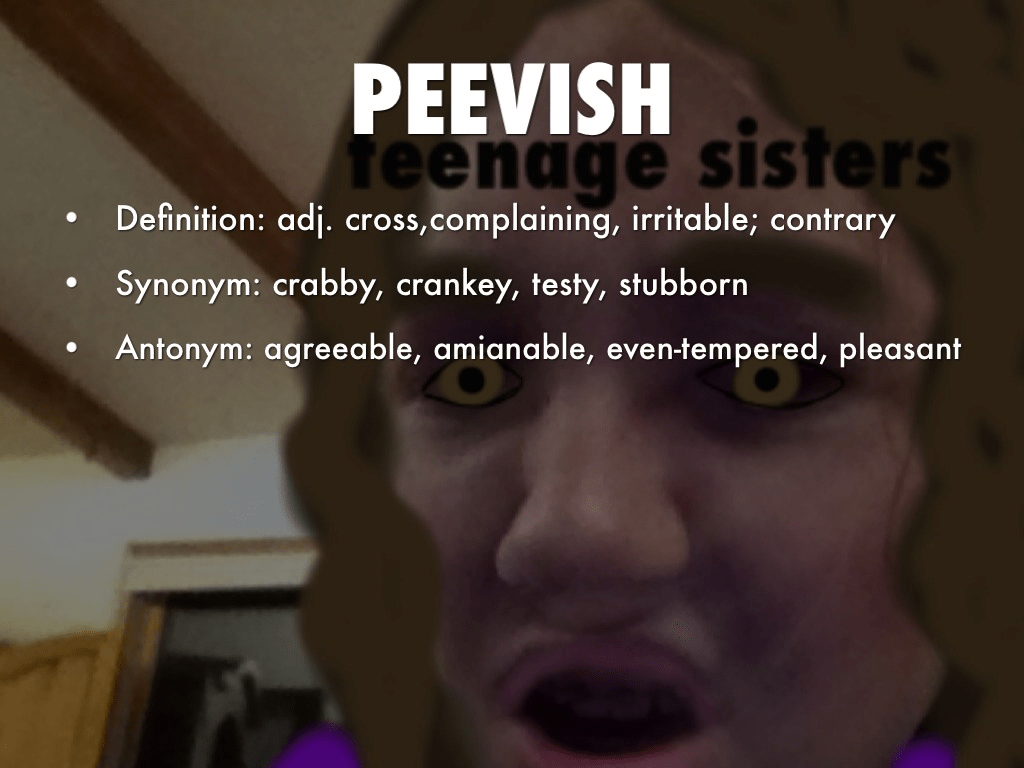
Who would from the associations of the word (antonyms and synonyms, as well as the photograph) above want to be ‘peevish’ in the terms of this modern aid to vocabulary. Yet we hug too our ‘pet peeves’, accept with irony and jocularity that we all have ‘pet peeves’. But i think i might resist the temptation to ‘normalise’ myself thus and name MY pet peeves, One of the most telling of the 75 Parade pet peeves mentioned above iun number 44, which goes thus:
44. Lack of boundaries in general: Ever meet a person for the first time and before you know it, they’re sharing personal details that you’d never want to learn? Or someone who is constantly in your personal space? Something about a lack of boundaries is just mind-boggling.
My feeling about this is that it is the very essence of the hugging to ourselves of the ‘pet peeve’: a desire to protect one’s space from incursion of what we need to feel is ‘other’ than us.The need to set up boundaries is more easily understood if we call them borders or defences, or even barriers. The purpose of all of these is twofold:
- To define what I or we’ are in contradistinction to what is ‘other’ or beyond the ‘pale’ (pale being an older term for boundary).
- To defend ourselves from ever confronting that ‘other’: hence they remain other – not known and not desired to be known. The commonalities of the supposed other to our-self are forever unexplored and unknown. It can be popular. People in the USA seem attracted these days by building a wall along the Border to Mexico.

Trump wants the 80 mile wall to be painted ‘black’ throughout.
The neoliberal world that is so desired by Elon Musk, Donald Trump and their laughable British associate, Kemi Badenoch (and possibly this vapid present Government in the UK without principle or direction) is one where we defend our national identity whilst being unable to define it except by the walls we build around it, even ironic and jocular ones, that never ask or care about why people may have certain unconscious tics, lest we find we have them too – one being the building of dislike of others around petty causation and willingness never to expose our own alterities to ourselves. I wish people would. Perhaps they are my pet peeves; namely:
- People who cherish their pet peeves;
- Petting peevishly rather than loving openly; and;
- ‘Why beholdest thou the mote that is in thy brother’s eye, but considerest not the beam that is in thine own eye?’: the implication is that someone is ignoring a glaring fault of their own while criticizing a smaller one in someone else. The Co-Pilot assistant citing Matthew 7: 3-5.
There! I have done it. Peevishly typed out my own pet peeves (in an ascending order of significance) . Woe is me. I have sinned! Mea Culpa! LOL!
With love
Steven xxxxxxx
 Steve_Bamlett_blog