What’s the longest trip you’ve ever taken?
View all responses
Stories that stay mainly in one place can often travel further imaginatively – using dimensions in outward and inward space, time and the motility of focal choice in the the storytelling. This is a blog on the film Pressure directed and edited by Anthony Maras and written by Maras and David Haig, based on Haig’s 2014 stage play.
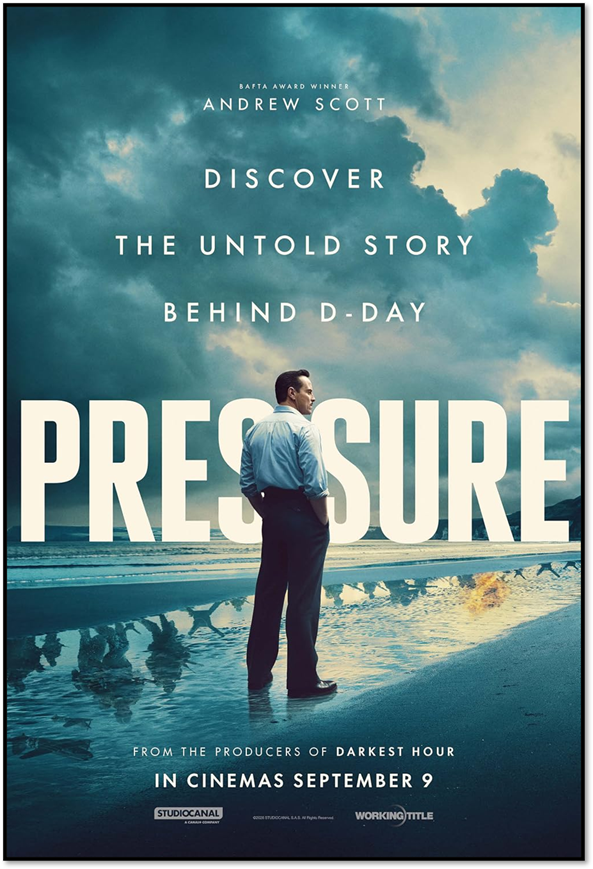
Geoff and I went to see Pressure, the new film about the 72 hours before the launch of the D-Day invasion really to see Andrew Scott, an actor so fine that the most buried emotion can be conveyed alongside the whole meaning of a character in their stance, the movements of the body in supposed stillness and motion, whether the latter has a purpose or not. Publicity boasts that the film gives us an ‘untold story’, though no-one would not know that an invasion by sea did not have to include a concern about the manner in which weather conditions and their effects on the sea, the visibility and movement on land and the skies was expressed and handled before such an event. Hence, it is easy to make this focus seem boring and nerdish. This then was the approach of the Guardian’s choice of critic when the film was released in the United States on May 29th, we in the UK had to wait until yesterday, the 9th September. For Jesse Hassenger the film had potential but only as being a good Dad-movie, a genre he defines by its intended audiences:
two adjacent demographics: weather dads and history dads. Those designations are honorifics, not gender-essentialist; spiritually dad-curious people of all ages (but, let’s be real: mostly over 50) may be interested in a behind-the-scenes story set in the last few days leading up to the allied invasion of Normandy in June 1944. Because this is the largest-scale seaborne invasion ever mounted, weather is a major factor, and the movie follows military higher-ups as they work around the clock trying to figure out whether a possible incoming storm will create unfavorable (sic.) or impossible conditions.[1]
Geoff and I are both well over 50 but have never been Dads or that strange invention of this critic, ‘dad-curious’ people. We have the potential to find war celebration movies distressingly irrelevant (given the issues of the Second World War at a moment when fascism was to become the common enemy of democracy in particular – something challenged so much in our current climate of far-right hate) and with a trendy distaste for the supposed British weather-obsession in a time where we ought to be addressing the cause of climate change. In brief, this would not normally be a film that, in description only, would attract us, so we went only to see Scott. However, having watched it what stays with me is not only Scott’s performances, and frankly those of others either as stereotypes of the bulldog hero sometimes seen in General Montgomery by Damian Lewis (but brilliantly performed) or the quite paternal typing as of a kind of caring but oft irascible ‘Dad’ Dwight Eisenhower Foster shines), concerned most by the care of his young soldiers by Brendan Foster, but the skill, beauty and meaningfulness of the story-telling.
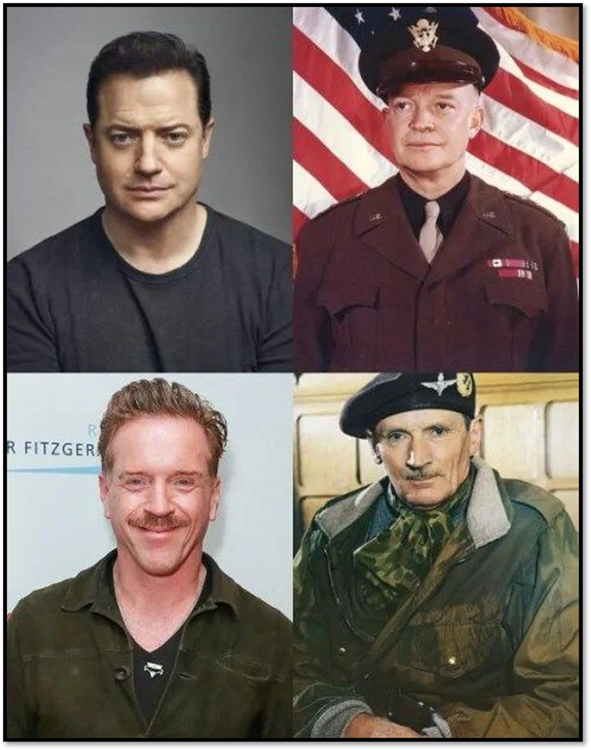
I want to say that first before quoting Hassenger again, because he clearly found nothing at all to remark upon in the mode of delivery of the story, that wasn’t to be expected, finding only what is jaded and already done in Spielberg’s Saving Private Ryan (referring of course to use of contemporary D-day footage alongside new filming or AI recreation). Here is what Jesse says:
The overriding problem is not the performances; it’s that they’re in service of repetitive character dynamics, all presented in the usual Focus Features palette of cool blues accented by military-jacket greens and browns. Meetings are held, Eisenhower demands answers, Krick insists that the mission needs no delay, and Stagg corrects him, as Summersby stands by and attempts to smooth things over – especially once Stagg hears that the pregnant wife he left at home may be in danger. Minor variations on this cycle unfold repeatedly, and when Maras attempts to broaden his scope with dramatization of the actual invasion (spoiler alert: D-day did occur), it betrays the movie’s attempts at a smaller-scale pressure-cooker, all for some poor-man’s-Saving Private Ryan montage work.
It would be delightful to report that this intersection between nerdy science and military history is a crackerjack dad movie, but Pressure never digs far enough into the procedural detail of its dual subject areas, especially Stagg’s expertise in meteorology. That kind of immersive nerdery would distinguish the project from any number of better thrillers – or a lower-tier made-for-HBO movie from 2002. Despite a few sparky face-offs between the actors, Pressure feels destined for a less notable fate: to cause plenty of armchair naps once it hits streaming.[2]
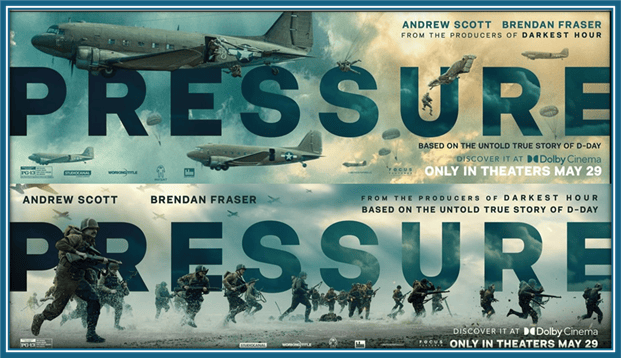
You couldn’t write a more damning review if you chose, although there is a way in which Jesse may be correct – watched in the way he sees it as a few dialogues of encounters and limited scenes of battle action, it would indeed send you to the sleep that critical minds as limited in their observation as Massenger’s apparently mimic well enough whilst awake. I say this because the film has a kind of lyrical beauty in its scope of visual and dramatic grasp to my mind, an alertness to the meanings of ‘pressure’ beyond those descriptive attempts to grasp the thermodynamics of a ‘pressure-cooker’. Of course the film publicity may have in part led to this reading of the novel as a vessel containing up energy before the release that D-Day might be considered by its publicity, which seemed to promise war action on a scale of ‘epic release, as in the two examples from the USA collaged below:
To me, the story-telling owed more to Oppenheimer, except for the duration (quite contained at 100 minutes for this film) which also tries to visualise some aspects of scientific theory in visuals alongside more conventional, if enthralling, dramatic-narrative mode (see my blog on that here). The nub of the contrast I make lies in the generic shifts in the story-telling, not unlike those in Shakespeare’s Henry V, where ‘a little touch of Harry in the night’ is made available to the romping English soldiers including a band once the friends of Falstaff.
Eisenhower and Monty’s English and American land-soldiers appear in night scenes in quite another mode, without the physical presence of the commander amongst his ‘boys’ but in scenes that cut between the boys aping heterosexual dance holds with each and rolling around in body contact half playful and half based on fighting that are cut with scenes of Scott as James Stagg trying to contain and control his anxiety about the coming day, the pressure on the weight of his weather predictions and his grief at the news that his wife may have been the victim of German bombs in a hit on St. Mary’s Hospital in London, with which he is not cleared to make contact. Stagg/Scott holds it in literally by grabbing onto to a wire perimeter of the temporary army camp whilst racked with anguish that perhaps undercuts male play and plays out for them emotions the boys are too young to feel (another myth of age and class indeed).
In truth the thesis of the script is clearly that both Eisenhower, his military, naval and aircraft under- commanders (with the exception of the boy-like gung-ho of belligerent Monty as he is played here (for whom lives lost is so much more grandeur) by Lewis, are motivated by minimising or at best optimising the loss of the lives of these soldiers. We see Monty touch the hands of the departing soldiers as if in parental care.

But it is the anxiety of complex multiple anxieties about the future in Stagg that drives the need for a model foil to the paternal care about the lives of young male soldiers the film takes as its emotional centre, much like that of worthy kings in Shakespeare’s plays,fathers of their people caring about their lives. It’s a myth but a beautiful one. Below he is receiving the call about his wife’s possible loss in an air-raid, whilst Eisenhower even shows his concern for him too – one that he will not and cannot show directly to Stagg. The shot collaged below that is one of the many beautiful very young men (the same who played through the night at the army camp) we see gazing out at us, though they see not us but the fearsome location of the Dunkirk beaches in front of them which the film insists they did for us, a view I can’t ever feel cynical about).
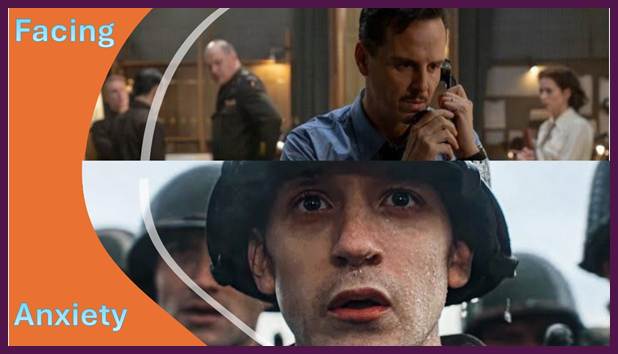
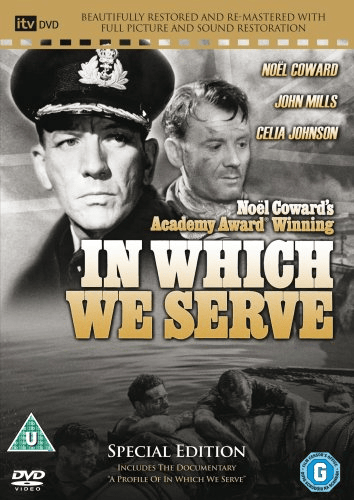
All of this lives at the level of sex/gender stereotypes that are taken seriously in films in the 1950s (such as Noel Coward’s In Which We Served) but here played as narrative tropes with symbolic meaning, a bit like the manner of Shakespeare on war.
Likewise the same might be said of the actor that Hassenger feels to be the best of the troup:
…, Pressure adds the always-welcome Kerry Condon as Kay Summersby, who served as Eisenhower’s secretary during the war. (All of the film’s major characters are real people.) “Men are too fond of that word,” she notes when someone throws around the term “genius”. At first, this seems like a streak of mild cheek in the screenplay, co-written by director Anthony Maras. “Did you know that weathermen are traditionally boring?” Stagg is dryly asked at one point. He concedes that possibility while noting that the weather itself could not possibly be described that way. [2]
Condon plays Summersby in strict concordance with one of the exceptions to the rule of strong women of an earlier time but still guided by the rules of binary sex/gender in that she has a soft spot (being a woman) for men who are hard and decisive but who mask behind that facade an interior of fluid emotional gold. Such myths are only possible in human attempts to understand and interpret according to simple standards ‘true’ stories – for it is here that myth can run wild, as it must have done for the singers of The Iliad in the 8th century BCE. However, I want to take major issue with the assumptions Hassenger makes about the view of Stagg that, though weathermen may be ‘traditionally boring’ (nerdy and nerdery are Hassenger’s modish translation of ‘boring’), ‘weather itself could not possibly be described that way’. Jesse insists that, as quoted above, ‘Pressure never digs far enough into the procedural detail of its dual subject areas’, one of which is meteorology.
I think I said of expectations of the scientific visuals in Oppenheimer too, that art need not be factual in its conveyance of science – and indeed neither is science these days with its insistence on tbe uncertainties that accrete around things science once called established facts and laws, like those of Isaac Newton before Einstein and quantum physics. But Hassenger is wrong that the dramatic interactions about weather prediction exclude ‘procedural detail’ even if they are there only thinly.
From his arrival, Stagg notices a problem with the metereological prediction methodologies which are concerned only with the collection of surface pressure level readings only and not with upper atmospheric readings, a distinction more easily grasped in the Encyclopedia Brittanica graphic below, which shows the level of data collectable even then from air balloons that Stagg felt betrayed the validity of the American metereologist’s predictions, favoured by Eisenhower in battle planning in other more settled climate areas heretofore, Irving Crick.
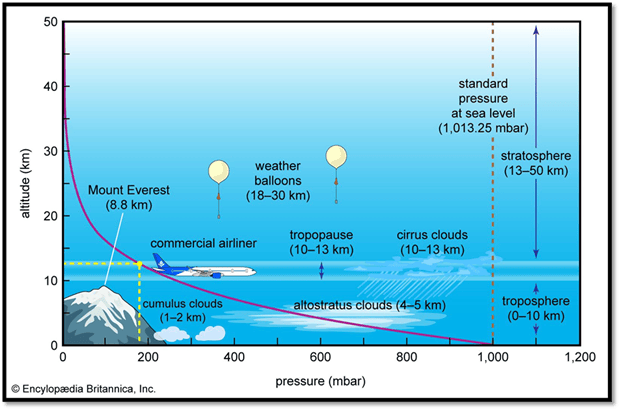
Meteorological air balloons are sent up. We see them rise from below, and see from an altitude that might be theirs, not that one could ever ride one and live, the forming of weather pressure cyclones below them in some amazingly beautiful photography. Stagg’s point is that the dynamics of shifts of surface pressure, and hence of weather, cannot be predicted from surface readings alone given the many factors involved in their metamorphoses. On top of this, Stagg’s dismissal of Crick’s use of historical analogies based on analogue maps as some kind of animal ‘shit’ is based also on this view of the complexity and multi-dimensional nature of valid and reliable weather predictors in the Northern hemisphere. Just because surface pressure patterns led to a certain kind of weather in the past could not predict that they would do the same in the present or future. The systems are not this stable.
The film, and the play before it, were called Pressure partly for this reason. The concept of pressure even in meteorology alone involves travelling long and high distances of space-time to get the appropriate data and cannot be judged from past narratives. And this idea drives the narrative of the film. That is so, of course, only if we understand more about the concept of pressure in a number of domains – intrapersonal, interpersonal and global. Let’s divert then to help from my old favourite, the Online Etymological Dictionary:
Pressure (n.) late 14c., “suffering, anguish; act or fact of pressing on the mind or heart,” from Old French presseure: “oppression; torture; anguish; press” (for wine or cheeses), “instrument of torture” (12c.) and directly from Latin pressura: “action of pressing,” from pressus, past participle of premere “to press, hold fast, cover, crowd, compress” (from PIE root *per- (4) “to strike”).
The literal meaning “act or fact of pressing” in a physical sense is attested in English from early 15c. The meaning “moral or mental coercing force, exertion of authority or influence” is from 1620s; the meaning “urgency, demand on one’s time or energies” is from 1812. Scientific sense in physics, “force per unit area exerted over a surface and toward the interior” is from 1650s.
also from late 14c. pressure (v.)“to pressurize,” 1886, American English, from pressure (n.). Meaning “to exert pressure on” (someone) is attested by 1922. Related: Pressured; pressuring.
It is clear that the story tells of intrapersonal pressure on Stagg and Eisenhower (Monty being too English upper class male for all this soft – and even hard – science) related to a highly developed conscience about the value of young lives and of his wife and baby, whom he fears dead but is not allowed to check whether that is the case. It tells of persuasion turning into interpersonal pressure in decision-making in many gripping individual conversations with raised male voices and expletives:
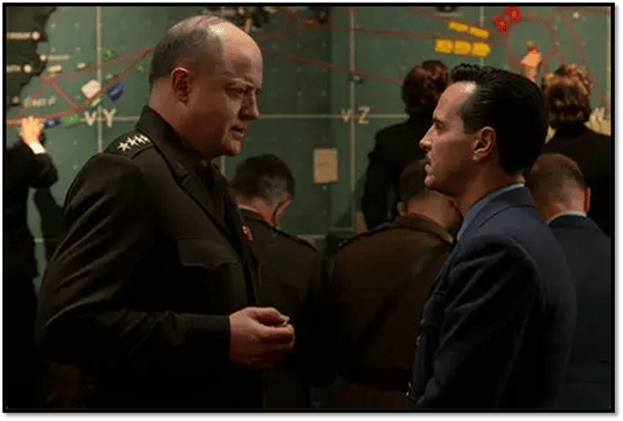
The emotional ‘weather’ of the film is often related to the degrees of control and regulation of outbursts of energetic and pressured emotion and language in dialogue between men trained to control and regulate such things by professional and/or military standards of training. This is the reason for many meetings in the film, in which the lid kept on to contain the thermal energy is oft blown off by Monty’s aristocratic lack of care of bourgeois professionalism or of working class lives, or by other men blowing their top. I loved those scenes:
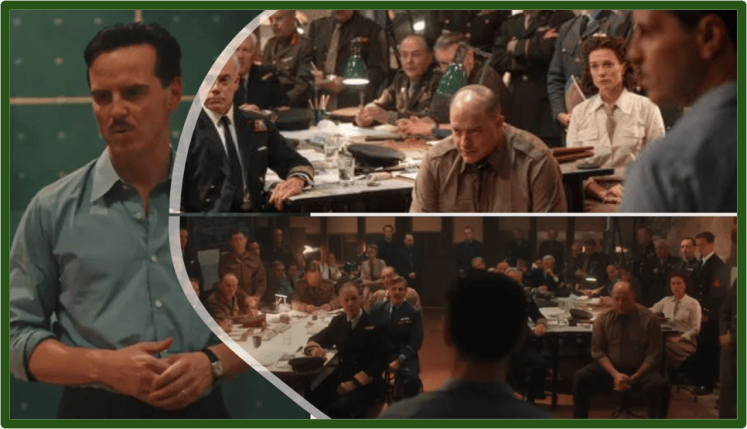
Of course the myths on which this film is built demand that even men who feel wronged by each other or feel humiliated by the other being proven to be right, do learn civility. This, like many 50s films is one where the gentlemanly handshake, if properly conducted and felt, is the sign of much in a film where men, if not working class soldiers, must maintain distance from each other in the exchange of emotional signs, a distance for which an institutional barrier like a desk, often helps signify.
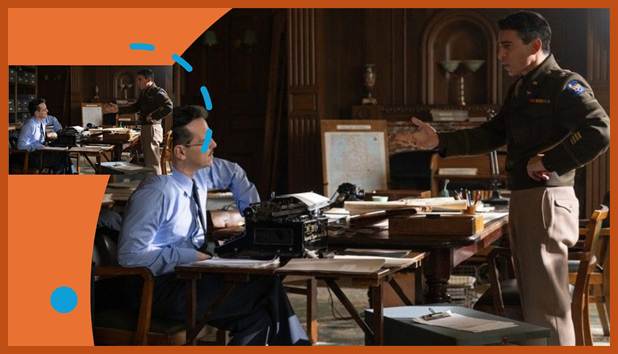
And although the use of old contemporary footage of D-Day helps make the event tbe film is made more beautiful by creation of imagined or recoloured mise-en-scène that impel into history all tbe kinds of pressure the film is about, especially in remembering tne origin of the word in industrial processes of pressing and their clever transformation into the extreme machinery of persuasion, torture (see the etymology above).
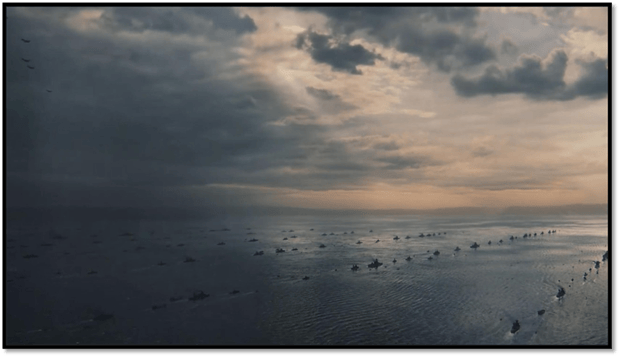
Take this lovely scene (above). It works by setting up contrasts of light and dark, the engine of hard pressure in war that is an invading/liberating Armada, the size if small dots in our perspective set against our heightened awareness to read pressure in the skies and atmosphere., and to see in them a notable ‘terrible beauty’ being born, as Yeats wrote of the failed Easter 1916 rising in Ireland:
I write it out in verse—
MacDonagh and MacBride
And Connolly and Pearse
Now and in time to be,
Wherever green is worn,
Are changed, changed utterly:
A terrible beauty is born.
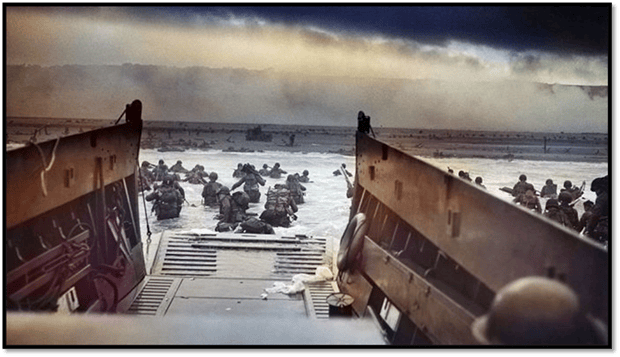
And this is what I meant about the longest journeys that can be narrated in my title. In truth the distance in miles to Dunkirk was relatively small in space and the time consumed, to avoid detection by the enemy, but the rest of the film is in one space – an encampment around a stately home and the biggest distance travelled is between meeting and work rooms, to the estate’s church and the camp safety perimeter. The men are contained in this spot but the distances the negotiate in time and distance are huge, sometimes in the form alone of data collection but sometimes track by the gaze of the camera, sometimes from above, or from a high angled perspective or across lateral distance across seas, that don’t seem as narrow as the English Channel, even the Dunkirk beaches, whose length must have seemed beyond measure in the context. Weather readings from the Azores are important for both meteorologists but Stagg realises that Cricks are confined to surface pressure and are fallible. As a landing craft lands at Dunkirk – the vision opened up to the gaze of the cinema-goer may seem to go on for ever, partly becuse the cinemagoer is trained by the film to look above and long into the clouds, not only at their surface beauty but the terrible power of the depths and heights of energy and pressure shifts they represent and where dark and light are at war. Look below:
And there are other scenes that look so much like the action painting of Jackson Pollock, so disturbed are our perspectives on them we realise that they are not attempts to describe a terrible war operation – the practice for Dunkirk, Tiger Operation, created by Eisenhower in which he felt it meet to create realism and genuine atmosphere to pressure his shoulders about the import of their role that he ordered live ammunition and many lost their lives. We get flash backs to it where the seas are stained vermilion, the colour of some wonderful art, by the blood of soldiers ‘playing’ at war but dying in reality and beautifying the transparent water around the crests of waves. It is only latterly, after his guilty talks with Summersby and after Stagg’s direct accusation against him about the hubris this involved, perhaps greater than that of Achilles. When we see a beach scene from above like that below hubris is writ large and beautiful – there is terrible beauty but as Stagg says unnecessary waste of young male lives:
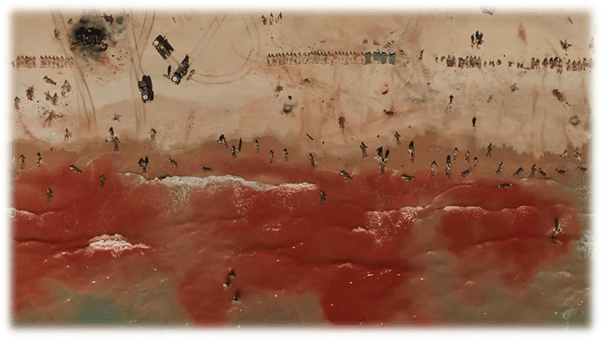
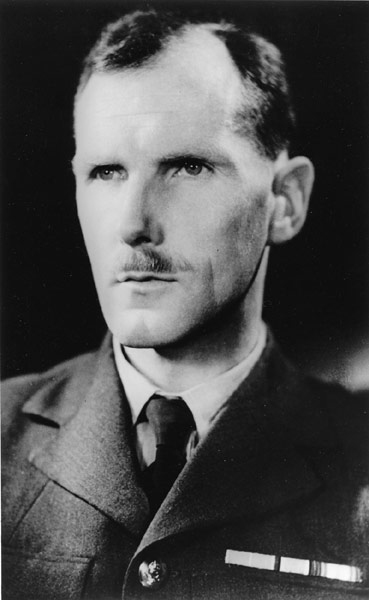
It is not for me to say whether Andrew Scott truly represented the inner conflicts of James Stagg, even whose potted biography in Wikipedia suggests a man who lived at some distance from any emotion but anger at the certitudes about scientific uncertainty he paradoxically lived by. Whether he lived an interior life at a depth and distance that fooled the cold gaze he commanded and returned to yours, certainly officially and at work is an open question. Footage of him speaking on TV suggests a man incapable of reaching to imagine another empathetically but for that the evidence is worse than subjective and ahistorical given the nature of professional and military training of the period. Nevertheless he did democracy service that is ill repaid by the recent history of Far Right intrusion and imitation of Nazi ideologies.
This film is told imaginatively and must be read in the same way and, if it is, it WILL take you on the longest, deepest, highest journey in space-time you could ever contemplate.But don’t – absolutely DO NOT – feel any PRESSURE to do so!
Bye for now, with love
Steven xxxxx
[1] Jesse Hassenger (2026) ‘Pressure review – Andrew Scott and Brendan Fraser can’t save lower-tier D-day drama’ in The Guardian (Wed 27 May 2026 01.45 BST Last modified on Wed 27 May 2026 01.46 BST) available at: https://www.theguardian.com/film/2026/may/26/pressure-review-andrew-scott-brendan-fraser
[2] Ibid.

