What are your top 10 travel destinations?
Only the ‘settled’ travel, the diasporist, according to R. B. Kitaj ‘pursues the phantom myths of nervous histories’ they claim for their own, ‘into the intractable swamps of ambiguous’ expression of their experience. What can we learn about the insufficiency of tourism from the migrant or exile. This blog reflects on the ‘First Diasporist Manifesto’ (1989) and ‘Second Diasporist Manifesto’ (2007) of R. B. Kitaj.
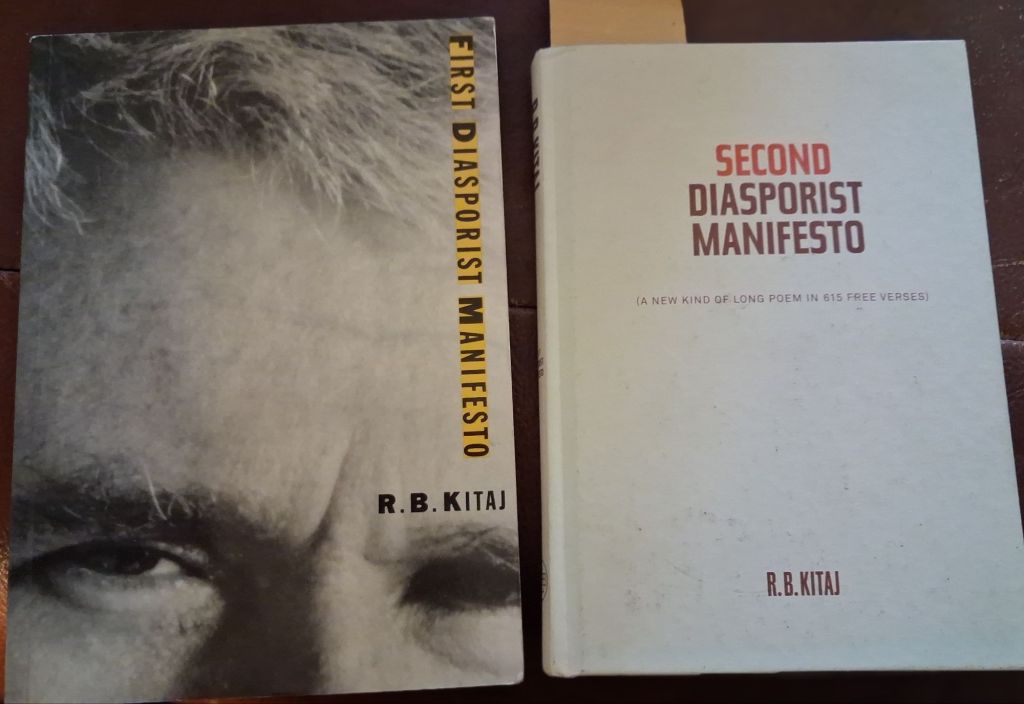
My copies of the ‘Manifestos‘
R. B. Kitaj raises pulse rates. When I studied a postgraduate course at the Open University in the History of Art, one particular teacher used him as an instance of art sullied by subjective theory and imposed Jewish identity, claims, they said, that twisted the function of art and revealed in place of art both narcissist self-obsession and his misogyny (oh! those ‘scholars’ of TERF freedoms reacting in all possibility to his 1984 Self-Portrait as a Woman exemplified in the First Diasporist Manifesto).
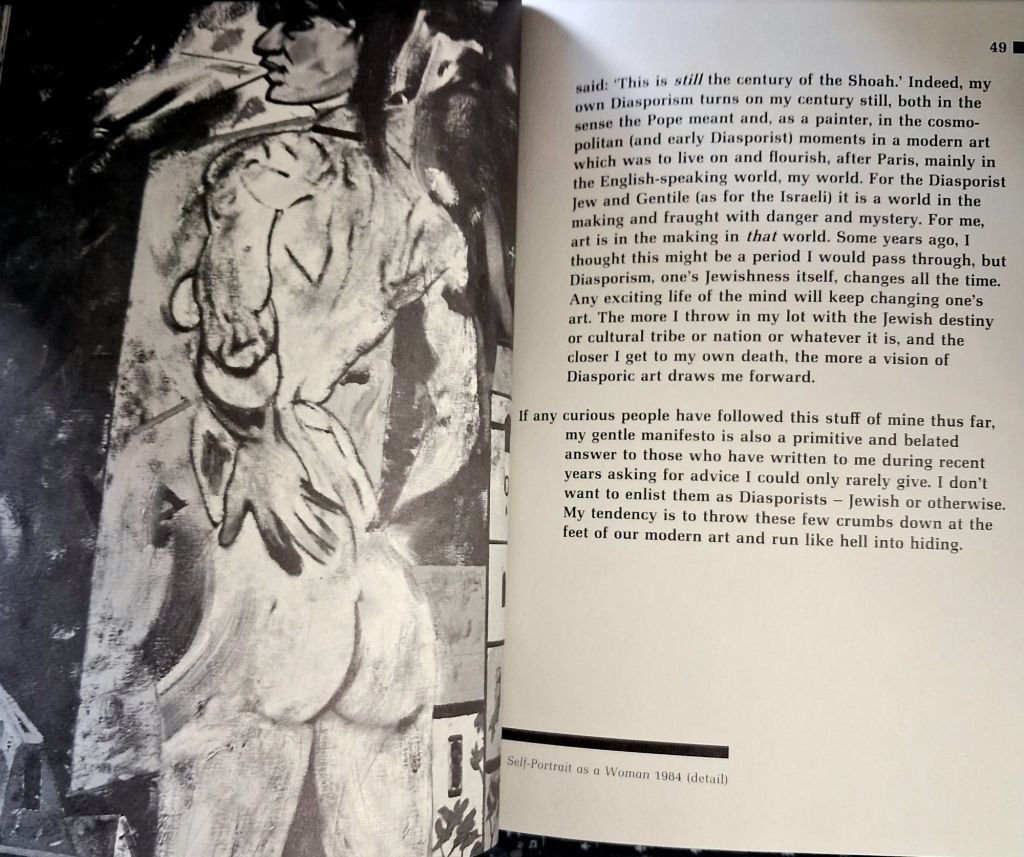
First Diasporist Manifesto, pages 48f., showing Self-Portrait as a Woman 1984 (detail)
Kitaj was no friend of rigid boundaries particularty in art (although he did value specified categories of identity too), especially earlier in his career. He called the art establishment the ‘art scheme’, an institution so embedded even in the singular minds of its adherents that it enforced a set of schematic beliefs about art – that it differed from its interpretations and was free and independent of the process of interpretation. Not so the God of the Jews, an entity he became more and more engrossed with by the time the Second Diasporist Manifesto, where he invoked, alongside giants in diasporic Jewish literary criticism like Harold Bloom, complex self-interpreting and oft contradictory religious schemas in Jewish theology, such as the tradition of the Kabbalah, even copying the supposed aesthetic form in that Manifesto, which he described as ‘a new kind of long poem in 615 Free Verses’. Here is Verse 490, a verse in the original set in larger type than the surrounding prose and bounded in a text box of red lines:
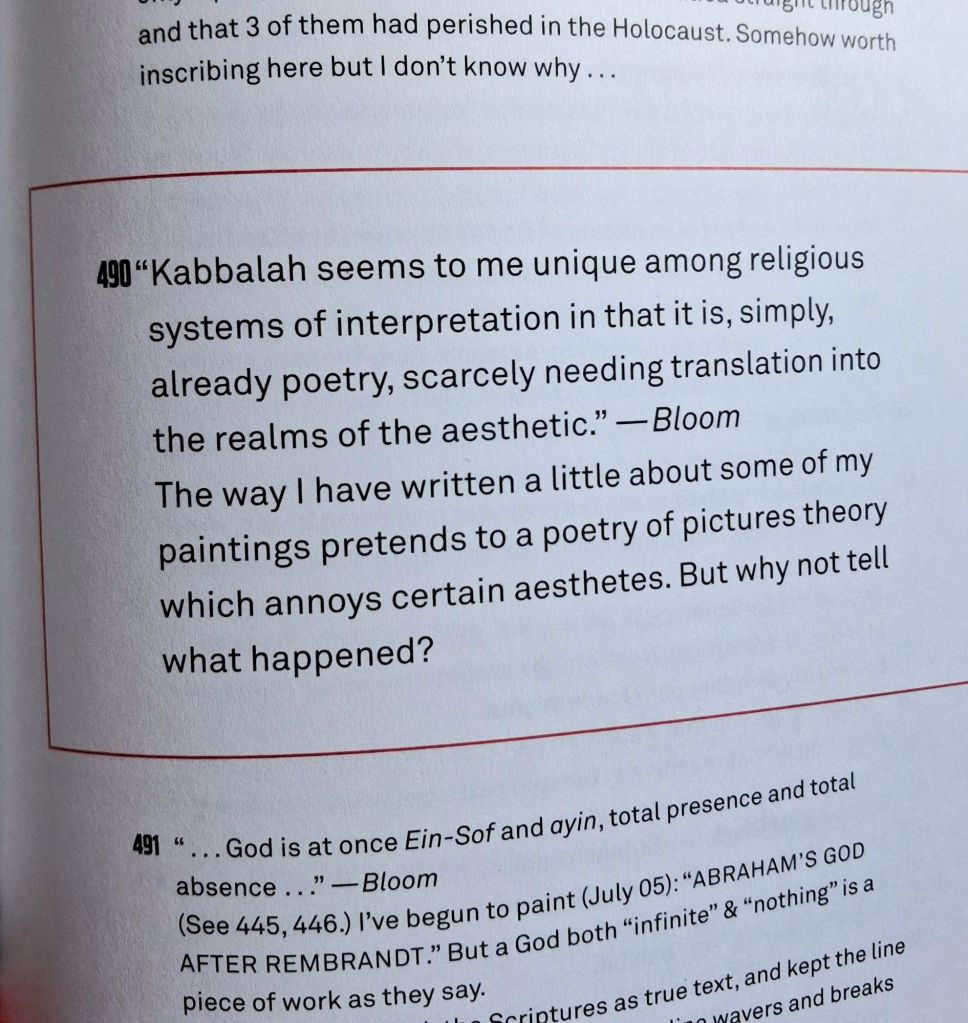
If Bloom is describing how literary interpretation takes on the same forms as the poetry it interprets, this was even more radical when applied not to written but to the art that is solely composed as a visual image or composed as a collage (in the same or different media) of images, in some way separated, like the painting Kitaj made called Cecil Court, London WC2 or ‘the Refugees’.
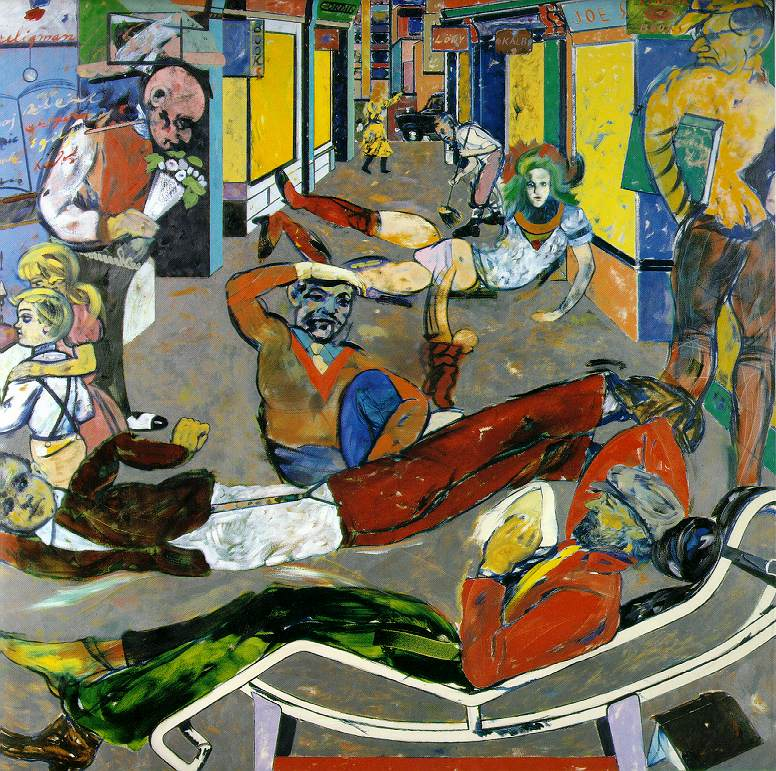
That Kitaj insisted on both stories and interpretation (and their singular) existed within (early Kitaj used text in the paintings as did his friend David Hockney) or alongside such paintings annoyed the ‘art scheme’, for who visual art was independent of its interpretation and extrapolation into other forms. It is to these ‘aesthetes’ Kitaj responds: ‘Why not tell what happened?’
The Diasporist Manifestos require a lot of thought and responsiveness to their rich sources and it isn’t the purpose of this blog to examine them as such. Rather I want to use the definition of the diasporist – if it can be defined in any way that doesn’t yield to the need for variation, translation, continual re-interpretation and versions – as a way of expressing what perturbs me about the concept of tourist travel. Tourism is a concept based on the values of the settled who reserve to themselves the entitlement to travel without unsettling their interior selves which remain rooted in the place to which it is their intention to return, and the values of which they carry into other cultures much like the colonist does.
The latter differ because they ‘take over’ the colonised space. However, they only stay in that colonised space if it can be sufficiently translated into a version of their settled home, as so often shown in novels of the British Raj and is so well illustrated in E.M. Forster’s A Passage to India. In the First Diasporist Manifesto, in particular, diasporists were not necessarily Jews though very definitely included Jews, even Israeli Jews though with a difference of interpretation as to what ‘unsettled’ means, but anyone removed from settled existence by potentially permanent migration through space that that is either physical or mental (he particularly included ‘the homosexual. illustrated for him at that time by the queer icon and art model, Quentin Crisp of whom there is an impressive nude of 1979).
Though all such migrants ‘settle’, they do so only under sufferance of the communities with which they come to uneasily identify. Continually trying to turn the continuing experience of solitude into the experience of community, the diasporist takes on local versions and translations but is essentially never settled, except perhaps in physical space and usually at some cost to self-determination. By 2007, Kitaj was mainly writing solely, at least mainly, about Jews as diasporists and concentrating on why his invention and embrace of the term made him turn to the concept of Jewish Art as something particular as art and a necessary project in which all Jewish artists must be involved. Jews were still not any easier to define than the diasporists in the 1989 text but they were the main focus. Kitaj appears to attribute this to his concern with the global meanings of the Jewish experience, including those throughout history whose self-definition was as equally contorted from a clear lineage as his was – heroes such as Baruch Spinoza, Sigmund Freud and Franz Kafka, who were equally important (at least the last two) in 1989 but not just as Jewish exempla.
In 1989 Diasporist art is the name for a movement in art, not unlike Cubism or Expressionism, but it also specified something about the nature of its creators, who in their person as well as art showed what it meant to be diasporist. Whilst all Jews fitted the category, so did dispersed Black populations and anyone not settled to cultural norms of belonging and category – in some way fragmented and dispersed. This was clearly expressed about Jews of the diaspora. However, the characterisation of Israeli Jews as diasporist is much more difficult in the 1989 text, where there is a decided need to spell out the fact that the establishment of Israel also made considerable increaze in the number and kind of diasporists including those Kitaj identified as such, as I do, Palestinians, displaced in the 1948 Nakba, Here is what he says on page 27:
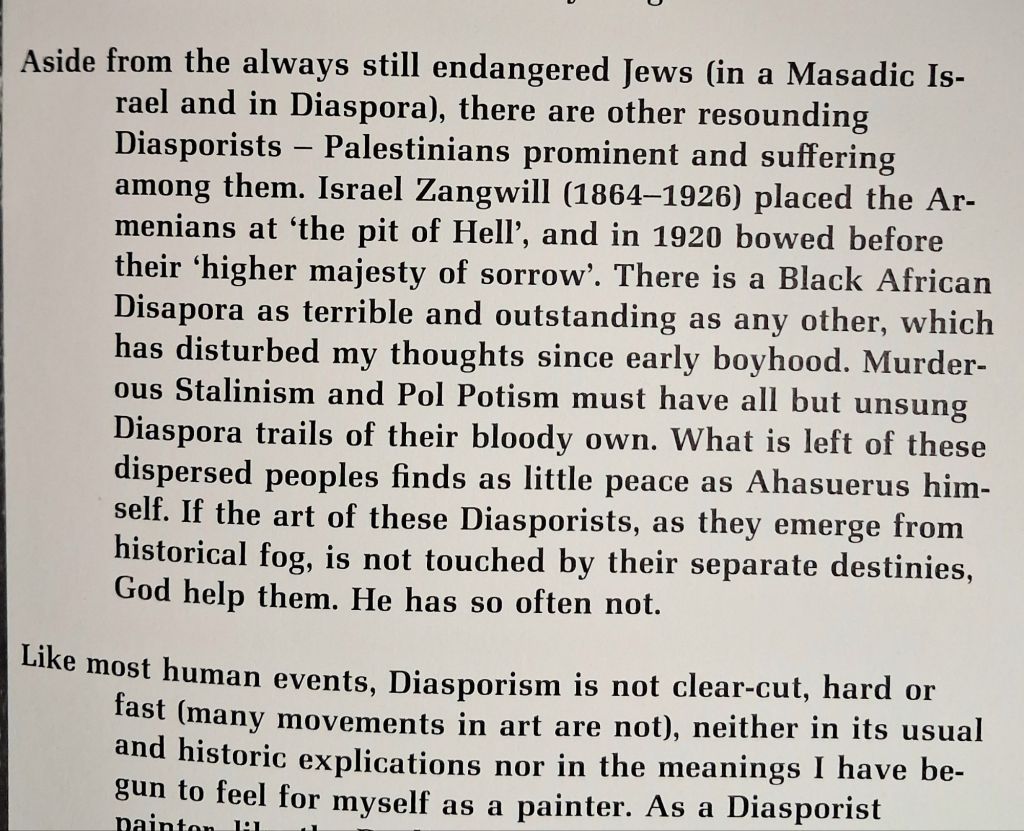
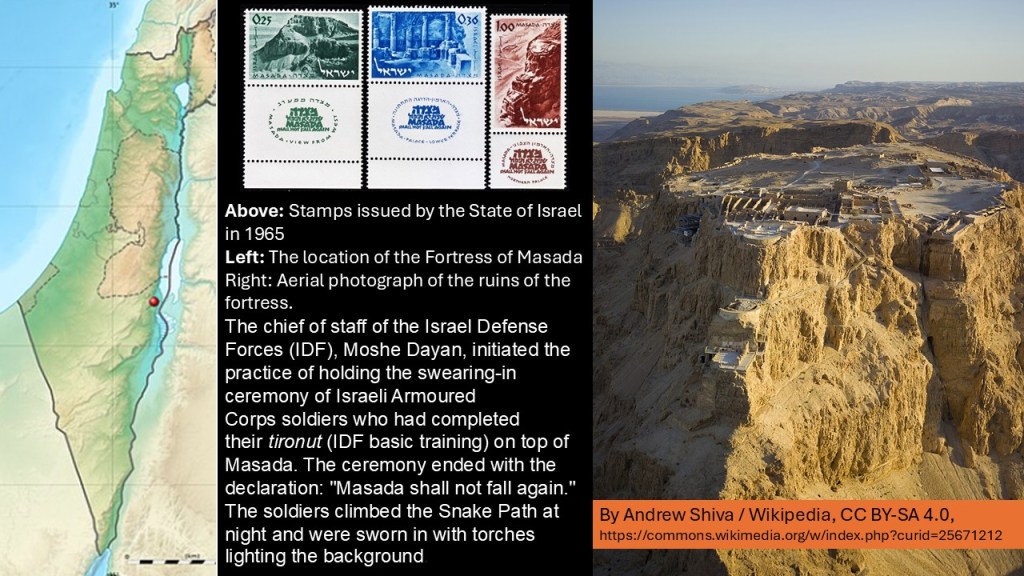
The view of Israel here I cannot find in the 2007 text. I take ‘masadic Israel’ to refer to the embattled state of Fortress Israel still apparent in 1989, and referring to the symbol of Zionist Israel, the fortress of Masada, the fort of Herod the Great in the wars against Rome and counted as a symbol of might that still caused a fall. MASADA became a symbol by the 1960s of this very attitude, being used by the Israeli State to define the military necessity of offence against its enemies, including those it created by stressing its own separation of values from semitic values and the aggression of its survival response: ‘Masada shall not fall again’ became the identified moral aim of the Israeli Defence Forces (IDF – see below).
Given that this is what ‘madadic’ means in Kitaj’s text, there is even greater boldness in the statement that Palestinians are ‘resounding Disasporists’; even declared as ‘prominent and suffering among them’, justified from Jewish witnesses much earlier in the century. That idea of a definition that is a fuzzy one is central: ‘not clear-cut, hard or fast …, neither in its usual and historic explanations nor’ when used of an artistic movement as Kitaj does to explain his own defining role in it.
My own feel for the term and identification with it is more at ease with the First Diasporist Manifesto than the Second Diasporist Manifesto. By 2007, there seems less desire to stress the ‘usual and historic explanations’ of diaspora – often mainly the effect of colonial pressure – as in the case of the ‘masadic’ Jews referred to as a model of the new Israel, which Kitaj felt to be somewhat doomed in 1989, where Rome was the oppressor, and the analogy hardly spoken but there with the Palestinian Nakba.
There is less about power and more about culture in 2007. And, as in Israel itself, the dominating image of Jewish vulnerability and need for resistance is The Shoah (which non-Jews name ‘Holocaust’). Yet, the readings of displacement, marginalisation and exclusion refer more to cultural factors in Jewish life than political ones, especially the defense of the right to literary commentary on the mainstream of happenings in the world. As a result we get a more depoliticised Kafka (see verse 367). But the issue of the settled against the displaced who try to establish home ground after home ground by varying the home cultures they absorb, and are in part absorbed into but never fully ‘settled in’, is still central.
And this matters psycho-culturally, for today we face a vast growth in thinly veiled nationalist racism and preference for armed defence against ‘foreign’ intrusion (and that is not only in fascistic styles adopted by parties like Restore and Reform) that lives alongside an entitlement felt deep in the roots of white identity that other countries are to be travelled to, toured and appropriated in a form suitable to the traveller, but never to the cost of unsettlement about one’s ‘home’ values. I cannot see the answer to this.
What happened to Kitaj was an increasing retreat inward and a questioning of whether for him the whole issue wasn’t being ‘cut off’ and embracing that fact ‘due to my obsessional neuroses via-a-vis the Jewish Question and a Jewish Art,…, isolated in strange habitats and studies’ leading to the ultimate question to self, which I think elides a purely biological answer: “do I undergo something like what Mayr called ‘a genetic revolution'”.
Bye for now
Love Steven xxxxxxxxxxx

