


Etymology is a game surely for the past uses of a word mainly have no life in its heirs in contemporary language necessarily, but yet again even in contemporary language one word can signify different things to different people (even when they speak ‘only’ one language) for language use is also a thing of multiple being even within one supposed language, even in one country. Language use oft divides use of particular words by differential access to certain examples to the thing they name. What differentiates access to food service includes variables like income, class, education, even appearance (my husband and I were refused access to the poshest restaurant in the city of Funchal in Madeira). It was that restaurant attached to the Belmond Reid’s Palace Hotel, favoured by Sir Winston Churchill as his favourite on the island and in which he daubed, to cure his depression, some of his ‘paintings’.

In this ‘restaurant’ dining is a thing you do in order to be seen and admired for your taste and bank balance:
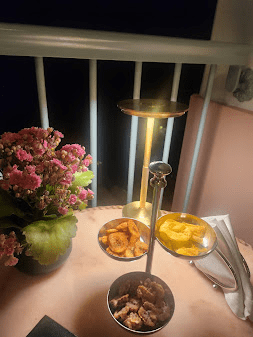
What to someone is a diner or a cafe, may be to me a restaurant! And, as in the example of Sir Winston, we choose and favour for different understandings about what is ‘favourable’ and ‘choice’.
In cases such as these, etymology helps for it revives some of the understandings which gave associations to the name of things. Etymology.com, a constant resource to me, shows that even as a practice in knowing language, etymology contains all kinds of variance and sometimes doubtful stories as in that one told there about the restauranteur, Boulanger. But the most vital part for me is the link, the digital version of which is preserved in my citation, to the word ‘restore’ with all its original associations, even going as far as links to redemption (all quoted in my title from the entry on ‘restore’): ‘free from the effects of sin’.
Now, I am almost certain that restaurants, far from making us free from sin, are more likely to evoke deadly versions of the same: gluttony, even in these days of over-expensive taster menus; pride; and even (here I think of Geoff and I stranded on the dark coast road of Funchal) envy. And, after all, it would have taken some effort to clear sin away from tne mass of Sir Winston Churchill. But the idea of restoration outside the religious context does appeal, although even here Boulanger it seems, if the story in etymology. com is not apocryphal, rather turns it into an advertisement passing as promise of renewal of customers who hunger and yet have the ability to pay for the service was the condition of that promise: ego restaurabo vos [I will refresh you]. Read the full etymology below:
restaurant (n.): “an eating-house, establishment where meals may be bought and eaten,” by 1806, in a French context, from French restaurant “a restaurant,” originally “food that restores,” noun use of present participle of restaurer “to restore or refresh,” from Old French restorer (see restore).
Les restaurans ont donné naissance aux Restaurateurs. C’est un établissement qui a eu lieu à Paris vers 1765, & qui fut imaginé par un nommé Boulanger, lequel demeurait rue des poulies. Sur sa porte, il avait mis cette devise, qui était une application peu respectueuse d’un livre très-respectable: Venite ad me omnes qui stomacho laboratis, & ego restaurabo vos. Boulanger vendait des bouillons ou consommés. On trouvait même chez lui à manger quand on voulait. Il est vrai que n’étant point Traiteur, il ne pouvait servir de ragoûts; mais il donnait des volailles au gros sel, avec des œufs frais; & tout cela était servi proprement sur ces petites tables de marbre, connues dans les caffés. A son imitation, s’établirent bientôt d’autres Restaurateurs. […] La nouveauté, la mode, & peut-être même leur cherté, les accréditèrent: car ce qu’ils fournissaient était plus cher que chez les Traiteurs ordinaires. Mais telle personne qui n’eût point osé aller s’asseoir à une table d’hôte pour y dîner, allait sans honte dîner chez un Restaurateur. [M. Le Grand d’Aussey, Histoire de la Vie Priveés de Français, Tome II. 1782.]
[Translation: Restaurants gave birth to Restaurateurs. This is an institution that began in Paris around 1765, and was the brainchild of a man named Boulanger, who lived on Rue des Poulies. On his door, he had put this motto, which was a disrespectful application of a very respectable book: Venite ad me omnes qui stomacho laboratis, & ego restaurabo vos. Boulanger sold broths or consommés. One could even find something to eat when one wanted. It’s true that as he wasn’t a Traiteur (‘caterer‘), he couldn’t serve ragoûts; but he did serve poultry in coarse salt, with fresh eggs; and all this was served neatly on those little marble tables known from the cafés. Other Restaurateurs soon followed in his footsteps. […] Novelty, fashion, and perhaps even their high prices, accredited them: for what they provided was more expensive than that of ordinary Traiteurs. But a person who would not have dared to sit down to dinner at a table d’hôte, would go without shame to dine at a Restaurateur’s.]
The identification of Boulanger was unusual before 1780s; earlier accounts from 1760s-1770s variously name Duchêne, Roze or Vacossin as the premier restaurateur from Rue des Poulies. For the restaurateur’s rival the traiteur, see trattoria.
Italian spelling ristorante attested in English by 1925. Middle English had similar words in legal language, such as restaurance “restitution.” …
The word has a beauty to it, if we think of it as providing that which we need to be again as if newly created or invisibly repaired (for reparation has a beauty too whether it be of a psychological or material kind). Nevertheless in the mid sixteenth century in England, some developments in the meaning of the word verb ‘store’ occurred, as mentioned for that word at this link: ‘The meaning “to keep in store for future use” (1550s) probably is a back-formation from store (n.)’.
These developments, of course, were eventually to associate both the verb ‘store’ (and by a similar back-formation ‘re-store’) not with immediate need specifically but over-provision for the moment either in the hope of future use (as in the moral comparison of the Town Mouse and Country Mouse – or store-mouse – of Aesop fable and later fairy tale) or sale of excess accumulation at prices that enable a profit.

That latter meaning perhaps fits with our conception of ‘fine dining’ (as they call it on Master Chef) if we are not the one doing the dining but rather those peeking into the fancy windows of a restaurant filled with our ‘betters’ (you will recognise a resurgence of Geoff’s and my own jealousy in that dark Saturday in Funchal).

But imagine the ‘restaurant’ that was true to its verbal origin – as a restorative, re-newer or redeemer; an infusion of freshness into what has become tired, depleted and without evident life in its motions, gestures or speech.
That basic idea lodged itself into the institutions of Christianity, we are urged to believe, in the story of The Last Supper, where on offer was the bond between the physical and spiritual body and blood of a redeeming, renewing, and restorative God. Until he decided it must be a metaphor (and not the ‘Real Presence’ as Catholics continue to call it) and changed Western European Christian history, that very idea so revolted Martin Luther, that a Godhead could offer of his own flesh and blood for food service:
Matthew 26:26–28: Institution of the Lord’s Supper
26 Now as they were eating, Jesus took bread, and after blessing it broke it and gave it to the disciples, and said, “Take, eat; this is my body.”
27 And he took a cup, and when he had given thanks he gave it to them, saying, “Drink of it, all of you,
28 for this is my blood of the1 covenant, which is poured out for many for the forgiveness of sins.
And think again of a favoured restaurant as a scene that intrigued painters, and one version of which, Leonardo’s The Last Supper, has stuck with us as the idea of what is done in restaurants – though it was in an upstairs room of a caterer privately taken for the purpose:
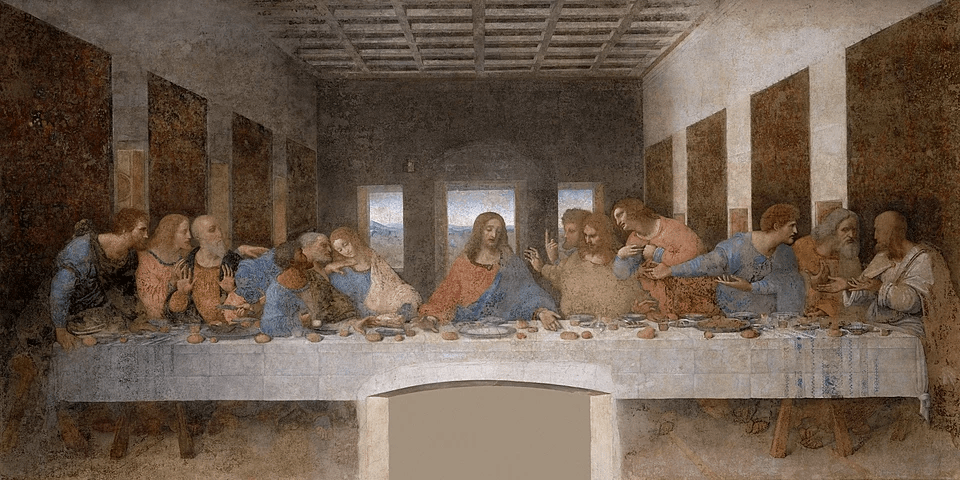
And what is done has less meaning, or meaning on a different register of human and spritual value, for some than others. Whilst the painting invites our eyes to focus on Christ at the central vanishing point of the painting’s perspective, mimed by the room’s wall, differential perspectives keep disturbing us that take our minds and focus elsewhere; to the ambiguous handling of Mary Magdalene, in one sub-focus, to different kinds of attentive ignoring of Christ in terms of other disciples with other fish to fry – a theological argument on the viewer’s right perhaps, a piece of gossip on the left. Amongst the group on the left, each person seems may be looking at Christ but a.ong them or those whose vision may stop short of that. None but Christ look at the laid table, about which Christ is discoursing, even at the ‘bread’ of restored life his right hand points towards to guide the external viewer’s vision; our vision.
The point of it all this, in the Church’s interest, is to enforce the view that the altar in a church is a table that God has reserved for you in his restaurant – the main dish being His Son, and the refreshment intended being universal redemption beyond all apostolic and ecclesiastical dispute. Christ looks serene, for to offer food, simple food (except in that it incorporated his viscera), is a simple and beautiful thing that happens in the moment our dining, so that we can go on beyond and outside it – not dispute how better our understanding of the divine body and blood is than yours, forever going over stories of a famous dinner at a favourite restaurant.
Perhaps we live in a world of eating disorder (not excluding my own) – of under and over consumption – engineered by inequalities and justifying it but lived through in psyches and the damaged bodies that carry them around, precisely because we are more concerned with grading restaurants than understanding their purpose, which is to be filled enough with what we need, no more nor less. We scrunch overmuch before that which we scrunch has the wherewithal to scrunch for itself and may scrunch us (with apologies to Dickens’ invention of the word). One Dickens character, Mr Boffin, the’Golden Dustman’ in Our Mutual Friend, so blames himself for his miserliness, he thinks his wife and his heir, Bella, must both be blaming him too for the distortions in his economic and moral life:
‘Praising me? You are sure? Not blaming me for standing on my own defence against a crew of plunderers, who could suck me dry by driblets? Not blaming me for getting a little hoard together?’
He came up to them, and his wife folded her hands upon his shoulder, and shook her head as she laid it on her hands.
‘There, there, there!’ urged Mr Boffin, not unkindly. ‘Don’t take on, old lady.’
‘But I can’t bear to see you so, my dear.’
‘Nonsense! Recollect we are not our old selves. Recollect, we must scrunch or be scrunched. Recollect, we must hold our own. Recollect, money makes money. Don’t you be uneasy, Bella, my child; don’t you be doubtful. The more I save, the more you shall have.’
Bella thought it was well for his wife that she was musing with her affectionate face on his shoulder; for there was a cunning light in his eyes as he said all this, which seemed to cast a disagreeable illumination on the change in him, and make it morally uglier.
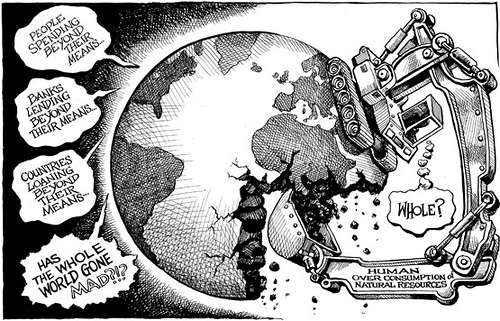
This comes from Chapter 5 of Our Mutual Friend, wherein the wonderful old man justifies building his ‘store’ of stuff to be sure he won’t be plundered by others. It might also explicate the rather good cartoon below, used from a learned ethical economics blog at this source: 4. The impact of the risk society thesis on environmental politics and management in a globalizing economy – principles, proficiency, perspectives | The Environment Under Foot.
But that is quite enough for now. Bon appetit!
With love
Steven xxxxxxx

