


The last thing you learned OUGHT always to be to distrust the learning that refuses to be open to change. Some thoughts about Kirill Serebrennikov’s film The Student.
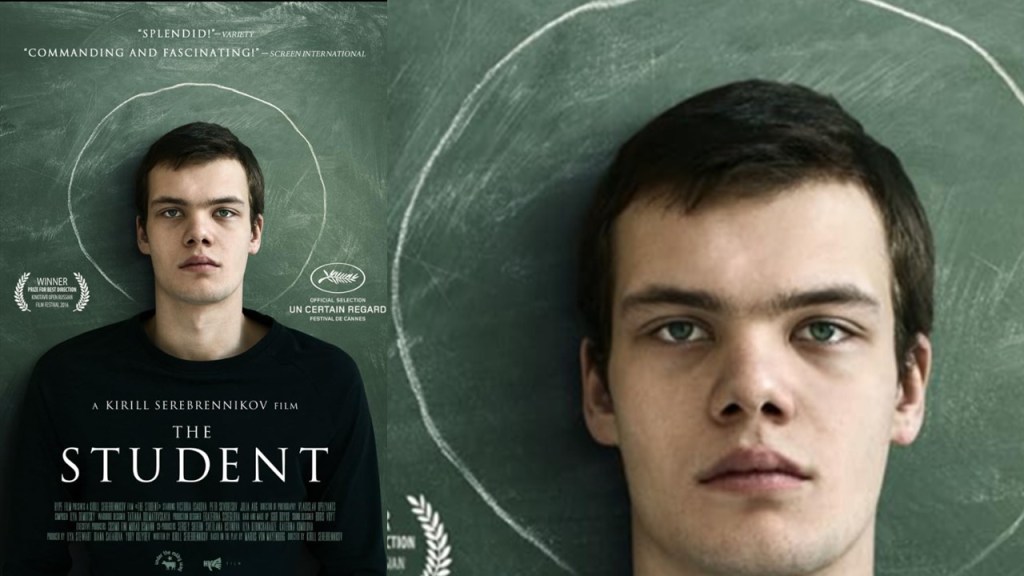
What if you discovered that every truth you will; ever need, sufficient to contest any other truth, except its own contradictions from the same source, was in one book. What if, you then identified with the embodied principles of that book to become its incarnate central character. At one point Veniamin in Kirill Serebrennikov’s film The Student, a boy whom we see well into his obsession with one book from the get-go – the Bible -defines himself as a saint, drawing a halo in chalk on the greenboard behind him in class the better to challenge his teachers, and the class – whichever appears to oppress him most at the time. Later he will build a structure from a desk and one metal-frame chair to bang on the wall from its pinnacle with nails and a hammer a wooden plyboard cross (impractical of course for actual physical crucifixion) to the wall of a classroom.
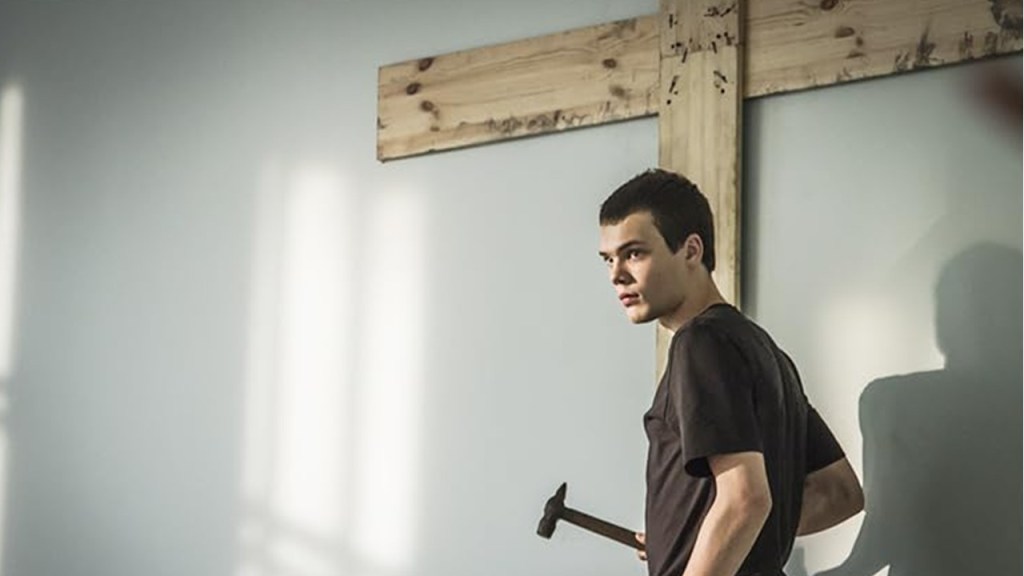
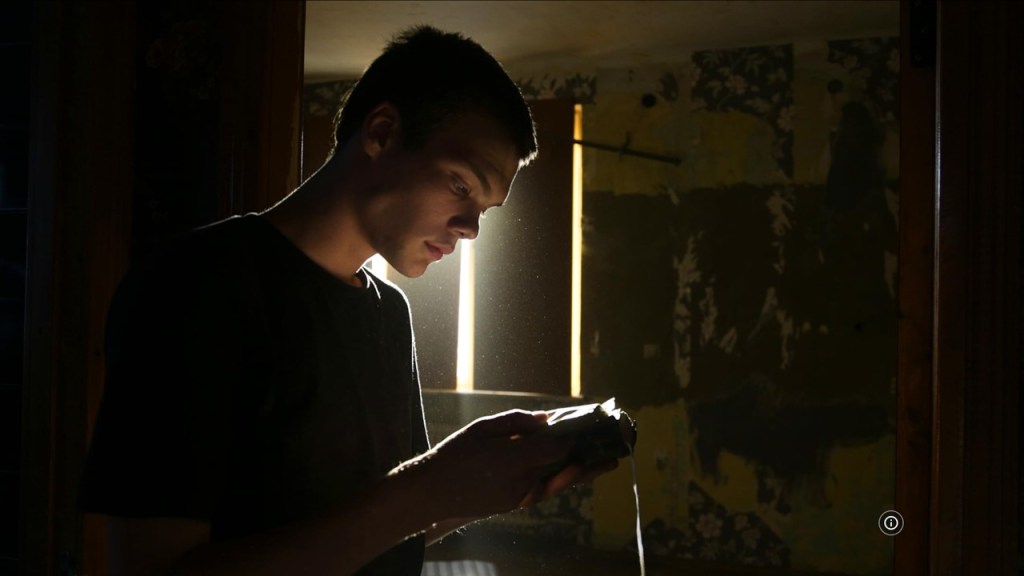
The film-maker’s attitudes to all this are always as deeply involved in muddled confusion as the film’s characters, though, as you might see from the play of light from windows and shadows cast by that light in the still above, those attitudes can even support the most extreme of sdlf-delusions. There is a sense in which the film wants to illuminate Venjamin’s claims to divine authority, at least against those held by institutions like the Church and the State⁷. When, after having stripped his bedroom of wallpaper and half barricaded his windows, Veniamin’s readings of the Bible are lit as if they emanated the divine light that the boy thinks he gets from them.
First of all, then, accept that this film is a modern masterpiece and that it is likely that we do not know how to read the levels of tragicomic satire in Russian film-making. That is certainly true of Wendy Ide’s brief review in The Observer (nine years ago – this is not a new film). She says:
A teenage boy finds religion, causing waves through his school in contemporary Russia. Slightly strident in tone, but unnervingly timely, this slow-burning drama works as a small-scale satire of the rise of extremist rightwing views and religious intolerance. Director Kirill Serebrennikov employs elegantly choreographed, long, unbroken takes to absorbing and sometimes uncomfortable effect, as Veniamin (Pyotr Skvortsov) mounts a concerted assault against his liberally inclined science teacher.
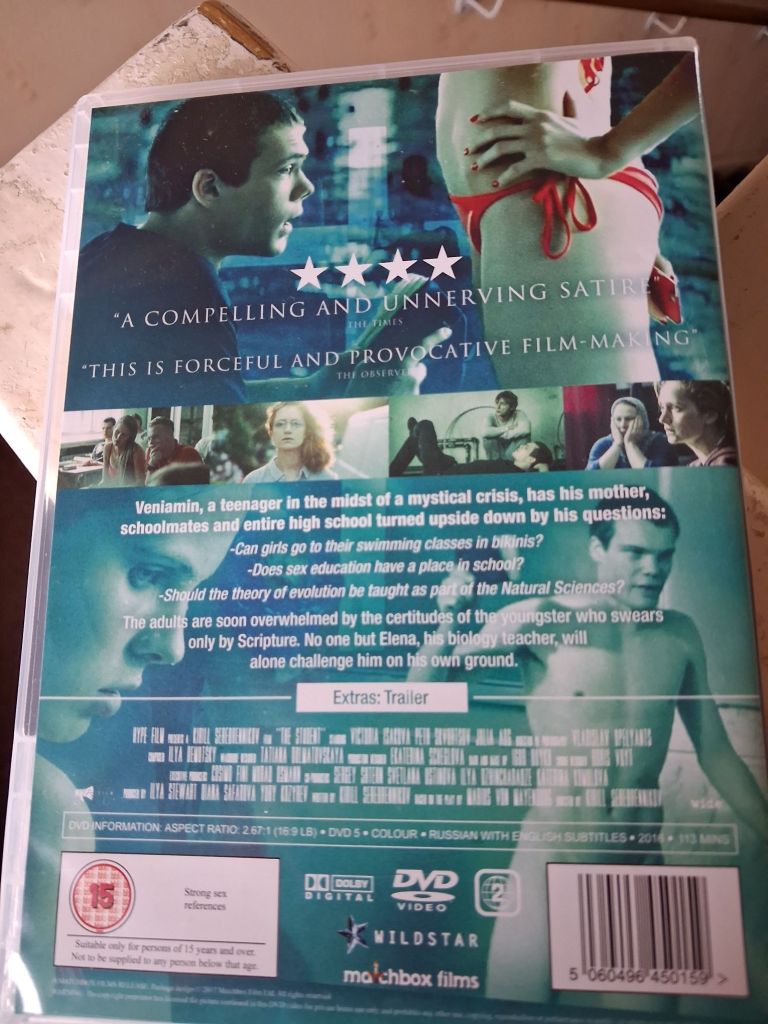
There is a theatricality to the film that can feel a little overbearing at times – it’s hard to sympathise with the grandstanding central character – but this is forceful and provocative film-making. [1]
This critical piece is so full of stereotypes that it entirely fails to match the ambition of the film and the tragicomic meaning of its central characters’ behaviours. Where it fails as an aid to appreciating the film’s depths, underneath its humorous surface, is in its assumptions I think about Russia, as somehow structured ideologically so much more simply than the Anglo-American West. No doubt ‘extremist right wing views and religious intolerance’ are prominent in Russia and exploited, when they fit his needs by Putin, but they are clearly not those promoted by Putin as an orthodoxy, who still claims to be the focal representative of modern liberal-democratic governance.
The Russian President’s photograph hovers on the walls of the school that is perpetually trying to moderate and absorb into itself an Orthodox priest teaching the most putrid antisemitism based on the medieval thought of St John Chrysostom (born 407 A.D) in the school with any and all points of view, including, provided she does not want to promote it as the hegemonic view of the school, the belief in scientific reason of a left-leaning Jewish woman who takes Darwin and STD awareness training as very literal truths. The priest tries to absorb what he calls Venjamin’s ‘passion’ into something approaching the school’s own uncritical take on the necessity for verbal challenges to either right or left, ancient or modern, dictatorship (the students must write on tne advantages of Stalinism at one point) or democracy, provided nothing has to change drastically from the status quo as a result, which is I think exactly Putin’s view of Russian ideology.
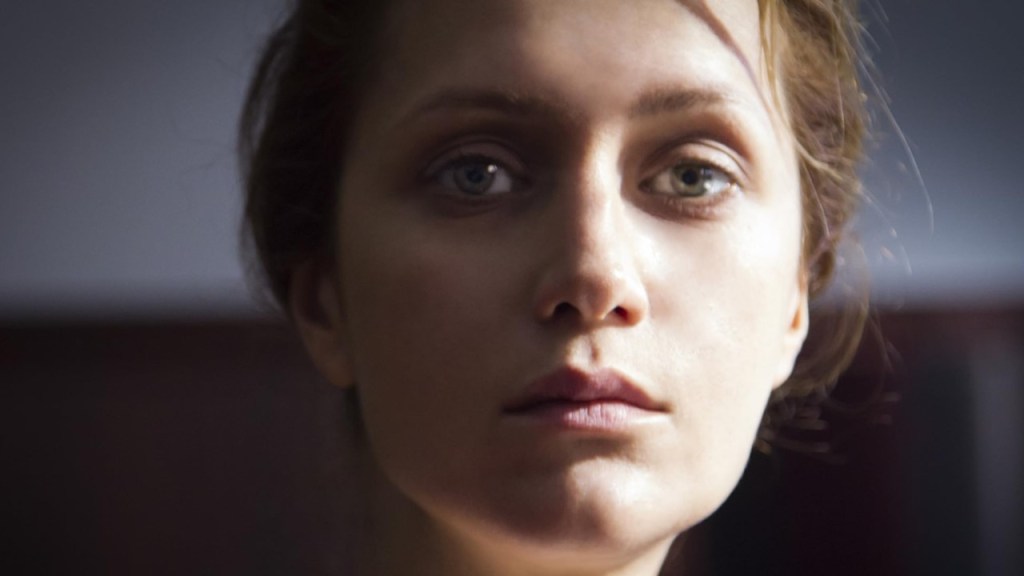
The ‘liberally inclined science teacher’ (Viktoriya Isakova as Elena Krasnova in the still above) is by no means a centre of appropriate ways of thinking in the film any more than the vapid supposedly centrist thinkers that run the school or Venjamin himself. Both the teacher and Venjamin (Veniamin Yuzhin, nicknamed Vĕnia) drive particularised thought patterned to extremes, generalising them over all experience. She herself becomes obsessed with Veniamin’s rationale for opposing her, trying to explain his behaviour, often in none-too rationale ways – notably by reading the Bible as obsessively as he does – in order to explain its attractiveness to her student. Her best reading of the mission of Christ and its appeal to Venjamin is that he is a symbol of male romantic bonding and queer community, as a justification of her mission to teach diversity tolerant sex education, and a sufficient reason for Veniamin’s passion for the Christian message.
But when we watch the film we can’t help favouring the comic chaos Veniamin causes in her lessons, particularly the one in which she teaches how to apply a condom using a carrot to represent the erect penis (all people my age were in that kind of sex lesson). Venjamin responds by criticising how and why the lesson raises issues it cannot confront directly like the reality of bodies including real penises. He undresses to share his body and penis, the latter both male and female peers find attractive in its largeness.
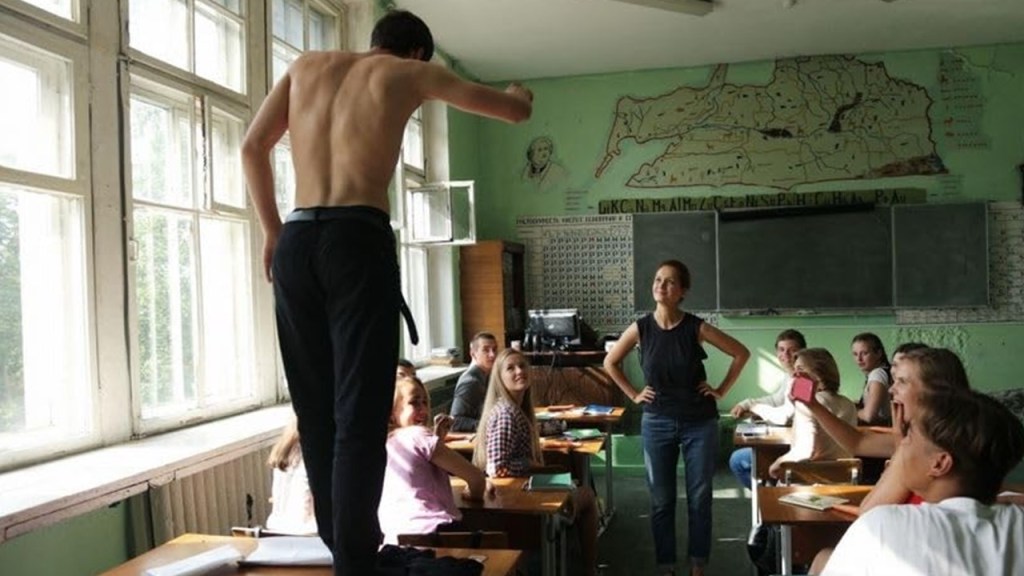
Similarly he contests the teacher’s class on Darwinism and natural selection by rendering Darwinian theory literal and dressing as a chimp and jumping and crouching between items of school furniture. Venjamin’s rejection of sexual licence then is not a fear of the body but a recognition that human bodies are powerful, and not a neutral element in all thought, that uses regulation to stand off from animal function. His nudes display attracts to him even the girls he got school rules changed for so that she or other girls could not wear bikinis in the school pool, only full body swimming suits.
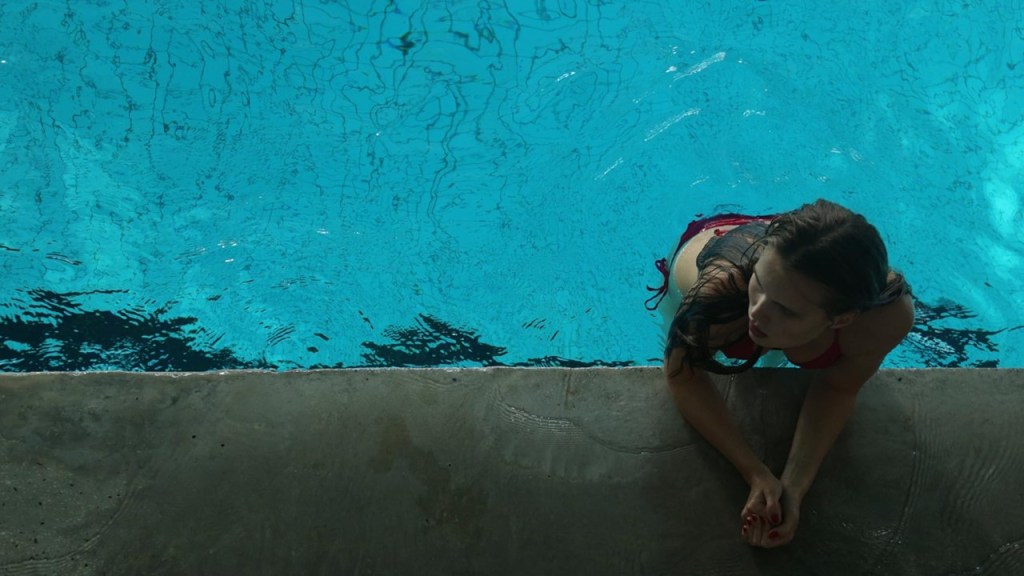
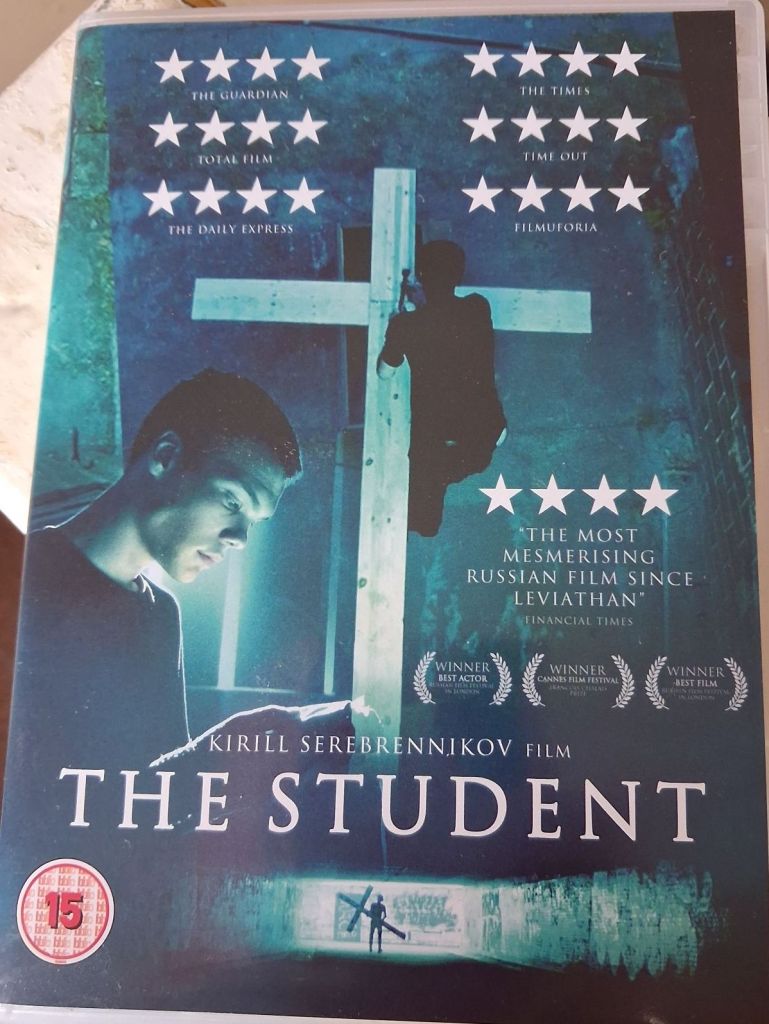
The nude or semi-nude shots dominate the box of the DVD as sold in the UK in ways that are both true to the film and not. Venjamin does not hate to confront the body himself – he even shows some beginning of readiness to accept body contact from others, one girl and one boy in particular, only to then literalise the contact offered into a prohibitory Biblical quotation. The reference to these quotations always appears on screen – in Russian-Cyrillic script. It is as if Venjamin is text itself contemplating what it means to live in a body – the Word made Flesh.
Yet the text that Veniamin transforms life into is exceedingly literal. Reading that Jesus found common purpose with ‘cripples’, he makes friends with a boy in his class with one leg shorter than the other who therefore limps (Aleksandr Gorchilin as Grigoriy Zaytsev).
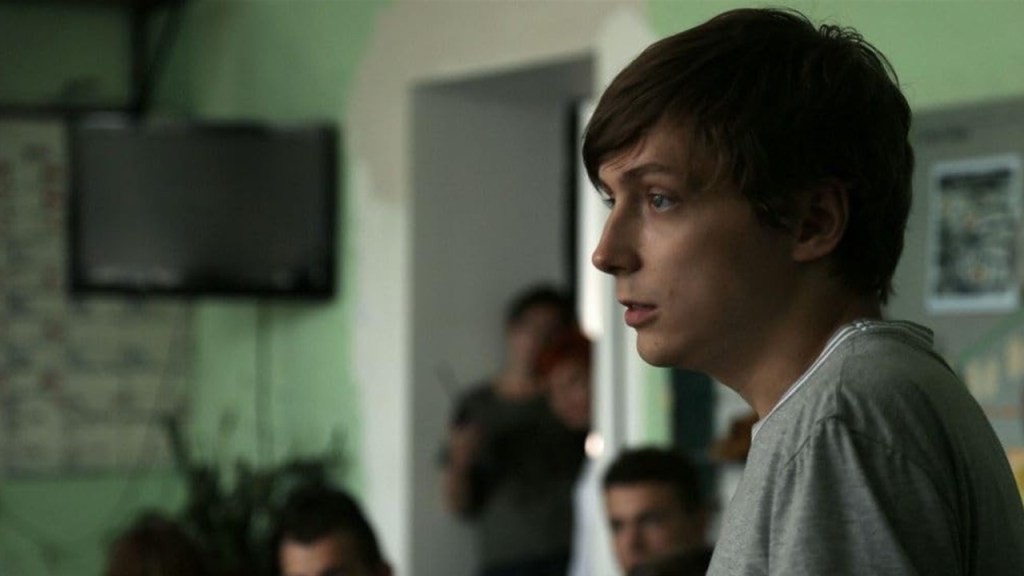
Aleksandr Gorchilin as Grigoriy Zaytsev
Furthermore finding Jesus able to heal people with limbs that fail to serve everyday needs efficiently by touching them, he promises Grigoriy he can heal him by touching his shorter leg and asking this limb to grow. People coming upon that scene infer some sexual ritual, but of more concern is that Grigoriy himself feels Veniamin’s touch as sexually motivated at a level beneath his literal words. Veniamin’s whole attitude to Grigoryi speaks of comfort with each other’s bodies and of mutual touch, as in the two stills below. Eventually Grigoryi takes more literally Veniamin’s body language than his words – for words are rarely used as literally as Veniamin uses them.
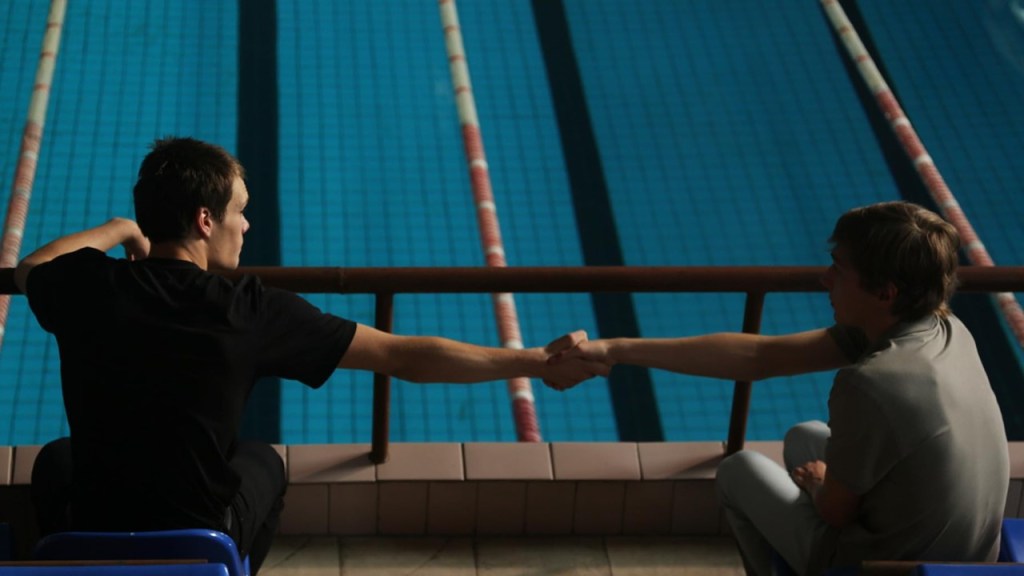
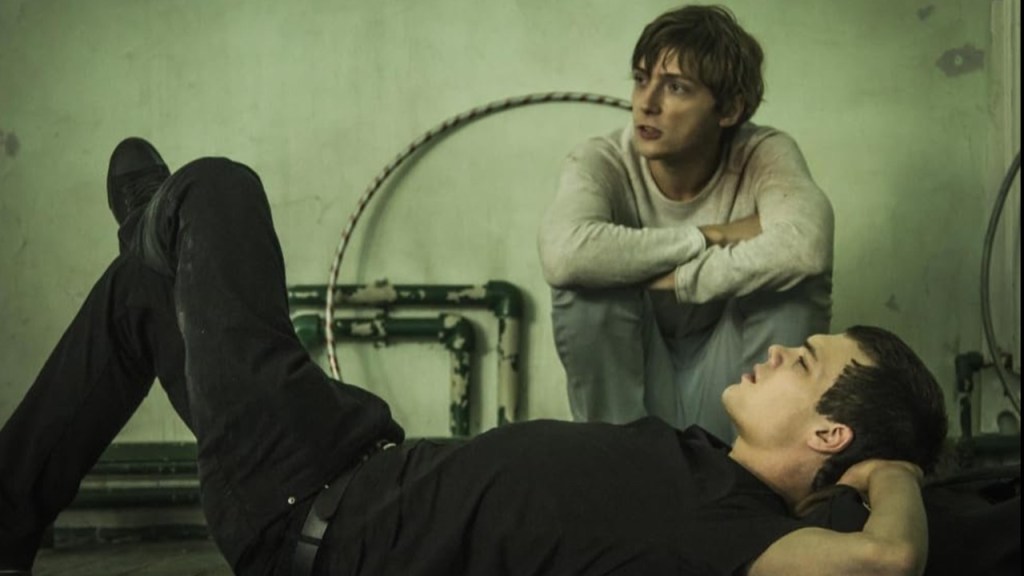
The film more than any other asks you to beware believing that you have learned anything from your last experience that can’t be then dis-confirmed, for it will express confused truths about the world – some of which we can, others of which we cannot, be conscious but all of which might have ambiguous consequences – the opposite indeed of what you hope.
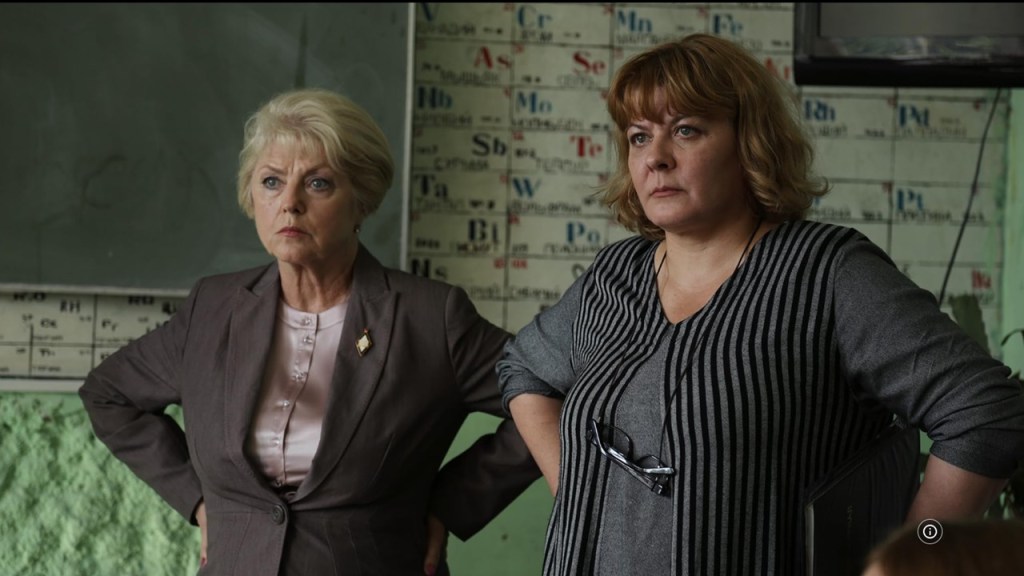
The funniest element of the school are its Principal and its History teacher (in the still above) who variously struggle to show that they have any belief in that which they profess to teach, and whom do not seem to be able to learn but who nevertheless find solace in the status quo, and the pictures of Putin so oft behind them..
This is a remarkable film. Watch it. You might not learn anything, with any luck, for we all know that a little learning is a ‘dangerous thing’.
With love
Steven xxxxxx
________________________________
[1] Wendy Ide (2017) ‘The Student review – a forceful and provocative lesson from Russia’ in The Observer (Sun 5 Mar 2017 08.00 GMT)available at: https://www.theguardian.com/film/2017/mar/05/the-student-film-review
 Steve_Bamlett_blog