


Let’s take a break from the malign influence of the populist feminists’ treatment of binary sexual difference, as, in Foucault’s words, ‘a causal principle, an omnipresent meaning’. Simple formulae validating themselves as ‘biological science’, not biological oversimplification, have popular appeal but undermine equality based on diversity. Let’s celebrate Stephen F. Eisenman (1989) ‘Gauguin’s Skirt’, London, Thames & Hudson.
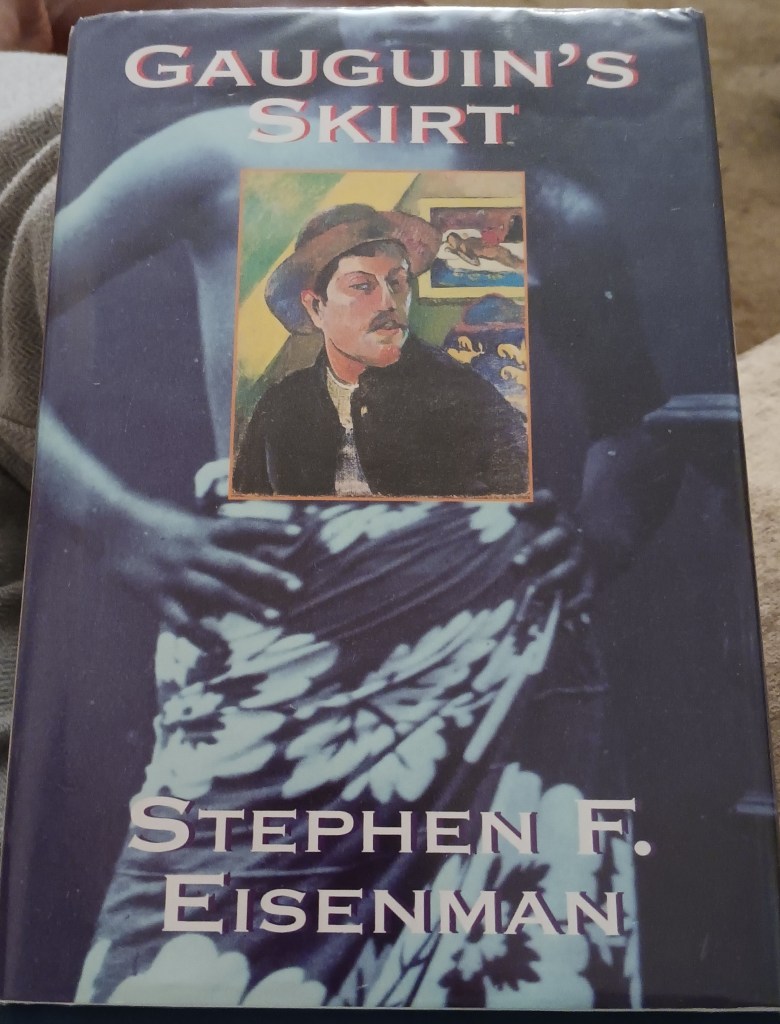
In a world heavily influenced by populist rhetoric, pretending as it has done before to be the product of contemporary sciences, promoted and spread by every simplistic trick of right wing tending mass propaganda, I need a break from them. If that means a return to books that championed scholarship and a lack of fear of counter-intuitive truths, let me do that by celebrating a book about a man in a skirt, with that illustrated on its cover, whereon, in a photographic reproduction, stands a young Polynesian man or older boy, with hands on hips are covered by the folds of a long skirt, or more accurately ‘an ankle-length pareu‘ or pareo. The young person’s torso would be naked were it not covered over by a reproduction of a Paul Gauguin self-portrait, one at his most ‘manly’. Let’s say ‘manly’, though especially when used normatively, as a value judgement, are deeply subject to cultural variation and individual perception. However, when Gauguin first reached Papeete by boat, well before he donned a pareu, his long hair, even covered by a ‘vast, brown felt hat’attracted to him jeers by women and the name ‘taata vahine‘ (man-woman) – for tips on Tahitian language use this link.’ Eisenman’s views on Polynesian anthropology were influenced by books in the 1990s by the anthropologist Nicholas Thomas, whose later extension of his ideas in relation to Gauguin are referred to in a blog on his own and later book on that artist in French Polynesia (see this link) and yet another on seeing that charming anthropologist on stage at Hexham Queens Hall (see this link). Thomas’s view of Eisenman in his Gauguin and Polynesia (2024: 254f.) is that Eisenman fails quite to articulate fully that Gauguin’s work ‘is contradictory in the deepest possible sense’, about colonialism, Polynesia and, well, everything. But I read Eisenman to illustrate, even if not overtly, precisely Thomas’ conclusion.
That is because Eisenman impresses in a manner that few academic books on art or literature, and historical anthropology (or all three as in this case) do not. This book is readable but does not hold back from making scholarship available to a wider audience nor from counter-intuitive conclusions well based in different kinds of evidence, without overt conclusion on anything. In part he uses very lightly annotated photographs to make his point as in the fold below of photographs of Tahitian persons. These photographs code sex/gender ‘differently’ says Eisenman, but (here at least) leaves it to us to see and interpret for our ourselves with the uncertainties of our own cultural entrainment in our own sex/gender coding, how sex/gender appears as part of the representation of Tahitian groups and individuals.
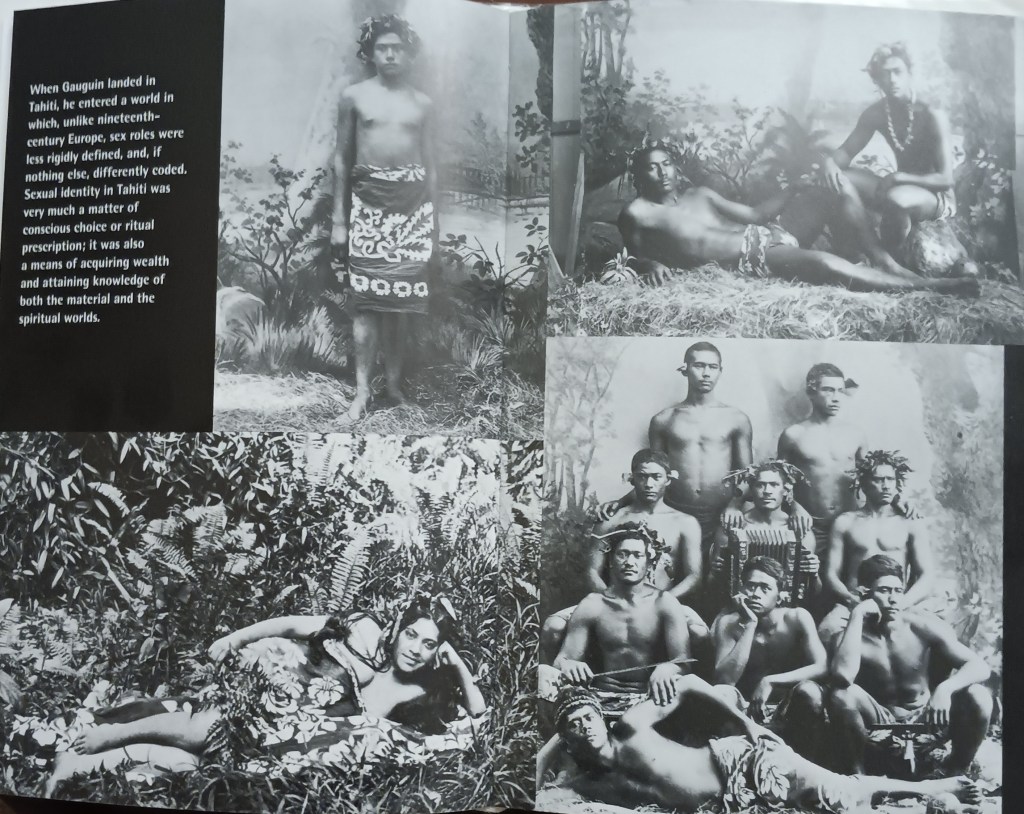
The allowance made for males to lounge and self-decorate, as we might see it, provocatively jars with Western masculine conventions, and though the homosocial bonding created by a network of hand-to-flesh links is not unlike that of a contemporary rugby team, the proximate lingering of naked flesh to naked flesh in a public gaze is not, nor the way, hand, hip and pareu interact in those who take (or were invited by the photographer to take) the lounging style beneath a pyramidal fleshly wall of their colleagues.To say ‘sex roles were less rigidly defined, and, if nothing else, differently coded’, is to say very little that doesn’t allow any other conclusion than that this difference is not for us to articulate. Thomas in 2024 says Eisenman was primarily interested in ‘sexual androgyny and through the prominence of third-sex identities in Polynesia, as a sort of critique of binary sex, and therefore of masculinism’. In fact, even here, Eisenman muddies the waters by showing how Gauguin may project those European concerns from the beginnings of anthropology, in Edward Carpenter for instance as a parallel if not influence on ‘intermediate types’, Gauguin was trapped in a third sex box indeed in Eisenman’s reading,: not fully accepted into male homosocial groups, his chief access (because he was a man working in crafts and therefore compromised as a ‘Polynesian male’) was with all-female and Māhū groups. Moreover, it may have made sense to him that this was the case from affiliation with Verlaine, and the sharing of memories of Rimbaud, Eisenman thinks. I get the impression that Thomas may see some of this as queer special-pleading on behalf of a possible closet forebear, but only because he reads the book as if it were more certain of itself than do I.
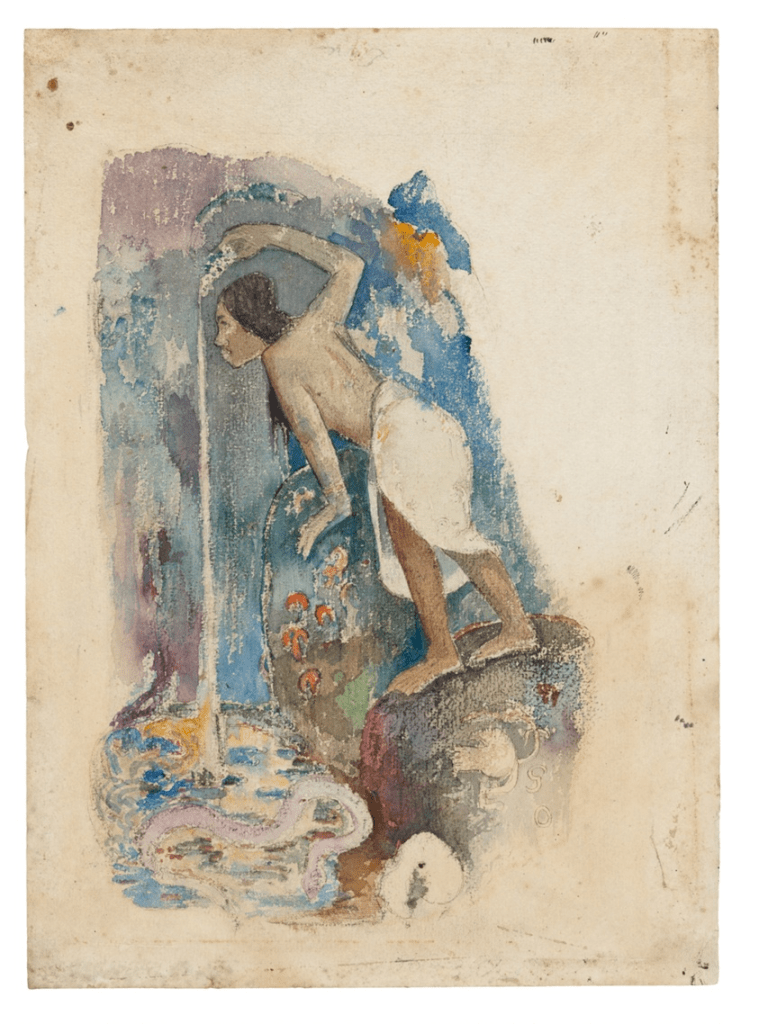
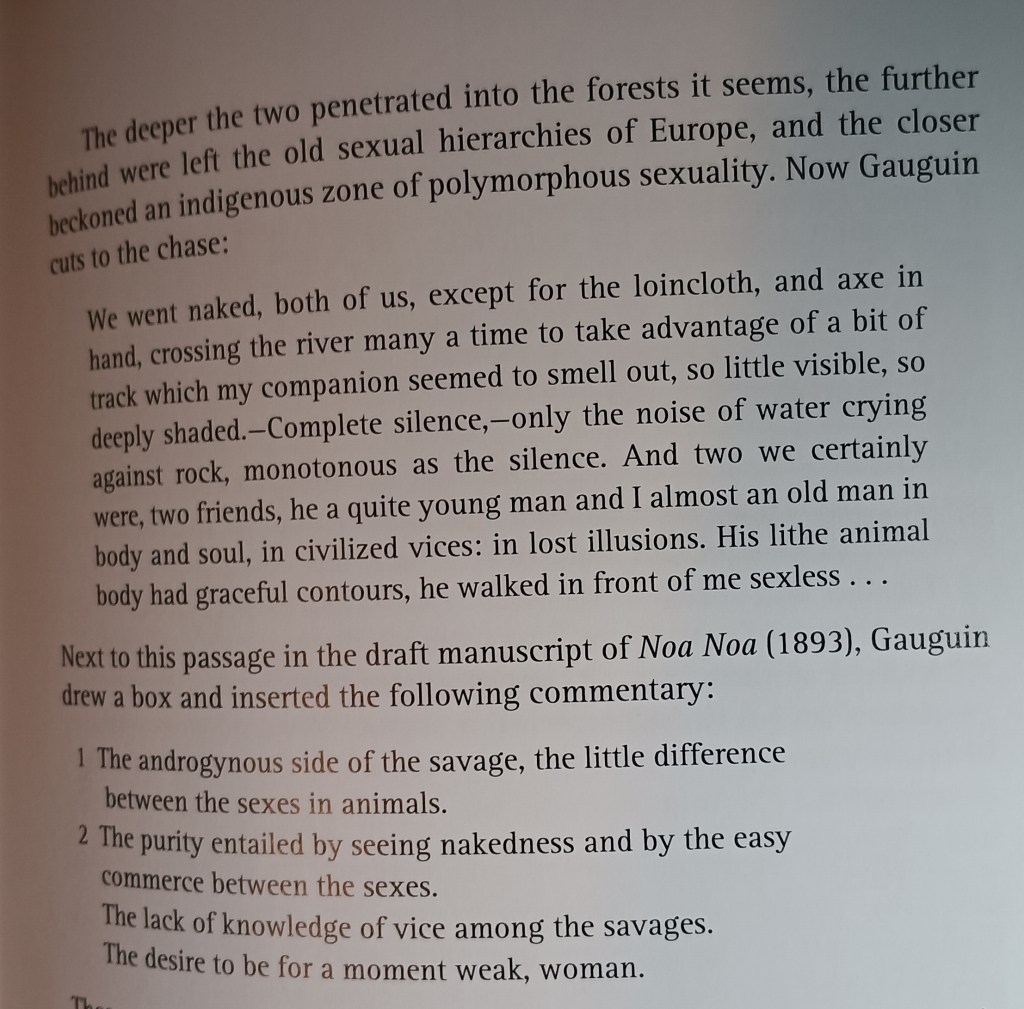
Eisenman’s book is a sheer delight to me because it comes to a ‘not proven’ stance that speaks through the contradictions in the painting and the writing. Its value is precisely to stop academics from carrying the day with too overt conclusions based on too little evidence, for most of the evidence is, and has to be, soft. So I will leave these beautiful statements from Gauguin, the first a painting, Pape moe (Mysterious Waters) 1893, the second a record of a trip to Tahiti’s interior with a young male by Gauguin with the artist’s queries [sex/gender Questioning] on sex / gender, with no conclusions drawn (from Eisenman op.cit: 315). Of course, Gauguin’s use of the term ‘weak’ for women, as with the word ‘savage’ for Polynesians, does not fit the Polynesian women (or men) he knew well as he would say in other contexts.

Bye for now. Don’t let the simplistic legislation loving TERFs get you down my trans friends.
With love
Steven xxxxxxx
 Steve_Bamlett_blog
This dives into complex ideas about feminism and difference in a way that really makes you think.
LikeLike