


Political views that change ‘over time’ are most often based on political interests. Free-standing, and relatively independent thought, feelings and action regarding politics – about how different kinds of power are distributed and used – probably do change over time in reflection of learning, provided we allow ourselves to continue learning over our lives. However, I suspect that this question addresses stereotypical views about change over time, in predictable swerves to the right of politics and in defence of the status quo, that is a reflection of increasingly conservative self-interests, rather than independent thought. This blog is stimulated by Peter Oborne (2025) Complicit: Britain’s Role in the Destruction of Gaza New York & London, OR Books.
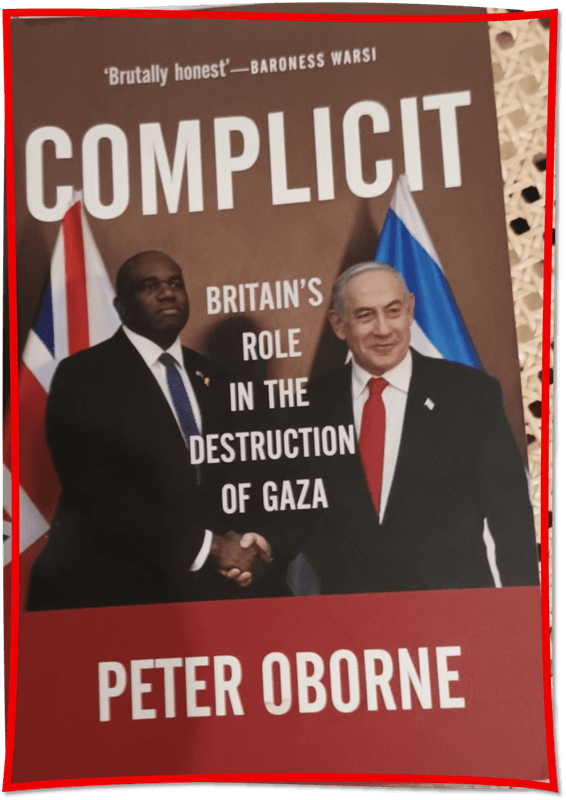
I referred to this book yesterday in relation to its candid exposure of the political and moral cowardice of our current Prime Minister, Sir Keir Starmer. However, that piece merely reflected views I already had but had never seen the case so well expressed. Nevertheless, see that piece at this link. Today’s blog takes Oborne’s book more seriously.
The assumption in the WordPress prompt also addressed in this blog, that our views change over time, is an old one but not one based on any candid belief that this is an open question with unpredictable variety in its answers. It is probable as I state in my subtitle that ‘free-standing, and relatively independent thought, feelings and action regarding politics – about how different kinds of power are distributed and used – probably do change over time in reflection of learning, provided we allow ourselves to continue learning over our lives’. But as the ironies implied in my statement of that idea suggest, I do not have great faith in the persistence of a desire to learn in persons, irrespective of former education. This is a dilemma Oborne addresses regarding a man he clearly admires despite being in marked and honest disagreement with his views. The man so pointed out is Lord Danny Finkelstein (ennobled by David Cameron, whom it is much harder to respect for any kind of probity or honesty) who defended the Israeli Defence Forces (IDF) against the charge that Israeli drones had targeted children as part of a strategy, Finkelstein saying: “An Israeli drone will not have targeted a child. Full stop”. In response Oborne marshals yet more evidence (for some preceded the point about Finkelstein) that this is precisely what happens. Yet, subsequently Oborne stresses that he does not hold Finkelstein solely responsible for his ‘article of faith’ that ‘no matter what the evidence shows. It is a priori the case that an Israeli drone will not have targeted a child’.
He points out that Finkelstein is ‘a man of integrity, personal kindness, and decency’, and that had he (Oborne) ‘come from the same family heritage as Finkelstein, I might have reached the same conclusions’. But the generosity is tempered with the realisation that Finkelstein’s ‘own newspaper, The Times, has suppressed stories that challenge the dominant Israeli narrative’, not unlike most of the rest of the British press.[1] There has to be a responsibility somewhere for challenging the preconceptions of one’s own culture and projected sense of decency into others without looking at the evidence. However, the generosity shown to Finkelstein shows that the withholding of the same ‘generosity’ in the cases of Rishi Sunak, David Cameron, David Lammy and Sir Keir Starmer reflects the culpability of much more than ignorance, or of inadequate learning; the culpability of lying and suppressing truths of which you were fully aware. This is why Baroness Warsi’s pre-publication comment on he ‘brutal’ honesty of this book (see front cover of the book) matters, for her resignation from the last Tory government was on the basis of full awareness of this culpability, without the freedom to call it by its terrible name.
The issue is that Finkelstein might have changed his mind in different circumstances but what changed for most others exposed by this book was their self-interest in maintaining office, power, status in the establishment and income (when they were paid civil servants instructed by political masters) that meant their expressed views must change with that self-interest, without consulting the data in evidence, or suppressing it, or directly lying about it. My own feeling is to be more angry about Labour politicians that do this than Tories, from whom I largely expect it. And in this light, this book’s admiration for the consistency of support for the practices of international law In Baroness Thatcher surprised me most (she wondered where the world would be without international law) – making me even more aware that we seem to gone over a cliff in the standards of integrity in world politics in the USA and the UK, but in a strong sense LED by the USA, even before Donld Trump. Yet Thatcher challenged Ronald Reagan. Starmer did not challenge Trump, despite the constant trumpery (a good word in this context) of his supposed legal probity and forensic analytic skills in the law. And the complicitly lies not just with politicians and political alliances like the ‘special relationship’ between the USA and the UK that has enforced complicity with the maintenance of direct lies about Israeli military practice and the role of the allies in it. In a list of acts of damnation which speaks out – sometimes with humour but often with bitterness – against persons (the Archbishop of Canterbury who ‘refused to meet a Bethlehem pastor’ but also whole groups of ‘atrocity deniers’. But in there too are we:
Damn those who didn’t care. Damn those who did care but were afraid to act. Damn those intimidated them into inertia. Damn the cowards and the careerists.
… Damn the pragmatists. Damn those who had their doubts but didn’t voice them.
Damn those who didn’t know. Damn those who didn’t want to know. Damn those who didn’t understand. Damn those who didn’t want to understand.[2]
Of course, to damn all of these groups and persons – the list is over three pages in the book – is also a kind of act of desperation, evoking infernal punishment systems we know not o exist. And the source of desperation follows the list: ‘I expect you all think you get away with it. You have in he past. But the world may be starting to change’.[3] The same structure of thought lies in Owen Jones’ comment on the book that it s a ‘contribution to the coming reckoning’. But this semi-eschatological reading is partly wishful thinking. Indeed this book is already showing signs that it is being buried by those who see it as either telling inconvenient truths or prepared to still invoke the argument that the case against Israel is one of old anti-Jewish tropes, like ‘the blood libel’.
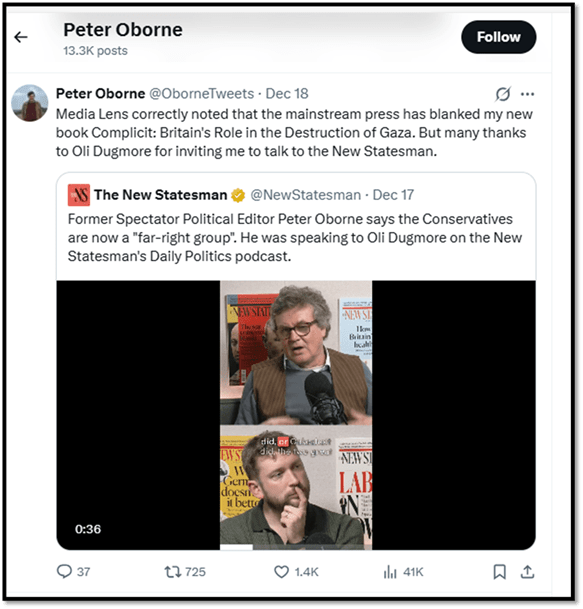
Benjamin Netanyahu uses that line of argument and accusations of antisemitism constantly to brand his critics or those who point to the disproportion of his response and its link to the founding principle of Israel to own the land ‘from the river to the sea’. That phrase is often invoked to brand people who want a just non-segregated solution for Palestinians as antisemites. Its source is Israel’s constitutional position to ensure that there will never be a Palestine secure zone or consensus. This book shows us that with brilliant marshalling of the plain-to-see documentary historical evidence. This line of argument is even used against Pope Francis before his death because he identified the clear signs of genocide or his refusal to stay silent about Gazan Christian communities. Melanie Phillips repeats the old tropes, as does Dan Jaconson, the novelist, talking of the resurrection of ‘the same merciless infanticides inscribed in the imagination of medieval Christians’. He should know better – the evidence exists in this case of genocide, in which infanticide plays a part unfortunately ( in all genocides). Phillips is another matter. She says:
“When he suggests that the Jews may be guilty of genocide, it’s hard not to hear echoes of his predecessors’ accusations that the Jews were guilty of deicide – the claim that lay behind centuries of Jewish slaughter”.[4]
Mixing historical tropes is a favourite in this game, though Francis spoke of Israel and the IDF, he is accused of branding all Jews.
Some of the material is difficult to read. The way in which the representation of the horrible attack by Hamas on settler communities on the ‘border’ of Gaza works is brilliant though, showing that constantly Israeli sources magnify the horror, already horrible enough, of October 7th – specifically to include a specific lie that Hamas burned Jewish babies to death in an oven. Of the treatment of the evidence from the invasion of Gaza, there is horror that doesn’t get told or only when absolutely impossible to hide. There is a searing moment when a newspaper journalist shows Oborne some of the visual material of the brutality of IDF attacks that was just too horrible to show (‘Once seen they live with you forever’), even though that shown was clear enough.[5]
The case against the Labour Government still has the power to shoch someone who knows that it is has set out to render the Party a party of complicity with a status quo that has cruelty and violence in its structuring DNA, and knowingly so. There is too much to recount – but the case is undeniable and laid bare in the words of the agents themselves: Lisa Nandy, Keir Starmer, David Lammy and so many more. The proof that ‘international law’ might still have bite is shown as the basis for a distrust of international law and human rights legislation led by those who ought to be its protectors. I can only hope there is enough humanity left in the Reform-stained UK population to understand this.
Please read this book. As proof that political ideas do not withstand self-interest and cowardice it is MASTERLY.
Bye for now
With love and hope
Steven xxxxxxx
[1] Cited Peter Oborne (2025: 201ff.) Complicit: Britain’s Role in the Destruction of Gaza New York & London, OR Books
[2] Ibid: 260
[3] Ibid: 261
[4] Ibid: 217
[5] Ibid: 210
 Steve_Bamlett_blog
3 thoughts on “How have your political views changed over time? Political views that change ‘over time’ are most often based on political interests. This blog is stimulated by Peter Oborne (2025) ‘Complicit: Britain’s Role in the Destruction of Gaza’.”