


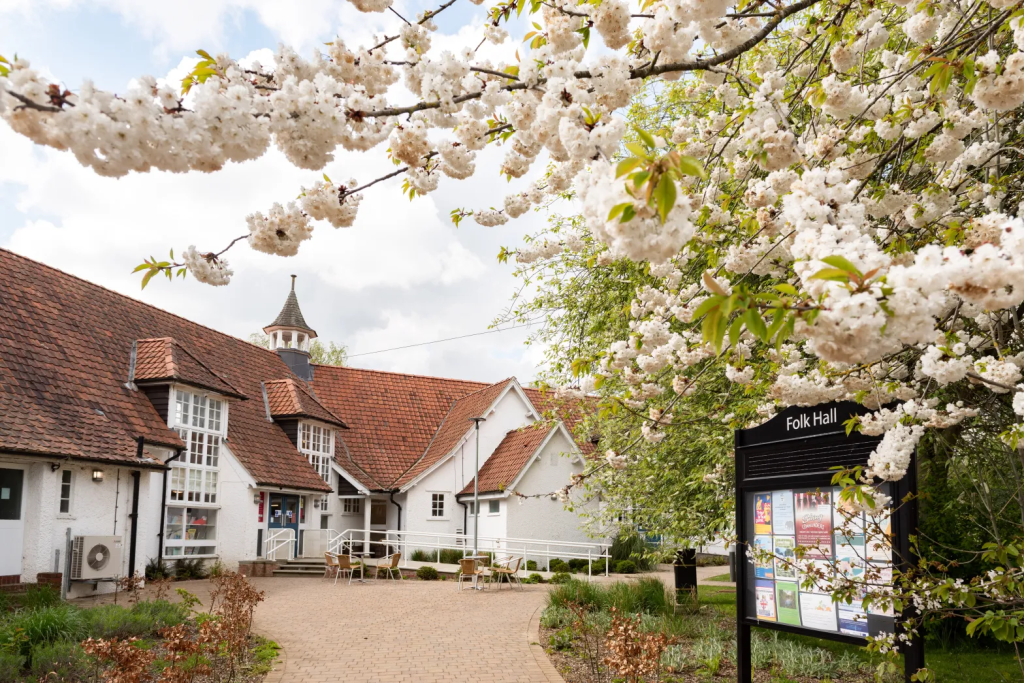
The Folk Hall at New Earswick.
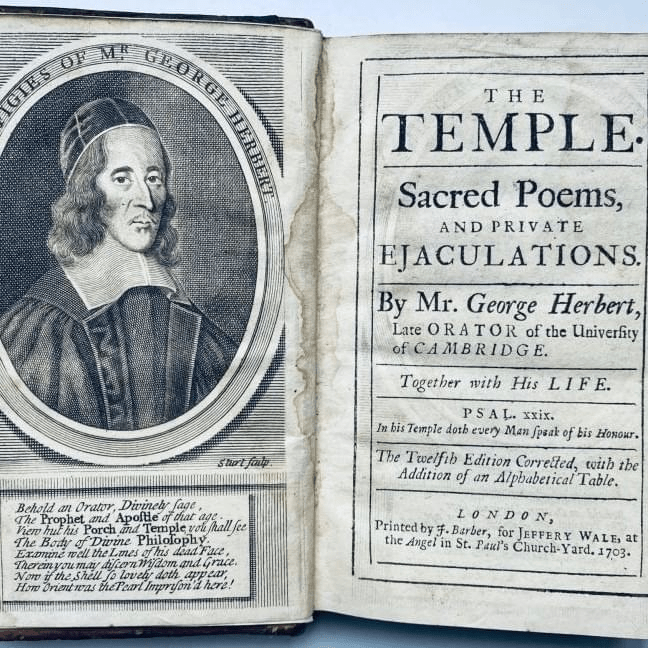
My first go at this prompt related to a vague memory of the recitation of a speech from Measure for Measure (see it at this link). Since then, my friend, Ann, who has been my friend since we both went to Wooldale Primary School, has reminded me of much I didn’t remember. Ann did not, in fact remember the Shakespeare attempt – but otherwise her memories seem much more reliable than mine. The event was held in the Folk Hall in New Earswick (a remnant of the idealistic communal villages of York chocolate magnates) , outside York, and she attended two, reading from Jane Austen. I apparently decided to do two performances – oh the arrogance of youth – the second being George Herbert’s poem about bondage to the clerical role, The Collar by George Herbert, but with lots of important issues in it about the relation of the free to the bound, resistance to perceived oppression and necessary submission to the setting of boundaries promoted in love. Here, it is:
I struck the board, and cried, "No more;
                         I will abroad!
What? shall I ever sigh and pine?
My lines and life are free, free as the road,
Loose as the wind, as large as store.
          Shall I be still in suit?
Have I no harvest but a thorn
To let me blood, and not restore
What I have lost with cordial fruit?
          Sure there was wine
Before my sighs did dry it; there was corn
    Before my tears did drown it.
      Is the year only lost to me?
          Have I no bays to crown it,
No flowers, no garlands gay? All blasted?
                  All wasted?
Not so, my heart; but there is fruit,
            And thou hast hands.
Recover all thy sigh-blown age
On double pleasures: leave thy cold dispute
Of what is fit and not. Forsake thy cage,
             Thy rope of sands,
Which petty thoughts have made, and made to thee
Good cable, to enforce and draw,
          And be thy law,
While thou didst wink and wouldst not see.
          Away! take heed;
          I will abroad.
Call in thy death's-head there; tie up thy fears;
          He that forbears
         To suit and serve his need
          Deserves his load."
But as I raved and grew more fierce and wild
          At every word,
Methought I heard one calling, Child!
          And I replied My Lord.
I still don’t remember the recitation or the response to it though Ann claims ‘I nailed it’. Fondness breeds bias of course. I do also, however, recognise the emotions I probably felt as a boy growing up with an unusually large desire for ‘freedom’ from regulation and equally large resistance to being told that certain things and behaviours are appropriate, whilst others are definitely not appropriate. I feel now the bitterness I felt then more fully against the ‘cold dispute / Of what is fit and not‘. It went with a vicious pride in youthful platitude about the certainty that rules were nought but conventions, which standing naked in the light of day would be seen for what they were: ‘petty thoughts’. I wonder sometimes whether my politics have matured? But they must have for I no longer feel the virtue of submission to the ‘Lord’, which truly must always be the complementary definition, by its binary opposite of what the poem types as also bondage: ‘Good cable, to enforce and draw, / And be thy law, / …’.
The point, I suppose, is that my psychological and political perspective has passed like the world through the learning limbics of the brain regulated now by the existential psychology and politics of Sartre and Camus, wherein regulation is a choice, a bondage embraced by the call to some outer representation of authenticity to chosen moral codes. There is no one we need to call ‘lord’: politically or religiously though many successful Alcoholics Anonymous graduates might disagree, being versed in the 3rd step of the 12 step-programme that claims we must have:
Made a decision to turn our will and our lives over to the care of God as we understood Him.
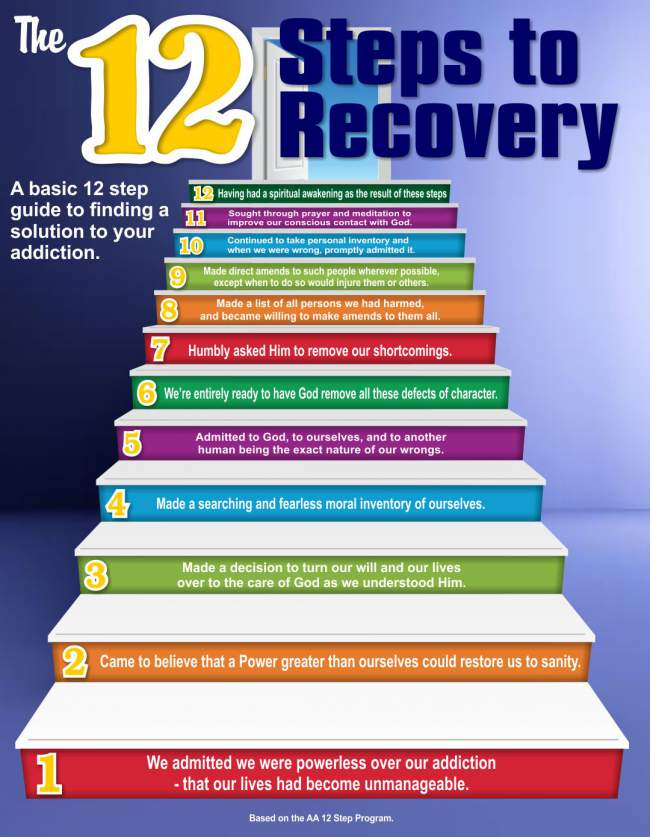
The ‘God’, or for some ‘Higher Power’, AA submit to – in order to displace the excuse making ‘ego’ – is not necessarily metaphysically or physically external to them, as their main influence, Carl Jung always insisted. The point is the ability to recognise that when we rave and grow ‘more fierce and wild’ in our petulant rejection of any bondage – any collar laid around our neck (clerical or otherwise) – we can sometimes see that such choices are a necessity policed by our mortality. The ‘death’s head’ need not be a memento mori at all. It can also be a sign that our time is limited but that we need something, some goal – not one we own alone but yet ‘ours’ because lying in the collective and continuing of good rather than ill – that will endure only when we embrace its demands of us and on us as sentient, emotional and intelligent human beings.
This poem is a meta-poem, of course. It is a poem about how the constitution of poetry itself manifests the problems in human conduct it speaks thereof. The first iambic pentameter line in this poem is a meta-statement about what such lines in poems should feel like – free, especially when they follow after curtailed syllabic lines with fewer than five feet in each:
My lines and life are free, free as the road,
Loose as the wind, as large as store.
But note that there is only one ‘irregularity’ in that iambic line – one trochee that displaces the iamb that ought to be there. The scansion is easy of course. I reproduce it below with the stressed syllables bolded:
My lines / and life / are free, // free as / the road,
Loose as / the wind, //as large /as store.
The trochee is the fourth metrical foot in the line. It emphasises the repetition (over the boundary of the breathed caesura [//]) of the insistent word ‘free” just as the opening trochee of the next line (an iambic tetrameter otherwise) emphasises by its placing of ‘Loose’ in primary position and sequence in the line, that ‘looseness’ is a considerable degradation of what ‘freedom’ means’. That is, in other words, the second trochee appears as the first foot of that next line, emphasising, in my mind at least, how uncomfortable it is to feel ‘loose’ compared to feeling ‘free’, or even feeling somewhat ‘contained’ by chosen boundaries of behavioural regulation. It is the latter that I feel is the mature modern state of existential and post-patriarchal psychology and politics.
Existential freedom is fearsome as Sartre made clear, and some work on the the collective standards of a humanist is what he called for in Existentialism is A Humanism.
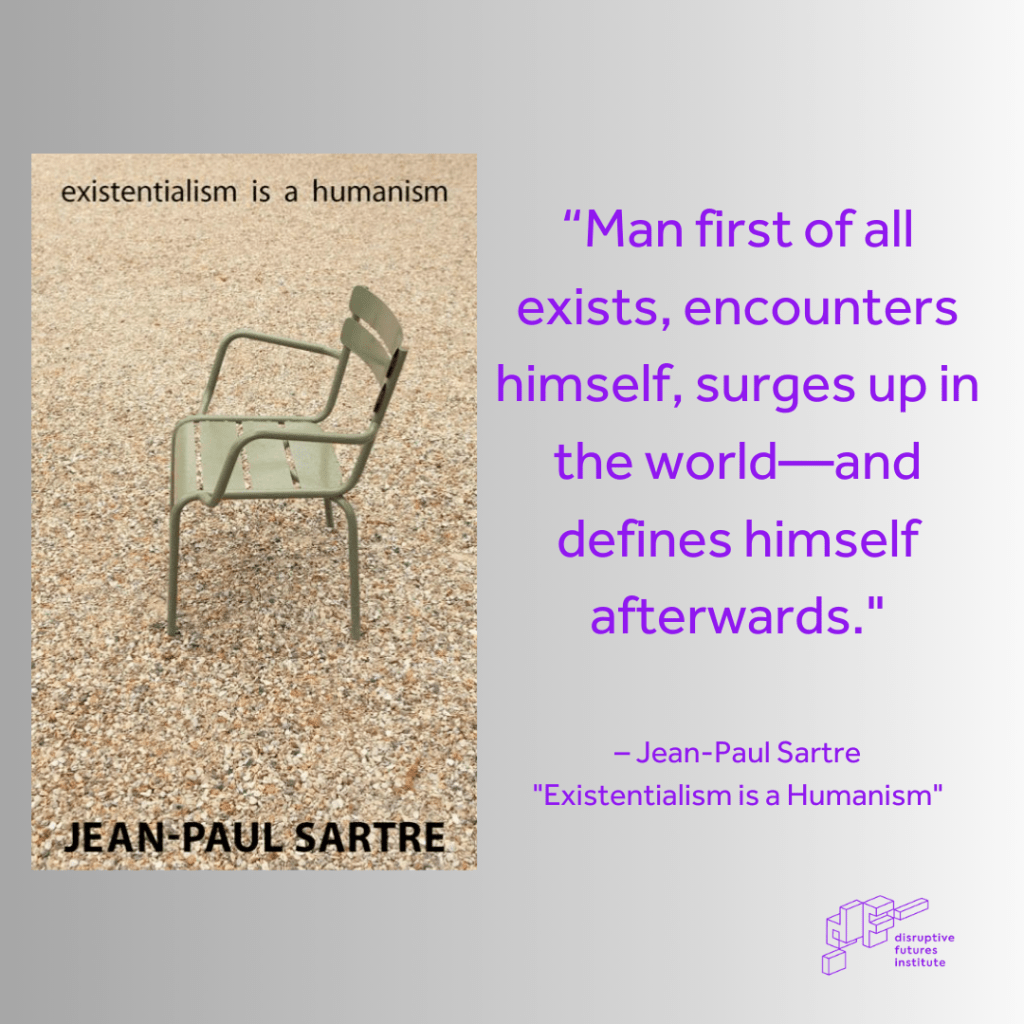
That act of self-definition must be both individual and collective so involves constraints on the naiveties of ideologies of individual freedoms, those of bourgeois revolutions, like those in France and the USA, and beloved of teenagers. Such self-definition does not submit to lord, master or father – for Herbert types the protest in his poem as that of a teenage boy wanting out of his father’s house. The ‘board’ which Herbert thought of at one level of he allegory as the altar served by the country priest, is also the family table – a thing often struck by petulant teenage, as it storms.
As I remember back, I remember that that Sartre text and the seventeenth century Metaphysical poets were probably my reading then, and they meant something. They meant a need to submit to self-regulation but to grow into that constriction as a necessity of tying down one’s own looseness into something that we ‘humans animals’ self-construct as our non-animal, but mindful of those animal bodies being equal to ours, humanity.
So there you go. And I wish that I could have recalled that and my friend’s Jane Austen recital.
Wirth love
Steven xxxxxxx


One thought on “An Addendum to my first version of this: My friend Ann says I Recited ‘The Collar’”