
When, in Act V, Scene 3 of King Lear, Lear carries in the body of his youngest daughter who had, unlike her sisters refused in the first scene to say enough to prove her love of her father to win his favour, he points out that women are to be preferred who speak hardly at all, and that, if they speak, they modulate their voice in volume and tone to that describable as ‘soft, gentle, and low’.
Cordelia, Cordelia, stay a little. Ha!                                    (line 327)
What is ’t thou sayst?—Her voice was ever soft,
Gentle, and low, an excellent thing in woman.
In the same scene, some lines before, one of those voluble sisters from the opening, now the Queen of half the kingdom, Goneril, after being exposed of plotting against her husband showing her husband, the Duke of Albany, has the same Albany say to her:
.... Shut your mouth, dame,                              (line 185)
Or with this paper shall I stopple it.—...
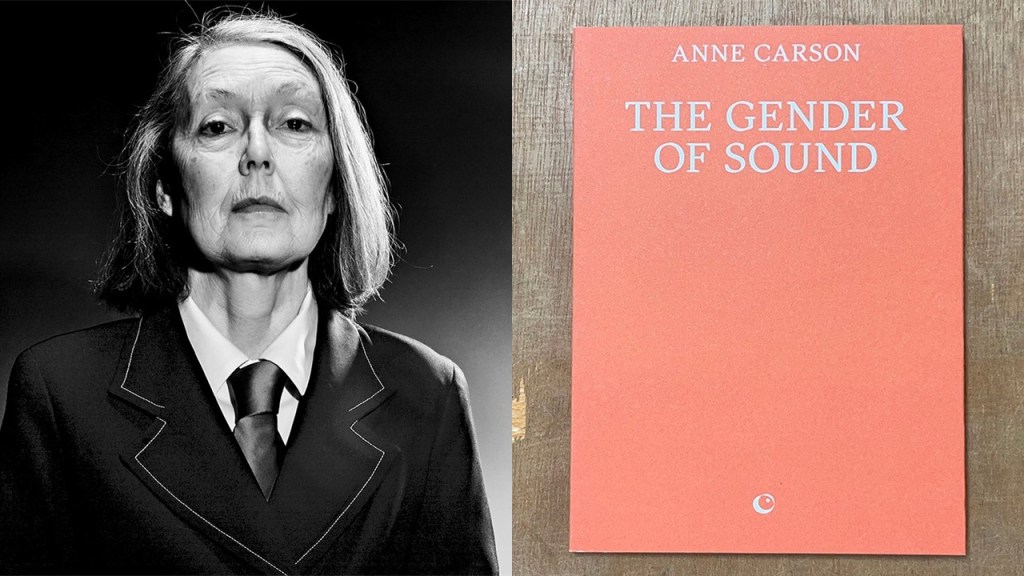
One way or another then women must be persuaded to speak as if they could not speak, as if their mouth were stopped, either as proof of being good enough women or as people whose mouths are fit for nothing but evil and poison to come volubly from them. Recently an early essay of Anne Carson, the poet and scholar of Classical civilizations and languages, has been republished (originally copyrighted 1995), named The Gender of Sound. The basic contention of that essay is expressed thus: ‘Putting a door on the female mouth has been an important project of patriarchal culture from antiquity to the present day’. [1]
The chief mechanism of normative male fear of female and feminized or queer voices, for it applies to males who talk too easily too. These young men,’ the ones who turned out to be terrific talkers’, according the the fictional feminist leader of the assembly of Athenian women from which all men were excluded, Praxagora, in Aristophanes’ comedy Ekklesiazousai or Assemblywomen (Ἐκκλησιάζουσαι) – though we know the Assembly of Women was real enough and functional in Attic Greece – ‘are the ones who get fucked the most’. [2] It gave a new meaning to Aristophanes’ favourite insult to men penetrate by men – gape-arsed – for the anus of these young men became equated with their mouths. Such a comparison fitted with the mythical support for the notion that post-virginal women had two mouths, an upper one and a lower one – the vagina already penetrated by a man. Carson instances in support of the myth’s potency ‘ a group of terracotta statues recovered from Asia Minor and dated to the fourth-century BC’ consisting ‘of almost nothing but two mouths’, of which talk was the product of the lower mouth, the upper one being that lips of the vagina. Together the two mouths produced a sound the Greeks called kakophony, from which the modern word cacophony derives. [3]
Carson does not use King Lear amongst her examples, although she uses an even wider range of ‘mingled evidence from different periods of time and different forms of cultural expression’, that extends to the examples of the male fear in modern times – in Ernest Hemingway in particular – of the linguistic innovations of Gertrude Stein and Alexander Graham Bell’s restriction on his deaf wife learning sign language (or any other) from archaic Greece (8th century BC onwards) as in the poems of Alkaios of Lesbos) to Plutarch in Roman imperial historiography. Carson even feels her own voice to be limited by certain kinds of restraint in exposing the cultural restraints on female voices by seeing them, when used beyond the domestic sphere and softly, as loud, jarring and dangerous – and, at the very least, considered very unpleasant to hear for an length of time. She mounts her attack on the term sophrosyne, which equated with the virtue of self-control and being slow to add words to their plethora of too much sound altogether in the world. She wants to ask if this is the recipe for order or rather the tool of hierarchical suppression of those whose needs are under-represented (especially of non-normative voices), virtue rather than sexual and other kinds of repression, of the interior secreted self rather than a being that associates inner and outer worlds. Yet Carson says that Carson’s own work across cultures is something ‘reviewers like to dismiss as ethnographic naïveté’. Yet, she continues: ‘I think there is a place for naïveté in ethnography, at the very least as an irritant’. [4]
We know that it is still a belief current in society that voices considered ‘feminine’ are themselves seen as irritant, especially when endured over a news programme. Carson cites a queer friend of hers who was forced to train to ‘deepen, darken and depress his voice’ before being allowed access to radio waves. [5] When that is not the case, there is usually an attempt to stereotype in order to ridicule – as in the TV voice of Alan Carr. Yet there is a point in being an irritant, Carson clearly says above – for sometimes our only chance of upsetting the order of things is to be, for as long as you are not eliminated, its living irritant.
With love
Steven xxxxxx
__________________________
[1] Anne Carson (2025: 5) The Gender of Sound Spiral House, The Silver Press.
[2] ibid: 2
[3] ibid: 30
[4] ibid: 33
[5] ibid: 3
 Steve_Bamlett_blog