


Seeing the Gary Clarke Company embody the way that history in which my husband and me were involved flashes before our eyes – intense pleasure, pain and the value of contemplating past darkness in times moving apace to times of potentially greater darkness.
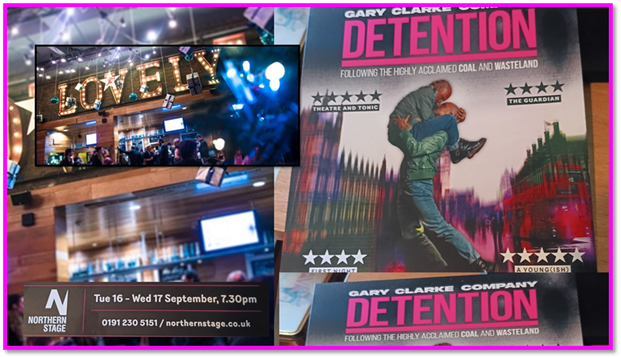
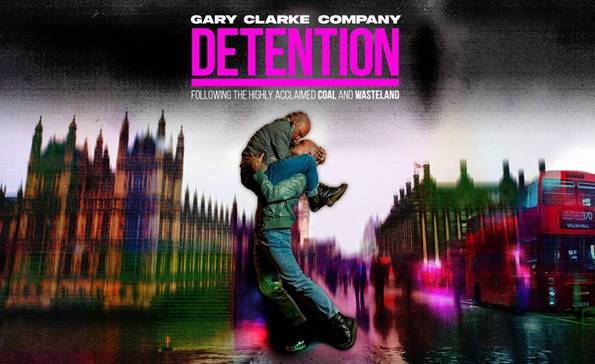
The publicity told us that ‘Detention is a powerful new dance theatre show at Northern Stage’, a theatre embedded in the campus of Newcastle University and with that ‘LOVELY’ bar space pictured in the collage above, ‘exploring the impact of Section 28’ of the Local Government Act of 1988 ‘on the LGBT+ community through exceptional choreography and storytelling’. Every quoted word here tells the truth. The choreography and storytelling was indeed ‘exceptional;’ but also emotionally and viscerally accurate (and oh so viscerally) and suggestive of even more of an emotional and sense-related hinterland than boundaried by its story-line. Sometimes bodies are literally capable of having the dynamics of what we imagine to be electricity – after all the interactions in the nervous system require electrical charge along neuronal axons. At one point as bodies twisted and turned in sequences of flow and jerks I thought of Walt Whitman’s fabulously celebratory queer erotic poem I Sing The Body Electric but with a painful nuance which may or may not have been intended:
I sing the body electric,
The armies of those I love engirth me and I engirth them,
They will not let me off till I go with them, respond to them,
And discorrupt them, and charge them full with the charge of the soul.

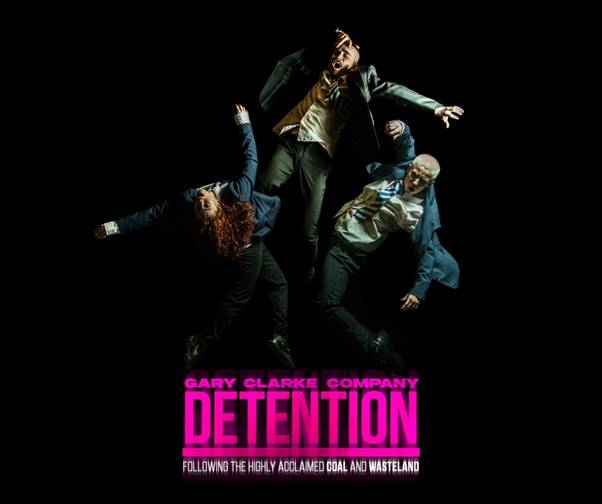
Look at that word ‘charge’ with its associated contexts of the action of armies, the legal process and the coincident action of the passage of an electrical charge, especially when the dancers are dressed as schoolchildren as in the still from the show’s dress rehearsals above. Using all of these, Whitman aims to clean the notion of the conjunction and admixture of bodies, and I expect bodily fluid of meanings considered ‘dirty’ (or ‘unclean’) and ‘corrupt’. Most bodies on this evening moved with the dynamism of electricity but also with the darker meanings of the term ‘electric shock’.
Did the dancers intend to connote the meanings of the countless electric shock treatments used to ‘cure’ bodies of queer sexual volition in those dark days when young people had, as Margaret Thatcher termed it at a Tory Party Conference before her election – and played from her speech (voiced of course by Steve Nallon) in jerkily repeated extracts, to be, violently if necessary, disabused of their belief that they had ‘an inalienable right to be gay. All of those children are being cheated of a sound start in life. Yes, cheated.’ (Margaret Thatcher, 1987).
The vile Saatchi and Saatchi company turned this into an onslaught election campaign on the idea that Labour councils were flooding schools with active ‘propaganda’ in their teaching but also in a huge plethora of books (hard to find in truth these books for largely they did not exist but in the minds of Tory ministers and paid propagandists like Saatchi and Saatchi) in school libraries.

As the show explained the one ‘book’ this propaganda of the political right exploited the mass over-coverage of, for a book entirely intended to make the adopted children of lesbian and gay couples feel as part of a normalized family structure as biological children of heteronormative parents. Its name was Jenny Lives with Eric and Martin (Mette bor hos Morten og Erik in Danish) and was translated from the original Danish of Susanne Bösche in 1981 to be published by Gay Men’s Press in 1983. This show dramatised scenes with a lot of cross-dressed character acting and role-play, that even more pointedly pointed out the innocence of the original publication – unless the naked torsos of two men in a double bed eating breakfast with their daughter between them in her nightie on a Sunday morning is considered innately ‘sexual’ (the minds of Conservatives are hard to ‘discorrupt’ as Whitman too was to realise).

Meanwhile Detention, a title that recalls the name of school punishments as a shadow of the prisons used for adult transgression. Strangely prison detention was never used for Section 28 transgression – though many local education authorities (LEAs) so over-policed themselves that it was rare to find transgression. There was plenty of evidence however (embodied in the dance drama) of well-meaning teachers of schoolchildren known to be psychologically and physically (the latter through the continuance of neglected homophobic bullying) being afraid to fulfill their duty of care to queer children, of queer teachers being especially vulnerable and of youth suicides – high among young males tortured by questioning of their sexuality by self and others. Witness again how that might look in the still of a dance where the body is racked by the involuntary electrodynamics of compulsion, or by the shock conversion-treatments urged on those who ‘came out’.
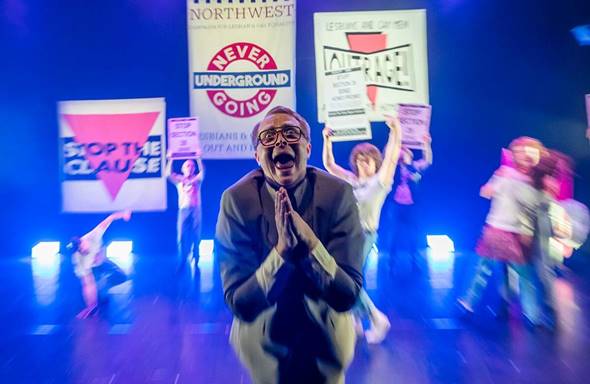
However, the central sections of the drama showed dance movement of extraordinary joy that was spontaneously applauded by the largely young audience of queer people and allies, for these sections dealt with the fightback to the introduction of Section 28 to the Local Government Bill, its enactment and the nine year period of its stay on the Statute books. The play’s publicity tells of this joyful section – set against the placards of the period created in resistance to the clause:
The performance combines vivid choreography with personal narratives and testimonies, including insights from the LGBT+ Switchboard Logbooks. It features a diverse cast of dancers and local LGBT+ voices, creating a rich tapestry of experiences that highlight the struggles and resilience of the community during this period. The production is noted for its striking designs in film, sound, light, and costume, along with music from the iconic band Test Dept.
Theatre hides some of its skills in our joy at performance and the bodily skills of performers, but these are impossible to imagine without the excellence of collateral effects such as lighting – and some tremendously effective blackouts – by Joshie Harriette, and total ‘sound design’by Torben Sylvest. Moreover some of the action – especially of the political material was projected film (by Kamal Macdonald). All these effect required expert choreographic and theatrical co-ordination that melded Adam Zmith’s scripted text superbly so that no joins were felt, except those that tore though queer bodies by the action of a law that used oppressive social prejudices to further marginalise people already marginalised by the social interpretations of the AIDS syndrome illnesses and HIV infection, too little understood or studied at the time.
The touring cast aren’t named in the publicity I saw but the narrator – who spoke the words that characters over-determinately expressed in tortured as well as joyful dance was excellent and the same performer, Lewey Hellewell (see them below).
Special notice needs to be given to the local community performers, for this gave the piece an authenticity that the skills of the professional performers sometimes hides under the naturalised artifice of good enactment of the body expressing itself in various non-spoken forms. The were particularly well used to do some really wonderful tush-shaking with the message of Section 28 worn on their bum cheeks like the metaphoric legal toilet paper it was. The local cast below though was that for the Manchester production – I would stand tall in honour however of the Newcastle cast too.
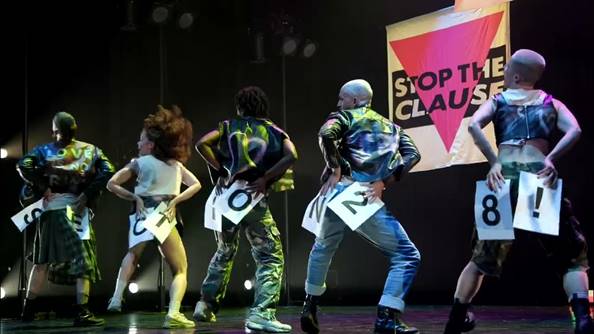
The pictures below too are of the original rather than the touring cast but the cast may be the same (the original ensemble of dancers being Gavin Coward, Alexandra Bierlaire, Alex Gosmore, Mayowa Ogunnaike and Imogen Wright). I can attest however that this cast ensemble was as lithely beautifully a set of unmeasured dancing heroes, a delight to see, where joy was as visceral as the pain of other scenes, as those in the Salford Lowry theatre production photographs below. It was more hard-to-watch, however, in scenes of violent homophobic attacks or of the psychological humiliation of lesbian mothers.

Sarah Monaghan in a blog post review of the production for All About Theatre online at the Salford Lowry theatre tells us this production is one of a trilogy about 1980s politics including the critically acclaimed ‘ COAL and Wasteland, that explicitly focuses on ‘exploring working-class communities in 1980s Britain’. She continues:
Where COAL unearthed the pain of pit closures and Wasteland surveyed the aftermath, Detention dives headfirst into the hidden anguish caused by Section 28 — …. Detention is both a personal reflection and a political statement, … (1)
She goes on to point out that set and costume design by Ryan Dawson Laight is ‘simple yet punchy — all protest banners, denim, leather and slogan tees, transporting us straight into the 80s’ but what we should notice too is that this design is intended to reflect the working class communities – not reflected by glitzy stage dance costumery and properties in the very class-consciously elite forms of ballet and, to some extent, contemporary postmodern dance. I can also agree with Monaghan’s conclusions about the show, which are as below:
Detention is not an easy watch — nor should it be. It’s a visually striking, emotionally raw and unapologetically political piece of dance theatre that demands we remember a dark chapter in British history. Powerful and thought-provoking, it tackles its themes with honesty, heart and creative fire, never shying away from the discomfort and injustice of the past. Through brave storytelling and bold physicality, it challenges audiences to reflect, question and remember. The inclusion of local community members with lived experience of Section 28 adds an invaluable emotional depth, grounding the piece in real lives and real pain. This is a show that stays with you — resonant, relevant, and relentlessly human.
Monghan says this effect is particularly realised by the use of local volunteer actors who are LBGTQI+ people who themselves ‘experienced the effect of Section 28’, but Sarah Monaghan is obviously too young to see herself in that role. Both Geoff, my husband, and I are in our 80s and 70s respectively and we were part of most of it – most happily in memories of our participation in London with Coal Not Dole demonstrations of the time – especially under the banner Lesbians and Gays Support the Miners. But some of the memories trigger visceral memories of psychological pain either from one’s own or loved friend’s memories, not least of fellow activists we lost to AIDs like our friend, the queer Renaissance historian, Alan Bray, or of others lost to suicide or partially damaged with enduring mental health issues. For if there was resilience that everyone applauded there also remains vulnerability.
As I pass through my home town, Crook, the streets are lined with St. George flags meant to terrify anyone not represented for the norms they currently stand for, despite the insistence of a current Government blinded to the context of a turn to right-wing responses to immigration and sexuality that they have encouraged, after ridding their party of the heroes who supported queer chosen families to integrate in the Greater London Council in the 1980s, and promoted, through ILEA, Jenny lives with Eric and Martin.
As I look out of my bedroom window, I see the emblem of a hating community flying its hate high. The play we saw ended with a clear demonstration that there is still a need for queer switchboards and counselling – for politics is turning against us – to the exclusive boundaried hate of ‘pretended’ straight (for performatively no family is entirely ‘straight’) white families. We shouldn’t be the ones looking to switchboards whilst Elon Musk publically incites the likes of Tommy Robinson (the working class mask of Stephen Yaxley-Lennon).

Goodbye for now. Pray we all avoid detention in fas ist concentration camps for not consigning our specialness the rubbish bin in the favour of the norm, oppressive and boring. But don’t avoid the Detention production. It brings political, emotional and cognitive hope to the portal of your mind and heart, rather than the hate of Yaxley-Lennon variety.
With love
______________________________________
[1] Sarah Monaghan (2025) ‘REVIEW – DETENTION BY GARY CLARKE COMPANY | THE LOWRY | 14/05/2025′ available at: https://www.allabouttheatreuk.com/post/review-detention-by-gary-clarke-company-at-the-lowry
 Steve_Bamlett_blog