


My mood was a mix-up, dusk and light seemed a match
To the flow of colours in this translucent gown.
Surely Night would not, when I fell in his bed, frown
His disapproval, or with his claws pull and scratch
Away this feminine attire, or so he named
It, as if non-binary being should not be
Fully blatant in the wide open air. I'm blamed
For seeming what I feel. Can Night not really see
That to be mixed is as valid as the bright Day
Is. He thinks I steal from him his lonely essence
By being intimate with light, as if I lay
With her each evening to prove his own absence
Hurt no one. He fears he will not ever truly
Come to be if he's not named king of the nothing
That is the effect alone of eyes that can't see,
For darkness has put its colour range in hiding.
His glory is ersatz, mine is greater now
For all things to indefinability bow.
These few extended lines (all of 12 syllables) of verse were prompted by the essay called Night by Colm Tóibín in the new book on the paintings of Pat Steir 2018 – 2025 [see a blog on it at this link]. In prefacing his comments on poems of the night by Fulke Greville, T.S. Eliot and Rainer Maria Rilke, he says: [1]
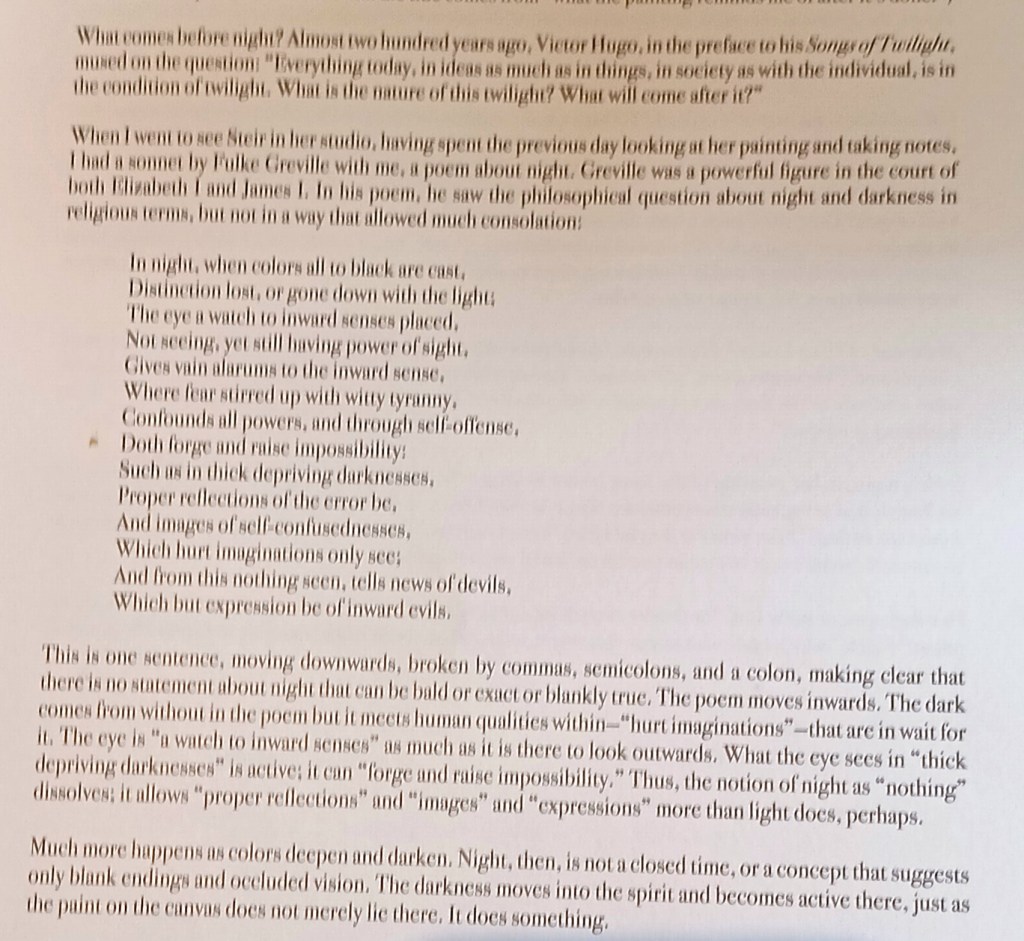
But, in truth these verses are dedicated to Mike Monsoon, a beautiful friend; boldly non-binary as twilight is. They may not recognise themselves in this, but the principle is the same.
_______________________________
[1] Colm Tóibín (2025: 15) ‘Night’ in Jake Brodsky, Sussanah Faber et. al. (Eds.) Pat Steir: Paintings 2018 – 2025 Zurich, Hauser & Wirth Publishers. 11 – 16.
 Steve_Bamlett_blog
❤️
LikeLike