


The answer must be that art motivates me. Here I am testing ideas and prejudices about the supposed rivalries between great artists! This might be the reason that I am here anticipating a trip to London today (20th August 2025) to look again at Jenny Saville at the National Portrait Gallery and to see a play (Born with Teeth, the RSC at Wyndham’s Theatre) about a hypothetical supposition that William Shakespeare and Christopher Marlowe collaborated on the play Henry VI Part one.
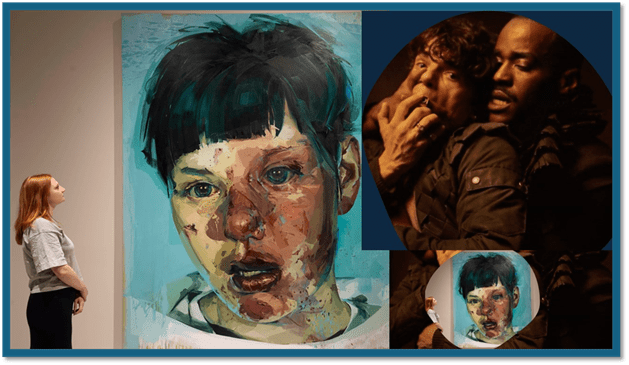
Art is a great motivator. My train leaves Durham at 8.45 and by then this blog will be online. Let’s start with background to how this trip has now coalesced into some kind of structure.
I first saw Jenny Saville’s work at the National Galleries of Scotland in the Modern Gallery but wonder if I saw her aright. This is the time to get out my current books on her (on my return) and look again at an artist I, and it appears others have grossly under-rated because of a tendency in all of us to make shallow comparisons with earlier artists who are supposed to be greater than they. I think I may have fallen into an error that Jonathan Jones suggests to be common in his review of The National Portrait Gallery’s show, The Anatomy of Painting. Jones says very confidently that:
Ever since the early 1990s, Saville has been compared with the late British figurative master, hyped as a young female Freud, or criticised as “just not as good as Freud”.[1]
At first blush the nudity in the female figures of Saville does remind you of notable works by Freud, and I certainly in the past fell into that arena of facile comparison – not least because paint and flesh are seen to suggest each other in both painters, as in Titian – and it may be that this stops you testing the comparative quality of the older artist and his later ‘rival’. Perhaps no rivalry ever existed here. Jones is of that mind saying that:
One artist it does not make you think of is Lucian Freud. … This exhibition proves how utterly different they are (my bolding).
And hence I travel aiming for an eye-opener into the Saville I may have missed, and ready when I return to open my little library of her book, together perhaps with the catalogue from this one to help that project. But I have to say that though I am getting excited now, visiting this exhibition was an ‘afterthought’ for the true purpose of my visit was to see Born With Teeth, Liz Duffy Adam’s imagination of a writing collaboration between Elizabethan playwrights (well before Shakespeare’s art has manifested itself in plays well beyond the potential even of other playwrights and where Marlowe’s dominance would be taken for granted as a poet in drama. The rivalry between these particular playwrights is often assumed – and there are critical books on its significance (see Robert Sawyer’s book cover below), as well as some wild guesses that they are the same person.
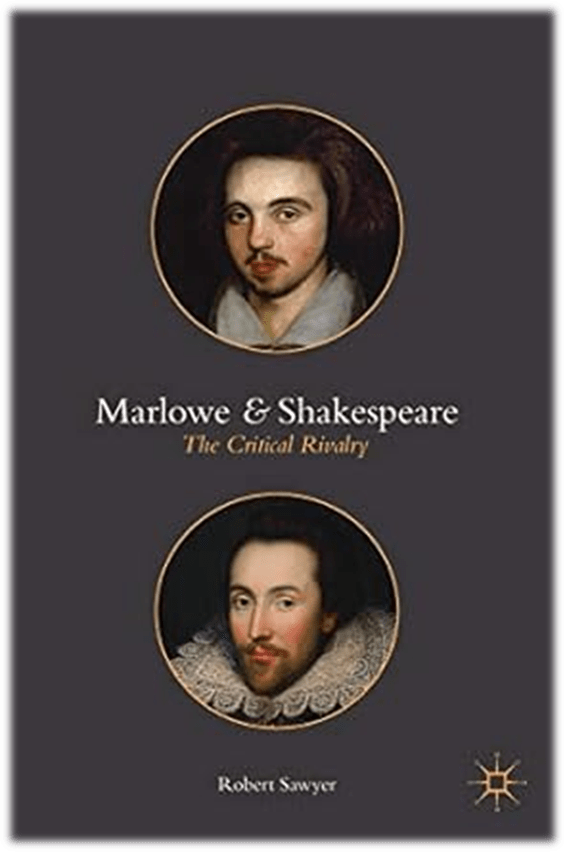
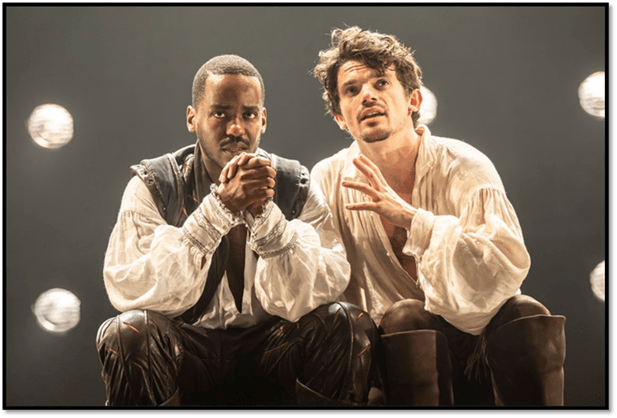
But take those beruffed gentleman out of the picture and put in their place, as avatars, two young actors with raunchy reputations and you see already the potential for giving the encounter between them a sexual as well as an aesthetic aspect. Forget Marlowe’s supposed statement: ‘All they that love not tobacco and boys are fools’, a remark attributed to Marlowe from the testimony of Richard Baines, a government informer, in 1593, and just see the lithe and sexy figure of Ncuti Gatwa in that role to Richard Bluemel’s Shakespeare.

And add to that a restaging that might take liberties with the play than did its debut in the USA, although that two clearly went for some degree of testosterone-based sexual chemistry:

How it was possible to release a photograph of the present production like the one below. I’m glad they did. Seeing Gatwa thus suspended over the body of Bluemel is tantalising and I can’t wait to see where Marlowe lands on Shakespeare:
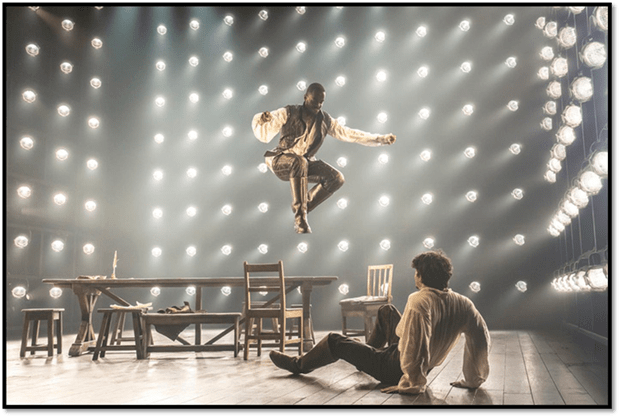
I don’t intend to say more, or review the reviews – this one I want to see fresh, because the text is not published until Thursday, on the day after I see the play, and (if it isn’t available in the theatre) I will order one from Amazon to blog away afterwards. The issues in the play are possibly as much about the visceral body – there is plenty of that in the language of both Marlowe’s and Shakespeare’s plays – but I will be warmed up to that from Jenny Saville, if Jones is right about the exhibition’s effect:
Looking, suggests Saville, is not really the point. You have to see beyond the details of skin and bone, beyond anatomy, to feel the ungraspable but omnipresent realness of others. When that understanding hits you it’s a shock.
More blogs afterwards then but that is all for today. I will put this online before I have my morning shower. I have not used the photos of Gatwa’s naked torso. You see: art is a great motivator and a comprehensive one.
With love
Steven xxxxxxxx
[1] Jonathan Jones (2025) ‘Portraits so powerful they override reality – Jenny Saville: The Anatomy of Painting review’ in The Guardian (Thu 19 Jun 2025 00.01 BST) available at: https://www.theguardian.com/artanddesign/2025/jun/19/jenny-saville-the-anatomy-of-painting-review-national-portrait-gallery-london
 Steve_Bamlett_blog