


I should have worn out my dislike of “positive psychology” by now, but for me, it reeks of everything that is wrong with the core belief of the capitalist global North and West in ‘His Majesty the Ego’, as Freud calls the object of the narcissistically derived self, that central ‘I’ that feels itself the sole arbiter of what is good or bad, true or false, or ethical and unethical. It isn’t, as is wrongly believed, a hedonistic agency that ‘I’: in fact, it is a principle that feels itself the rule and ruler that measures, compares and contrast binaries that it feels it must balance in order to maintain its belief in its own integrity. It doesn’t pursue pleasure alone and per se, for that would unmask its belief that it just ignores ‘reality’ and rejects any degree of ‘unpleasure’ [as Freud’s translators worded that other side of the pleasure principle]. It believes itself the principle that maintains balance between the self maintaining its right to fulfil itself but in ‘realistic ways’. What it denies is that there is any other mode of knowing the world except in its own terms, where the first duty is to self-interest, howsoever it interprets that term.
The folk psychologists of the capitalist North and West now colonise large parts of the South and East globally but the folk cultures of some of the latter are still nearer to ways of seeing less based on self, and more on the communitarian, the interests of survival of the whole commonality of cultures not the petty ego.
Positive Psychology started in the laboratories of Western Psychology: in Seligman’s cruel post-Skinner controlled experiments based on simulating in dogs active resistance to self-help or ‘learned helplessness’. Seligman conditioned dogs such that they hadn’t any agency of control over their fate – which was to have unexpected electric shocks applied to their paws. These dogs were the animal models of the first Positive Psychologists. People forget about that nasty start now that Positive Psychology claims entirely to be a humanist psychology, working with heuristics like positive development, organic growth (in Carl Rogers), or flow (Csziksentmihalyi).
Occasionally, the canon of positive psychology is enlarged by proposals of another way of expressing and monetising the old theory. Let’s take one example, Pamela Fredrickson. The extract below from a web-site devoted to her theories is typical of the thinking of contemporary Positive Psychology
Fredrickson’s work on the study of positive emotions, like love, began in 1998. Her foundational research led to her to develop a theory on positive emotions called Broaden and Build Theory. The substance of this theory lies in the notion that positive emotions play an essential role in our survival. Positive emotions, like love, joy, and gratitude, promote new and creative actions, ideas, and social bonds. When people experience positive emotions, their minds broaden and they open up to new possibilities and ideas. At the same time, positive emotions help people build their personal well-being resources, ranging from physical resources, to intellectual resources, and social resources (Fredrickson 2009). The building part of this theory is tied into the findings that these resources are durable and can be drawn upon in later moments, in different emotional states, to maintain well-being.
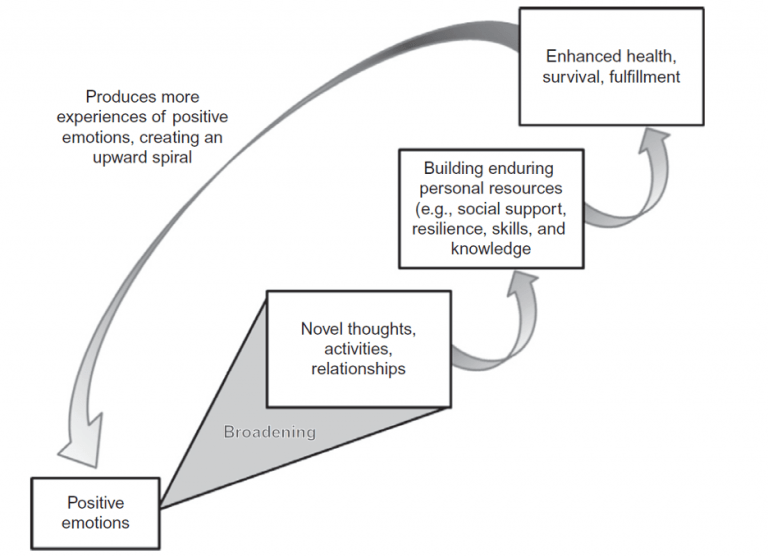
The theory also suggests that negative emotions serve the opposite function of positive ones. When threatened with negative emotions like anxiety, fear, frustration, or anger, the mind constricts and focuses in on the imposing threat (real or imagined), thus limiting one’s ability to be open to new ideas and build resources and relationships. Fredrickson draws on the imagery of the water lily to beautifully illustrate her theory:
Just as water lilies retract when sunlight fades, so do our minds when positivity fades
(Fredrickson 2009, p. 55).
In her 2009 book, Positivity, Fredrickson’s research defines and how it can transform people’s lives. At that time, research showed an approximate 3 to 1 ratio of positivity as being ideal in terms of high functioning teams, relationships, and marriages (this is sometimes referred to as the Losada Ratio). Fredrickson explains how experiencing positive emotions to negative emotions in this approximate ratio leads people to achieve optimal levels of well-being and resilience. This scientific discovery was groundbreaking in beginning the discussions on how a positive state of mind can enhance relationships, improve health, relieve depression, and broaden the mind.
A 2013, a study conducted by Nicholas J. L. Brown, Alan D. Sokal, and Harris L. Friedman challenged the validity of the Losada ratio. Their concerns stemmed from an empirical viewpoint. They did not find issue with the idea that positive emotion is more likely to build resilience or that a higher positivity ratio is more beneficial than a lower one. They found issue in assigning applications of mathematics to pinpoint the “ideal” emotional ratio. (Brown, et al 2013). Fredrickson responded to the critique by agreeing that more study is likely necessary to designate a precise mathematical value/ratio, however, she does stand firm that her research has adequately proved that the benefit of a high positivity/negativity ratio is solid: “Science, at its best, self-corrects. We may now be witnessing such self-correction in action as mathematically precise statements about positivity ratios give way to heuristic statements such as “higher is better, within bounds.” (Fredrickson, 2013). The door is open for further scientific study and one can expect with time, more data will come.
I call it typical because it tries to characterise itself as all things to all people. Starting off with an insistence that its hypotheses deal with quantifiable objective ‘things’ (which can be measured empirically), it insists it is a hard science just awaiting better data to validate it. Meanwhile, it is happy to be a softer discipline that deals with heuristics – just as folk psychologies always, and qualitative sciences sometimes, have to do. This has much to do with the favoured imagery here: particularly that of the lily that fades when deprived of positive sunlight
But even sunlit lilies must fade. Some suggest, like Prince Hal [that arch dissember] in Shakespeare’s The First Part of Henry IV, that ‘lilies that fester smell far worse than weeds’. But the rate of decay of organic matter has very little to do with its reputation for especial beauty and scented excellence. Lilies betoken death in our culture for another reason: they ape the pale purity of bloodlessness in white cultures.
All things die, and only the communal survives. It is time we found a communally ethical substitute for lingering on our so-called positive emotions and coming to terms with those we oversimplify as negative, as in the mind map below.
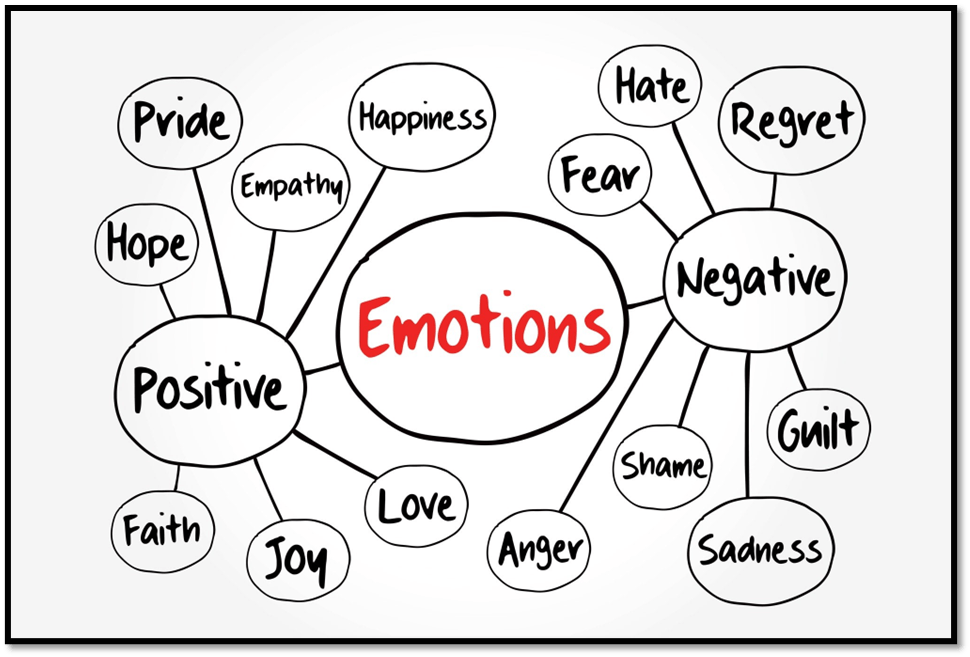
In the end, even Western Christian medievalism could be a better model than mindless mindfulness. Both the Seven Heavely Virtues (look them up for yourself) and the Seven Deadly Sins provide such a model because they are about actions consequent on emotion. In the former motivating emotions are tinged with thought that makes the emotion pallid, and, for modern thinkers unbearably ‘negative’. Whilst the deadly Sins at least allow the self some sway, neglecting to condemn, even rejoicing in, the victory of emotional need over any rational thought. In the following traditional list of deadly sins, there is more room for the positive emotions than the negative ones to hold sway in each of them.

Moreover, traditional Catholic morality has made room for the negative emotions in them only as a result of their practice, either experienced in earth on pathways to repentance, or inflicted by a loving God in a pre-built place of their delivery, HELL. In the lead role of the Seven Deadly it was conventional to place PRIDE.
Bur since pride or positive self-esteem, often nuanced as of a ‘realistic’ kind is the fulcrum of capitalist society and of positive psychology, let’s add another one; now the eighth and commanding one to stand for the Lucifer in the graphic below:

That goat King’s name is traditionally Legion, but here are two of his names, or aspects:
- 1.’defending my right to positivity’, and;
- 2. ‘colonising the world with this replacement for ethical action’.
The plea to self-interest is common to both neoliberalism and positive psychology. Predictably, proponents of both say: “You have choice: misery or seeing the best in things.” In institutions like nursing homes, it takes the form of ‘enforced cheerfulness.’ Moreover, not only that , but you have to look as if you yourself chose that cheerfulness without prompting.
I started this blog at home in case I finished my current book, Benjamin Wood’s Seascraper. I did finish it, trying to shut out noisy Oasis fans on the train. Thus I did more on this blog and in my hotel room:

I went to the play I had booked, on Fred Godwin meeting Adam Smith Make It Happen, and the play rhymed with my blog theme in a way, but I will write on it later, so I did more on this in the interval. The play’s magnificence of theme and realisation has been absorbed gratefully, and I am in awe of Brian Cox, the whole cast and crew.


I am finishing this blog over a wonderful fish curry.

At 7.30, I see two favourite writers talking together: Allan Hollinghurst and Tash Aw. What a day!!
All for now
With love
Steven xxxxxxx
 Steve_Bamlett_blog