Being curious about questions you never thought you’d ask! A way of preparing to see a new play: seeing James Graham’s ‘Make It Happen’ at The Festival Theatre Edinburgh on the 9 August 2025, 2.30 p.m.
Being curious about questions you never thought you’d ask! Can the ghost of an eighteenth-century Scottish liberal moral philosopher save capitalism from its own contradictions and from the reputation cast back on him by neoliberal followers from Margaret Thatcher to Fred ‘The Shred’ Goodwin, the notorious Chief Executive of the Royal Bank of Scotland and architect of its demise, who misquoted him? I look forward to seeing what will be, unfortunately, the last performance of James Graham’s Make It Happen at The Festival Theatre Edinburgh on the 9 August 2025, 2.30 p.m.
A statue of Smith on High Street in Edinburgh, erected through private donations organised by the Adam Smith Institute: By Stefan Schäfer, Lich – Own work, CC BY-SA 4.0, https://commons.wikimedia.org/w/index.php?curid=34656567, the posthumous portrait (1800) by Wade, and a print by Kay in 1790 which may have created the trend for always seeing Smith just as ‘The Author of ‘The Wealth of Nations’’. The detail that shows an image of Cox is from a larger one by Mihaela Bodlovic.
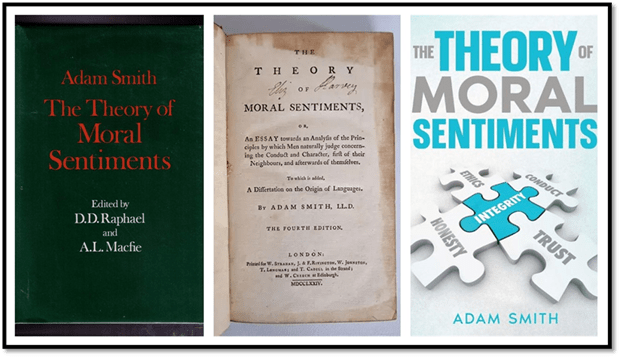
It may be that in fathering modern theories of liberal economics, Adam Smith has been forever cast into the role of the defender of the primary operation of self over moral interest, but Brian Cox, who plays his ‘sweary ghost’ in the Dundee Repertory Theatre and Edinburgh Festival premier production of Make It Happen was determined to redeem the man as a moral philosopher, a man who said in The Theory of Moral Sentiments that: “We are but one of the multitude, in no respect better than any other in it.” It was he, Cox has claimed in interviewers who pushed James Graham and James Panton, the writer and director respectively, to include the role of Smith (in more than one sense) in this drama of the practical destruction caused by capitalist ideology. Who is playing the ghost of Adam Smith. Of course, it is Brian Cox – despite the fact that he has almost become type cast in the role of ruthless capitalist entrepreneurs at the very top of their game.
I am so pleased that I am going to see it, for at last political theatre is finding an amiable voice for exposing the ideological struggle in the origins of economic and ethical liberalism. For this production, there is, as yet, no published text, and hence I cannot pre-read it as I love to do before seeing how the words of a play, including prompts to its setting, acting style and proxemics in the stage directions, is realised in performance. This may be good for me. Nevertheless, there are hints in the pr-production write-ups, based on interviews with Graham, Panton, and of course that irrepressible socially critical actor and Scottish working-class hero, Brian Cox, whose presence in the play ensures its lure to popular audiences (there were 8 seats left – and in the Upper Circle only – when I booked last week). Nevertheless, one of the features of the play, as seen in its preview run in Dundee, for Michael Alexander of The Courier was that, despite his brilliance and command of acting excellence, Cox does not steal the show from its cast, including the well praised ‘tragic hero’ Fred Goodwin as played by the wonderful Sandy Grierson.[1] I loved this rehearsal picture of Grierson and Cox in conversation about how the two actors mount their central interactions, o crucial (I presume) to how the ideological discussion of the issues in the development of the neoliberalism of our age attempted to become the practice of global capitalism, and almost led to its demise.
Nevertheless, Michael Alexander in a very brief review, of the provincial newspaper type, also puts Adam Smith at the ‘heart’ of a play about the attempt to eradicate emotional grasp of the human moral consequences of capitalism. It is part of the essence of the play, it seems according to pre-production write-ups to redress the imbalance created by the existence of right wing think tanks to see Smith as a simplistic disciple of the natural operation of self-interest as a lever for the governance of nations.
At its heart is the spirit of economist Adam Smith, summoned from the grave into a Scotland and UK grappling with potential economic ruin.
…
Goodwin, with his obsession with power, risk, and global dominance, misquotes Smith to justify his corporate crusade.
Cox’s Smith, bemused and exasperated, pushes back – insisting he was a moral philosopher, not a prophet of unregulated capitalism.[2]
Mark Fisher in The List gives a fuller consideration of the idea, based on interviewing James Graham, which reads like a primer that ought to be slipped into Donald Trump’s beside drawer instead of his free copy of the Gideon Bible, used by him for the purloining of ideological backing supposedly from ‘Gord’:
It is a mistake to characterise Smith … as the kind of free-market messiah championed by the right. He is more complex than that. Although he was in favour of the rights of the individual, he was also a moralist who respected the role of government in keeping tyranny at bay. ‘Different sides of the ideological spectrum have weaponised Adam Smith to sell a particular narrative,’ says Graham. ‘I’ve summoned Adam Smith into the 21st century to set the record straight in a bombastic and comedic way, which excited Brian and made it fun to write.’[3]
Fisher, like other journalists, uses the splendid photograph used in other write-ups, from the production team presumably, to show that the modern upper echelon of the ideologues of capital had, as it were, colonised institutionalised capital and government space, and the grand settings of its hubris (‘from Ancient Greekὕβρις (húbris) ‘pride, insolence, outrage’), or less frequently hybris (/ˈhaɪbrɪs/)’).Wikipedia’s final definition, ‘Extreme or excessive pride or dangerous overconfidence and complacency, often in combination with (or synonymous with) arrogance’ characterised the neoliberal right in 1980s and 1990s, although in its sock puppet spokesperson Margaret Thatcher the model was the less august Christopher Fry for its expression than Aeschylus, Shakespeare or Arthur Miller: The Lady’s Not For Turning.[4] I use the Aristotelian term because there are plentiful hints that the mode of Make It Happen is tragic, if with the hints of broad ‘sweary’ comedy that Shakespeare lent so well to tragedy, without even metamorphosing his plays (think of Macbeth, Hamlet and King Lear here) into tragi-comedy. In David Vintiner’s photograph the whole of the establishment decorating itself in neoclassical grandeur, with a swirl or two of the baroque, is implied in the architecture, stance and suited arrogance of two ordinary men, with a hint of being characters from a play by John Galsworthy, seeming to have ‘made it happen’, mostly to the benefit of themselves
In our own day, I think the cover-up that followed the financial crash of the 1990s the most potent sign of the fact that the ideology of capitalism, unrelieved by what Adam Smith called ‘moral sentiments’ is at the base of our present ills as a society – but that is not a diagnosis that lends itself to easy prescription of treatment. Adam Smith thought it might be treated by the spread of what he called ‘sympathy’, which had very different connotations and denotation then. Etymonline.com only picks up on that more recent change in relation to the word’s ‘weakened sense’, as evidenced from the nineteenth century.
Sympathy (n.): 1580s (1570s in Latin form), “affinity between certain things” (body and soul, persons and their garments), from French sympathie (16c.) and directly from Late Latin sympathia “community of feeling, sympathy,” from Greek sympatheia“fellow-feeling, community of feeling,” from sympathēs “having a fellow feeling, affected by like feelings,” from assimilated form of syn- “together” (see syn-) + pathos “feeling,” which is related to paskhein, pathein “suffer” (from PIE root *kwent(h)- “to suffer”).
In Middle English in reference to an occult-like, almost magical influencing of one mind or body by another, especially in physiology and pathology: It was used in reference to medicines that heal wounds when applied to a cloth stained with blood from the wound.
The meaning “conformity of feelings, agreement of affections or inclinations” is from 1590s; weakened sense of “favorable attitude of mind toward” is by 1823. The meaning “quality of commiserating with the sufferings of another” is from c. 1600; that of “a feeling identical with or resembling that which another feels” is from 1660s.
An Old English loan-translation of sympathia was efensargung (even, that is “likewise,” sorrying) and compare German Mitgefühl. Sympathy card is attested by 1916, earlier deepest sympathy card is by 1914.
In the twentieth century the term’s use was so weakened that counselling psychology looked to another word to suggest “fellow-feeling, community of feeling”, the term EMPATHY. Popular psychology, as in the website SimplyPsychology (see the infographic below from this site), sees the term as totally contradistinguished in a way not supported by the early history of the etymology of the term ‘sympathy’ as seen in etymonline.com.
Smith’s understanding of sympathy, or more fully ‘sympathetic imagination is very clearly described by Edward Harpham in a very welcome blog from Adam Smith Works:
Smith believes that the operations of sympathy must be understood in the light of three observations about the human condition. First, we have no immediate experience of what others feel nor any direct entry into the subjective experience of others. All we have are our observations of their actions, expressions, behavior, and words. Note that for Smith sympathy does not provide fellow-feeling through a mechanism like the sympathetic vibrations of violin strings or a contagion-like spread of germs. How, then, is any fellow-feeling of sympathy possible? Smith’s second observation is that we use our imagination to conceive what others are feeling. Fellow-feeling through sympathy is not about directly experiencing the passions or emotions of another; rather, fellow-feeling is generated by imagining being in the situation of the other person and forming a conception of what their subjective experiences are. As Smith explains,
By the imagination we place ourselves in his situation, we conceive ourselves enduring all the same torments, we enter as it were into his body, and become in some measure the same person with him, and thence form some idea of his sensations, and even feel something which, though weaker in degree, is not altogether unlike them. (TMS 9)
A question follows from this general line of argument: Can we legitimately call this fellow-feeling produced by the imagination “fellow-feeling” if it is not the same feeling experienced by the other person? Smith’s response is revealing. Having fellow-feelings is not about sympathizing through the imagination at one point in time, nor is it having the same subjective experience as the other person. For Smith, sympathy is a process in which two parties work towards a common understanding of their respective subjective experiences.
This argument about the meaning of fellow-feeling hinges on a third observation Smith makes about shared human experience: Humans are driven by a desire for the pleasure that arises from mutual sympathy. “(N)othing pleases us more than to observe in other men a fellow-feeling with all the emotions in our own breast; nor are we ever so much shocked as by the appearance of the contrary.” (TMS: 13). Humans are naturally disposed to share their feelings with one another and willing to adjust the outward expressions of their passions such that others might be able to share them through their respective imaginations.
There is a caveat to this. What a spectator feels observing another person’s sorrow will never be the same as the original sorrow. Sympathy does not provide special access into the mind of another. It only provides a route for creating and sharing feelings in a very particular way. Smith explains,
What they feel, will, indeed, always be, in some respects, different from what he feels, and compassion can never be exactly the same with original sorrow; because the secret consciousness that the change of situations, from which the sympathetic sentiment arises, is but imaginary, not only lowers it in degree, but, in some measure, varies it in kind, and gives it quite different modification. (TMS: 22)
Our sympathetic imagination as envisioned by Smith does not result in a unison of our fellow-feelings in society, nor does it leave us trapped in our own subjective experiences. It does, however, generate enough shared “fellow-feeling” to create a harmony among individuals living in and experiencing the world together. As Smith explains, “Though they will never be unisons, they may be concords, and this is all that is wanted or required.” (TMS: 22)[5]
Compare that with Margaret Thatcher’s view that there is ‘no such thing as society’, and the full force of those ‘concords’ described by Smith become evident. Multiple concords of persons once imaginatively integrated and interactive is ‘society’, even if this ‘thing’ is far from objective in its boundaries rather than liminal and open to shifting boundaries.
Mark Fisher gives enough of the biography of Fred Godwin to understand why he was nicknamed ‘The Shred’, and how actively he set out to prove that there was no place for widespread ‘sympathy’ of the Adam Smith type in the leadership of institutions (witness the same in the ruthless leadership of Elon Musk in business and government and Donald Trump par excellence. Fisher writes:
Fred Goodwin’s life has a classic rise-and-fall arc. Born in 1958, he was brought up in a Ferguslie Park council house, became the first in his family to go to university, and emerged as a high-flying chartered accountant and then a banker. It was his willingness to make ruthless cuts in his role as deputy chief executive of the Clydesdale Bank that earned him the nickname ‘Fred The Shred’. He joined RBS in 1998 and, having become chief executive in 2001, set about a series of acquisitions. It started with a £23.6bn takeover of NatWest (and with it, the loss of 18,000 jobs) and culminated in a £55bn bid for ABN Amro.
Under his watch, RBS became the fifth largest bank in the world, but only at a cost. The £350m bill for the RBS HQ at Gogarburn pales in comparison to the bank’s global spending spree. The expense left the organisation especially exposed to 2008’s financial crash. In February 2009, it posted a loss of £24bn, the biggest in British corporate history. By then, the government had stepped in with a rescue package, and Goodwin was out. Although the playwright is angry about the financial crash, he has no intention of demonising Goodwin, who is played by actor Sandy Grierson. ‘The play questions whether he was just symptomatic of a broader culture,’ states Graham. ‘If it wasn’t him, would it have been someone else? Was he too unfairly made the face of a much more widespread failure of regulation of the banking sector?’
Moreover, to limit our interest to the ‘banking sector’, which Graham clearly does not do having chosen to write of the confrontation of Goodwin and Adam Smith, is itself reductive of the social issues at play in this piece, as I imagine it from the slim evidence I have. The writer and the director, James Graham and Andrew Panton have, Fisher goes on to say, actually done what the state and the establishment failed to do, to hold the systemic operations of capitalism up to scrutiny and, in doing so, seen the rot in the entrails of those systems. Fisher quotes Graham saying:
“Infamously, not a single individual was prosecuted for the biggest financial crash since the Great Depression and it was entirely man-made. The absence of parliamentary inquiries, court cases and law suits is where drama comes in. We can re-interrogate these things and try to understand people’s motivations and the flaws in the system.”[6]
When Paul English interviewed Brian Cox for Big Issue, Cox was understandably less indirect about his critique of persons like Goodwin involved or in collusion with the system. English describes a ‘very angry Brian Cox’, saying of Goodwin:
“He still has a £700,000 pension, which I think is appalling, and that’s it having been halved. He should have had it taken away from him and now he should be on his uppers, like a lot of people were. A lot of people lost everything because of his actions. They took away his knighthood, but so what? I’m not a great believer in them so that doesn’t make much difference to me, really.”
English also gets Cox fulminating as if he were Adam Smith, though other accounts show that Smith as seen in the drama is not only seriously upset (in a ‘sweary’ way) at his treatment by posterity but able to understand even some of the vulgar gratifications of commodity capitalism and working-class style holiday outfits for the ‘front’. Yet his role is as moral as the demons who talk to Dr Faustus about his moral choices in Christopher Marlowe’s Doctor Faustus:
“When Fred takes another wrong turn, which he does many times, I pop up and correct him, bully him, make fun of him,” Cox says. “I suggested the character of Adam Smith should be included. I was sick of Thatcher misquoting him all the time, big time, so I wanted to redress the balance.
“There’s one point in the play when I meet Gordon Brown [PM at the time of the collapse] and I tell him I’ve been to see Thatcher and haunted her too, because she got it completely wrong. She constantly misquoted him.”
Not a word here, however, about the fact that Gordon Brown was the Chancellor responsible for the deregulation of the financial markets, a crucial turning point for neoliberal capitalism that Thatcher had failed to complete and left for Blatcherism to do so.
But Cox is a great actor and who are we to iron out political contradictions so endemic to that period of politics to which the play refers. And for Cox, it is important that this play is not reduced to a Guardian article on neoliberalism, even though he tells English he read (or “dipped into”) The Theory of Moral Sentiments and a few of the formidable 900 pages of The Wealth of Nations. What Cox seems to love is the emphasis on the Scottishness of the great eighteenth century philosophers represented in the play even taking ‘aim at Sandy Stoddart’s grand statue of philosopher David Hume, whose toe has been rubbed into a high shine by the thousands of tourists who touch it for good luck on Edinburgh’s Royal Mile every year’. He went on to say, and I can’t wait to see this in the play:
“Smith is fascinated by modern Edinburgh. He goes to visit David Hume, sitting there with everyone rubbing his toe, and asks what’s he dressed like that for. He says you’d more often than not find Hume pissed falling off his chair, than sitting in it.”
If there is something of pantomime in this, all the better. Cox is a man of my extreme liking and I find myself in ‘sympathy’ (in Smith’s use of the term) with his views on the best way to take theatre away from the self-serving middle-class elites it has served for two long (not true of theatre in early Scotland, England, Ireland, or Wales. Cox said to English, talking about his roots in Dundee where English did his interview:
“Theatre, especially in those days, was always a very middle-class pursuit. In Dundee they used to call the audience who went to the theatre ‘the felties’, which was what they called the women in felt hats. They were fairly middle class. My auntie was very aspirant middle class even though she was working class, and she introduced me to the theatre. I’m always sad that theatre is regarded as a middle-class pursuit. It’s for everybody. It’s inclusive, not exclusive.”[7]
I am very much in the mood for this play. Roll on 9 August. I will report back.
With love
Steven xxxxxxxxxx
And hoping that curiosity does not kill me in the process, together with the cat.
2 thoughts on “Being curious about questions you never thought you’d ask! A way of preparing to see a new play: seeing James Graham’s ‘Make It Happen’ at The Festival Theatre Edinburgh on the 9 August 2025, 2.30 p.m.”




 Steve_Bamlett_blog
2 thoughts on “Being curious about questions you never thought you’d ask! A way of preparing to see a new play: seeing James Graham’s ‘Make It Happen’ at The Festival Theatre Edinburgh on the 9 August 2025, 2.30 p.m.”