


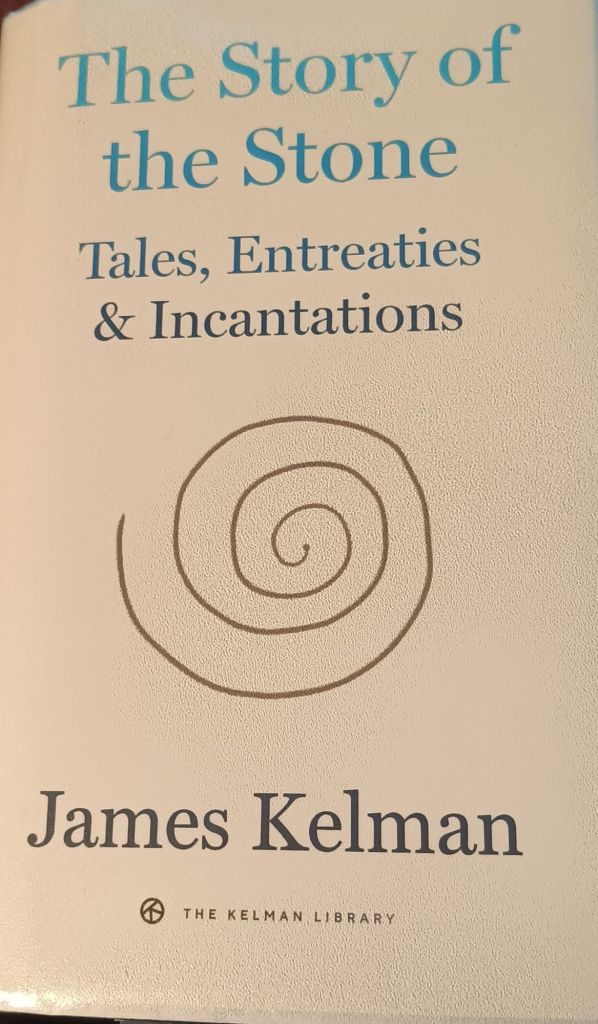
The prompt I chose today asks this: ‘Do you have a quote you live your life by or think of often?’ If I am live my life with anything like significant assistance of a few linked words, then those words can not really be described as a ‘quote’, for whatever the specificity of their individuality as someone’s words, I must be absorbing them into myself, inviting them to be a thing I can temporarily also be; as at one with them, a kind of at-one-ment.
I began to think of this in response to my present reading: the great James Kelman’s new set of stories The Story of the Stone: Tales, Entreaties & Incantations (published by Kelman’s bold new Californian publishers PM Press). This set of stories [I am only about a third way through them] has a brilliant introduction by the artist; the name Kelman rightly prefers to describe his working role.
In it, he tells the story of his first job role as an apprentic compositor and how he became fascinated by a journeyman who told stories only tellable in a langusge of his own at work amongst his workmates that wouldn’t be told in that language anywhere else, for anywhere else, at his home with his grandsons. That individual does not exist as such, but is diffrently composite. As Kelman tells of him, his own language adapts into that of that old man, of which the following is only the second half of a long, barely punctuated sentence.
… didnay fuck8ng matter how it sounding whatever it was man fuck ye never fucking knew like know what I mean how they came fucking out man, fucking laugh, just fucking man whatever it was the story some stupid cunt man usually himself, he ended up man whatever just like story eftir story the way he telt them man ye just fucking know what I’m saying, bustards, getting the fucker, just like how he telt it, the fucking story man rhe way he felt it, trickier than it fucking looks and I wanting to get them, spot on cause if ye didnay there wasnay a fucking story.
I say ‘barely punctuated’, but even what punctuation there is serves a different purpose than the norm – it serves to indicate breathes and causes remote from their service to formal grammars. The aim is I think for Kelman to fuse the narration of the story, such as he told his mates. Such that it incorporated the man by the way ‘ like story eftir story the way he telt them”.

James Kelman
But in my paragraph above, I ‘quote’ Kelman, using quotation marks, in a way he does not serve the old journeyman compositor in his telling of the old man’s words. For though we pretend quotation is a means of fair attribution go the right speaker, ig also distances me as a speaker from both the story and it’s linguistic choices in grammar, spelling, punctuation and lexis.
Kelman addresses this too, as an aspect of his art in his introduction, in the passage below [from pages xxii – xxiii].
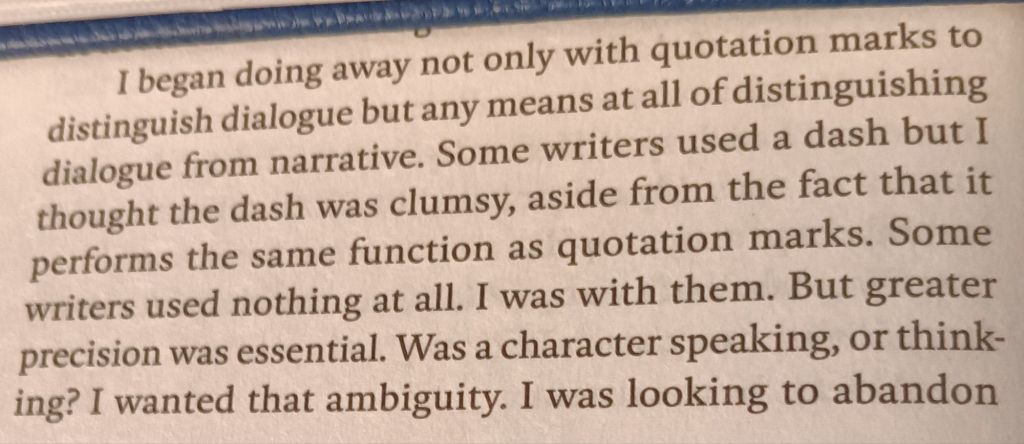
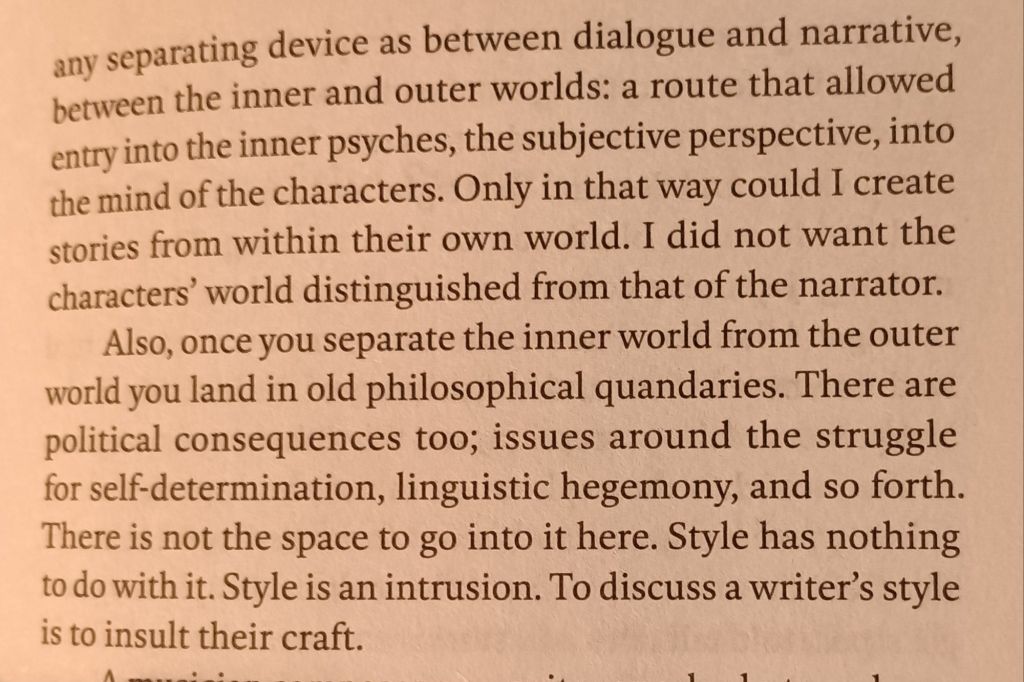
This is, as it states, meant to make us rethink our attitude to quotation, or its modern abbreviated equivalent, the ‘quote’. Philosophically, Kelman suggests the quote has tje function of separating thd inner world from the outer world, the shape of the inner sensation, thought and feeling that confirms to someone they have somewhat to say in words from the word forms in their external appearance as text or auditory output.
To quote someone is to put ourselves at a distance from their individual ways of sensing, feeling, and thinking of the world and putting our ways, as a narrator of the world into a position of power over them, even ic they be Shakespeare, for to limit the validity of what is said and how it is said to some idiosyncratic manner of being. Even when we call that idiosyncratic manner ‘genius’, we tend to belittle its significance to us as a communality in the end. That is why we like to say that genius is akin to madness. It invalidates the worth of what is said, by genius, mad person, or other quoted authority, to a niche space of possible irrelevance to everyone else’s world. Yet if we listened, we might be able to speak their thoughts, sensations and feelings just as they do.
When that happens, we aren’t living our life by a ‘quote’,we are inhabiting and sharing that la gauge, even when it gas been labelled ‘odd’, queer, or as madness or genius. That individuality of being becomes a significant pat of our individual and communal being.
So that’s not an answer, I suppose, to the prompt question. However, since I do quote James Kelman, even if only in the process of unpacking what it means to ‘live your life by a quote’, it will have to do.

All my love
Steven xxxxxxxxx
 Steve_Bamlett_blog
3 thoughts on “‘I began doing away not only with quotation marks to distinguish dialogue but any means at all of distinguishing dialogue from narrative’. No words that matter in the way the question suggests can really be called a ‘quote’.”