The Art of the Pit Head Bath.
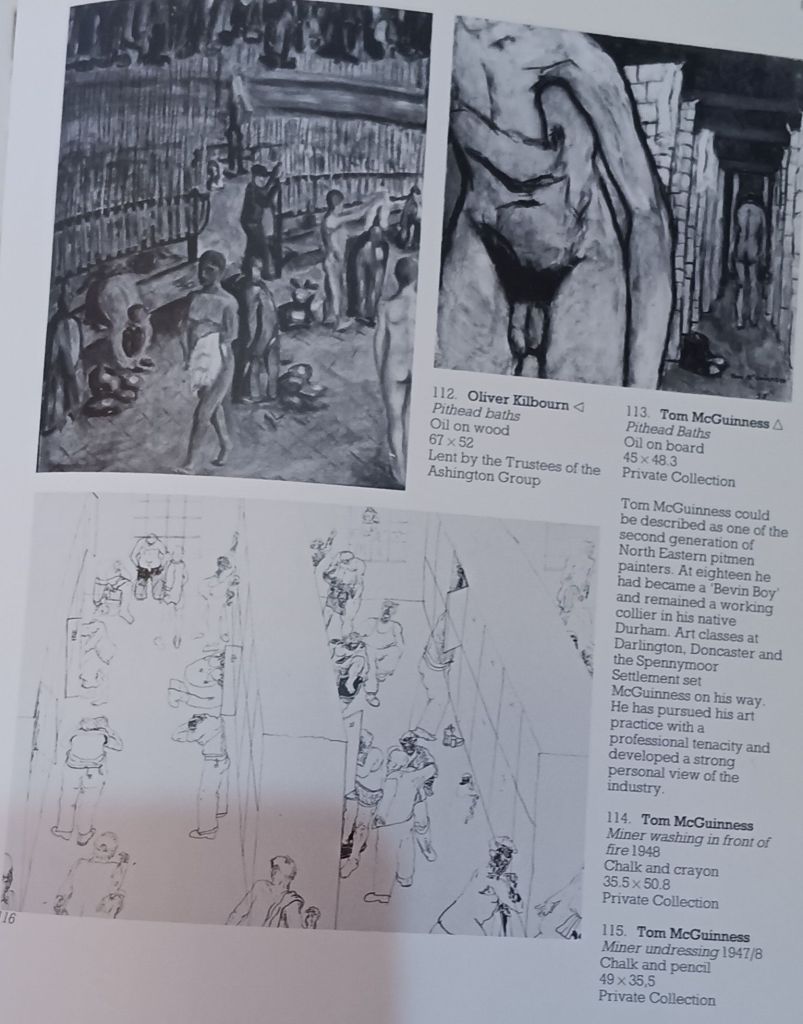
Joanna Drew (Arts Council of Great Britain – ACGB), Douglas Gray (art selector & essayist), Norman Siddall (British National Coal Board – NCB), Sir William Rees-Mogg (ACGB) & Dr John Kanefsky (essaysist) (1982: page 81) Coal: British Mining in Art 1680 -1980, London, The Arts Council of Great Britain.
I first saw the page above when I was researching the art of Tom McGuinness as part of a first year MA Final Essay at the Open University (a qualification never finished after passing the first year with a Distinction). The essay was based mainly on the use of themed art in heritage museums: specifically, taking as my case study the Mining Art Gallery at Bishop Auckland near to me. The painting I am focusing upon above is a huge one, yet I have seen it in the flesh (so to speak), though it was actually shown in 1982 – 1983 in an exhibition that toured Stoke-on-Trent, Swansea, Durham and Nottingham (in the midst therefore of a painfully conflicted Miners’ Strike) and co-organised by the Arts Council of Great Britain, the National Coal Board and Barclays Bank. In the catalogue that accompanied that exhibition it appeared on a page, in a diminutive black and white reproduction together with pictures of the hygiene arrangements in other pits (though very few had pithead baths). See the page reproduced in my headline picture. I chose to put it there rather than the picture itself since whenever I have tried to talk about it that talk has been censored, probably because of the full frontal nudity of the picture – the nude being unidentifiable. The rather prudish discussion group in the Open University decided it was an example, using Kenneth Clark’s patrician distinction, an example of the art of the ‘naked’ rather the ‘nude’.
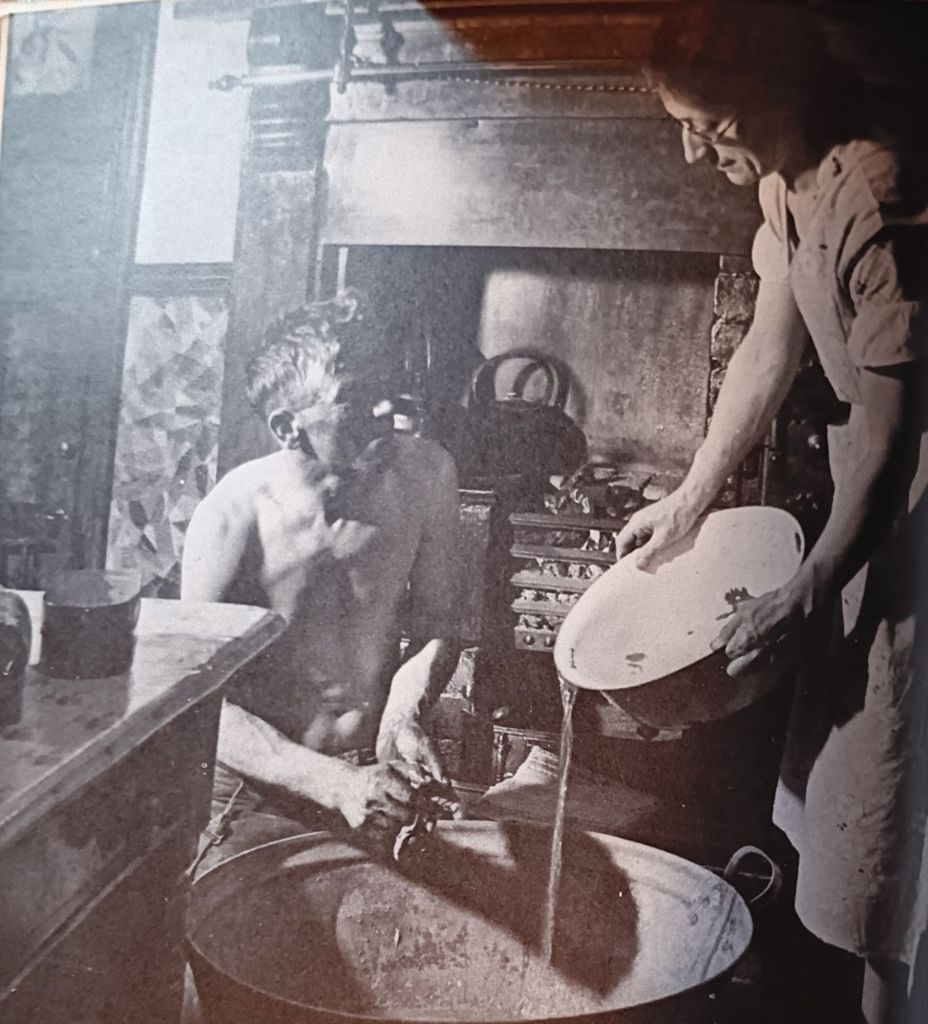
And indeed, it seems that this might be shared. It has never been displayed to my knowledge in the Mining Art Gallery that has access to it from the Bequest of McGuinness paintings to Durham Town Hall, and now owned by Durham County Council, except at the time of the Gallery’s opening in a set of colour reproductions in a digitised set of the rest of the oeuvre of mining art by various masters theoretically available to the Gallery. That show itself no longer exists. In the catalogue for the 1982-1983 show the rationale for showing it is to group it among those paintings announcing the social innovation that was the late introduction to the pit-head, only at very large pits, to the improvement of mining lives. In most of County Durham, the bathing available to men continued to be your wife or your Mam providing water from a basin at a fire-hearth bath-tub. The lady below has arms as muscled as her son’s (or husbands) from this service at his ablutions. Local people talk about the wonder created in them as children when their Father was one of those able to come home already clean.
So I have said enough to justify showing a better reproduction of the picture below – a digital one from ART UK. The bodies irt shows are not typical of McGuinness – the mining figure having more realistic fleshly rounding and articulation than his usual distorted figures. The colouration as well as got some sophistication – flesh tints in the figure nearest to us showing through a patina of grimy black dust (most telling on the exposed nipple of that man) that then runs into the exaggerated boundaries of the body – painted in thick black lines. Yet there are pinks in this amalgam as well as harder orange flesh tones – this is clearly a yoing man. Where the flesh folds or bones protrude there are black marks (coal or indicative of form – the painting is anbiguous about its representation of the clean and the still dirtied. The ark lines at the bodt borders though show confident and, as yet, firm flesh – except perhaps in the body at the right of the painting where darker thicker lines serve only part of the body only: indicating the torso and the hang and crack of his anus. His arms however fade into those laterals that define the passageway he walks down, and the coal-stained grouting of the pit-bath cubicles (perhaps showers)
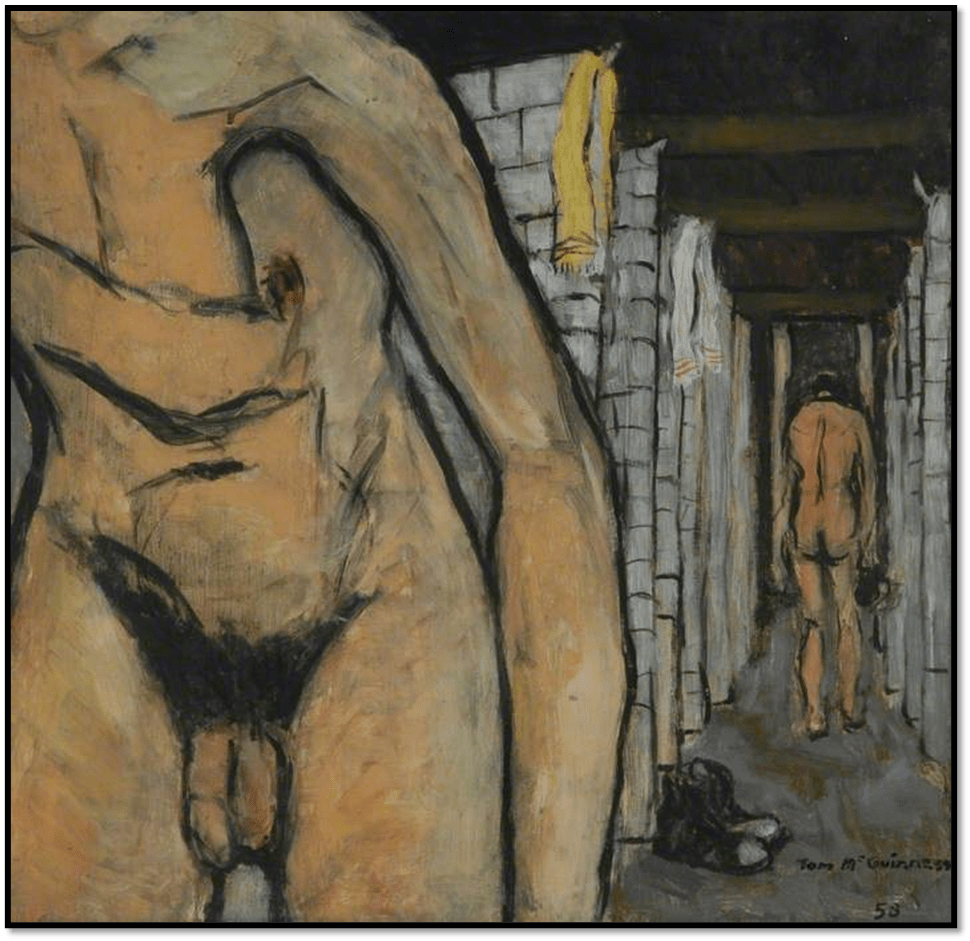
Tom McGuinness (1926–2006) ‘Pithead Baths’ Oil on Board 45 x 48.3 Donated to Bishop Auckland Town Hall and loaned from their collection when visible
The one thing I do not see here is the shame that has accompanied any showing of the painting thus far, at its honest exposition of the beauty of male physique, even in a mine. Nakedness is not, whatever Kenneth Clark said, a seedier kind of idealised nudity. McGuinness makes this point by aligning his signature in a straight lateral leading from the heavy boots in the corridor and the two very different pit-scarves hanging on the lintel of cubicles behind the frontal figure.These young men are complex dandies that nevertheless went heavily shod. Most of the photographic evidence, show the pitbaths as a place of joviality – as below.
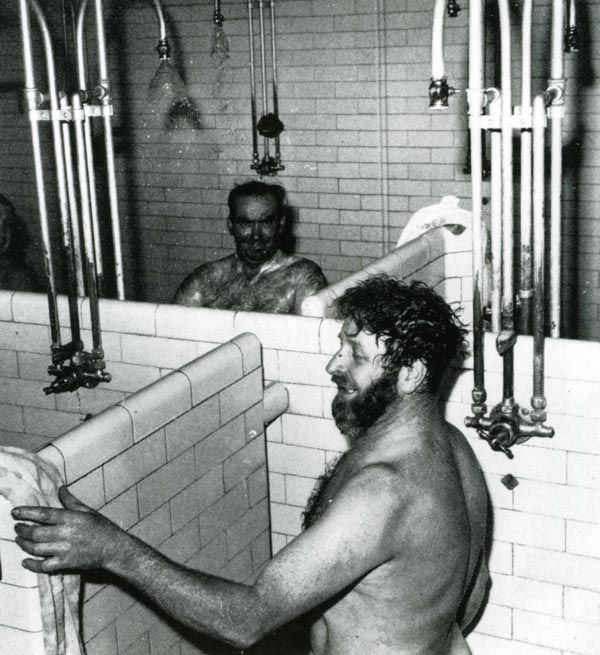
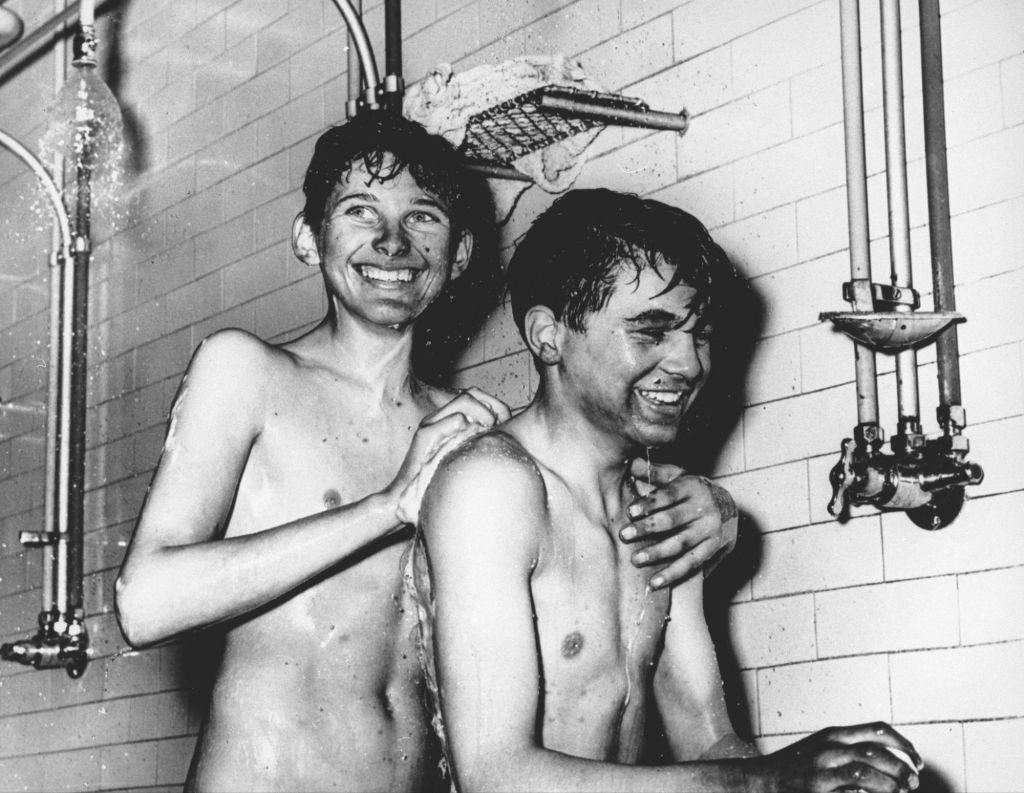
The picture of two trainee boys below showering each other below show no shame at all – though some fun in performing a service for each other than can only be done naked. That both boys are laughing at some wit coming from the photographer is shown in the very different directions of gaze – only one confronting the photographer.
In a book I have just added to my mining collection – when I took books to dispose of as part of my books clear out and defeated the object by buying another – is Anthony Burton’s beautiful collection of photographs in a 1976 book called The Miners (Andre Deutsch Ltd with Futura Publications)
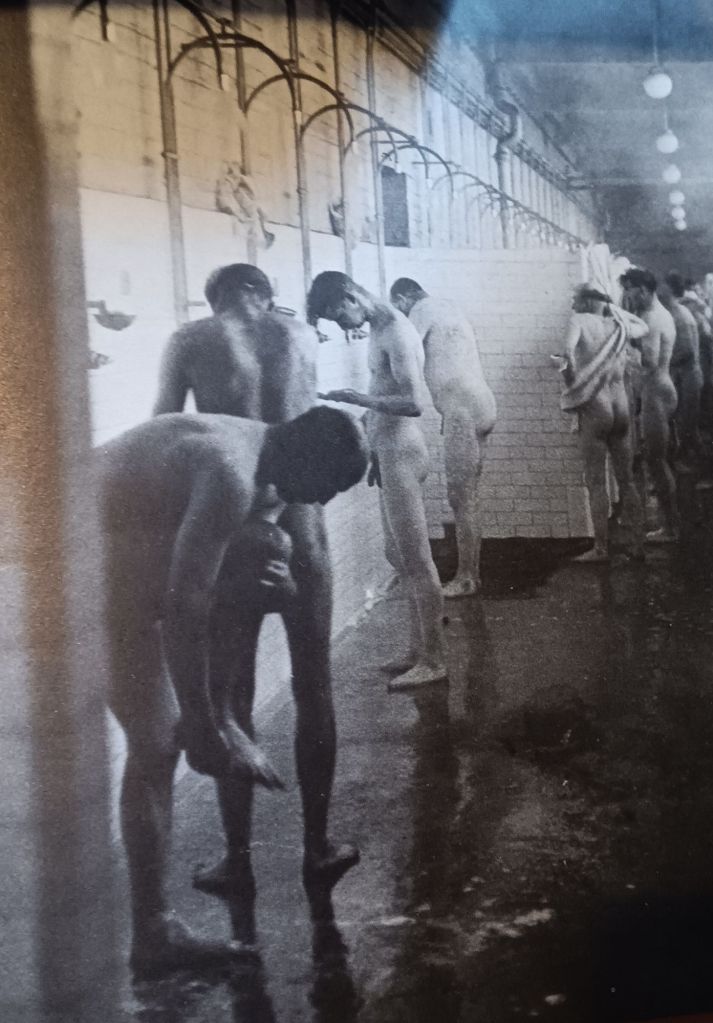
The book has a fine photograph that shares something with McGuinness in elaborating an aesthetic of pithead-bath art. Here too men are naked and some are seen with their genitals as innocently exposed as in McGuinness’s painting, though not as focally placed. The beauty of this photograph though emerges from the non-idealised bodies of the men: youths are sen with more middle-aged men fatter torsos with exceedingly slim ones. Some men are self-absorbed, others sharing ‘craic’ (pronounced crack) with each other about their night to come.
In truth, of course, McGuinness’s design for his ‘Pithead Baths‘ deliberately sets the genital of the man portrayed as a focal point. That is I think, another of its wonders as a painting. Art is constructed as the realm of private seeing, even of voyeuristic looking, but that is not the aesthetic of the selection of pithead bath photographs above show. And this is not because working class men were immune from the beauty of male form or even, for some at least, its sexualisation, but because these topics were not aligned with private guilty viewing but social sharing. The whole point of his The Pithead Baths is to ask its viewer – why, outside of the appropriate social context, do you look at me. Is it to feel the tension between voyeurism in bourgeois art and the social integration of an art of living more appropriate to the working class.
When the BBC however did a programme on Pithead Baths, it was elegiac about their destruction In the BBC still below, a man (decently clothed) is walking away from an empty bath-house.
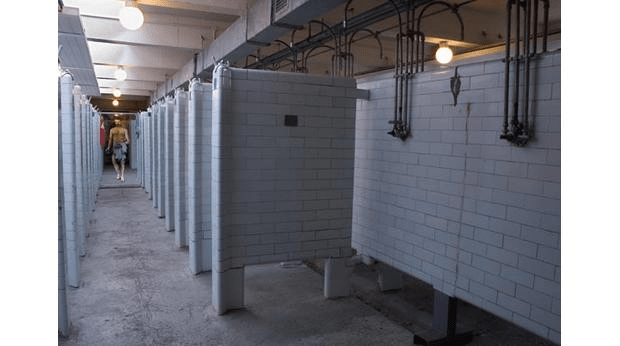
Partly there a few examples of pithead bath architecture extant because the Thatcher government wanted that there be no monuments to mining and its communities – for, as she said, they believed: ‘there was no such thing as society’. That lies too at the bottom of the prudish Open University on that topic. None, I think, of these buildings are preserved in County Durham (there is one in the National Mining Museum in West Yorkshire.
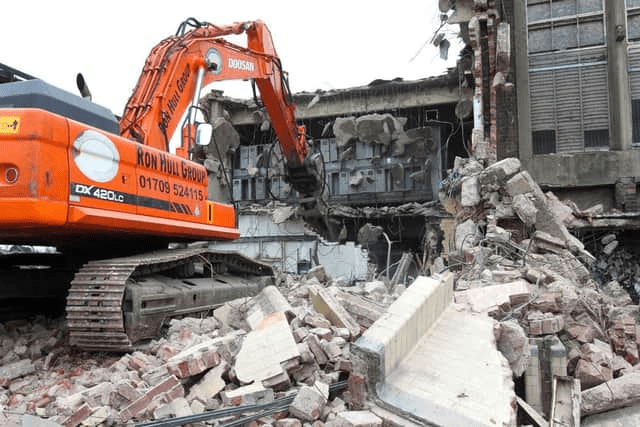
A pithead bath (Kiveton) being demolished.
Bye for now
With love
Steven xxxxxxxxx
 Steve_Bamlett_blog