



This blog prompt is almost identical to a earlier one (see my answer here at this link). The title there was:
What is the greatest gift someone could give you?
Put yourself in a prompter’s shoes! What difference did they see in the prompts? Well, first, the question asked then for a chosen ‘one’ out of several ‘best gifts’ you might at sometime receive in your continuing future, but now decidedly asks for one you evaluate as the ‘greatest’ among past gifts. Then last time I wrote about acquiring in that future a notion of the the meaning of a gift and given quality, a birthright revived or to be acquired through education and training, given by a definite someone or something – a ‘Power’. That is why the final verse of Robert Burns ‘To A Louse’ seemed so inviting then:
O wad some Power the giftie gie us
To see oursels as ithers see us!
It wad frae mony a blunder free us,
An' foolish notion:
What airs in dress an' gait wad lea'e us,
An' ev'n devotion!
But now we must stop looking around us in the vast abysm of time in hope of acknowledging the past receipt of a gift from some power’ with Burns, but seek out a hope or expectation of a supreme gift that matches the shape of our desires so perfectly it cannot but be ‘the greatest gift’. No longer will a memory of one of multiple ‘best gifts’ suffice, nor will be asked to share it, we must just own up to wanting to own that gift for ourselves.
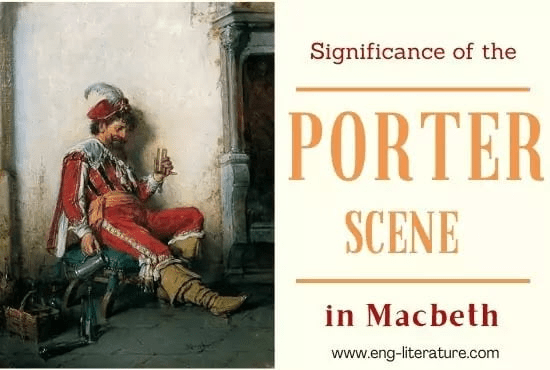
in Act 2 Scene 3 of Shakespeare’s Macbeth, a red-nosed Porter is forced to awake to the knock of a party visiting the castle he keeps the door of in Inverness. He wonders why people are so impatient as to rouse him so soon and so importunately:
Who’s there,
 i'th’ name of Beelzebub? Here’s a farmer that hanged
himself on th’ expectation of plenty. Come in time!
You can hope for too much the philosophical Porter says and the gift you get will either not match your expectation or your impatience to reach it will force you to stop the movement of time altogether. Hence the farmer hangs himself just because he wanted ‘plenty’ from his stock but could not bear the time he must wait in expectation of it. For the Porter all desire for a great gift is such. In enumerating the issues that beset the drinking of alcohol to the guests he has now let in, it mentions that it is a one for promising the greatest gifts that it cannot deliver. his example is the gift of sexual satisfaction:
Lechery, sir, it provokes and unprovokes. It provokes                30
 the desire, but it takes away the performance.
 Therefore much drink may be said to be an
 equivocator with lechery. It makes him, and it
 mars him; it sets him on, and it takes him off; it
persuades him and disheartens him; makes him
 stand to and not stand to; in conclusion, equivocates
 him in a sleep and, giving him the lie, leaves
 him.
Consider that – a desire of a gift that you cannot use if it is an object or cannot perform if it is a desired action. Alcohol is the thing that prompts the desire here but is not all desire an equivocator as the farmer found when he was hanging himself. We cannot contemplate ‘the greatest gift someone could give you’ without thinking whether we are worthy of receiving it or finding that either we are not or are and thus denying its efficacy as the ‘greatest’, for we must live on hoping yet for something to outmatch that ‘greatest’. The thing is that the farmer who hanged himself lacked patience; Lear (in Act 2 Scene 4 of King Lear) says it better. Desiring a gift is to desire something beyond our needs, something that matches desire:
O, reason not the need! Our basest beggars
Are in the poorest thing superfluous.                         305
 Allow not nature more than nature needs,
 Man’s life is cheap as beast’s. Thou art a lady;
 If only to go warm were gorgeous,
 Why, nature needs not what thou gorgeous wear’st,
Which scarcely keeps thee warm. But, for true need—
 You heavens, give me that patience, patience I need!
He knows his daughters follow fashion that exposes their bodies rather follow the purpose of clothing to keep you warm. To them the ‘greatest gift’ is a dress that exposes them as an object of desire. We desire more than we need, except that the best gift – the greatest gift – would be the patience to accept and to wait on a goodwill that we cannot evaluate nor measure.Patience isn’t just about waiting, especially in the Middle Ages and the English Renaissance, but about expecting and accepting that time comes with suffering and the only gift to match it is the ability to bear it – hence the ‘patience of Job‘. Greek tragedy is full of people that argue that the greatest gift is never to have been born. Christianity changed that to a message of acceptance that for most life was arduous and painful but must be borne.
For me without Christian or other faith in a ‘Higher Power’, though suspicious of the only earthly remnant being the individual consciousness (enough to accept the AA view that we have to act as if there were a Higher Power that human ego even though there is not and at best let it lie in hopes for community), PATIENCE still seems a gift worth pursuing and wanting. It is the greatest gift because it must grow as fast as both need does, and the imagined desires that outstrip it.

Patience, engraving by Hans Sebald Beham, 1540
With Patience let me hug my Lamb of Love and pretend the beast that wants me to eat it (AND EAT IT NOW) has nothing whatsoever to do with me.
With love
Steven xxxxxxxxxxxxx
 Steve_Bamlett_blog