


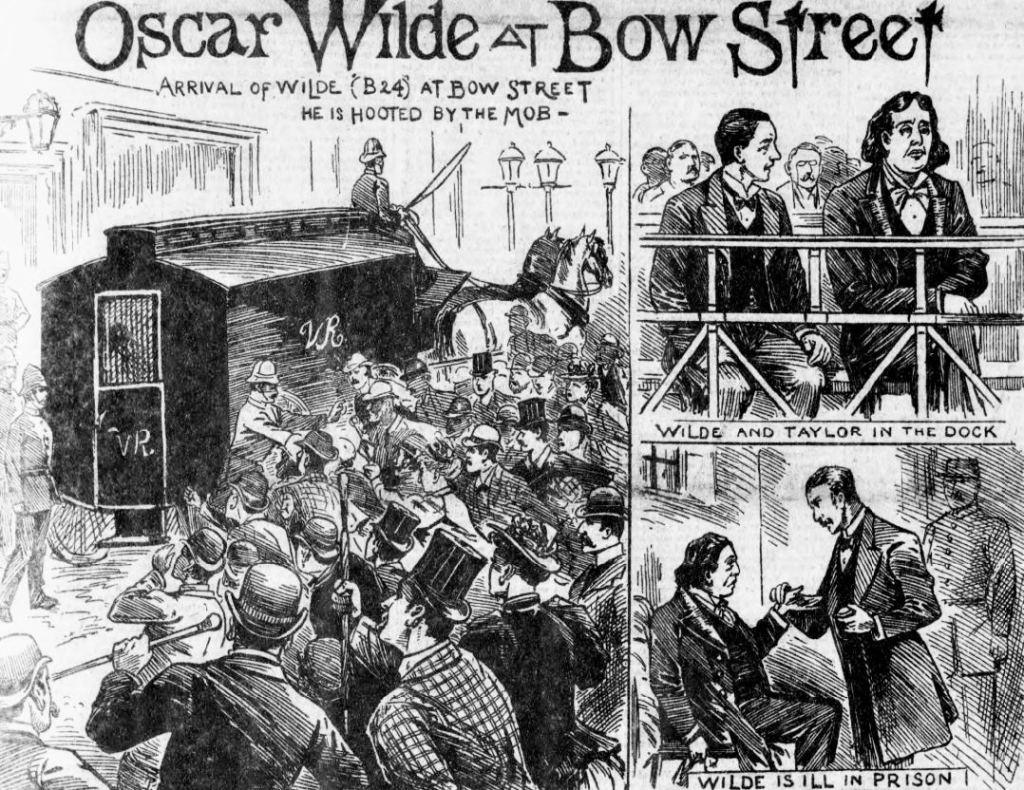
Oscar Wilde is reported as saying the law ‘is an ass’ (as are many others – it is actually a misquotation of lawman Dogberry in Shakespeare’s ‘Much Ado About Nothing’), but was to find that some asses had incredible power to hurt.
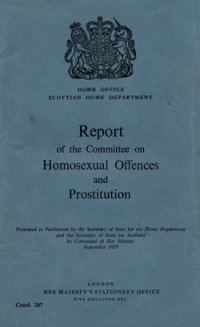
I was born in 1954. The law was part of a vast symbolic structure that I had yet to learn might touch on my life. I was 3 years of age when the Wolfenden Committee reported on tne law on Homosexuality and Prostitution as part of a review of the relationship of the state, and the laws that expressed the will of the state, to what it was inclined by then to be considered as matters of private and personal ethical responsibility. Since the law expressly confined itself to sexual acts outside any kind that a 3- 11 year old might engage in without force being applied to make them take part. even when the Rports recommendation that consensual sexual acts in private should not be considered unlawful, became law in the form of the Sexual Offencs Act of 1967, it neither consciously concerned nor threatened me.
But the point was it did concern me. The period after 1957 was one of the most oppressive in queer history, partly because the law was being tested by a homonormative, and to a large degree homophobic, state (or some of its more vocal and over-empowered citizens) around issues of both what constituted a sexual act (did it include passionate kissing for instance) and in what circumstances was it considered by the law to occur in private. Since precedence eventually set the latter definition to a building in which no other person was present, it was illegal to have aex in a private flat of apartment in a building of multiple domestic occupancy.
Again, it was not because I was engaged in sexual acts or interested in being so, but it did shape my consciousness. In truth, I brave myself to say that I engaged in no mutual sexual act until I was well over 20. Yet as a sixth-form pupil at school. I might have broken the law had I fallen in love with a boy of the same age and with similar feelings, or short of those desires, and he had led the event: he would have had to have led for I was capable of being aftaid of my own shadow had it not proved it was attached to either me or my poorly cared-for body.
I can imagine then that I would had consensual sex with that imagined youth. It would have been intentional, and it would have broken the law. However, would it have been breaking the law intentionally? There’s the rub! As a thought experiment, I start examining a painful memory from my late adolescence. I was by then in the first year of the sixth form, as we knew it then – had finished O levels and was preparing for A Level mocks. For the first time ever a gut I knew, his name was Ian, and his girlfriend Anita invited to Ian’s birthday party. I remember arriving and entering the dark Edwardian house whose front room seemed larger than the whole floor plan of our family council house. I handed over my obligatory bottle and sat in that front room, darkened because the curtains had been pulled though it was still early evening and light. I sat, and I sat – and I drank rather nervously. Boys and girls I knew passed by and nodded, but none spoke. Time passed, and it grew darker and the music seemed to blare. I saw people begin to dance and couples to get closer – all heterosexual – and more frenetic in their dancing. Ian and Anita slipped upstairs to the bedrooms, followed by other couples peeling off from the thin frenzy of the room. I sat on, but the room span a little.
Then Tom arrived (not his name). He saw me and talked. I was surprised as he sat on the same sofa because it was cramped and his leg seemed to be nearer mine than I had ever experienced.

A keen sportsman and tall, slim and extremely good-looking, Tom was not in a group of people I knew or was likely to get to know. He talked on though, gesticulating as if talking to a close friend – sometimes nudging me. He talked on and on -only getting up to change the record to one by Elton John.
‘Heh’, a belligerent friend of Tom cried. ‘not him – he’s queer!’
‘He’s married’ (and of course he was I knew), another bloke insisted as if the fact of a heterosexual marriage resolved all ambiguities.
Tom looked annoyed. As the track whose lyrics contain the line began, ‘Someone Saved My life Tonight, Sugar Bear’, he started up and spoke evenly and crisply with the authority only he ever managed but not usually in such causes – far from it: “I think people can be more complicated than you think, Jim: This song was written to a male friend who saved his life following a crisis in his sexual identity’. No-one but Tom could have said this without a rumour machine grinding into motion. Instead Jim grunted in abeyance and things moved on. I sat on. A few minutes later Tom sat down again and smiled.
‘Wanker’ he said. ‘Some blokes are so simple-minded’.
I remember the song but I remember most an exaggerated sense of Tom’s proximity, as if his talk had freed some captive inside me, rushing to hug his kneews and rest his head on Tom’s ample thigh. Every sense felt his nearness – even the strong smell of some deodorant he used heated by his body. What was said I hardly remember – by now, the slowly sipped alcohol was taking charge. I just hear the words of the song that seemed to go on forever, especially in those repetitions and swirls of despair mixed with liberation at its end:

And someone saved my life tonight
Sugar bear
(sugar bear sugar bear)
(sugar bear...)
You almost had your hooks in me
Didn't you dear
You nearly had me roped and tied
Altar bound
Hypnotized
Sweet freedom
Whispered in my ear
You're a butterfly
And butterflies are free to fly
Fly away
High away
Bye bye
Someone saved someone saved
(someone saved my life tonight)
(someone saved my life tonight)
Someone saved someone saved.
I was a hefty guy, overweight in a way that underlined the sense of being unattractive that had yoked itself to a sense of being ‘different’ from other boys for ever so long. I was shielded by weight like armour from the fact of which I was deeply sure that no-one could ever be attracted to me. Maybe it was the booze – but even guys like this can feel like ‘a butterfly’ and that ‘butterflies are free to fly’. It is a feeling that I would later associate with a poem by William Empson called Success, where he sings of how substances immoderately taken lighten the sense of rerstraint in life:
I have mislaid the torment and the fear.

You should be praised for taking them away.

Those that doubt drugs, let them doubt which was here.

Well are they doubted for they turn out dear.

I feed on flatness and am last to leave.

Verse likes despair. Blame it upon the beer
I have mislaid the torment and the fear.
,
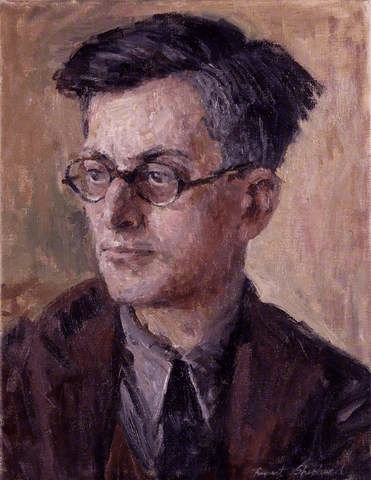
William Empson
With the torment and the fear, my body waited. I knew it was waiting for Tom to take away the ‘torment and the fear’ and save my life: melt me into a state where he was my Sugar Bear.
Only a liitle time passed but it seemed an age. Tom’s body swiveled, his knee touched mine: “Been nice talking to ya, Bambi – we should talk more, another time!’. He leaned in to my ear.
“There’s that hot piece, Linda’. I have something in my pants for her!’. Did Linda know? It seemed a short time till Tom and she joined the couples upstairs.
I desperately needed the toilet but even to tread the stairs upstairs now seemed impossible – afraid to hear the offshoot noise of passion, whoso ever it derived from. No longer a butterfly, I still knew I could fly and fly I did. But it was not from fear of intentionally or unintentionally; breaking the spirit of a law whose ghost still hung around as if the law itself still did.
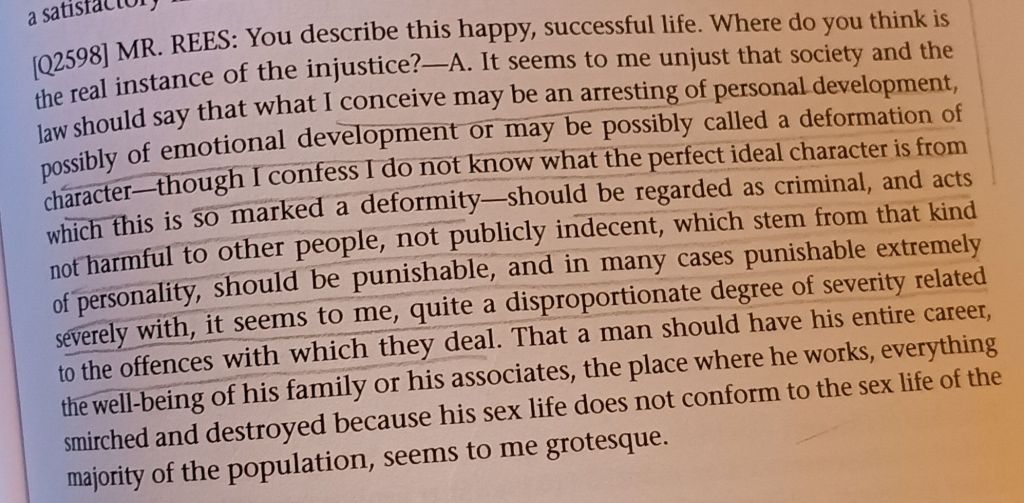
Now, as I query the internalised hatred of others to what was the content of my feelings and desires as a queer adolescent guy, I think of one of the answers (labelled A) to a question asked by a Wolfenden Committee legal representative, Mr Rees, I think of this incident, for it tells of how medicine and a hegemonic view of psychology that normal sexual development always led to heteronormative ends made by an anonymous respondent (he was in fact a doctor), other than being labelled a ‘homosexual’, that carried on the torment and the fear after the law had so much done its worst and had to changed. There was no relaxation of the ‘torment and the fear’ if what you did was no longer legal but proved you to be subject to ‘ an arresting of personal development, possibly of emotional development or may be possibly called a deformation of character’.
Steven sat at a party while his peers tried out their choices of partner for romance or even just safe sex (Ian had provided a bowl of condoms in the bathroom I believe). If he has not been arrested in development before, he was probably that now. And the butterfly flew away. The name of the butterfly is Psyche, damaged from the hot wax that fell on their leg from Cupid’s solely heterosexually employed candle.
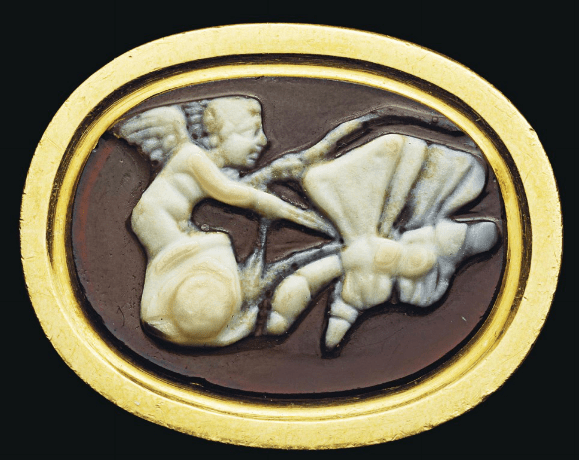
This Roman sardonyx cameo from the 1st-2nd century AD shows Cupid on a butterfly-driven chariot. It is set in a 19th century gold ring. The butterflies here represent Psyche. In Greek mythology
With love
Steven xxxxxxx
 Steve_Bamlett_blog