


I have always avoided this WordPress prompt question because the word ‘sport’ feels a source of great discomfort to me. Why might that be so?
The occasion of ‘sport’, even a too frequent use of the word, does cause me discomfort and I have no explanation of this beyond that I felt as a young boy as my experience of being poor at it: always picked last to join a team and dreading contact with the weapon that was the object of the game – a football or cricket bat or ball – when picked; thus doubling my undesirability to sports team captains. Being last at cross-country though was duplicated in the play of board games.
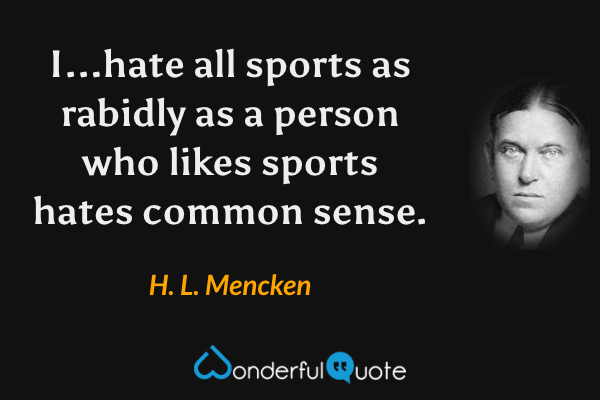
Yet I wonder if this explains it all, for when I was a boy it was usual not to confute sport with winners and losers and make that the object of the play. Everyone spoke crisply of ‘competitive sports’ as if they were a sub-category of a larger category of sports in which competition played no part. That was a time in history after all when there were debates in the press between those who saw school sports as practice for the adult world of competition with others for the glittering prizes of life and those whose view of work and leisure focused upon social and group co-operation in both spheres. The debate was extremely simplistic and it is in this sphere that the famous quote from H.L, Mencken makes sense (see it in the ‘Wonderful Quote’ graphic above).

Mencken was not a nice guy. He hated representative democracy and anything he thought resonant of groupthink . His thinking, feeling and action was geared to the support of elites quite openly. Effective elites were not, he believed as an article of common-sense, fostered by sports. And, in truth, had I been a good thinker myself at that time, I would have seen that a competitive society had better ways of reproducing itself than sport; ways in which I now realise I was complicit. Injustice and inequality can not survive through the boorish methods of sportsmen and sportswomen alone.
Elites have to think they are part of an elite by nature not skill (and even if skill – one that that they believe they were born with at least in aptitude to the right training – by birth, selective education, intelligence or other predetermination). I, quite unlike Mencken, hated elitism as much as I do now . the idea that it was a pleasure to be though to be better than people denominated ‘losers’ , whose main characteristic was their inferiority to people like oneself, winners,. Nevcertheless, I have to admit that I accepted the benefits of an elitist mode of educational selection (the norm then) and of competition – winning so many prizes for A-Level performance that I still feel giddiness at the circling of Huddersfield Town Hall (beneath the stage on the left to reemerge to mount it again on the right) at the prize-giving day.
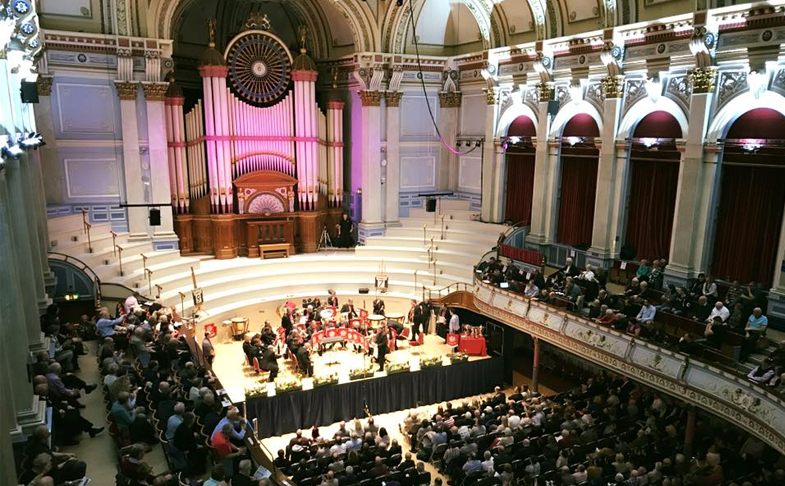
I won the prize for first year performance (the Ker Memorial prize) and the final year Morley Medal at University College London too. To what result? I never rose to the top of society like colleagues at the time who pressed competitive advantage. But still I was complicit! I could easily renounce sports because I thought them competitive by nature without also renouncing glittering prizes for academic performance. That is not only inconsistent, it shows that renouncing things is a very vain way of thinking you might make a difference in a society characterised by the dynamic inequalities and injustices by which elites ensure they remain elites. That is the way of proceeding in competitively organised capitalist societies.
I think now the visceral gut reaction I have even to the word ‘sport’ must have other factors supporting it. Hence, I took on this prompt and, as always, started with the etymology of the word. In truth, before that two echoes came to me from Shakespeare’s King Lear, of course the text I musst think contains all wisdom given that I cite it so often. Two quotations hummed in my head, both from the character of the elder, the Duke of Gloucester, in the play:
But I have a son, sir by order of law, some year elder than this, who yet is no dearer in my account. Though this knave came something saucily to the world before he was sent for, yet was his mother fair, there was good sport at his making, and the whoreson must be acknowledged.
(Gloucester in King Lear, Act 1, Scene 1, lines 18-23 , my emphasis)
Even as he makes these punning references – all based around the fun that comes from the two meanings of the verb ‘conceive’ – Gloucester jests with his interlocutor: the noble and honest, if in courtly terms rather dim of ‘wit’ Earl of Kent. But Gloucester, starting the play with a sense that ‘sport’ is a playful activity participated in for the pleasure alone of its participants (though sometimes with unforeseen consequences) has, as the drama unfolds occasion to use the word differently – to denote sport in the very doubleness evoked by this WordPress prompt. Blinded, as a traitor to them, by Lear’s daughters Goneril and Regan, who both lust after Gloucester’s son, Edmund – the very ‘whoreson’ at which Gloucester had ‘good sport at his making’ – he is thrown out into the common heath and in bad weather to ‘smell his way to Dover’, where the French troops are gathering in support of Cordelia’s (Lear’s other daughter) claim to the kingdom. Gloucester meets his other son Edgar, his voice disguised as a poor man and tenant of Gloucester’s estate. Gloucester, though blind, is beginning to ‘conceive’ of the evil of the world in which he lives, summing it up in one of the most famous quotations from the play:

As flies to wanton boys are we to th’ gods;
They kill us for their sport.

Gloucester in King Lear (Act 4, Scene 1, lines 41f. my emphasis.
In summary then., the character of the Duke of Gloucester in King Lear splits itself around two conceptions of sport:
- (1) as a pleasurable by product of an everyday human activity:
- (2) as a spectator event aimed at killing the time regardless of its cost to others.
As I noticed this, for the first time, I began to realise my deeper reluctance to the notion of sport in its common usages outside of the issue of competition which dominated my boyhood thinking; which was always ultra-political. But, of course, King Lear is a play from a different era. Words change their meaning, even if association with older meanings might survive.What of ‘sport’ as either a participatory or spectator activity.
sport (n.) : early 15c., sporte, “pleasant pastime, activity that brings amusement; joking, foolery;” a shortening of disport “activity that offers amusement or relaxation; entertainment, fun” (c. 1300), also “a pastime or game; flirtation,” also pleasure taken in such activity (late 14c.); from Anglo-French disport, Old French desport, deport “pleasure, enjoyment, delight; solace, consolation; favor, privilege,” which is related to desporter, deporter “to divert, amuse, please, play” (see sport (v.)), also compare disport (n.).
Older sense are preserved in phrases such as in sport “in jest, by way of diversion” (mid-15c.). The meaning “game involving physical exercise” is recorded by 1520s. The sport of kings (1660s) originally was war-making. Other, lost senses of Middle English disport were “consolation, solace; a source of comfort.” In 16c.-17c. it could mean “sexual intercourse, love-making.”
In reference to persons, sport is by 1690s in a now obsolete meaning “subject of mirth or derision, laughing-stock.” The sense of “man who lives by gambling and betting on races” is by 1861; the meaning “good fellow; lively, sociable person” is attested from 1881 (as in be a sport, by 1913), perhaps suggesting sportsmanlike conduct. (Old) sport as a modern familiar form of address to a man is by 1905 in American English colloquial.
The early fifteenth century meaning clearly resonates with the use in Shakespeare two centuries later and survives even into modernity despite etymonline finding old usages ‘obsolete’ and despite the pressure of institutionalisation and commodification to make the word ‘sport’ seem to mean mostly the name of a spectator sport whose players are not playing at all but working as professionals. Amateur players often ape the manner of the professional, as if in progression to that status as a watchable star. Nevertheless, there are still instances of that jokey sociality in obvious survival’ where it is the interaction and bodily contact that brings pleasure. And in that survives the idea of sport meaning “in jest, by way of diversion”
But note that the word from the first bore the association of being a frivolous, and perhaps even amoral if not immoral, evaluation of the activities in which you place yourself in ‘sporting’. That view is emphasised in the growth of overtly moral performance of Christianity, in the Puritans, for instance, against which Shakespeare pointed jokes and which even Milton had his grotesque Comus rail [in the masque Comus]. Milton knew moreover that Comus was a spoof of the disgraceful play of some early Classical Greek aristocrats, known as kōmos (Ancient Greek: κῶμος) and displayed in their symposium pottery [see my blog at this link].

Sport indicative of this komos-like kind (if in heterosexual form) is the word that describes Gloucester’s sexual play with his fair lady which produced the ‘whoreson’, Edmund. It’s worth remembering that in those words women who play sport are seen as ‘whores’, whilst for men the ‘sport’ is merely pleasure. From early days, then, sport was a means of describing things that might be, though engaged in at the same time and place, okay for some with the privilege and time to play them and others without that social privilege and time. Here the deciding factor in privilege is sex/gender but often it is class. The reason why this is common is clear.
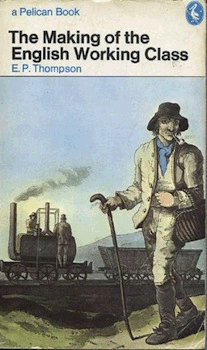
Only the very rich (or hangers-on of the rich) are considered entitled to their play (whether aristocrats, courtiers or the non-executive bourgeoisie so beautifully distinguished from the baser forms of the middle-class in the novels of Zola): the working class are meant to work. My grandfather had many jobs – the earliest I knew was him in a brick yard – and in-between periods he called ‘laking‘ (Yorkshire idiom for ‘playing’), though in fact these were periods of hardship for him and his family. There was strength from the beginning of the formation of the working class, as E.P. Thompson shows in his classic debut for the history of that class The Making of the English Working Class (and shown below in the edition in which I first read it below) in their resistance to enforce upon them a world in which work for them was perpetual. Thompson’s stories about the various ways in which weekends were extended tells a lot about this resistance of the apparently powerless to the powerful ‘bosses’.
Fair use, https://en.wikipedia.org/w/index.php?curid=15332681
And when Gloucester uses the word ‘sport’ differently, he does it to show the irresponsibility implied by ‘sport’ (a disregard for any possible consequences). I wonder if he then links his ill-treatment to his own disregard in his sexual sport, for, in the form of his paternal relation to whoreson Edmund it has contributed to his pain. In fact Gloucester still does not quite see the point in his moralising, in this he is like Polonius in Hamlet:
As flies to wanton boys are we to th’ gods;
They kill us for their sport.
Gloucester in King Lear (Act 4, Scene 1, lines 41f. my emphasis.
For a start, he blames the Gods for irresponsibility where he ought to be blaming the class of selfish Machiavellians his privilege has birthed (in this Goneril and Regan are like Edmund). Second, he attributes the irresponsibility, even of the Gods, not to wealthy entitlement to ensure the maintenance of one’s power and rights (how Goneril, Regan and Edmund are playing the game) but to male children not yet morally mature enough to be anything but ‘wanton’. Nevertheless he gets the circumstances of his suffering right – his suffering is likened to the irresponsible playing with their power as a pastime. A pastime where the extreme of enjoyment is ‘killing’ the less powerful and marginalised beings in their vicinity.
That ‘sport’ was in fact an exercise of the entitled in extending their power, as it is in another way globally for the terrible regime in Dubai in our days, is clear in King Lear but also in my memories of sport when I was a boy. Sport was used as a means of identifying the weak and those refusing to meet the norms of, for instance, masculinity. Having been identified, the processes of involvement in sport reinforced the reasons for identification. This was a topic admitted in culture but only in cultural work, often based on ‘true stories’, mythicised as ‘true stories’ always are, that spoke of the underling defying their status and becoming what they were not – a world-beating competitive sportsperson in their own right. Take the British film comedy Geordie of 1955, (only in the USA was it ‘Wee Geordie’): a film I remember well and with trepidation in relation to participation in sport.
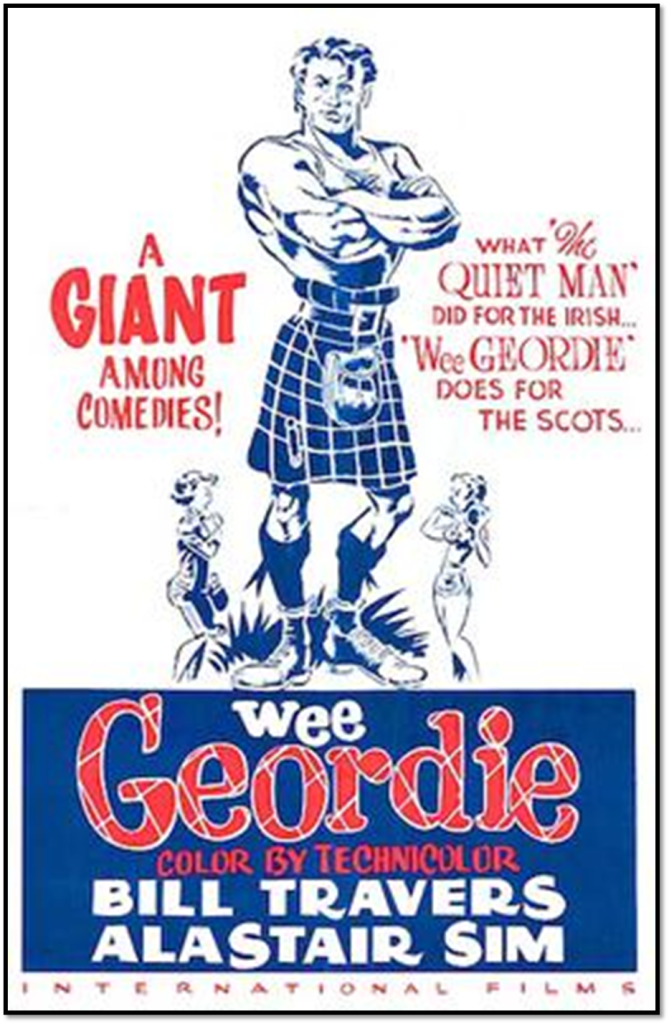
In this a working class man finds the strength to challenge his sense of being diminutive and less than others by training in a scheme like those real ones promoted by Charles Atlas. He finds fame both in participating in sports and being a spectator sport hero (the full plot can be found in the link on the film name above) but learns that his social class dioes not entitle him to be in the public eye (the laird tells him so) and he returns to working-class domesticity as a gamekeeper like his father and married to a girl who finds him ‘braw’.
The film’s ideology was that reproduced in every school. It promoted sport but it made its higher reaches only right for the entitled classes who knew how to handle celebrity and avoid moral dilemma. Things are not so simple now, of course, where celebrity is gained by self-subjection to ridicule. Playing a TV game is enhanced by being a sport in the oldest sense that etymonline says is obsolete: “subject of mirth or derision, laughing-stock.” Take Jade Goody and the casts of Big Brother, or those of Love Island or Traitors,and you see the truth of that I speak.

The stars themselves took the derision gleefully, indeed often encouraged it by what would once have been thought inappropriate behaviour. Such behaviour was used to enhance their look as a ‘sport’ in many of its (even obsolete) meanings. But I think as I wrote this I discovered why I have discomfort with answering the question, which is:
What are your favourite sports to watch and play?
First, I think watching is forever akin in my mind to ‘being watched’ and no sport would justify the ridicule I as a child, and to some extent still as an adult, feel I would attract by being watched. This is a function of low self-esteem but it makes me uncomfortable with being the critical, and perhaps even the appreciatively so, gaze fixed upon others. So why do I like the theatre? In the theatre (in drama at least) everyone who is seen knows that they play a role. And as for playing, unless playing a role where everyone knows that is the case, I feel the eyes (perhaps paranoically) of those ‘wanton boys’ wishing me to end failure or dismemberment. Though that sounds like an answer, I know it is only hypothetically so. I am not going to be testing it any time soon – even in a board game, if that is a sport?
Another unsatisfactory answer! Lol.
With love
Steven xxxxxxxxxxxxxxxxxxxxxxxx
 Steve_Bamlett_blog