In the self-published memoir-cum-novel poof: a curriculum vitae, James, the narrator, generalises on the background human condition assumed in the work. He says, for instance: ‘Despair over our own existences certainly makes us bury obvious truths. Masochistic for meaning, we give ourselves over to existing powers so easily’.[1] At one point, James says: ‘Now I have become a master of fieldwork psychology’. [2] Yet we cannot know the full context in which that naming of this role has meaning. This blog tries to read this analytic novel’s study of the lives of masters and slaves, and a world where power seems all there is in relationships, in a way that makes sense to me.
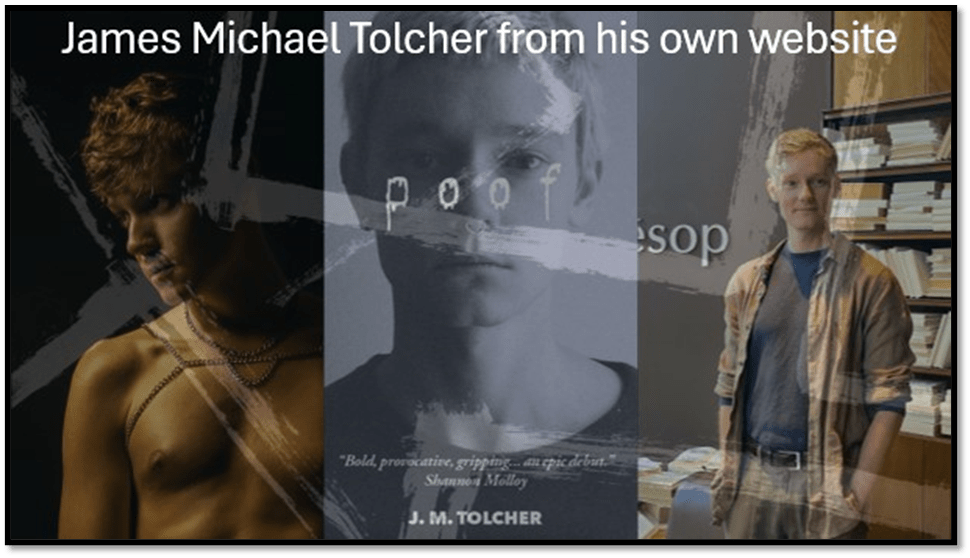
The young man James Michael Tolcher in the pictures collaged above in his website (linked here) is certainly as pretty as he describes himself in is novel-cum-memoir./ That makes particular sense because James sees himself in the tradition of pretty young men in the power of men of established power and authority. The radiation is headed by Antinous, the beloved of Roman Emperor Hadrian, whom, on the former’s death, the latter raised to the status of a God.
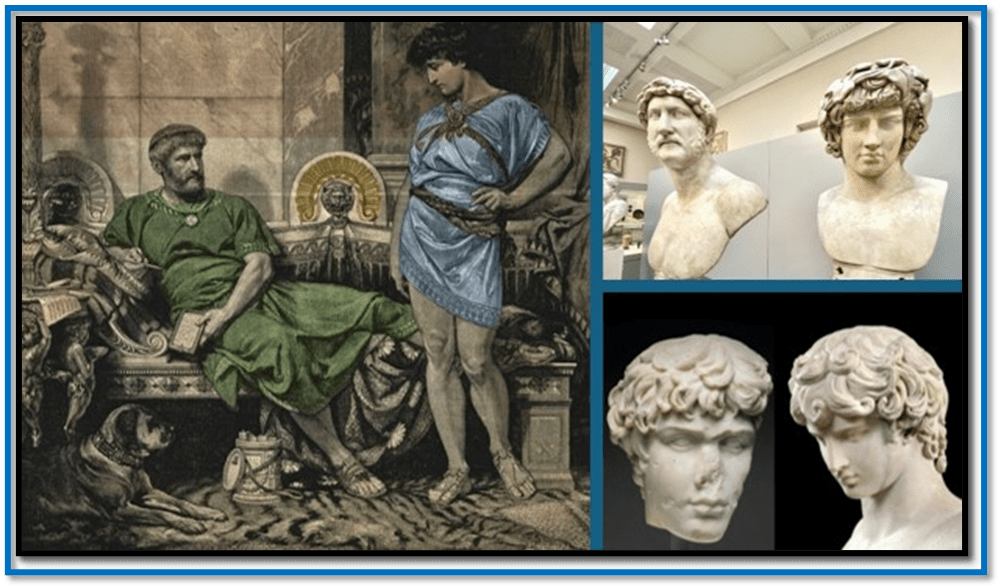
But the tradition of those who take authoritative power on the basis of an amalgam of power, status and masculinity is much longer, and in the contemporary times through which the account travels, much wider. Hadrian seems a pussy to some of these – including Aeschylus Pentheus, of the Theban royal family, returned as a ghost to show he is unreformed to Dionysus and anachronistically surveying how he still imposes – through enforced haircuts – his hegemonic model of a masculinity that defines itself against a binary to femininity and fosters its image in schools, families and in the bedroom – and seems the basis of the memoir’s take on sado-masochiism (perhaps!. Here is Pentheus talking to Dionysus:
I’ll cut off your love-locks myself,
                       And those of your little fagboy,
                       Antinous. [3]
Dionysus answers ‘With what hands’, reminding us that Pentheus may here but speaking but is still in the fragments of body into which the Bacchantes, women enraged by Dionysus and his wine and including Pentheus’ mother, tore him and even physically unreformed. Bacchantes as moralists
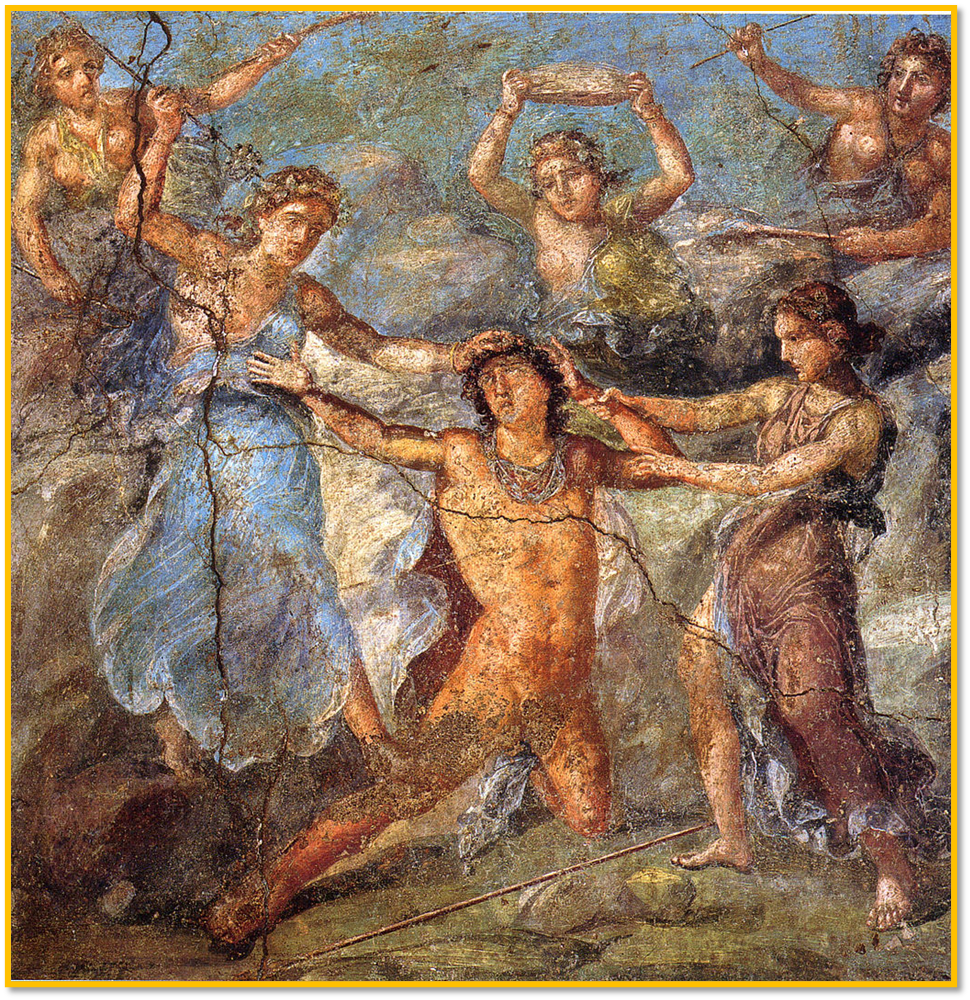
These haircuts relate to those that his primary school (was it really called Vienna Woods) and secondary school enforced on him, if not totally successfully because of is (in their eyes) ‘difference’ to the norm. The haircuts represent the sparagmos of Pentheus and it is appropriate that Dionysus uses this reminder to Pentheus that he is much more radically cut up than any haircut could reproduce. Yet though Dionysus comes to ‘unveil the / story of the last of your gods, / that young boy shrouded in mystery’ he works in vain for the story is shrouded precisely because it keeps being appropriated by other, from Emperor Hadrian onwards:
The deity's story is unknown because
his shrine is not for him at all, the
                     sacrificial youth
in all his beauty has been used
as mothing but a shrine to Hadrian himself/
Look at what I possessed, the emperor says,
the most beautiful boy of all time belongs
                     to me!
Though Dionysus goes on to show that the fightback to honour not the master but the slave, the serf and not the king, the boy and not his Daddy, his tools seem hardly appropriate. The Bacchants that dance onto the stage as his followers are in fact enemies of the hermaphrodite beauty of Antinous and led by Joanne Rowling (in Britain we know her as J.K. Rowling, The Bacchants are double-faced as Janus – apparently chiding those who chastise those in Dionysus’s image (hermaphrodites’, ‘gynopédies’ and ‘those damned faggots too’ ) they in their ‘me too’ role say that Antinous’ and others refusal of the masculine / feminine binary is responsible:
For our discomfort, he is to blame!
Little poof, burn him with flame![4]
There is a lot going then on in the creation of an identity for James, the first person narrator of the inventive ‘autobiographical’ account poof. James in this work emerges out of some kind of Dionysiac disorder in the meaning of personal existence assumed to lie behind human life for all of us, and oft represented in verse dramas such as that quoted above between the chapters and opening the book. So much is that the case that that author, J.M Tolcher calls his novel ‘ a curriculum vita’, as if it described how James might meet the personal requirements of a social role that someone might offer to him for him to fulfil. But even were he to fulfil it, he knows all such roles to be fraught with ambiguity. If you become a god, your honour still belongs to he who makes you a god – it is the latter who stands in for you as your owner, master and superior and even the whole chorus of the world, thrilled to be in the presence of a god lets people as duplicitously deranged as Joanna Rowling speak for their thrilled frenzy. Other Bacchants include figures from the Australian and world sexual political scene (though their views in some ways are contradictory and, as a Pom, I cannot know why all of them are there); the most prominent and there for obvious reasons being ‘the corpse of Joh Bjelke Petersen’.[5]
Identity is complex. You win it only to find, like Antinous, that you are robbed of it by the very person who gave it to you and that it serves to voice his greatness, In this autobiography then it is not enough to try to look, sound and represent the ‘poof’ you assert you are despite discouragement for you image, voice and meaning is stolen by others and used for their purposes – for it is they who have and want to maintain the entitlement and power to name others in ways that render them possessed This is so of Hadrian with Antinous but of James too with a whole list of men (young and old) that he and we meet. It is true too though of James when he takes on his own beautiful boy, who he designates (as he has been designated) ‘a pig’ and treated with contempt, whilst being not allowed to escape his ‘abjection’. We an all it seems be both the oppressed and the oppressor in a system of relationship making inn which relative power only (though that can co-vary) dictates the nature of the interaction and meaning of the relationship. In terms of queer relationships, especially in the leather and S-M scene, this is typified in the Daddy-Boy relationship, a variation of master-slave / serf relations but with implied emotional blackmail in the mix. The relationship between all this and the Dionysus and Antinous stories is implied in the connection between the epigrams for this work stating with Anton Chekhov cited saying that if, in a story you write ‘of a young man, the son of a serf, made to submit to others; ideas, …’ you still need to allow to emerge through that story the ‘morning he wakes to find the blood coursing through his veins is no longer the blood of a slave but that of a real human being’.
It is that ‘real boy’ and ‘real human being’ the work pursues, ensuring that the authentic voice expected does not collude with its own silencing, or submit to be made appear in any other role than one it has chosen freely as it is possible to do, This happened, he says to Antinous but also to his friend, Jacob, another masters pig and boy, whose death by suicide might as well be described as murder. As he says: ‘our narratives are erased, time and again – powerless against the men that use and destroy us’. At Jacob’s funeral, the man who used Jacob and destroyed everything that kept him alive, James says, sat, gigantic sunglasses to hide his eyes red from tears, not for Jacob whom he claimed to love, but for himself – he cried for he could not admit his own cruel nature’.[6] And this is complex because this ‘cruel nature’ James shares in his treatment of ‘the pig’:
I torture the pig until he is almost crying. I want to send him over the edge> I want him to know how I’ve felt. … / I whip him with a burnt rope that Michael had used on me …[7]
Michael was one of James’ torturers, perhaps the chief one, but no different in dual nature than Jeremy, who only becomes a ‘monster’ through practice and the use of crystal meth.[8] But it is up to each in the role of the disempowered to stand trial for their own duplicity. All it takes to be free is to be able to stand and ‘stare into the abyss as I have done’. And once you do it that you know that you can accept a nearer view of both your own innocence and guilt, agreeing to ‘be satisfied by anything except being complicit in my own silencing’.[9] And hence the whole work has strained to hear this complex voice bearing the dual nature of Dionysus : both Hadrian and Antinous simultaneously. This then is no simple ‘coming out’ story – that happens with much of the story yet to unfold when he confronts his loving parents, feels loved by them but is still unresolved.[10] For his parents gave him everything except the one thing needful – the knowledge that conflict (both external and internal) is the only path to truth. The story proper starts with a false paradise of parental protection:
I grew up in paradise. … My parents made every effort to protect my sister and I from negative and bad forces in the world, to be role model members of society, and in this succeeded too greatly. … I was unprepared for any conflict, believing the larger world, …, to be on my side.[11]
Hence invisibility and silence became strategies for survival in James when he ought to have recognised them as his chief enemies – those things that keep him locked-up, willingly in chains. Now this book is inevitably going to be read first and foremost by those with an interest in sado-masochism and it is replete with fulfilment for anyone thus wishing to see and hear about it, but it is most interesting in my view in seeing the apparent conflict implicit in sado-masochistic relationships as a paradigm of how power interpenetrates every process of growing up and adopting various identities and building them collaboratively with others in a relationship. There is plenty of real inflicted pain in this book – rejected by the experiencer or welcomed, but the meaning of sado-masochism is never allowed to be a thing clearly understood. In my title I say that James, the narrator generalises on the background human condition assumed in the work, such as: ‘Despair over our own existences certainly makes us bury obvious truths. Masochistic for meaning, we give ourselves over to existing powers so easily’.[12]
I find those sentences unnerving but interesting. Existence – being (what we might call our ontology) is the basis of the search for personal identity that has meaning for us. Without ability to name that meaning we succumb to existential despair, anomie – call it what you will. But that condition of the human being is the basis of the impulse to masochism. We are ‘masochistic for meaning’. This seems to me to mean, that humans prefer any pain – even desire that pain – rather than feel meaningless in a world with no obvious God to name and simultaneously thrill. Hence Antinous becomes a God but not on his own terms – he must bear the pain a sadist inflicts on him. Likewise James. Likewise any survivor of relationships – they learn that the meaning they are most likely to have is being ‘possessed’ by a greater, already ‘existing power’: an Emperor or a rich man. But these men, although they enact ‘monsters’ as Jeremy does so superbly but not so naturally as Michael, are themselves subjected to meaning they can’t control – part of the same paradigm as the masochist. Tolcher writes as James just before he tells us how he ‘created a profile identifying’ himself ‘as a slave and a masochist’ that, even when he turned the tables and enacted the sadist to his own ‘Piggy’, and became a sadist he was not free of other people’s meanings imposed on him. I find this fascinating, as he asks himself if masochism is the same as ‘abjection’, though he thinks not:
Whether or not my masochism is and was a symptom of my abjection I cannot say for sure. If it is, it would appear that sadism is a symptom of the opposite – in my experience it is not those that have freedom amongst the herd that demonstrate the trait of sadism, but those who have great power at the cost of their freedoms.[13]
It would appear, though this refuses to say so clearly – for about this one cannot be clear or speak without nuance – that both sadist and masochist are bound by the meanings and power of others, and the role comes along with those meanings and its actions sour both masochist and sadist. It is in this context I worry about another statement about a page later than the last: ‘‘Now I have become a master of fieldwork psychology’. We cannot know the full context in which that naming of his role as fieldwork psychologist has meaning. Such a psychologist researches psychological phenomena in the real world – perhaps even the phenomenon of masochistic desire within relationships, But the paragraph continues with James casting himself as a kind of therapist based on his research, advising ‘many friends on their imminent self-destruction’, successfully or otherwise. Since he ensures the ‘dangers’ are recognised, ‘pointed out, their mental states explained to them’. we van expect that he has ‘changed many lives’ and would expect that to include his own. However his example is not of his own near self-destruction but of how he helped to facilitate it ‘in the case of my pig’..[14] Nothing here is straightforward explained as perhaps we hope mental states ought to be. We are instead merely ‘staring’, I would suggest at ‘the abyss’ where meanings of all thoughts, feelings and behaviours thought to constitute human psychology are whirling and colliding against each other.
And this is the strength of Tolcher’s book in my view. It avoids certainty of statement about whether the sado-masochistic paradigm is a basic description of all relationships, or whether just those of societies who work hard to distribute power unevenly. This is the case for everyone for we are all ;masochistic for meaning’. He uses his own meek and mild parents as illustration of that very phase and not his own experience of visceral infliction and receipt of pain between two people. James is not truly trying on the role of psychologist: researcher or therapist, except en passant. He is showing that the names we give ‘existing power’, even to medical authority, are not written in stone but arise from us all being ‘masochistic for meaning’, I think. It is for others in the book to make straightforward statements, as in the case, of his view that had he listened to his body earlier, in its response to inflicted pain, he would now have healthier ‘boundaries’ and not go ‘near those people that only wanted to hurt and use me for their own self-interests’. But having said this he raises a radical doubt whether that is or would be the case. All that remains is the fact that he works ‘daily to change my habitual desires to throw myself into self-destruction as I have been trained to do’. So far, so good, except the next sentence already queries the straightforwardness and even correctness of that task:
What danger? It’s all in my imagination, isn’t it? Or is it real and I owe it to my people to destroy myself?
Those radical questions and doubting ruminations are as real as the statement of health preceding them. Tolcher knows, and I think they are right: nothing is that certain, even if these questions of dramatised other voices – for those too van be internal or external to the psyche.
I think this is a great book. Thank you @talulahbluebell for recommending it.
With love
Steven xxxxxxxxx
[1] J.M Tocher (2023: 102) poof: a curriculum vitae Milton Keynes: Ingram Content Group. ISBN: 9 780646875873
[2] Ibid: 131
[3] ibid: 54
[4] Ibid: 11 – 15
[5] They appear ibid: 95
[6] Ibid: 248f.
[7] Ibid: 114
[8] Ibid: 178
[9] Ibid: 255
[10] Ibid: 100f.
[11] Ibid: 17
[12] ibid 102.
[13] Ibid: 130
[14] Ibid: 131
 Steve_Bamlett_blog