


My lovely husband who is 83 is ill of the lurgy-thing I seemed to be sloughing off, as I approach 70 next Friday. I am in the guest bed trying to let him rest and not able to sleep. I hope using a nonsense poem he loves from Alice’s Adventures in Wonderland to answer this prompt will help cheer him up. God bless the ‘wicious pride of youth’. It honours the airs it gives itself in beauty sometimes, if not in Old Father William’s son or Silas Wegg.
What is your favorite form of physical exercise?
Is the correct way to answer this to boast of one’s abilities. I don’t have any physical ones, never had. I have absolutely no core muscle strength so sit-ups are an impossibility. If I could magic some physical a ibilities up, they would be the ones that another fat old man had – Lewis Carroll’s Father William. William is the perfect answer to the queries made in conversations between generation. Dickens gives a wonderful example of such a conversation when he writes the paragraph below. It is in Chapter 7 of Our Mutual Friend. Venus is the remodeller appointed by Silas Wegg to remake, at a pretty cost, Wegg’s amputated fleshly leg (the bones of which which Venus keeps in store for Wegg).
During the ‘consultation’ Venus chides a young man who comes to pick up his stuffed canary. He chides him for querying the number of old men’s teeth used to replace some sixpences in the ‘change’ he was given by Venus after paying him with a large coin. Of necessity, of course, for he is presnt throughout, he must also address Wegg, another impertinent (if sixty-year-old-plus) young man. Silas (standing there on both his remaining fleshly leg and a wooden one) does not reply. The young boy however bows somewhat to Venus’ reprimand:
.. Mr Venus only replies, shaking his shock of dusty hair, and winking his weak eyes, ‘Don’t sauce ME, in the wicious pride of your youth; don’t hit ME, because you see I’m down. You’ve no idea how small you’d come out, if I had the articulating of you.’
This consideration seems to have its effect on the boy, for he goes out grumbling.
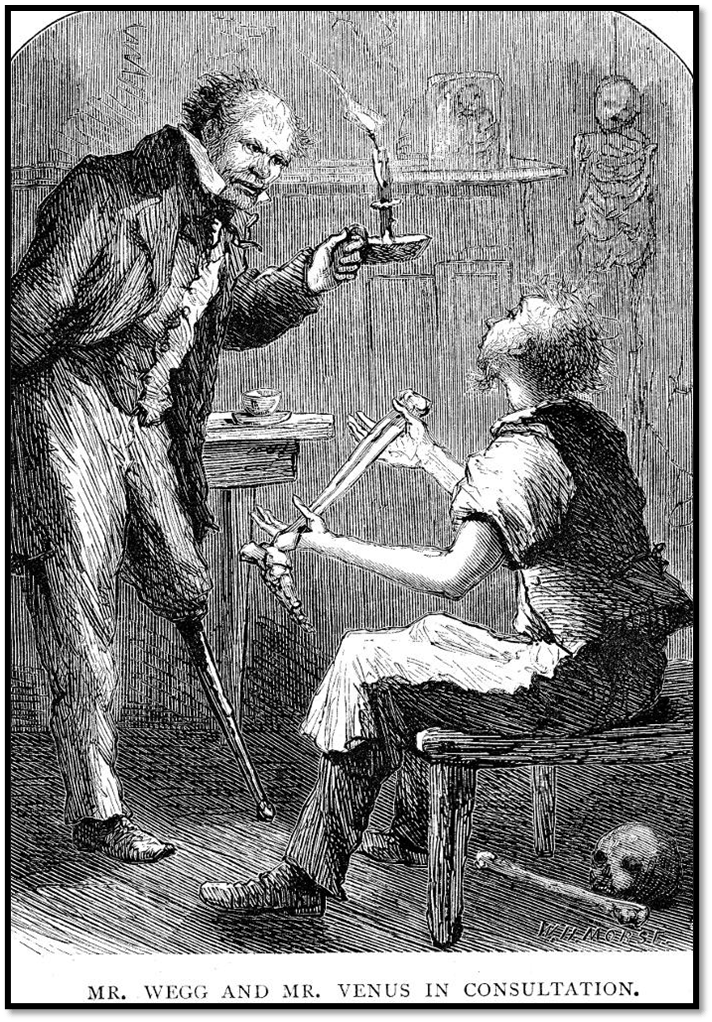
The young cannot help but patronise the old as they flex their supposed inner empathies early on in their moral development. Children, even when adult, continue to talk to their parents as if they were incapable of understanding anything at all, attributing any cautious responses of a wiser elder to some infirmity. Of courze, we kmow that as we age there is a telative and inevitable slowing-up of physical-motor-responses attendant usually on that process. However, for some, there may be no such weakening evident.
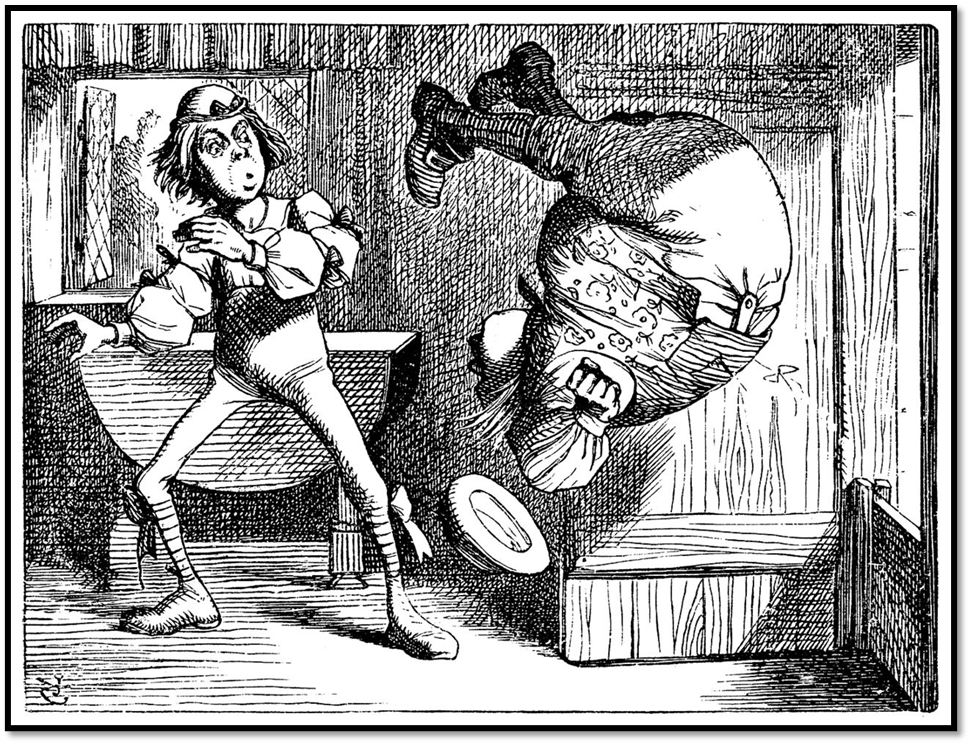
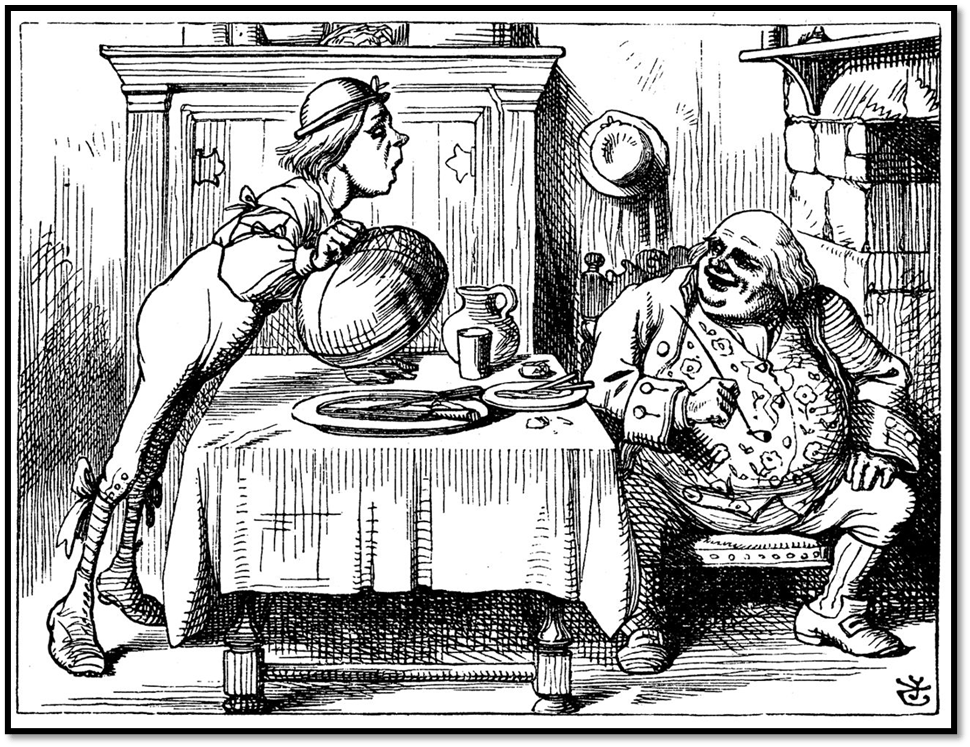
Hence Carroll created Father William. When his snot-nosed son patronises his dad without an ounce of self-awareness, zWilliam is notbing but amiable in his replies. The exercises favoured by Father William may not be mine or Geoff’s but they certainly confound the sons and daughters of this world that think most tasks outside the range of tje ‘elderly’. Of course eating a whole goose is a dubious example of physical exercise, though in truth it is one. Here’s the poem interspersed with Tenniel’s delicious illustrations:
"You are old, Father William," the young man said,
    "And your hair has become very white;
And yet you incessantly stand on your head—
    Do you think, at your age, it is right?"

"In my youth," Father William replied to his son,
    "I feared it might injure the brain;
But now that I'm perfectly sure I have none,
    Why, I do it again and again."

"You are old," said the youth, "as I mentioned before,
    And have grown most uncommonly fat;
Yet you turned a back-somersault in at the door—
    Pray, what is the reason of that?"

"In my youth," said the sage, as he shook his grey locks,
    "I kept all my limbs very supple
By the use of this ointment—one shilling the box—
    Allow me to sell you a couple."
"You are old," said the youth, "and your jaws are too weak
    For anything tougher than suet;
Yet you finished the goose, with the bones and the beak—
    Pray, how did you manage to do it?"

"In my youth," said his father, "I took to the law,
    And argued each case with my wife;
And the muscular strength, which it gave to my jaw,
    Has lasted the rest of my life."
"You are old," said the youth, "one would hardly suppose
    That your eye was as steady as ever;
Yet you balanced an eel on the end of your nose—
    What made you so awfully clever?"

"I have answered three questions, and that is enough,"
    Said his father; "don't give yourself airs!
Do you think I can listen all day to such stuff?
    Be off, or I'll kick you down stairs!"[
And youth ought to beware asking old men ‘what their favourite exercise’ might be. It is possible the social ordering of time that favours youth will dissolve as the world wakes up to its inbuilt and possibly necessary narcissism in thoze ephebes, even if time itself remains a relentless move to some end for some nevertheless that is an end forever. That ‘wicious pride’ of, and in, their youth can’t survive moreover the fact that its articulators age too and become patronised themselves. Few older men (or women) possibly ever remind the young that they are merely giving themselves ‘airs’, for they too were in that position of beong the ignorant youth once themselves with their own ‘olds’ (as youths used to call them) and prefer to smile at youthful folly rather give it an earful. Well they smile when they are not concentrating on balancing an eel on the end of their noses.
The older taxidermist Venus talks to the man who could be, but isn’t, his son, about the tools of his trade – of building joints in old dead bones to revive the look of the animal. It’s called articulating a dead body. Dickens makes it sound like the kind of vengeance he takes on his own characters – pricking-their-pride by virtue of the ridiculousness of the things he makes them say and do. Novelists have that power in their own novels, for they are expert in another kind of ‘articulating’.
You’ve no idea how small you’d come out, if I had the articulating of you.
The pleasures of older age are sometimes exercised in such articulations, verbal or written.
All my nonsensical love
Steven xxxxxxxxxxx
 Steve_Bamlett_blog