Sometimes, it seems that all away do run

Sometimes, it seems that all away do run
and I alone from them do stalk, feeling
colossal in my rightness, though alone
perhaps forever - turning in my mind
being abandoned as gifts held aloft
to send me elsewhere - to another sphere
of dominion, some place in which I'll
still reign,  again held special by a heart
that bleeds - again, again - until it yields.

Steven Bamlett
Sometimes, it seems that all away do run is a fanciful bit of verse piece that came into my head to represent the fatuous feeling of colossal alienated lonesomeness that has no reason, prompt and perhaps no meaning. A counsellor I once consulted was happy to see it as ‘existential angst’, what is left for human consciousness when it realises that no one will, or even can, validate for you any belief or principle you hold but yourself. It is the fearsome knowledge that any thing you thought ideal enough to guide your life – be it person, group, creed or principle – holds significance only because you chose that it should have that significance and that you chose it without truly knowing its own variances and independence of your thought processes.
Do we all at some point feel abandoned by the things, people and ideals that held you constant? Or perhaps it is that you thought those things, people and ideals held you constant until you realised you were not held at all, at least by them? Where you might be held – perhaps were truly being held all of the time – you neglected to notice. To continue self-belief above all other values is to wander away from those and that which no longer feels you significant to it – however dispersed and random seem the people and things they choose in your stead – but also perhaps from those who still hold you, and hold you calmly still though your fancies wander.
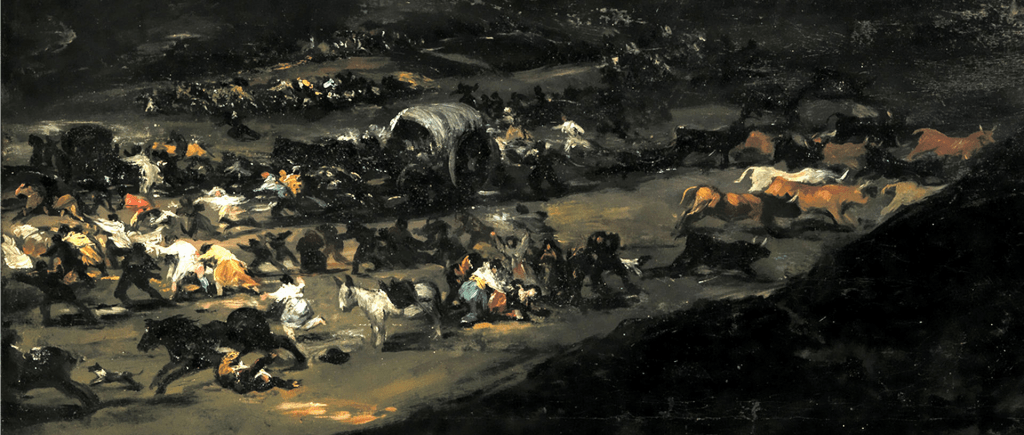
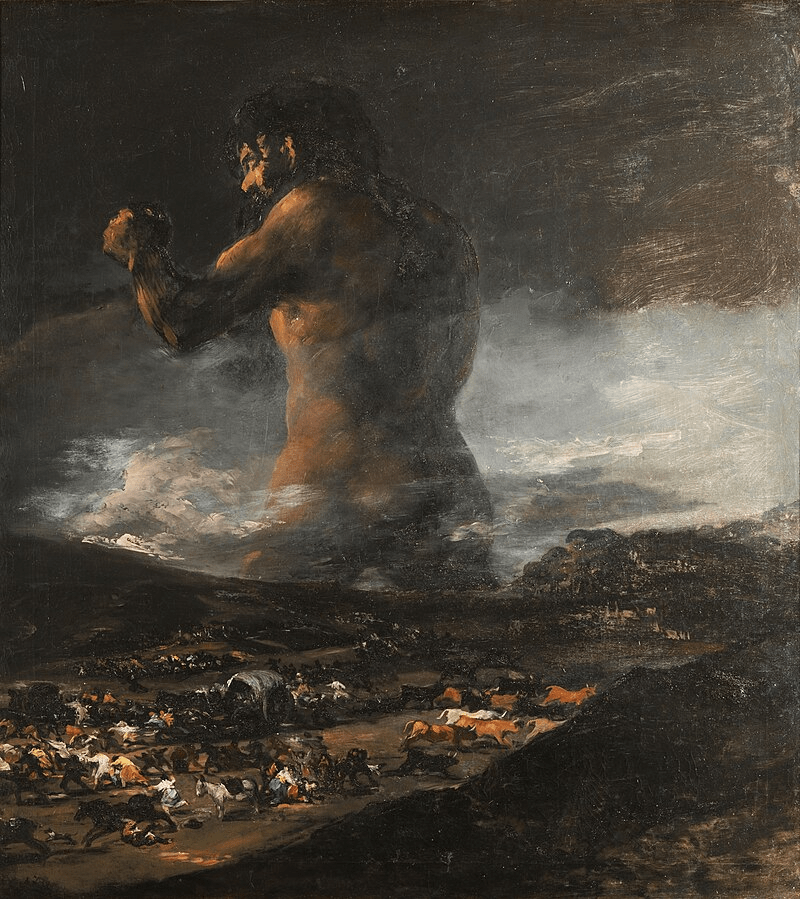
But most of all the thoughtless little verse showed me that even believing in your existential lonesomeness is a vapid empty thing, born of the remnants of narcissistic overvaluation of self. The colossal giant, that you thought that you once were, is stalking away from those in unreasonable flight – perhaps from themselves and in all directions, possibly too into rather than away from danger, like those dispersing folk armies from Goya’s picture at the head of this blog. Meanwhile you, an aimless giant, whilst you walk away, think yourself in the clear because your head is in some dark sky above the mists that cover common earth – the landscapes of the many where all resolution lies. To feel ‘abandoned’ is the most dangerously narcissistic of states – it never looks towards those places where love that is good enough, and more, sits awaiting in a vale where genuine tears are flowing like mighty rivers.
For to this colossus – power is all. No wonder some people think this picture thought to be by Goya is all about the complicated response in Spain of the success of Napoleonic imperialist armies.
The truth may be that to feel colossal lonesomeness is to create the means of your alienation. You have a choice. You just felt too good to choose it – better than all this is the phrase one narcissist I knew told me, when I represent that rejected by them. But who was the lonely giant – he or I. As I wrote this I thought of another echo in my head, Wyatt’s beautiful poem of being abandoned in love.
Wyatt is a great poet too little read. But this ends as a bitter little poem if beautiful and gigantically so still. At the end the poem’s words bolster the lyricist’s own colossal ego whilst it stereotypes the once-loved as a fickle thing fond only of ‘newfangleness’. We all know what he thinks she deserves, having rejected him.
They Flee From Me  by Sir Thomas Wyatt

They flee from me that sometime did me seek
With naked foot, stalking in my chamber.
I have seen them gentle, tame, and meek,
That now are wild and do not remember
That sometime they put themself in danger
To take bread at my hand; and now they range,
Busily seeking with a continual change.

Thanked be fortune it hath been otherwise
Twenty times better; but once in special,
In thin array after a pleasant guise,
When her loose gown from her shoulders did fall,
And she me caught in her arms long and small;
Therewithall sweetly did me kiss
And softly said, “Dear heart, how like you this?”

It was no dream: I lay broad waking.
But all is turned thorough my gentleness
Into a strange fashion of forsaking;
And I have leave to go of her goodness,
And she also, to use newfangleness.
But since that I so kindly am served
I would fain know what she hath deserved.

Source: https://www.poetryfoundation.org/poems/45589/they-flee-from-me
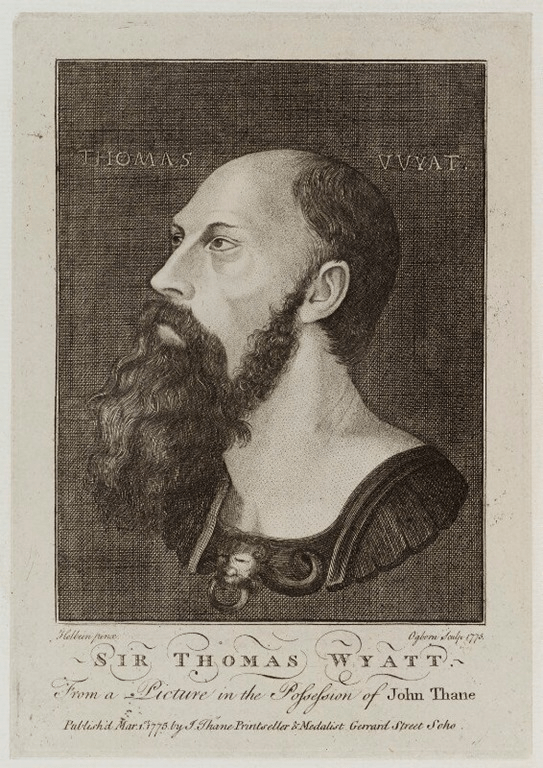
In fact Sir Thomas Wyatt it was who fell foul to colossal arrogance (all handsome 6-foot of him – a beautiful giant in his day)- his own and his chosen rival – for in ‘May 1536, Wyatt was imprisoned in the Tower of London for allegedly committing adultery with Anne Boleyn’ (Wikipedia), though unlike Anne lived to die naturally at home married to a staid wife in the usual kind of arranged marriage.
Well that’s enough flitting about for one day.
All mylove
Steven xxxxxxxx
 Steve_Bamlett_blog
Wyatt represents a pre-Romantic poet with a Romantic’s sensibilities … As such, you could say he was ahead of his time. He reminds me of Rasputin, always chasing after that Royal poontang. You could get your nails singed doing that.
Come visit my blog and leave some comments, if you like
http://www.dark.sport.blog
LikeLike
Nicely put Greg. My favourite is:
Who so list to hunt …
LikeLike