



Most bloggers create a tagline, although they attach it as a tagline name or statement of intent only the blogsite. Mine was ‘Lifelong Learning’. I intended, I thought to indicate a response to retirement, to a belief that divorced the idea of learning from institutional education and from work. But terms deteriorate.
Lifelong learning became the positive name given to the need for people in work to adapt to newly required skills, knowledge and values, sometimes changing at breakneck speed. In some profession, such as social work, this was always a necessity since it is a discipline that must react to changes in law (often calling for such changes for the establishment of shared values around diversity and equality), social trends and resource development or underdevelopment. Lifelong learning there was a professional demand of competence. The competence was tested in academic work and in social work practice supposedly. The same was supposed to happen in teaching. However, work itself everywhere and for everybody, came to be defined as an adaptive response by individuals to the the fluid or unstable labour market from 1he 1970s. Your choice of word to describe ‘markets’, between ‘fluid’ or ‘unstable’,began indeed to say a lot about your attitude to modernity defined by a need for perpetual and driven change or your place in the hierarchies of class, power and status, for fluidity or adaptability sounds like a good quality, especially to an entrepreneur, whilst instability does not, especially to a skilled worker in a dying industry like coal.
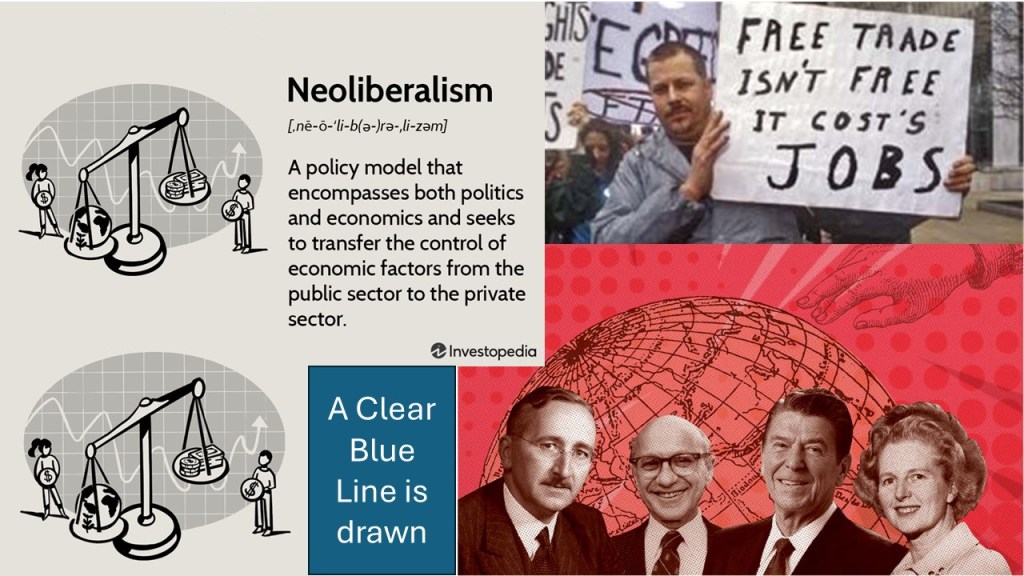
Neoliberalism as an ideology and political practice often divided people across a divide between those grasping opportunities for profit, who prided themselves in the fluidity and those subjected to changes that meant they worked longer hours, at more unsocial times and often for less wages in a more mechanised environment or were made redundant and left to learn again how to learn anew. Neoliberal politics came to the fore in the UK under Margaret Thatcher in the 1980s and was deemed, largely by itself and its representatives in academia and politics, as involuntarily regulated by the larger market serving the global supply and demand of commodities and services (often barely distinguishable from each other). It was involuntary but healthy people, neoliberals insisted, adapted to change. If not they died. There was a confirmed ideological belief inside neoliberalism in a process we call ‘social Darwinism’, a theme in political dialogue well illustrated in the 1982 – 1984 Miners’s Strike, where if you did not change or adapt you deserved to die, a misreading of Darwin’s term, ‘the survival of the fittest’. Roles in work came and went and only those adapting to new roles, often with drastic changes involving relocation, self-redefinition in lifestyle, through training, or submission to new forms of working and often crisis-led self-regulation.
This isn’t a process I altogether wanted to be associated with. You can see the tensions though even in the Wikipedia definition of the term:
Lifelong learning is the “ongoing, voluntary, and self-motivated“[1] pursuit of learning for either personal or professional reasons.
Lifelong learning is important for an individual’s competitiveness and employability, but also enhances social inclusion, active citizenship, and personal development.[2]
Professions typically recognize the importance of developing practitioners becoming lifelong learners. Many licensed professions mandate that their members continue learning to maintain a license.[3]
Lifelong learning institutes are educational organisations specifically for lifelong learning purposes. Informal lifelong learning communities also exist around the world.
What a slippery definition that is. My tagline is meant to apply only to my own desire to learn and to practise what I learn learning though I agree that this ‘enhances social inclusion, active citizenship, and personal development’, I wonder whether some of those goals are for the purpose, and in the interests, of the oligarchies currently controlling economic and social life for the few. The rest of the definition returns us to the fact that ‘lifelong learning’ rather than improving the autonomy (self-regulation) of the person is being returned to the institutions governing professional careers, work roles and institutional education. In the latter, the evidence is mixed. Whilst the Open University once tested the water of creating education by choice models, like Massive Open Online Courses – MOOCs – it has resisted it equally, the resistance coming from forces committed to serving the market on one side, or the traditions of outmoded institutions on the other – in the subject disciplines for instance. How soon Wikipedia integrates all the personal growth choices and autonomous learning into the needs and demands of regulating institutions.
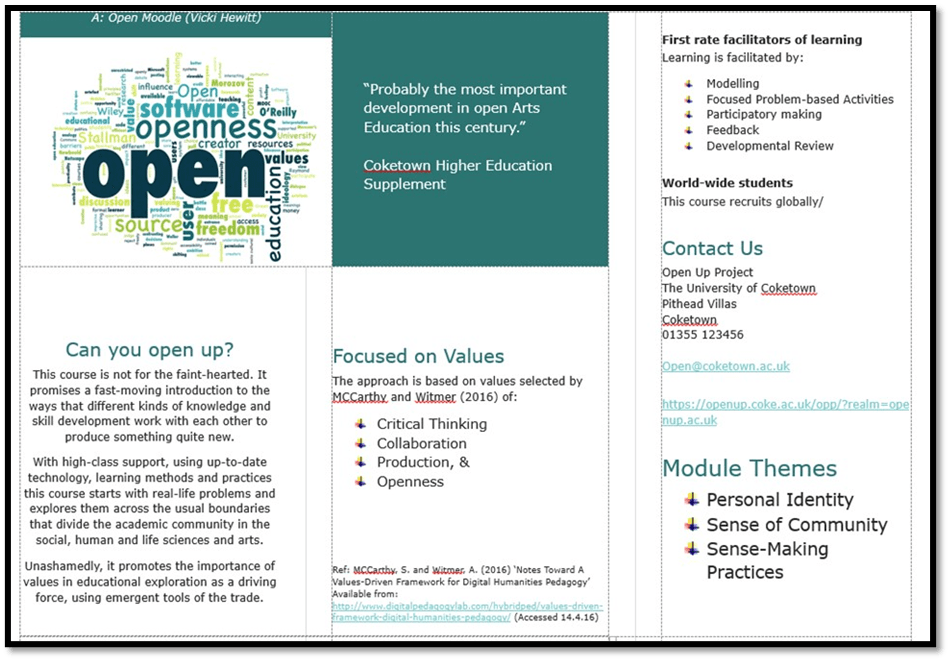
I produced this mock-up leaflet as part of a course on my MA in Open And Distance Learning at the Open University
So how can I change that tagline. Even when I studied Open and Distance Learning as you can see from the exercise I completed for an assignment above. The same in another assignment:
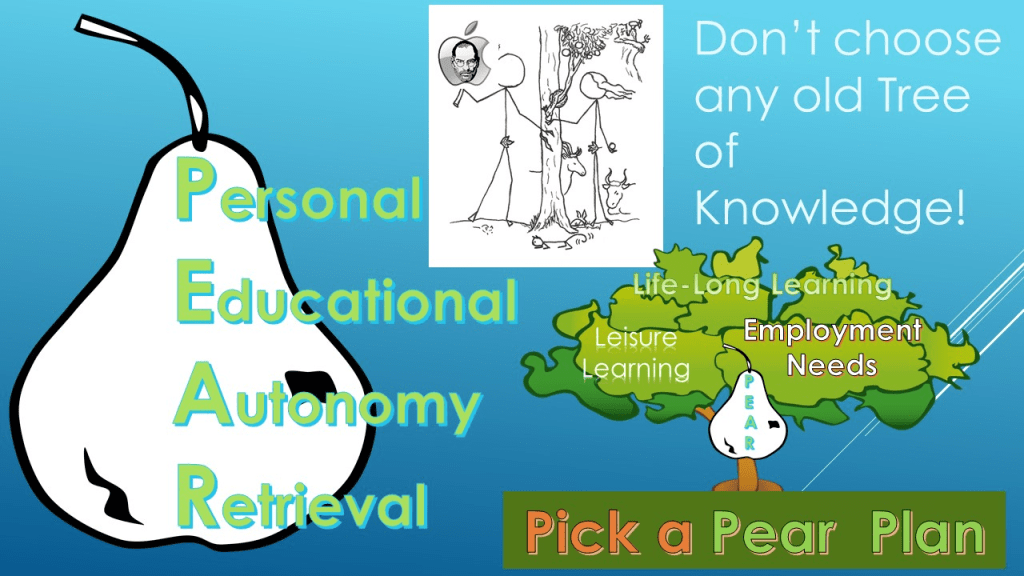
Okay, I used the buzz words but I thought as a person taught and employed by an institution creating course commodities based on there being a demand for them to justify their supply. Hence these are advertisements not information, ir infographics as the jargon term went. So P.E.A.R. is not a suitable tagline. But how about ‘Autonomic Lifelong Learning’. What I want this to mean is Learning through and of life for and by myself governed only by personal development needs, which in themselves need a social edge but not one coming from a neoliberally governed society.
But would it be understood, for the primary meaning of autonomic as been, since the late nineteenth century used it mainly in physiology to name the autonomic nervous system – that system governing involuntary and instinctual life maintenance behaviours like breathing (the sympathetic branch of the system in the jargon) and the involuntary emotions (the parasympathetic system).
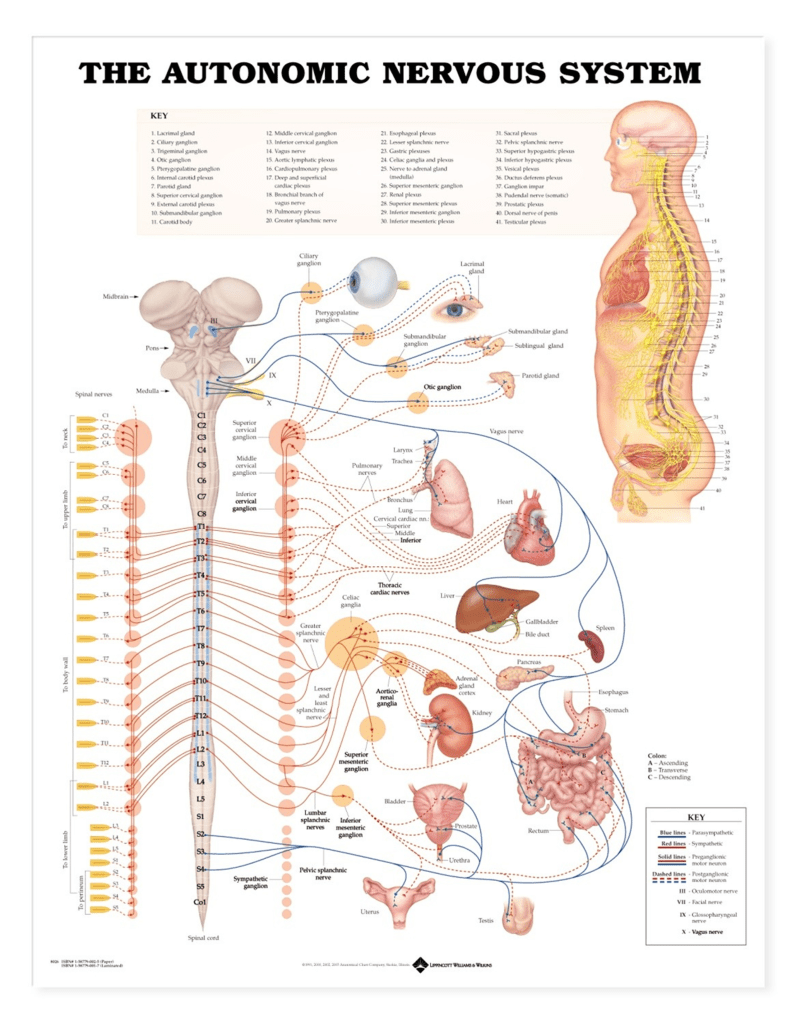
Like most characterisations mine in words is oversimplified for there is often integrated working between sympathetic and parasympathetic systems and some fuzziness in their distinction. Nevertheless from the label in physiology, autonomic came to mean in majority use, came to mean Using the typical entry in Merriam Webster:
- 1 : acting or occurring involuntarily, autonomic reflexes
- 2 : relating to, affecting, or controlled by the autonomic nervous system or its effects or activity, autonomic drugs
Of course it was not always thus, so I took recourse, as usual to Etymonline, where I found:
autonomic (adj.)
1832 (autonomical is recorded from 1650s), “self-governing;” see autonomy + -ic. Since late 19c. used mostly in physiology.
Related to autonomy (n.) (from autos “self” (see auto-) + nomos “custom, law” (from PIE root *nem- “assign, allot; take”)).
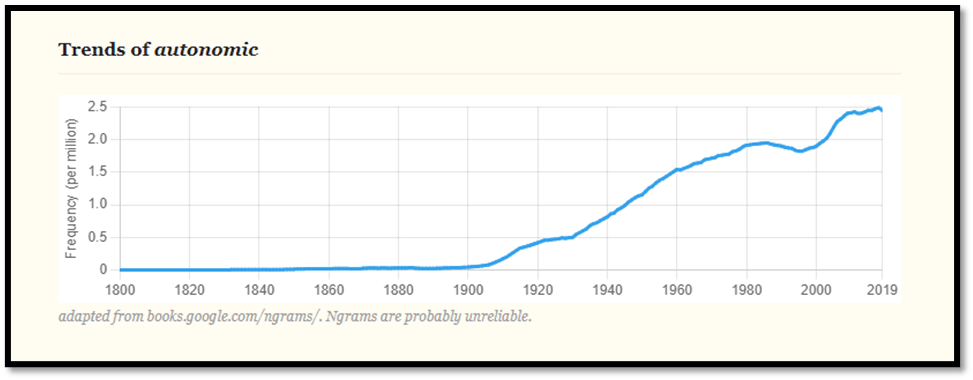
Perhaps I should go the whole hog and choose ‘autonomical’ as ‘self-governing’, which will do though it is clear that ‘autonomic’ took over the role of this world until the physiological turn. The etymology was fine – it would be about self-defined learning as its main parameter, not that of an institution, though of course it can’t escape the ideology of individualism, and that’s a problem. But the usage shows the words frequency, in the unreliable Google n-grams, using invalid methodologies, of course (but who cares – I am autonomous) that its growth in frequency comes only with the take up of its physiological meaning and offshoots as referring to ‘involuntary’. Now my learning, like my blogging, is involuntary, but is the aspect I want in as tagline setting me an aspiration to use the involuntary wisely. Here is the n-gram.,
Stuck between a rock and a hard place, I think at this point I will nevertheless stay with Autonomic Lifelong Learning as my tagline, for why not admit that turning the involuntary reflex of my soul into something I occasionally try to self-control sn’t a bad thing. After all, as addictions go, learning is a better one than drinking alcohol or smoking or over-eating, the first two of which I gave up years ago. Someone help with the last, fot there I would want to be. Hey wait a minute: what about ‘Addicted to Learning for Life, Convicted that I should regulate it sometimes’. Too long! And I am not sure I want to develop my ‘convict’ credentials from my convictions.
All my love
Steven xxxxxx

