What’s something most people don’t understand?
Lots and lots of energy are expended on meanings and how they touch upon lives, or even bludgeon some peoples lives into submission, like the words that are taken to infer not only a meaning but also a social status, and these are legion. Queer was once such a word but it has been reclaimed, first I think by Derek Jarman (in the UK at least), in the interests of a positive take upon the diversity of things in the sensed world. But lets take a more everyday word.
We all think we know what the word ‘understand’ means, but we rarely attempt to understand the difference between what it means to know and what it means to ‘understand’. Yet though, no doubt, some believe they are synonyms of each other, there is significant discussion about that issue and a cultural pressure to distinguish them, though not always in a clearly definable way. Indeed, if we take Wikipedia’s view of the matter, the words seem to indicate not only dependency between their meanings but very fuzzy boundaries to their definition, both as cognate and distinct words.
Understanding and knowledge are both words without unified definitions.
Ludwig Wittgenstein looked past a definition of knowledge or understanding and looked at how the words were used in natural language, identifying relevant features in context. It has been suggested that knowledge alone has little value whereas knowing something in context is understanding, which has much higher relative value but it has also been suggested that a state short of knowledge can be termed understanding.
Someone’s understanding can come from perceived causes or non causal sources, suggesting knowledge being a pillar of where understanding comes from. We can have understanding while lacking corresponding knowledge and have knowledge while lacking the corresponding understanding.Even with knowledge, relevant distinctions or correct conclusion about similar cases may not be made suggesting more information about the context would be required, which eludes to different degrees of understanding depending on the context. To understand something implies abilities and dispositions with respect to an object of knowledge that are sufficient to support intelligent behavior.
Understanding could therefore be less demanding than knowledge, because it seems that someone can have understanding of a subject even though they might have been mistaken about that subject. But it is more demanding in that it requires that the internal connections among ones’ beliefs actually be “seen” or “grasped” by the person doing the understanding when found at a deeper level.
https://en.wikipedia.org/wiki/Understanding
I think though that Wikipedia’s explanation may obfuscate by its excursion into the philosophy of mental process. Nevertheless, the trend of the passage fits my sense of the everyday ways I might use the words together, such as when I say to someone who doesn’t quite seem to be able to make the meaning of what they say relevant to me, when I feel it possibly is: “I KNOW what you are telling me but I don’t understand why it matters to me, you or our relationship together“. After all, sometimes, establishing knowledge becomes a masked way of not communicating the real message, as with a person I loved who used to communicate knowledge of ways in which he and I were different without communicating the understanding that he wanted to break up the relationship between those acknowledged differences of being.
I have a passion for etymologies. I ought, even, to have shares in etymonline.com. For on the one hand, and I think this implied above, the meaning of a word is a thing established in the moment: it’s a matter of currency in every way – it is what the word is taken to mean currently, and how it is exchanged in everyday interactions, like a currency or token of exchange. On the other hand, understanding takes a wider and deeper context, if not therefore a superior one. I love the way the Wikipedia passage struggles between whether to ‘understand’ is a more demanding process of thought than ‘knowing’ the same thing or vice-versa. And etymology helps here, possibly. Here is etymonline on ‘understanding’:
Old English understandan “to comprehend, grasp the idea of, receive from a word or words or from a sign the idea it is intended to convey; to view in a certain way,” probably literally “stand in the midst of,” from under + standan “to stand” (see stand (v.)).
If this is the meaning, the under is not the usual word meaning “beneath,” but from Old English under, from PIE *nter- “between, among” (source also of Sanskrit antar “among, between,” Latin inter “between, among,” Greek entera “intestines;” see inter-). Related: Understood; understanding.
That is the suggestion in Barnhart, but other sources regard the “among, between, before, in the presence of” sense of Old English prefix and preposition under as other meanings of the same word. “Among” seems to be the sense in many Old English compounds that resemble understand, such as underniman “to receive,” undersecan “examine, investigate, scrutinize” (literally “underseek”), underðencan “consider, change one’s mind,” underginnan “to begin.”
It also seems to be the sense still in expressions such as under such circumstances. Perhaps the ultimate sense is “be close to;” compare Greek epistamai “I know how, I know,” literally “I stand upon.”
Similar formations are found in Old Frisian (understonda), Middle Danish (understande), while other Germanic languages use compounds meaning “stand before” (German verstehen, represented in Old English by forstanden “understand,” also “oppose, withstand”). For this concept, most Indo-European languages use figurative extensions of compounds that literally mean “put together,” or “separate,” or “take, grasp” (see comprehend).
The range of spellings of understand in Middle English (understont, understounde, unþurstonde, onderstonde, hunderstonde, oundyrston, wonderstande, urdenstonden, etc.) perhaps reflects early confusion over the elements of the compound. Old English oferstandan, Middle English overstonden, literally “over-stand” seem to have been used only in literal senses.
By mid-14c. as “to take as meant or implied (though not expressed); imply; infer; assume; take for granted.” The intransitive sense of “have the use of the intellectual faculties; be an intelligent and conscious being” also is in late Old English. In Middle English also “reflect, muse, be thoughtful; imagine; be suspicious of; pay attention, take note; strive for; plan, intend; conceive (a child).” Also sometimes literal, “to occupy space at a lower level” (late 14c.) and, figuratively, “to submit.” For “to stand under” in a physical sense, Old English had undergestandan.

Text & chart from: https//www.etymonline.com/word/understand
I love such passages, not least because they leave me puzzled by the inconsistencies I can’t resolve from etymology alone. This one takes considerable space establishing that the Old English word ‘under’ ‘is not the usual word meaning “beneath,” but from Old English under, from PIE *nter- “between, among” ‘. It does all this only to end with a use of the word exploiting a very sophisticated use of ‘under’ meaning ‘beneath’ in an elaborate way: ‘Also sometimes literal, “to occupy space at a lower level” (late 14c.) and, figuratively, “to submit.” For “to stand under” in a physical sense, Old English had undergestandan‘.
But I do find the sense of ‘understanding’ meaning ‘standing among’ beautifully suggestive of the difference of understanding from knowing, for in understanding I have to place myself within and amongst the thing(s) and/or person(s) to be known rather than looking at, and handling, it or them from the outside as objects alone. There is something that is not only ‘subjective’ in understanding’ but also something intersubjective, something that is about the coming together and standing in the same space as the ‘other’ (such that it is less OTHER). The space I mean can be immediate or not so – limited to one time and space or transitional between them, as long as I am living with the thing(s) and person(s) to be understood.
The prompt question becomes absurd or worse, sinister, of course, in this context. To ask someone about what ‘most people don’t understand’ is to validate and define as superior the ‘understanding’ of anyone who attempts to understand what MOST others fail to understand. The inference in terms of the implied meaning of understanding is clear – it means, in this question, that there is an understanding specific only to very few, perhaps even one person alone, that excludes others and denigrates the state of their understanding. But to think like that is far from ‘standing amongst’ others and the thing or person to be understood in order to do the act of understanding, which involves every level of mutual communion and communication between the things of the world.
So there is no answer to this question prompt. I understand no more than most do, though I have a privileged education and know more things than many do. But we do have a duty to think about why and how understanding is ‘more demanding’ than knowing, and there should, I think be less onus on why why knowing is ‘more demanding’ than understanding (return to the Wikipedia passage quoted above if I have lost you in some supra-synaptic leap to understand where I am attempting to go here). Very often ancient texts of spiritual understanding help here, Take this: The Gospel of Saint Mark, Chapter 8, in the King James Version.
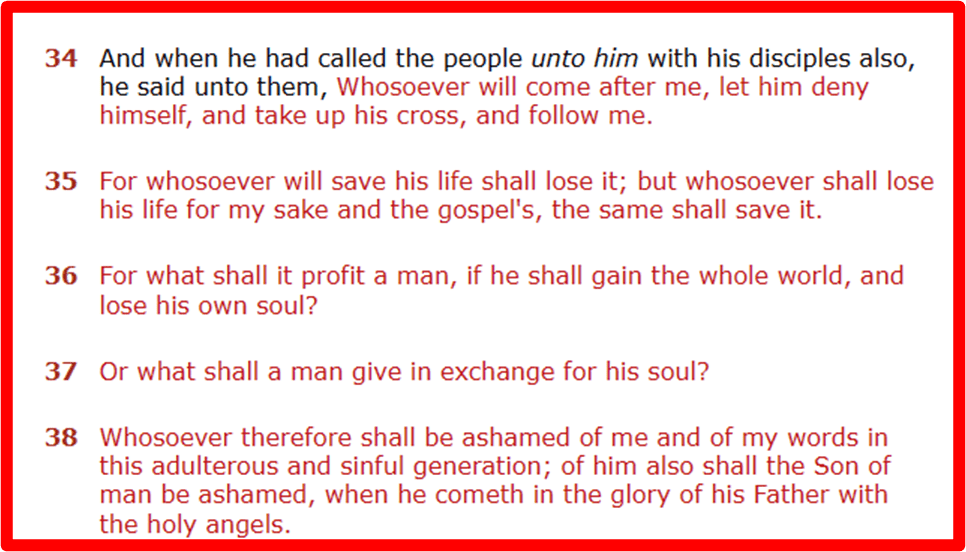
Christ makes it clear that even the disciples who think they KNOW Him do not lest they live amongst Him and His precepts, such as they know the weight of pertinence of that teaching in their very lives. In the Greek, the word translated as ‘soul’ also means ‘life’, and, as an atheist, I feel this passage helps me. But it also reminds me of how limited are Judaeo-Christian meanings, for though I swoon into Christ’s arms to understand the redemptive (in a non-religious senses) meaning of his life and death for me, I turn away in disgust when he uses, according to Mark, the threatening language of EXCLUSION to make me feel guilty (‘adulterous and sinful’, ‘ashamed’). Is there need to invoke shame in people who merely fail, for now at least, to understand? And, wait a minute, ‘take up your cross’ is too often read as an invitation to self-torture, using the symbol of the most brutal kind of such torture that kills by virtue of the body’s inability to endure its own unsupported weight alone, whereas it ought to be about commitment and engagement.

And, after all, to desire to shame someone and to project guilt upon them is not a wonderful motivation – even in practical terms, it only works with people long accustomed by being made to feel guilty and ashamed so that they have internalised it as ‘God-given’ or innate. It was so with the person I mentioned earlier who I loved and still love, now he is no longer alive. He once said: ‘I cannot know you anymore’ to me. What I should have understood is that he used words correctly. He meant I guess that he could not know me any more because, despite my magical thinking and wish-fulfillment dreams, he only ever KNEW me as an amalgam of things to be known, as an object. To understand me, he and I perhaps, would have had to live amongst each others demons with security rather than fear. For to understand demands so much containment of ‘the other’, even the bits you fear when they over-spill. I don’t feel ashamed of my failure but I understand NOW that it was a failure of mine and not just his. And all failure comes from putting up boundaries – being ashamed of the thing that promised to redeem you but could not, for the true redemption is in the effort to love in the first place. In this game we are all losers.
But I know the reasons why I love my husband have a lot to do with our living amongst each other’s truths of being and the mutual acceptance that each think of the other ontologically rather than just epistemologically. For it is in being together, not just knowing each other that good things happen.
With love to Geoff and you
Steven xxxxxxx

