Sean O’Hagan says in recounting an interview in The Observer with Jonathan Glazer that the film he directs, The Zone of Interest, is ‘… the embodiment of the Jewish writer Primo Levi’s insistence that it is ordinary people, rather than monsters, who are capable of committing atrocity. “Monsters exist,” wrote Levi, a Holocaust survivor, “but they are too few in number to be truly dangerous. More dangerous are the common men, the functionaries ready to believe and to act without asking questions”.[1] This is a blog on Jonathan Glazer’s film The Zone of Interest.

The Zone of Interest is not about monsters, nor is it about Nazi ideology exactly, for it is too easy to see Fascism only in turns of an abnormal psychology or even ideology, when we think of ideology at least as a set of articulatable beliefs by a ‘charismatic’ leader or group like those in Mein Kampf or the policies in government derived from him. Nor is it about the Germans as a people, just as much as collusion with genocide in Gaza is about Jews in Israel or Jews elsewhere in the world. First, not all of those people did, and do not now, collude and second, the likelihood is that most that did or do was really a function of what we call normative psychology operating normally, supported by the validating remarks of friends, in all human, though not other kinds of, animal.
Those people believe they accept that solutions have to be found and spend most of their time emphasising that the point is ‘getting them done’, whatever the ‘them’ is. The phrase is used to praise Rudolf Höss in the film, with or without the screenplay adaptation used by Glazer showing awareness of its use by Boris Johnson in the 2019 election where ‘getting Brexit done’ was the mantra of the ideologues of unitary national sovereignty on the populist political right. Hence, forget the dire red smoke from the Auschwitz crematorium’s chimneys in the poster shown above, contrasting with a red rose held by an innocent child. The issue is never a stark one between innocence and evil in this film, or even the politics of race.
Rather, the smoke of the furnaces is there as a background, though the smuts of charcoal it contains do sometimes drift and at one point are washed from Rudolf’s nose. The garden scenes often are backed by smoke – one stream of smoke is from a ‘Jewish transport’ train ominously spread on the skyline in a garden party scene, others from the more distant crematoria chimneys stacks. The smoke is not blood-red like the poster but is so delicate against the prevailing white and green with which Rudolf dresses his outer appearance and that of his sunny home, that it could pass for a dark cloud in the sky. The hungry social aspirations of the characters yearn outwards and upwards and yet become enclosed in the walls and gates of a house and a garden: a true hortus conclusus.
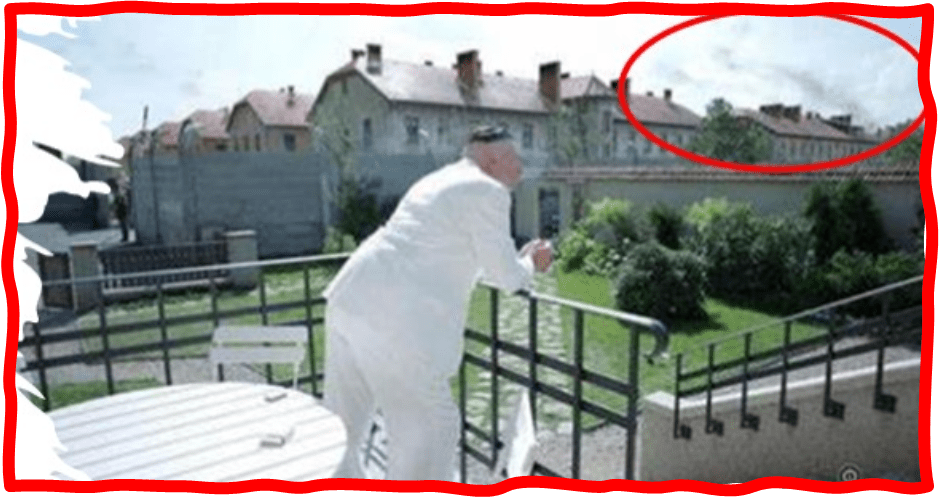
There are many levels of mythological reference in the film, including a labyrinth of tunnels under the house where Rudolf tests his Minotaur sexuality with a Jewish female prisoner, carefully washing his penis later before attending on Hedwig, his wife. Many are deeply complex in their nuance, including the allegorical association of the Greek nymph Eris (“Strife”) to Eve, who both sowed ‘discord’ (Eris’ Roman name is ‘Discordia’) with an ‘apple of discord’ from a Golden Garden. In this film an innocent well-intentioned child, Hedwig’s daughter, hides (or ‘sows’) apples for starving Jewish male work parties to find out later that these apples lead to Jewish boys being shot or drowned as they wrangle for the food they magically find (as far as they must believe).
Potent myths like these back up a kind of Gothic machinery that plays with the imagery of the uncanny, ambiguous insides and outsides (like the hortus conclusus I suppose), doors, windows, staircases, light and dark, and, of course, shadow. About racism however, it very definitely is. It defines racism as a thing that operates in the realm of what is permissible as ordinary or acceptable behaviour for ordinary people, who define themselves as apolitical and at the level of what are considered to be an ordinary range of likes and dislikes. Sometimes that innocence of involvement with the decisions that can be seen as entirely top-down is merely an appearance, but partly it is an appearance to the person themselves.
Such a phenomenon can so easily disguise from itself its deeper ideological roots, where ideology silently shapes normative thinking outside politics and demagoguery. Its worst behaviours are doing what it is told to do without challenge, if with some negotiation of self-interest. There are variations in collusion and the reasons prompting it. Rudolf is obsessed with getting jobs done as efficiently as possible, whatever the job. This motive seems to create the mask he uses to hide his complicity of motivation. Never really made to seem the ideal masculine hero of a soldier, he is happier at a desk or on the phone, whether it be about a more efficient furnace-building design, his career or the care of the lilacs in his garden that brute soldiers trample upon.
The most finessed illustration of a more self-conscious self-enactment is Hedwig Höss, a working-class woman who has achieved all she wanted in life and will not lose it again. Hedwig knows what happens in Auschwitz. She benefits from the goods taken from the murdered Jews and, since her husband is Camp Commandant gets first choice, like that mink coach she wears to show herself off, just before she adorns herself with make-up.
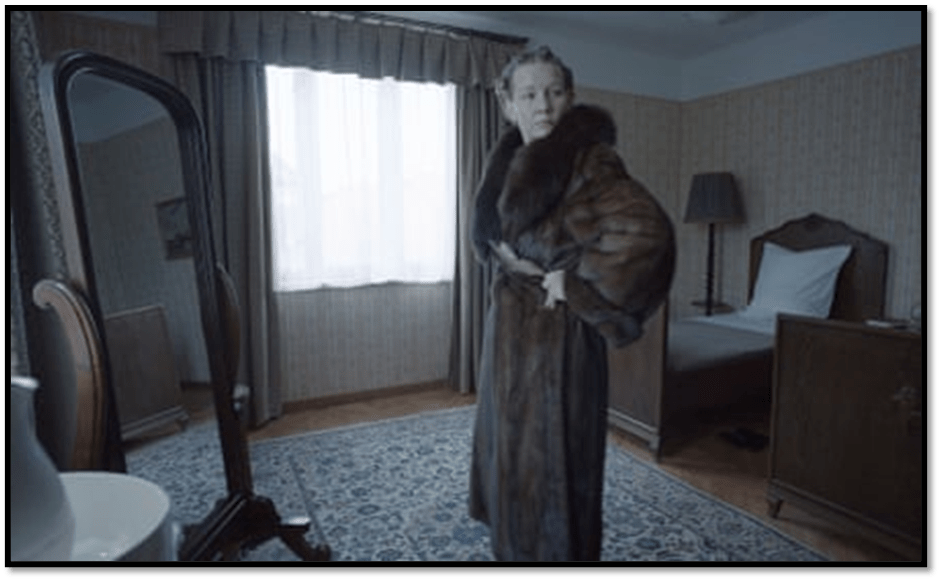
Sandra Hüller as Hedwig Höss in The Zone of Interest. Photograph: AP
There are many more myths, some deeply complex in their nuance, including the allegoric association of the Greek nymph Eris (“Strife”) to Eve, who both sowed ‘discord’ (Eris’ Roman name is ‘Discordia’) with an ‘apple of discord’ from a Golden Garden. In this film an innocent well-intentioned child, Hedwig’s daughter, hides (or ‘sows’) apples for starving Jewish male work parties to find only for these apples to later lead to Jewish boys being shot or drowned as they wrangle for the food they magically find (as far as they must believe).
The distribution of these apples occurs at night, the sequences film-shot using heat-illuminating camera in which the girl appears outlined in dark. At a party for Nazi officers, later in the film, dark and light pick out an illuminated swastika (an emblem of peace transformed to one of oppressive war) in ice-sculpture on a sumptuous table of food (one of many such tables in the film). Such elements lead to some of the finest Gothic cinematography I have ever seen.
Clarisse Loughrey in The Independent rightly describes the transformation of ideas of home and garden, the familiar to the unfamiliar in her review: ‘It’s a tidy home, rendered uncanny and hostile by Łukasz Żal’s cinematography’.[2] But this applies to may interiors – even Bauhaus style office blocks and their corridors, roads and paths through what might be nature, and Baroque theatres, and the part – half garden / half-home where we see the ice-sculpture (see below where we also see a thermal camera still).
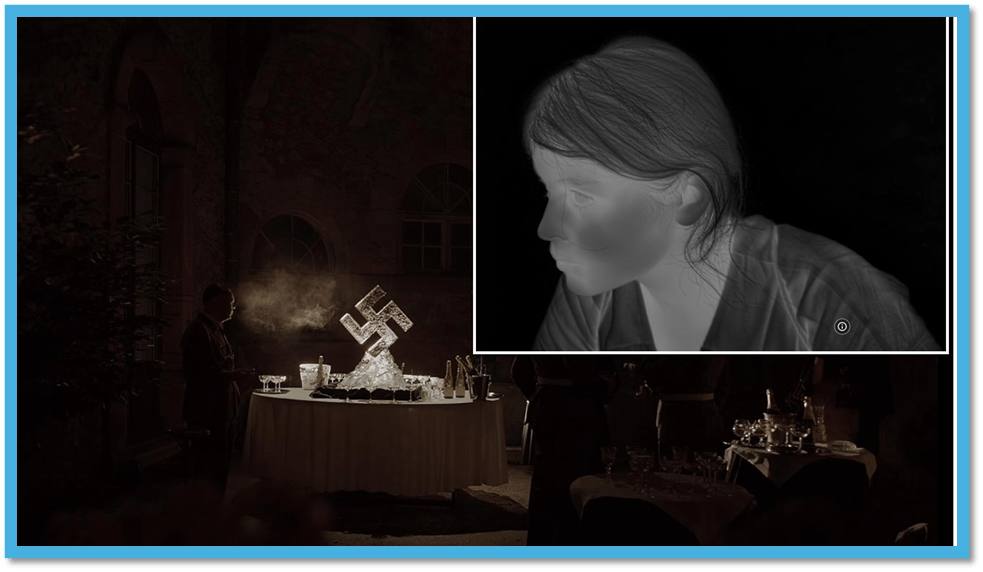
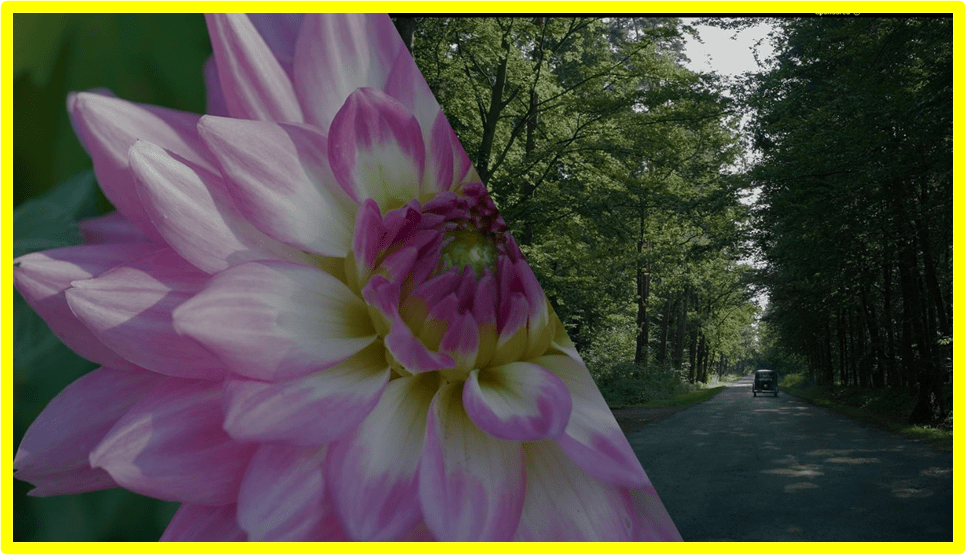
The cinematography of Łukasz Żal, of course, is exceptional as every critic confirms and not only in the moments like those in the above collage that evoke the uncanny: it is also so in the capture of the dulled ordinary in the interior and its dark shadows, that extent beyond the final dark staircase down to tunnelled cellars where Rudolph rapes young Jewish women. The intermittent, but less frequent as the film progresses, capture of both the everyday and the beautiful is truly sensational in the full sense of that word. A car proceeds down a road in a forest. The camera is held still so that only the car has movement it seems. What we sense is what is extremely everyday softened by the natural setting of the forested landscape, or perhaps though over-controlled manipulations of nature, as with the selection of flower shots to emphasise the natural, in the Höss garden.
As I try to recall my experience of the film in the cinema, I remember it starting in nature. But then memory jolts me, for this is not truly what happens. I get shaken by remnants of my original feelings so that I recall them as uneasily as I originally felt them, that it actually starts with a black blank screen held an almost unendurable duration into which noise intrudes – sometimes eerie but most often that of a nature associated with constancy of return of the spring with birdsong and insect noises. The eerie, the mechanical and the terrified noises of human terror and pain for unexplained because invisible causes, take over later in the brilliantly innovative score of what is almost an opera without human voices, a kind of continuous unsettling soundscape. However, sitting in front of a blacked out screen from the first, we actually have a version of that eeriness already as we sit perplexed by the auditory content of a world that is definitively outside us (something we are locked in from, kept in the dark from what light is out there), and, remote from a primary human context that is being denied us by the camera’s insistence on offering to us only what is impenetrably dark and more than obscure.
It is like the terror of the younger boy child shut into a conservatory by his older brother as the brother makes sounds like the hissing of deadly gas.Hence, I found that opening more frightening than the blood-red-stained blank screen we see later as our awareness of the unseen processes on the Auschwitz camp become more clearly understood if only abstractly. But both blanks work in the same way for their reality of purely auditory presence taunts our imagination with even more uncanny inner vision. The film’s soundtrack composer, Mica Levi, described this beautifully to Sean O’Hagan as an Orphean descent to the underworld:
“The music, like the dark screen, is a way of preparing you for what follows as you enter another reality,” Levi tells me. “It slowly descends in pitch as it takes you down into the story. All through the film, the music is taking you to a place below or beyond what you are seeing, almost a nowhere place beyond logical comprehension.”
The soundscape too of guards’ shouted orders, the grim machinery of death and screams plotted into Levi’s music by Johnnie Burn works to the same purpose as the music, creating a deliberate disorientation and splitting of the viewer and listener to the film, as I have tried to describe above. Glazer described it thus to Sean O’Hagan:
“There are in effect, two films. The one you see, and the one you hear, and the second is just as important as the first, arguably more so. We already know the imagery iof the camps from actual archive footage. There is no need to attempt to recreate it, but I felt that if we could hear it, we could somehow see it in our heads”.
Cited Sean O’Hagan (2023) ‘Interview: Jonathan Glazer on his holocaust film The Zone of Interest: ‘This is not about the past, it’s about now’ in The Observer (Sun 10 Dec 2023 09.00 GMT) Available at: https://www.theguardian.com/film/2023/dec/10/jonathan-glazer-the-zone-of-interest-auschwitz-under-the-skin-interview
The point is though, that what we see inwardly bears more of the terror than even the archive images once evoked. They are aided by those mythic elements such as the labyrinthine paths we see so often – interior and exterior, over and under the house. In the opening we yearn to see what is kept from us in that long dark passage of experience where the auditory is denied representation. Until, that is, we see the Höss family group at a picnic by a tranquil lake. It’s a family scene that is revealed that feels loving, ordered into hierarchic form by familiar norms that, maybe, aren’t yet seen to be the fearsome things these ordinary institutional arrangements of human behaviour can become, as they do for the Höss girl children, often found in this film transfixed by horror for reasons unknown to us by windows that look out to the camp beyond the garden walls at night. The boys seem less traumatised, at least the more powerful elder one.
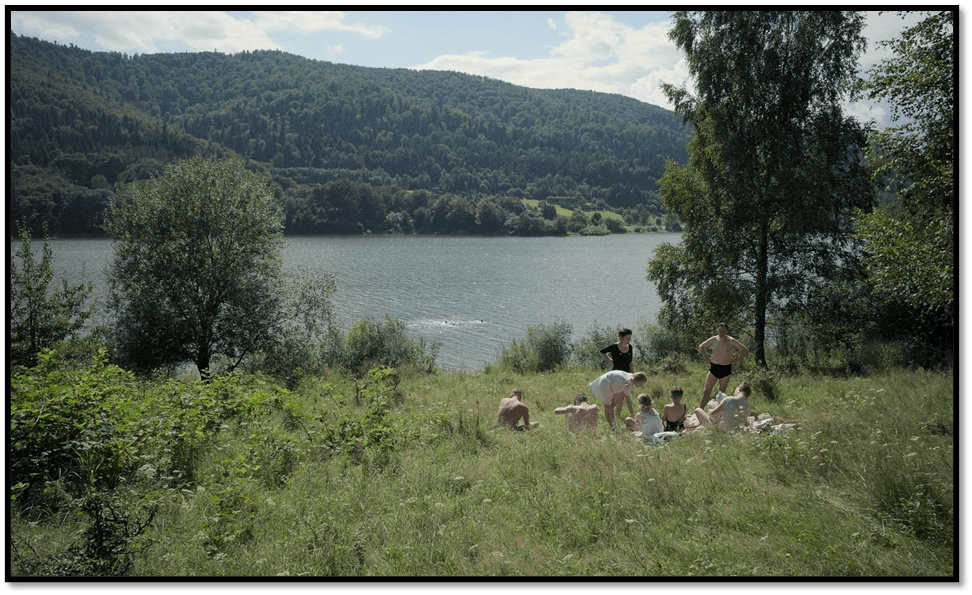
A Höss family picnic scene in ‘The Zone of Interest’. Photograph: A24 Films
These early scenes last a long time, but they aren’t entirely welcoming. The enclosure of the family scene is masterful even before real walls and barriers appear. That lakeside picnic seems a thing that our norms yearn to see as perfection. But they are held onto too long by the camera and too insistently as if the film is afraid they may be more temporally brief and superficial than they are.
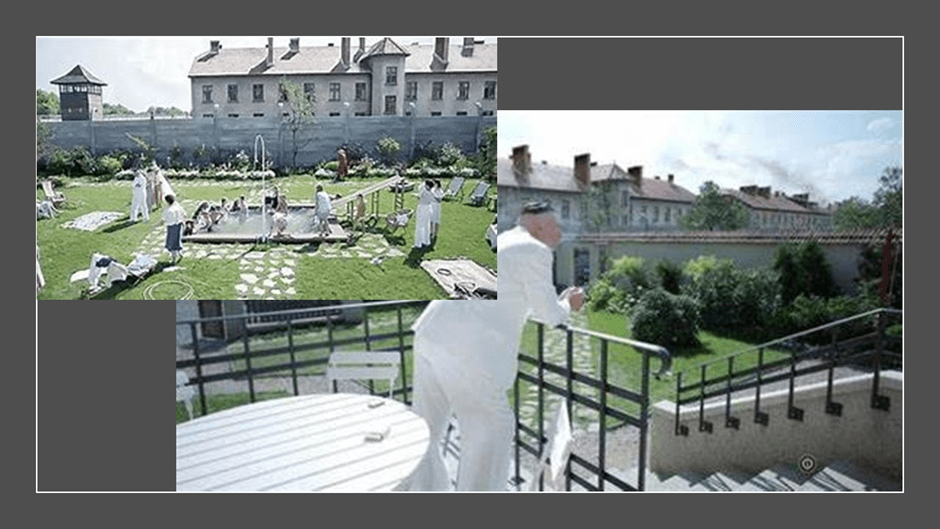
The scenes at the actual Höss home show the ‘zone of interest’. Sean O’Hagan points out that this is the ‘characteristically neutral term used by the Nazis to describe the immediate area around the concentration camp’ – the immediate perimeter area around the architecture of the concentration camps proper, where its senior staff lived. It perfectly describes the layering of interiors and exteriors of the home, defended and excluded from other realities by walls. rails and other gated barriers. It excludes them without denying their capacity to force their way in disguised forms as spectres and the hidden content of what sustains our self-interest. In the collage below, two things ought to be noticeable, at least, sometimes as smells, coloured lights at night, or the drift of smoke and debris of unspoken origin, that I have referred to above.
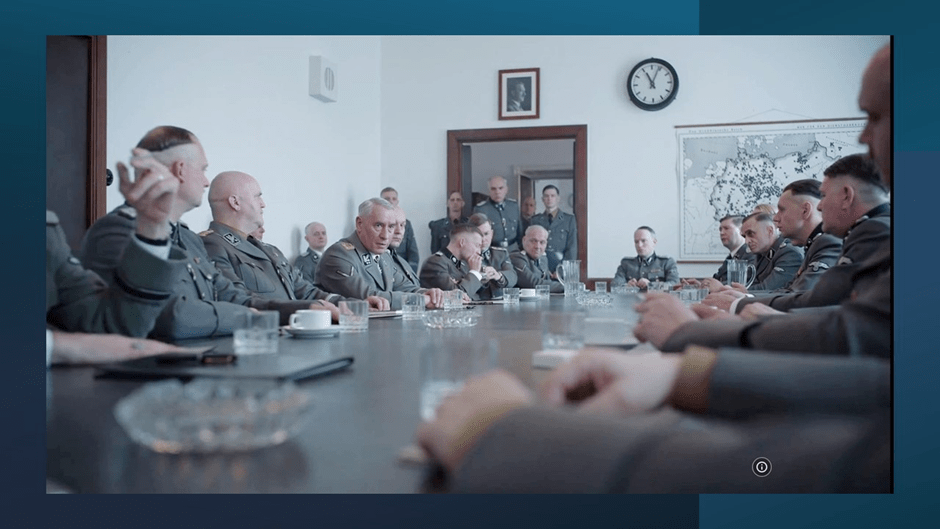
Interestingly enough Rudolf Höss, though somewhat creepy (in the modern sense), is not an object of fear, although to the Jews he is in daily contact with as servants, prisoners or Kapos there is about him the fearsome authority that Nazism won for itself. Yet even grouped together, the assembled camp commandants are a rather underwhelming group, talking mainly of productivity targets and even lauding each other for their statistics. Rudolf must have know he was well on the way to his real-life ‘achievement of , in Clarisse Loughrey’s words: ‘….the real-life commandant at the concentration camp in Nazi-occupied Poland where an estimated 1.1 million people – 960,000 of them Jewish – were murdered’. I think this vision of these men as rather nervous bureaucrats shifts the focus from ‘monsters’ to those ordinary functionaries Primo Levi describes as the force behind Nazi machinery. In the meeting shown below, the clock has a rather higher eminence on the wall than the picture of Hitler. In fact, the meeting discusses the logistics of the Hungarians having capitulated for quotas of their Jewish population to be transported for either extermination or labour depending on an assessment of their fitness to work. The map on the wall too speaks of these logistics of the Reich as it swung into deadly efficient running of that machinery.
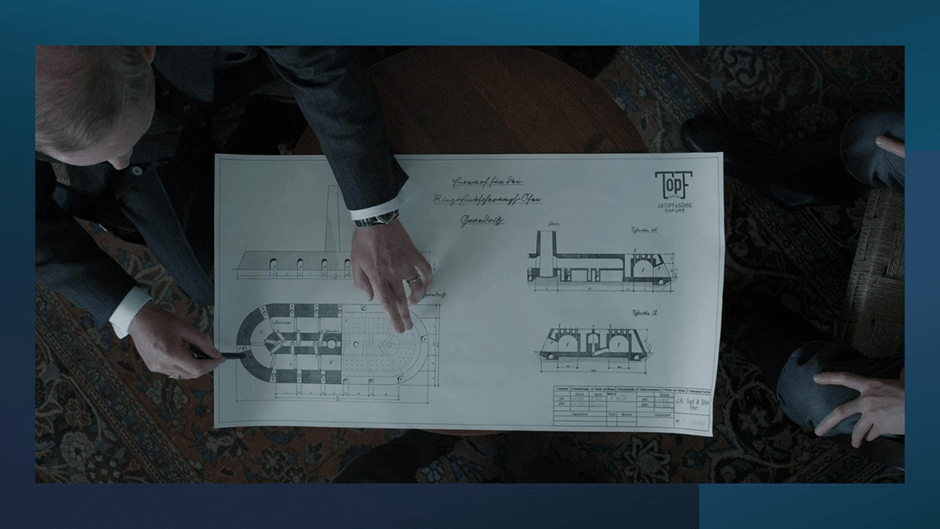
Perhaps the most chilling of these logistical scenes, of which that below is a shot taken from above, in which the manufacturer / inventor of a 24 hour device for burning bodies in one half, whilst the other half building and its deadly interior chamber cooled, introduces his architectural plans to Rudolf. It is again about the administration of processes inside structures that outwardly do not betray their horror; paperwork a very ordinary and rather paper-bound Rudolf hums too, as if it alone were all that mattered and which covered up the horror in preparation.
Those interiors ever expand. The collage below show various moments where Rudolf looks down on the assembled Nazi dignitaries relaxing after paperwork on the Final Solution and sees them through a fish-eye lens as if in a pit. He imagines, as he later excitedly tells his wife on the telephone in the middle of the night, how he could calculate the death of as many bodies as he can see below him in a spaces as Baroque-like and voluminous as this.
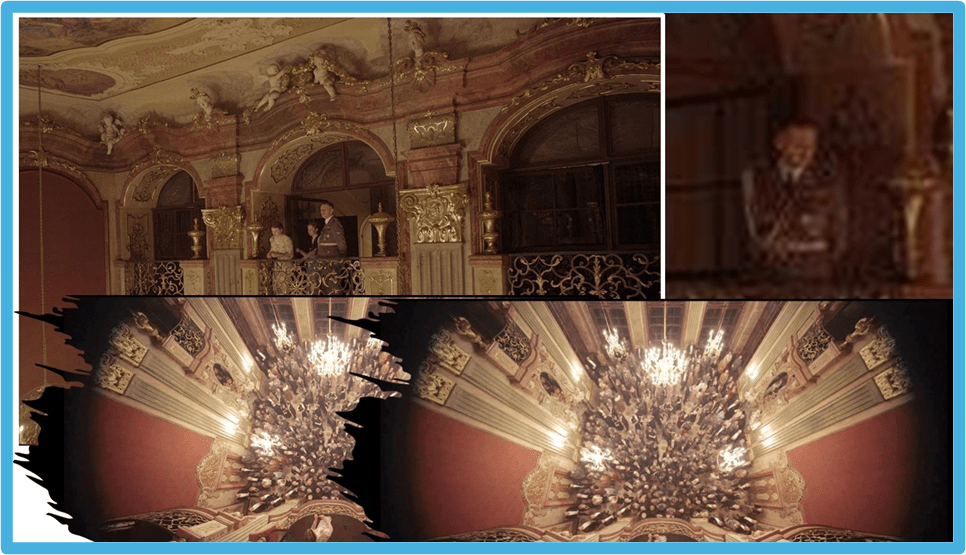
Hedwig tells him that it is late and she wants to go to sleep and he can explain to her on his return. It is chilling but not in the blood-soaked realities of the Holocaust but in the easily identifiable reduction of even such a project to challenging but exciting problem-solving exercises or mind-games⁷. As imaginary gas rises to the ceiling of this mock-Baroque external space, we sense just how Rudolf Höss is made so internally full of toxins that he will retch at every turn of a staircase downwards from his high-level, and high-building-storey meetings, with other bloodless heads of administration. Whether he knows that he is toxic with imagined gas is unknown.
Wendy Ide for The Observer sums up most of this in her analysis of the wondrousness of the acting skill of the actors, little known in Britain, playing the Hösses.
Unshowy but impeccable in the two main roles, both Friedel and Hüller excel. Friedel plays Rudolf as a pedantic, mid-level bureaucrat with a thin, needling voice and a despot’s haircut, whose unquestioning efficiency and commitment to the cause of National Socialism has facilitated his rapid ascent within the SS. And Hüller’s Hedy chortles over her good fortune as she cherrypicks the choicest possessions of murdered Jewish prisoners, parading her newly elevated status like a purloined mink coat. Nowhere is the understated brilliance of Hüller’s performance better demonstrated than in the delivery of a single line of dialogue, said to her housemaid: “I could have my husband spread your ashes across the fields of Babice.” It could be wielded like a deadly weapon, but Hüller says it conversationally, almost pleasantly. The impact all but knocks the breath from your body.
Wendy Ide (2024) ‘The Zone of Interest review – Jonathan Glazer’s unforgettable Auschwitz drama is a brutal masterpiece’ in The Observer (Sun 4 Feb 2024 08.00 GMT) Available in: https://www.theguardian.com/tv-and-radio/2024/feb/04/the-zone-of-interest-jonathan-glazer-brutal-auschwitz-drama-sandra-huller-christian-friedel-martin-amis
True enough of the acting as this is, it is important that Helwig never does realise she bears weapons of authority and control, for her her status in camp and garden, as party host, mother, spouse and domestic organiser is merely the fulfillment of a social dream of class eminence never before available to her. I think it is the film’s point that many of us bow to the same gods – a need for a perceived authority IN ourselves which we like to think of as from our true nature rather than acquisition.
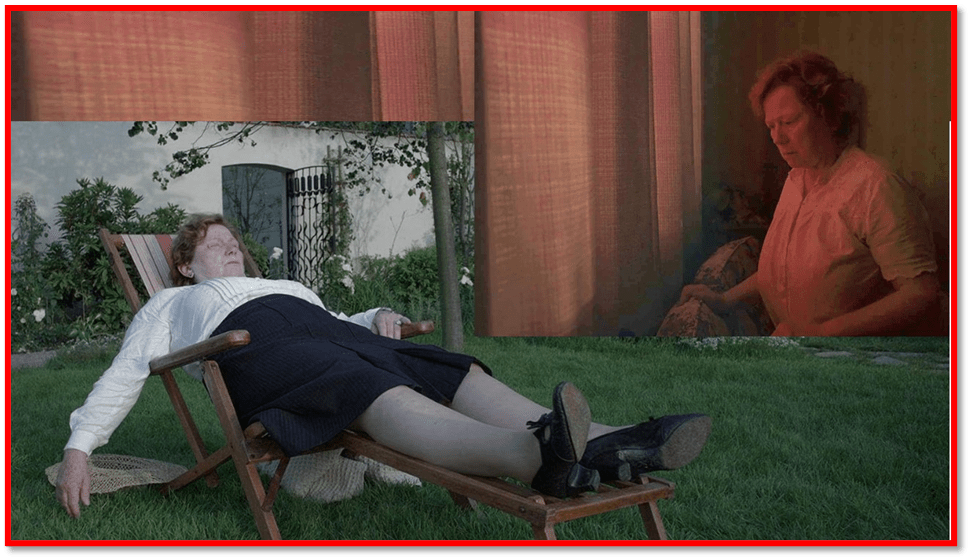
It is a transition that Imogen Kogge as Hedwig’s mother never makes. Whilst she wonders if the Jewish bourgeois lady she once held the role of house-cleaner for is in the camp and toys with the idea that the regime is right that when that met people she was up to ‘Jewish’ or ‘Bolshevik’ things and thus deserved her fate. But this woman – whose ignorance is so beautifully and empathetically played – has less defence from the reality of the nightly glow of flames through her bedroom window at her daughter’s home or from the soundscape of evil noises, which she can alone ONLY imagine. As she stays with Hedwig, her body collapses.
In one shot, we come upon her as if dead, and our emotions are complex. But she isn’t dead. She leaves the house secretly leaving a note, which, when Hedwig finds it, she reads to herself and shares with no-one, as neither does the filmmaker with his audience, and burns it in a kitchen furnace much like the furnaces in Auschwitz, we almost seem to remember but may just imagine. It is a fine study of failed repression on the mother’s part, repaired in herself by her daughter.
And it is a sign that the film probably is guided by Hannah Arendt view of the meaning of violence as well as that of Primo Levi. Clarissa Loughrey says:
…director Jonathan Glazer demonstrates Hannah Arendt’s “banality of evil” theory at work. First conceived during the 1960 trial of Adolf Eichmann, an SS officer and one of the primary architects of the Holocaust, the term views the enactment of such unspeakable crimes through a lens of “sheer thoughtlessness” – that men like Eichmann and Höss hid their evil beneath ordinary turns of phrase, mindless action, and quotidian bureaucracy.
Clarisse Loughrey (2024) ‘The Zone of Interest review: A hellish, daring spin on more traditional Holocaust movies’ in The Independent (Thursday 01 February 2024 16:00 GMT) Available in: https://www.independent.co.uk/arts-entertainment/films/reviews/zone-of-interest-review-jonathan-glazer-b2487901.html
Sean O’Hagan rightly extracts from Jonathan Glazer a statement that, though we may shudder at Hedwig and Rudolf’s behaviour, we as well (whether we acknowledge it or not) see the potential in it in many others and perhaps even, under powerful circumstantial social forces, ourselves, where our inner and outer lives become strange to each other. O’Hagan expresses it thus:
In the evenings, he reads bedtime stories to his children and, before he retires to bed himself, makes sure all the house lights are turned off and the doors locked. …“To acknowledge the couple as human beings,” says Glazer, shaking his head, “was a big part of the awfulness of this entire journey of the film, but I kept thinking that, if we could do so, we would maybe see ourselves in them. For me, this is not a film about the past. It’s trying to be about now, and about us and our similarity to the perpetrators, not our similarity to the victims.” / … I was really interested in making a film that went underneath that to the primordial bottom of it all, which I felt was the thing in us that drives it all, the capacity for violence that we all have.”
And note that locking of doors and turning off of lights, it is one of many Minoan-legend type labyrinthine and ill-lit corridors, staircase and portal scenes where dark and light mix (and sometimes Rudolf has to pick up a child torn apart by empathies for what or whom Rudolf can’t acknowledge . It is a deep journey within if you watch the film properly. And the way we know that the film attempts, I think it does it successfully, engaging us subjectively with the Höss family as our potential (but for accidents of time-and-space) mirrors.
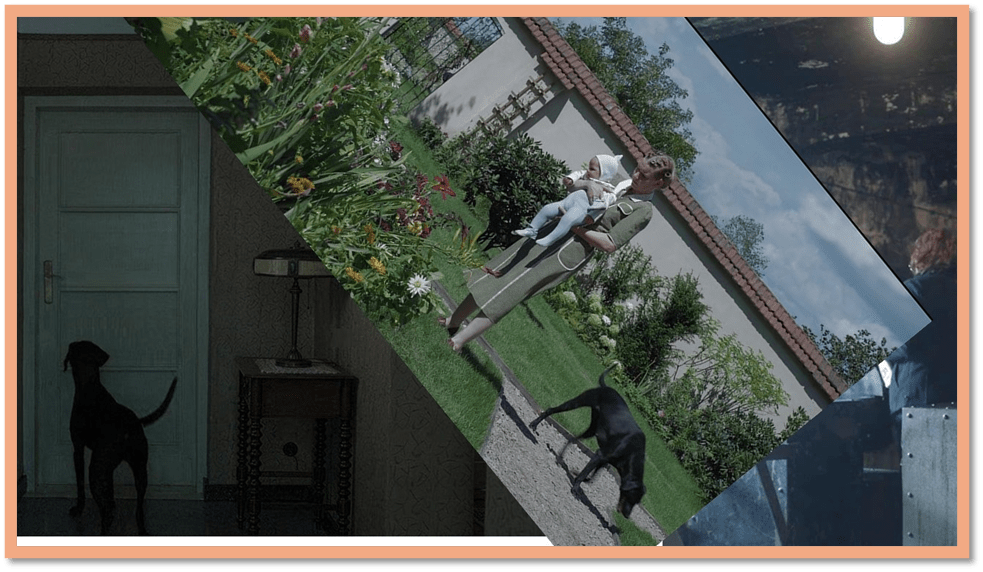
It also uses non-human animal behaviour is used as the foil for the human at the biological level as unthinking machinery is used at the technological level as a foil. In the collage below, there are examples of the ubiquitous dog of the Höss family. Whilst people, even in their own homes but also in other buildings follow all kinds of rituals at doors and portals in the film (Rudolf leaving his boots for instance for a Kapo to clean), she (clearly a bitch) jumps through a window when Rudolf leaves her within to go himself outside. Below, she waits outside the bedroom door that Hedwig has shut on her, as she tries on her mink, clawing and pawing it, clear that she wants control of the cusp between an exit and entrance.
She is there all the time, at one with the garden, as long as she has company. Rudolf clearly adores her as he does his children and his lilacs – and his horse, for his communication there is of the most tender kind, as with the dog of an old lady he sees at a park when parted from his own pooch. We are, whether we like it or not, invited into Rudolf – and less regularly into Helwig.
Now I have said I think Glazer does this very successfully. However, that is not the view of Peter Bradshaw in The Guardian. Where I see subtlety and nuance – ways in and barriers around these characters, he sees only examples of a joke:
A single, satanic joke burns through the celluloid in Jonathan Glazer’s technically brilliant, uneasy Holocaust movie, freely adapted by the director from the novel by Martin Amis, a film which for all its artistry is perhaps not entirely in control of its (intentional) bad taste. …
Peter Bradshaw (2023) ‘The Zone of Interest review – Jonathan Glazer adapts Martin Amis’s chilling Holocaust drama’ I The Guardian (Fri 19 May 2023 19.46 BST) available at: https://www.theguardian.com/film/2023/may/19/the-zone-of-interest-review-jonathan-glazer-adapts-martin-amiss-chilling-holocaust-drama
For him, its bad taste is to make the family’s ordinariness a constant reference to their refusal to acknowledge their own grim nature, which he thinks funny, and of which he clearly believes them fully conscious, and to do this without consulting what such people must mean to their victims and their surviving family. At the end, he thinks the ‘bad taste’ is at its worst,
not even trying ‘to accommodate Jewish testimony, though the final coda sequence in the modern-day Auschwitz museum may absolve the film of flippancy, but does oddly represent a kind of loss of nerve – as if the movie finally can’t bear to stay within the prison of historical irony and has to flashforward out of there to restate its humane credentials.
ibid.
In fact this was intentional for Glazer had already found disapproval from his own Jewish wider family for the project. Sean O’Hagan reports him thus:
The Holocaust, he says, was never openly talked about in his home, but “it was always present”. When his late father found out years ago that he was making a film about Rudolf Höss, the Nazi commandant of Auschwitz, his reaction was anger mixed with dismay. “He said: ‘I don’t know what you’re doing this for,’” recalls Glazer, “‘Why are you digging it up? Let it rot.’ …. I remember saying to him: ‘I really wish I could let it rot, but, no, Dad, it’s not in the past.’”
For Glazer’s father the Holocaust was unfaceable horror buried deep in memory, but I think the issue remained for Glazer himself that we can too easily ‘other’ the perpetrators of the Holocaust who are more like us than we like to think and which we build walls around us to bolster such views. Our complicity may have much more distance from the painful realities we refuse empathy for and action based on that empathy but but it can be complicity nevertheless – in a kind of attitude of ‘busyness’ and management of our inner selves. O’Hagan’s response is nearer to mine:
It is an unsettling film: a study in extreme cognitive dissonance. It stayed with me for weeks after I watched it, … it fulfilled Glazer’s aim “to make it a narrative that you, the viewer, complete, that you are involved in and ask questions of”.
For as Glazer went on to say about his research on the film:
“The more fragments of information we uncovered about Rudolf and Hedwig Höss in the Auschwitz archives, the more I realised that they were working-class people who were upwardly mobile. They aspired to become a bourgeois family in the way that many of us do today. That was what was so grotesque and striking about them – how familiar they were to us.”
And much, even about Hedwig, draws us in. Her parenting is over controlled and controlling but genuinely based on love. Her love and admiration for the cleaner that is her mother true, though her social aspiration almost also a compensation for her mother’s class status. Her love of her garden and flowers is a true one:
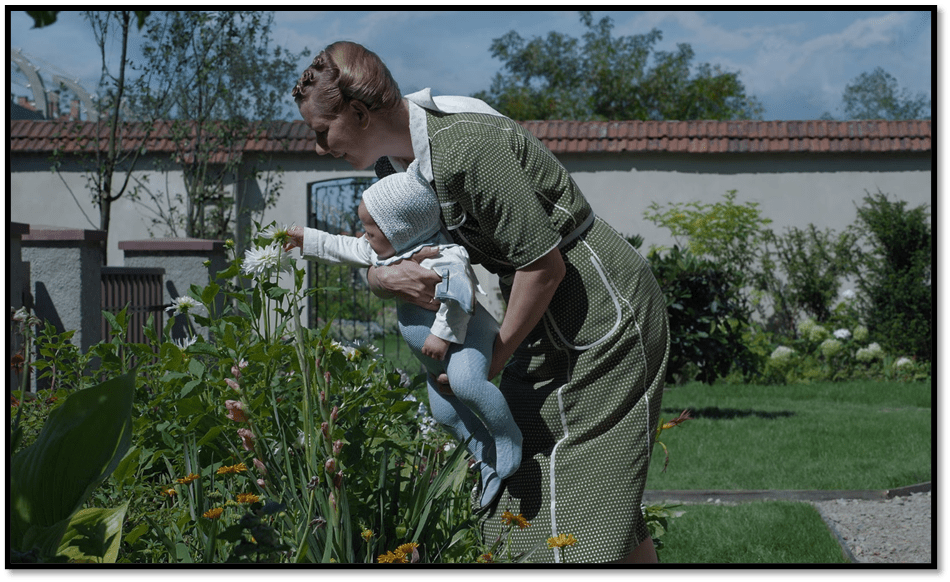
Sandra Hüller as Hedwig Höss: ‘I never planned to portray someone like her.’ Photograph: Courtesy of A24 / Mica Levi
Sandra Hüller, who plays Hedwig was shocked to “portray someone like Hedwig Höss.” O’Hagan points out that:
It took Hüller, whose background is in leftwing German theatre, a full year to commit to the film, but she is the most compelling presence in it: a ruthlessly narcissistic individual entirely untroubled by conscience and so lacking in empathy or self-awareness that she … boasts laughingly to her mother: “Rudi calls me the Queen of Auschwitz.” When she receives the news that he is to be transferred to oversee a death factory elsewhere, she becomes frantic with anger at the thought of leaving, shouting: “You can’t do this to me! We’re living as we dreamed we would.”
But ‘ruthless narcissism’ is a coarsely made judgement. Hedwig’s only chance was to absorb the Fuhrer’s code and play his game – sometimes to manipulate him as she asks Rudolf to do. Like Rudolf, she is ‘no monster’, just afraid of falling again into an insignificance she knows too well – akin to the insignificance and negative value she attributes to her Jewish servants and to the negation of thought that defends her from seeing the exterminations behind her garden-wall for what they are. Of her, my opening quotation (well, O’Hagan’s quotation, in fact), is also true:
“Monsters exist,” wrote Levi, a Holocaust survivor, “but they are too few in number to be truly dangerous. More dangerous are the common men, the functionaries ready to believe and to act without asking questions.”
And common women, the wives of functionaries too, we should add to Levi’s sentence, who had even less power.
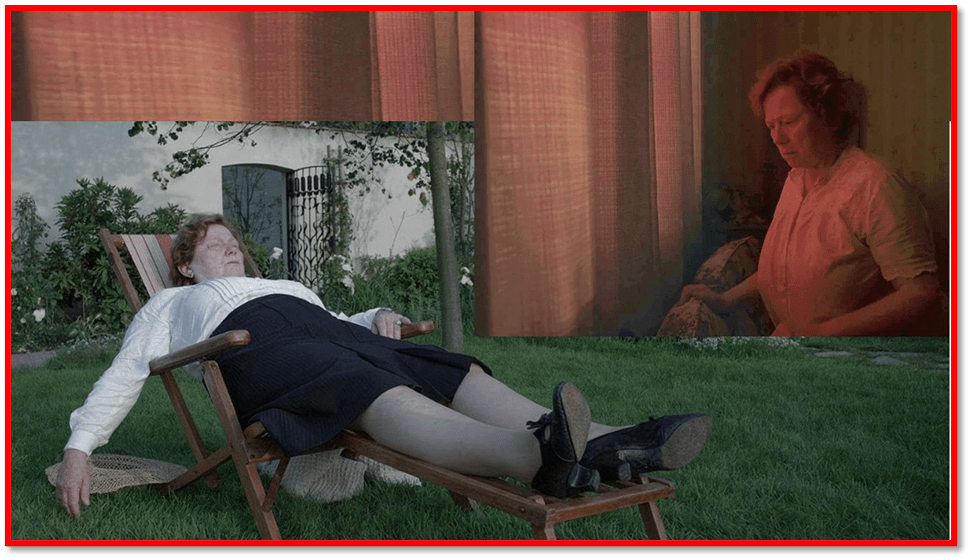
This character stays with me. I feel the exhaustion of her emotional energy and trauma – Steve
With love
Steven xxxx
[1] Sean O’Hagan (2023) ‘Interview: Jonathan Glazer on his holocaust film The Zone of Interest: ‘This is not about the past, it’s about now’ in The Observer (Sun 10 Dec 2023 09.00 GMT) Available at: https://www.theguardian.com/film/2023/dec/10/jonathan-glazer-the-zone-of-interest-auschwitz-under-the-skin-interview


4 thoughts on “Sean O’Hagan says that ‘The Zone of Interest’, is ‘… the embodiment of the Jewish writer Primo Levi’s insistence that it is ordinary people, rather than monsters, who are capable of committing atrocity. This is a blog on Jonathan Glazer’s film.”