Are you patriotic? What does being patriotic mean to you?
I have blogged before using this quotation, actually from a Canadian poet, but used on the outer wall, and as an epigram, of the Scottish Houses of Parliament at Holyrood, Edinburgh, as if they were the original words of Scottish author (poet, novelist and dramatist), graphic artist, ‘makar‘, socialist and ‘nationalist’, Alasdair Gray [read that blog at this link).
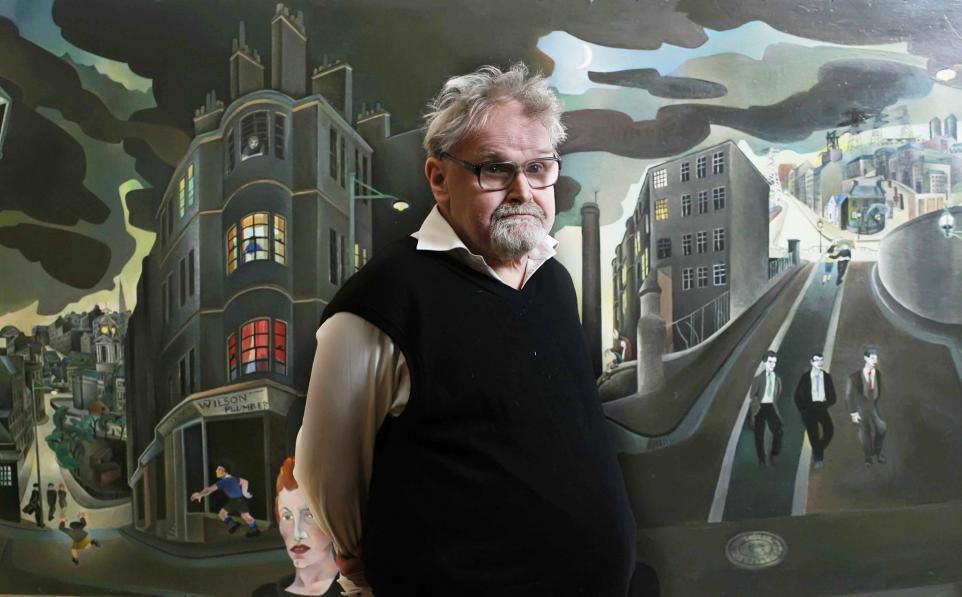
In the photograph above, he stands in front of one of his most famous paintings of Cowcadden, Glasgow, an area rarely honoured with national significance in the past and people by working class people and artists allied to them. The patriotism that Gray wanted to ‘work’ for is nearer to that I believe in, though with less easy relation to rationalism, for England is a submerged nation soaked in rancid fantasies of power over others rather care for its own supportive and inclusive self-governance.
Gray, in an essay he wrote that addressed his misquotation at Holyrood, says that there are some versions or assertions of even of Scottish patriotism that he stood firmly against. Here is a sample:
‘I hate hearing folk say “I’m Scots and proud of it”. All people should love their land where the government does not punish them for saying what they think, but the only people who think their nation can only be made worse, not better, are likely to be very rich.’
See full text of Alasdair Gray’s essay at: https://www.thenational.scot/politics/18137079.alasdair-gray-work-live-early-days-better-nation/
In brief, Gray believed that a nation can only be, however long and enduring its supposed history, an emergent concept. It is a concept that we commit ourselves to work at achieving enlarging its concordance with true freedom [and that means inclusive, access to such freedom], participatory political involvement from the basis of one’s own talents and the circumstances from which alone they flow, and shared enjoyment in the fruits of that work.
There is a nationalism and patriotism that is then the expression merely of satisfaction with the status quo and a selective and privileged versions of its past story and / or myths of origin, those that serve the interests of a ruling class. In nineteenth century England, the makers of the nation, which they deigned to call Great Britain, whilst meaning land under the hegemony of England, appealed to a thin kind of origin myth based on Arthurian legend.
This mythical concoction that was used by Edmund Spenser too to celebrate the nation under the glorious restoration and unification as Empire he saw in his historical Faerie Queene, Una, the symbol of the integrity of the monotheistic principle and the virtues of global hegemony, the ‘Empire’ proclaimed by the Tudors and based on myths too of Neoplatonism and selective histories of the Roman and/or Byzantine Empire.
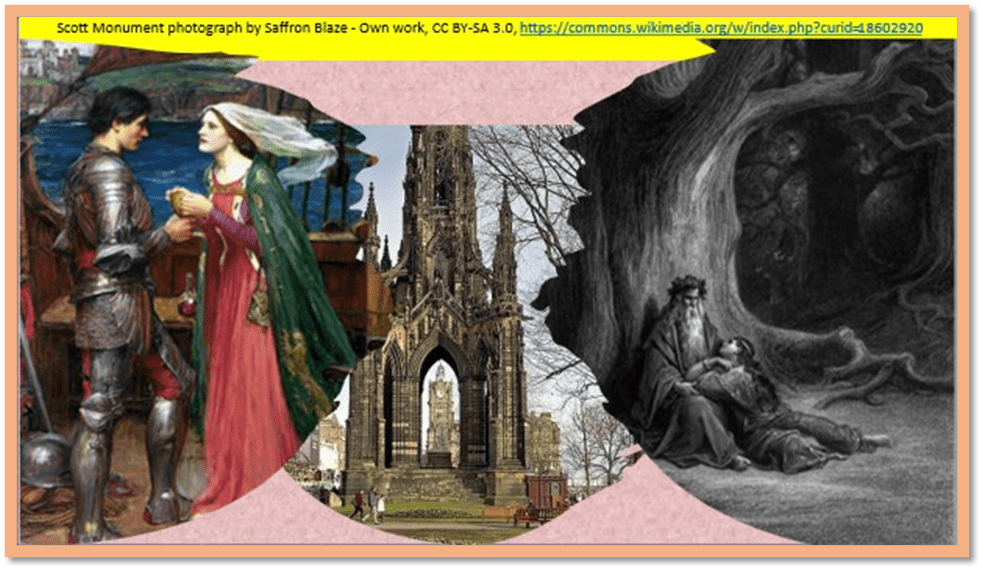
Alfred Tennyson as Poet Laureate, imaging himself the heir of Chaucer, Spenser and Milton (who planned but never wrote an Arthurian epic), made himself one with that selective ideology. It was an ideology reflected in other Victorian revived Arthurianisms, implicit in the artists who reconfigured the Neo-Gothic British Houses of Parliament in Westminster, replete with Athurian imagery, the English Pre-Raphaelites and George Meikle Kemp, in Scotland, labouring over the Scott monument fearing exposure as a common draughtsman, to that strange proponent of the Tory Union of British nations, Sir Walter Scott.
Tennyson was, I think, too much a poet to lend himself as fully to ideology as Spenser did, for whom poetry was an offshoot of power as he (and Spenser come to think of it according to Frances Yates on the Return of Astraea) thought Virgil was an offshoot of Imperial Augustan Rome. Hence, the Idylls of the King is a kind of lament for a lost ideal and praise of the energies of renewal yet to come, less idyll than epitaph of an old nationalism, its bright sword sinking into the Lake as Sir Bedivere dies (witness the Beardsley print below). Newness would come not from the depths of the past,the crusted old nation’s very masculine crown jewels but from below, from groundswell in democratic liberalism such as those predicted by his dead and beloved male friend, Arthur Henry Hallam.

Tennyson was a naive political but his theme of ‘ringing in the new’ in In Memoriam lies in the roots of the kind of patriotism favoured by Alasdair Gray, but for Scotland alone. This was, his article says, not exactly the nation supported by the Scottish Nationalist Party (SNP) and a compromise mirror image of the model provided by the British capitalist patriarchal state, but one that Scots infused with communal values were working together to build from bottom up, as in the Glasgow institutions he shared belief in with James Kelman and Tom Leonard.
This is my patriotism: a love of the traditions submerged like Excalibur under the master narratives of English nationalism currently parading as a defence of what is always presented as a beleaguered Brexit. Such traditions hug as yet the margins to which they are pushed, but they are never, as Arundhati Roy believes in relation to India, voiceless but rather actively but not effectively silenced by the loud voices of the thing that is paradoxically called in England, the Silent Majority. It is so silent that it deafens you; just as the noisy entitlement of while middle-class journalists with automatic access to the right-wing press silence the true voices of diversity by drowning them out with selective fallacious narratives they call ‘biology’.
Nationalism that invites in the other is the only true nationalism and hence cannot be built on slogans like ‘ Stop the Boats‘ or the re- affirmation of what Margaret Thatcher called ‘British Family values’. It is based on love, choice and openness not closed or over-regulated borders and boundaries. It refuses to see the safety of nations, as Israel currently does, in the elimination of any threat to it and refusal of negotiation outside narrowly defined binaries opposed to each other. It is about growth that grows downwards in hierarchical structures and inwards in overly objectified ideals like the honour of the ‘flag’.
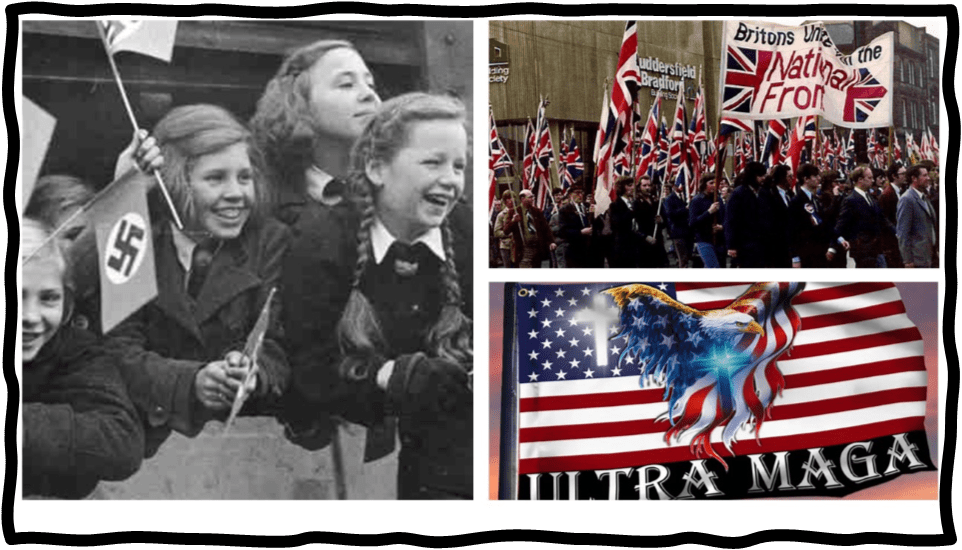
In truth, the intellectual organisation of the way we know and name the world is probably to blame for the difficulties I am pointing to. We like to think there can be no inside of a thing like the love of a country that has no outside, an alien set of nations and persons, that must continue to be excluded or hunted out if they have become the alien, or enemy, with which latter term Thatcher dubbed striking miners. Yet sometimes we have to remember the force of occluded and silent binaries in a concept.
Patriotism is one such concept, a rendering in the Latinate form of the love of the fatherland, the land of the pater, or paters. And fatherland longing has running through it, like Blackpool in Blackpool rock the exclusively heteronormative and the ideology of the binary, where the secondary binary force of the concept of motherland has been suppressed by force and power play. Before I go on I ought to note in fairness to Lancashire working-class traditions that Blackpool was a friendly queer homeland in the 1950s and 1960s to tell truth. But let’s return to the point. I am not saying that if NOT a patriot (in the terms I have defined) I do NOT think I want to be a Matriot either if such a concept were legitimised and validated; that would not be feminism or freedom of artificial barriers in sex/gender any more than supposed ‘radical’ feminists (or TERFs) are. We need a love of country that is not phobic to either diversity nor change and does not define itself by arbitrary borders or cusps of ‘debatable land’. And then if we had that, we might be proud of each other in our diversities, and not of power ‘we’ have OVER ‘them’.
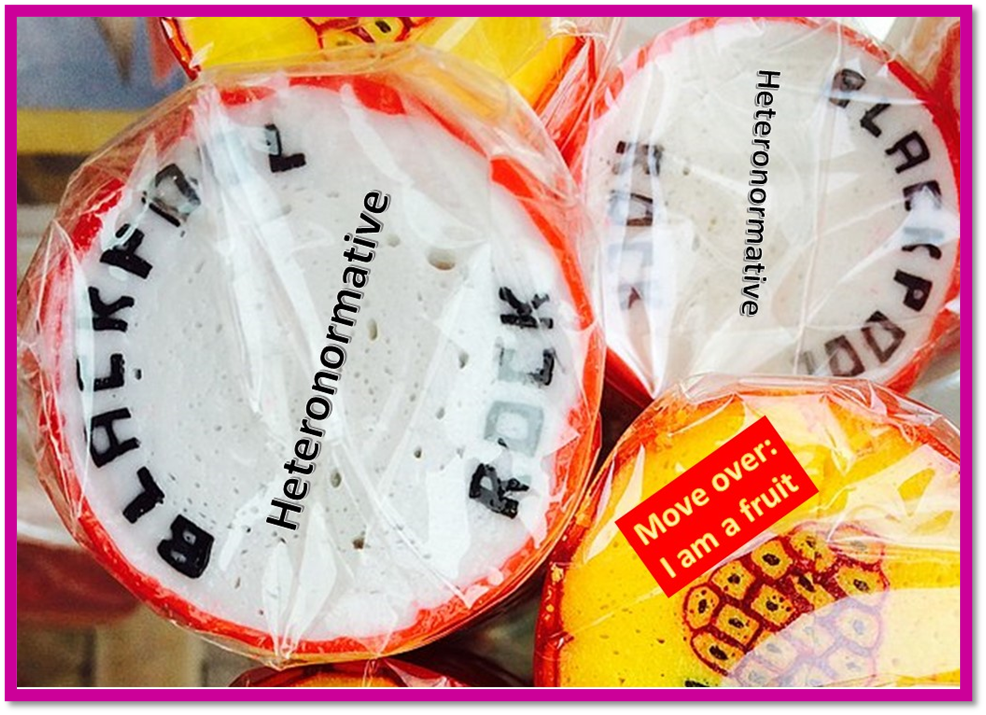
In this respect notions of transitional or scalar categories between polarised concepts properties do not form a greatly improved approach for they preserve the need to label, even if on a wider scale rather than between two absolute that form a binary. If there are poles, one can be dominant, and the other subordinate, all categories between them form a hierarchy. That’s why we should be suspicious of believing in even the notion of a comfortable interiority that requires a threatening exterior to it to form its identity. In non-binary thinking the inside is as much the thing as its outside and vice-versa, the subjective and objective only known when they help develop the other rather the define the other.
So, am I patriotic, matriotic, or somewhere in between? Am I proud of my country or in dismay at it? Both, for the pride comes from the belief that things must and will change sometime or be doomed. Either way I expect my own personal extinction to predate that. What survives us is the spirit of cooperation that has hitherto has only been emergent, squashed or silenced in a war between the two warring sides of the binaries, self and other, white and black, male and female and so on. No! A plague on both your houses! Let’s not love another as if we were each a similar and equal but separate self (though that might be a good start) but at last understand that we have no self if our self-concept does not imply, include too and bring to fruition otherness and that previously excluded or marginalised; all at the same time. My dismay at what my country is now is the only source of hope for it.
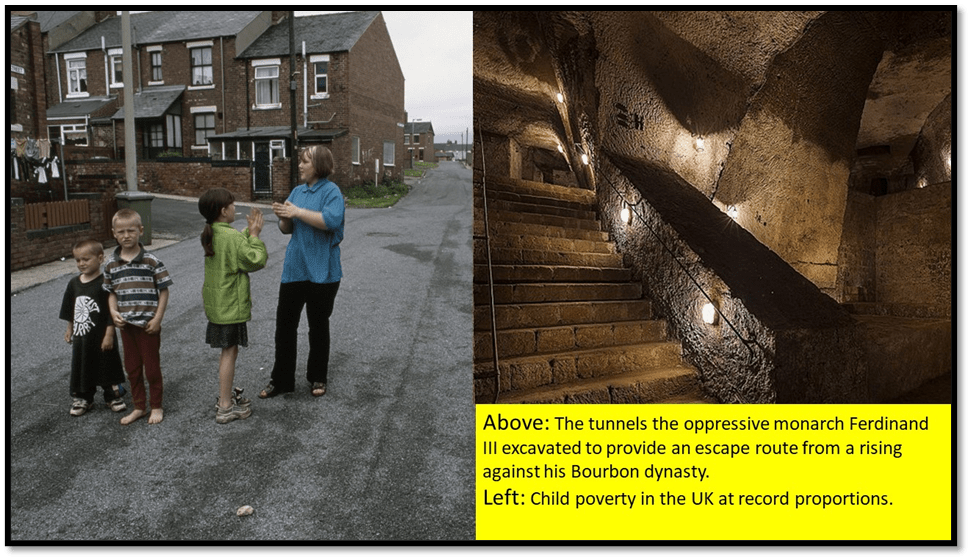
I want to say with Alasdair that: “All people should love their land where the government does not punish them for saying what they think, but the only people who think their nation can only be made worse, not better, are likely to be very rich“, or, we could add, otherwise entitled and involved in the maintenance of a status quo that is nothing short of evil incarnated, or as William Ewart Gladstone, Liberal PM in the nineteenth century, described the Hapsburg ‘Country of the Two Sicilies’ ruled front Naples, ‘the negation of God erected as a system of Government ‘.
Goodbye for now, with love.
Steven xxxxx
 Steve_Bamlett_blog
One thought on “‘Work as if you live in the early days of a better nation’”