Examining coolly and dispassionately a narrative that Fiona Campbell of BBC Three said was without ‘malice’, and was in fact in her view an example of the mainly Black comedians on the show Famalam ‘poking fun at all stereotypes’, Obioma Ugoala says, with all kinds of evidence and witness to back him up, that myths of Black potency and size are “used as a tool to dehumanise and justify the subjugation of Black people globally” and are inappropriate even used by Black comedians.[1] This blog looks at a popular version of an old trope of racist cultures in Obioma Ugoala (2022) The Problem With My Normal Penis: Myths of Race, Sex and Masculinity London, Scribner.
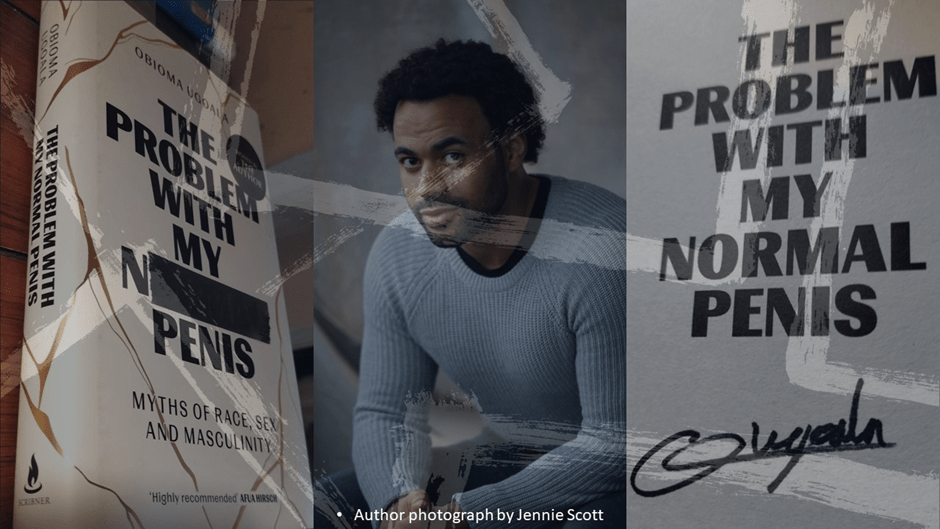
Usually men who identify largely as ‘straight’ but with full knowledge of the category errors often involved in these claims, as Obioma does so carefully in this book, still do not deal with all the issues about versions of masculinity as sensitively and comprehensively as he does. It makes me look forward to his new book this summer, The Making of a Man. His chapter ‘The Un-Blackness of Queerness’ was a tonic in unpacking the issues at the intersection of being Black and Being Queer, and though I sometimes run shy of open professions of Christianity, the treatment of religion seems functionally and beautifully appropriate as part of the discussion in the whole book.
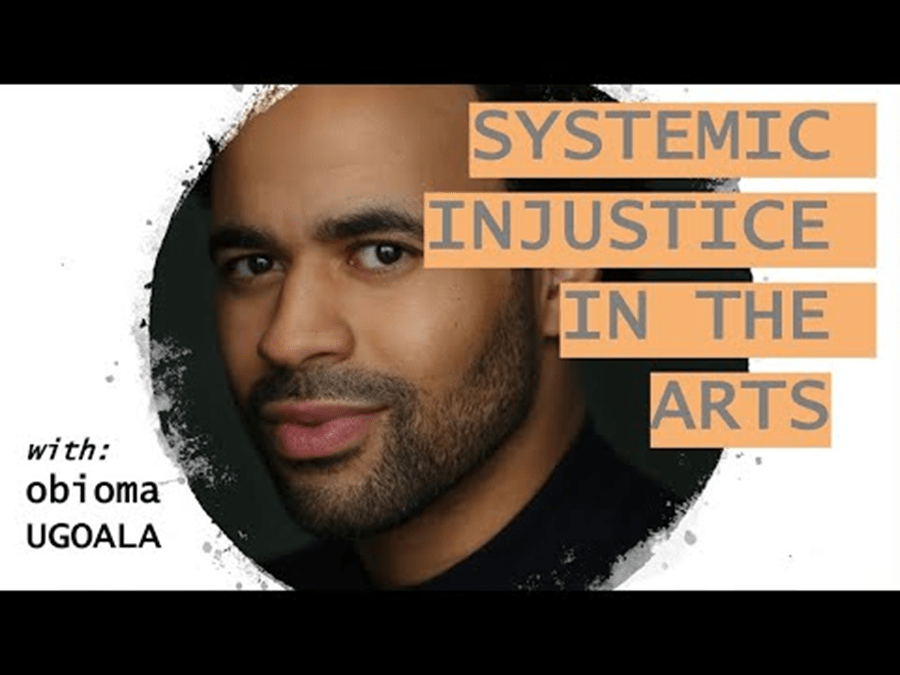
Obioma Ugoala is an actor, experienced at the Royal Shakespeare Company and elsewhere who was born of a rather wonderful, from the stories he tells of them both and his family life, Black Nigerian father and white Irish mother in the UK. There are many very shocking examples of racism that he gives in this book, some that place his awareness of his own heritages in the context of the history of his growing up. The most shocking, of course, are the murders of Stephen Lawrence and the effect of that murder and subsequent police cover-up on Obioma’s parents (who were bringing up three boys under a police force described now officially, if to no effect of change, as ‘institutionally racist’), Damilola Taylor (murdered when he was the very same age as Obioma), and Anthony Walker.[2] And even without violence occurring, the relatively greater likelihood of Black boys being in detention even in Obioma’s relatively entitled school, already reflected the discrepancies of Black male adults subject to the criminal justice system.[3] In the light of such events, as a reader, one might pause over whether the concentration in this book on myths of universal Black male potency and excessive penis size merit the concentration given to them.
Clearly some people did think that about him regarding many areas of discrimination and oppression he spoke of to them (and of course those oft unremembered micro-oppressions that the writer experienced). We hear of ‘friends’ who were actors who tell him to ‘stop whining’ and think of oppressions suffered by white actors, not favoured, as is obviously implied Obioma is, with youth and looks. Yet those oppressions are substantial enough and relate to the way Obioma had to fight lowered expectations of Black boys in school careers advise or the continual switching of social codes that he had to master to ‘pass’ as acceptable in situations in which white boys had no equivalent challenge. Such code switches were sometimes necessary too in contexts where he had to defend himself as having colluded with white people by Black peers. But Obi (let’s call him that henceforth) never in this books claims hardship or victim status in this book or ‘to have ‘had it hard’, as a white actor tells him in calling him a ‘middle-class toff’, and more which I will quote soon.
But the structured oppressions, hardships and disadvantage that a few Black people escape because their identities like everyone else, are intersected with other structured power differentials like class and socially pre-scripted value judgements of status, the worst of those hardships that threaten life itself are a necessary background to the case Obi makes. For that is about ow he confronted myths of race relating to sex/gender and sexuality, sometimes by carefully managing code-switches between group contexts. For the white actor I cited from the book in the last paragraph goes on to say that Obi was not only a ‘middle-class toff’ but one who ‘loves playing off the size of his prick to shag white girls’.[4]
This supposedly off-the-cuff remark relates to the two key myths relating to Black men that the book discusses and forefronts. These are, first, the myth of Black male sexual prowess, most often shown in beliefs about penile endowment (the Big Black ‘nigger’ – this is an offensive word but needed here because it is quoting the white women involved in the account in the book – dick) and second, the predilection Black men are supposed to have for sex with White women in particular.[5] These myths have been explored before if not as fully. Every white person will have confronted the myth, at least in hearsay, in white groups but they were raised in the earliest study of such matters by Frantz Fanon in 1952 in his Black Skin, White Masks.
The existence of these issues were reinforced for me by a pioneering set of essays complied by Derek Owusu, where Fanon’s thoughts are applied to the experiences of the Black men writing in it about how such ideas link to other oppressions such as the ability to sustain a job without sexual harassment or inappropriate sexualisation, even by white female employers or managers with some power and control over their employment. Personal cases raised by Courttia Newland and J. J. Bola.[6] Obi though gives very strong evidence of the role of these myths in newspaper and official coverage of riotous violent attacks on Black foreign service men in the First World War. One local Liverpool report supposedly defended ‘the negroes’ who were servicemen as being only ‘big children’ who, for that reason, brought white violence upon themselves by naivety, for they ‘would not have been touched but for their relations to white women’.[7] The same, if in rather more sophisticated and refined version is found too in The Times in 1919.
For Obioma, one example of the kind of micro-oppression experienced by Black boys in school that related to conceptions of penis size related to showering after games. Whilst he and a Jamaican heritage friend, Mark, showered more speedily than others after games, they heard one white classmate say about them in response to a white boy about to enter the shower too: ”Nah, don’t go in there with Mark and Obi … they’ll knock you out with those things”, causing eruptions of ‘fits of laughter’ across the whole room. Now, none of those boys, or any man (to this day Obi says) had ever seen his erect penis – or, he believes, Mark’s male friends either. Yet this example of submerged and ‘jokey’ micro-aggression found reflection in similar comments throughout the school that did not always have the appearance of jokes. The story may feel innocent (and perhaps even about the general anxiety of men on the subject of myths of penis size) but it instituted and confirmed a divide between white and black that had deeper psychosocial and social consequence.
The myth after all is one of others that dehumanise the Black man and make him monstrous – even in the joke there is reference to the supposed (and again mythical) threat of ‘primitive’ violence, bodily damage or rape posed to white people of Black male masculinity. And, as always, those myths based on competitive fear are often linked to a shadow side of desire for that other, even in its ‘wild’ violence. Having formed an open relationship with an older white woman Leah, Obi learns from her of her ‘fantasy of a big Black guy taking me in the middle of the night’, a fantasy she elaborates of him ‘having his way’ with her.[8] Likewise he is ‘dumped’ by his ‘first serious girlfriend, ’a younger white woman, who admits she just wanted try sex with a Black guy for the first time before going to university, as something experimental: “we’ve had fun. It was either date a girl or a Black guy”, presumably to discover if expectations of absence or supposed ‘excess’ of penis made a difference.[9]
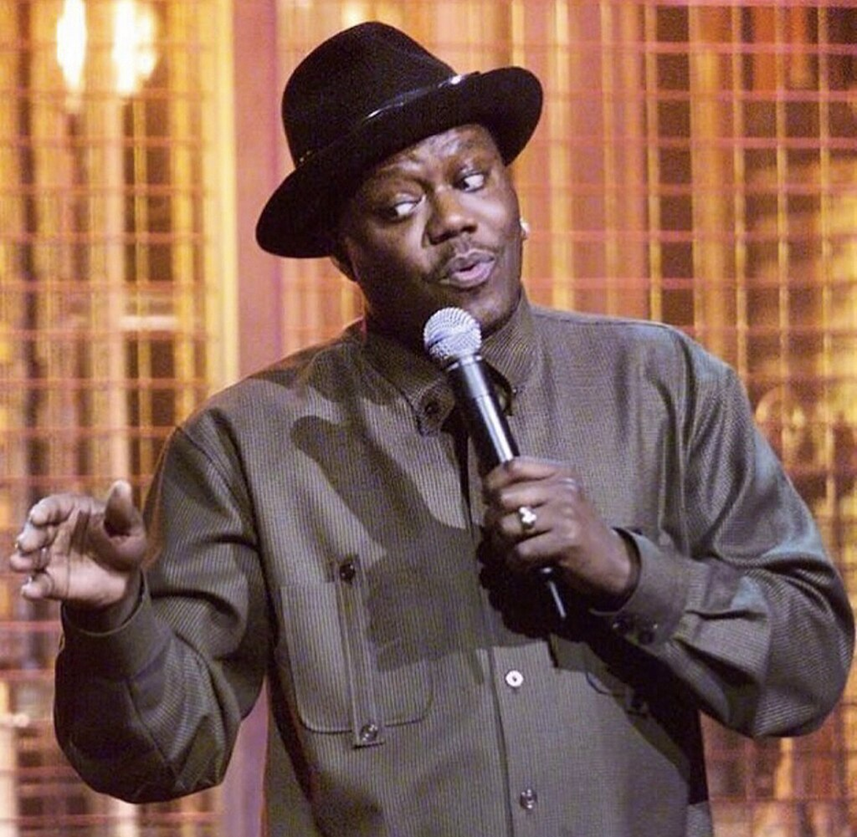
Mac at the Fox Billboard Bash in December 2001 By Frank Micelotta – https://news.amomama.com/147276-bernie-mac-had-a-very-successful-career.html, CC BY 4.0, https://commons.wikimedia.org/w/index.php?curid=140745260
Now the issue has, of course, more than reflexive important for self-making for Black men too. Obi speaks of hearing the gag-lines of the Black comedian, Bernie Mac: “And I’m blessed. I’m big bone-ded. I’m heavy structured. I’m hung low. If I pull my shit out the whole room gets dark”.[10] Now this phenomenon is half tongue-in-cheek of course, it uses the braggadocio to counter the stereotype itself and make it conscious to audiences whether Black or white. In some cases it uses the myth to accept the superiority in masculine equipment and attitude half-feared (or queerly – in a repressed manner – desired) by white people when they repeat the myth for whatever reason.
It is that kind of humour I refer to in my title quote, used by Black comedians to forefront the issue. In that case Famalam were treated to a Jamaican spoof on the quiz show Countdown, in which the movement of a clock’s hands were played off against the image of a male behind the clock and the mimic that interaction caused of a huge erection: “When you hear the Countdown conundrum, its letters, numbers, hell of a cock, boom.”[11]
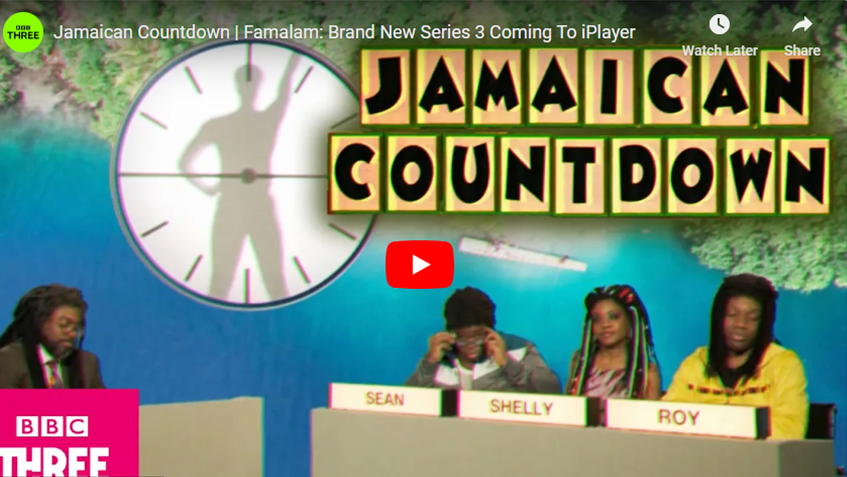
From : https://www.comedy.co.uk/tv/famalam/videos/20772/jamaican-countdown/
BBC 3 were probably correct that the comedians saw this as political satire based on social stereotypes, meant to expose it rather than honour it, the truth, as Obi says is never so straightforward. That all oppressive myths can be made to look ridiculous is certainly true, although this looks a thinner argument when used by white presenters and comedians using it to justify, as Danny Baker did, a ‘comic’ tweet showing Prince Harry Windsor leaving the hospital with Meghan Markle and their new baby, shown as a chimpanzee. Baker’s ‘lampoon privilege’ is a nearly identical argument but can’t excuse, as Obi says, Baker from not taking account of the history of dehumanising Black people as ‘apes’.[12]
And moreover, as Obi points out, such versions of Blackness feed into stereotypes in which young Black men, denied access to privileges otherwise, take on stereotypes of Black male toughness, hardness and sexual conquistadores as a means to some compensatory power and security from attack, an alternative to powerlessness that feeds off irrational White fears. Obi speaks of this, using Judith Butler’s concepts silently, in speaking of his friend, James feeling that ‘a performative version of Black masculinity kept him safe’.[13] And he to, as part of his code-switching has to learn this view of Black masculinity if he is to escape the perception of being a ‘choc-ice’ or ‘Bounty’ to Black peers – “Black on the outside and white on the inside, like the chocolate bar’.[14]

In effect this led to lies not to look ‘uncool’ , particularly in relation to status as aggressively sexually experienced with girls and tough under male pressure. The male pressure would see the choc-ice not just as collusive with white cultural oppression but as ‘soft’ inside – a PUSSYHOLE (for to be a vagina is one stop before being a ‘faggot’ or ‘gay’.[15] These lads. Including his brothers for some part of their development, had shown him that addiction to Garage music and homophobic lyrics in Coolio was a sign of Black masculinity so different to Obi’s preference for ‘that gay piano shit’.
…, young Black men weren’t allowed to listen to the wrong kinds of music. Nor be gay. For us, boys like him and me, our role was simple: get money and draw gash.
He knew the phrase ‘draw gash’ before he knew this term ‘derived its meaning from the female genitalia’.[16] And this is where the link for Obi comes in bout myths of race, sex and masculinity, for the identification of the weak link in Black groups could easily segue over into the identification of the penis-driven hard male. For Obi, though he identifies as heterosexual (but not therefore in its toughest version shown above), the potential to other subject positions in terms of his sexuality seems to be a condition of past and present circumstances, though hardened now into the habitual nature of being primarily straight. He has learned that there is much of assumption in having ‘always known’ he was thus, and discusses that beautifully and sensitively in the opening of his chapter ‘The Un-Blackness of Queerness’.[17] He had to reassure his family that he was ‘just playing a part’, when he had to kiss the actor playing Cole porter in his role as Hutch in High Society’s Favourite Gigolo, as well as kissing many women about which the question wasn’t asked.
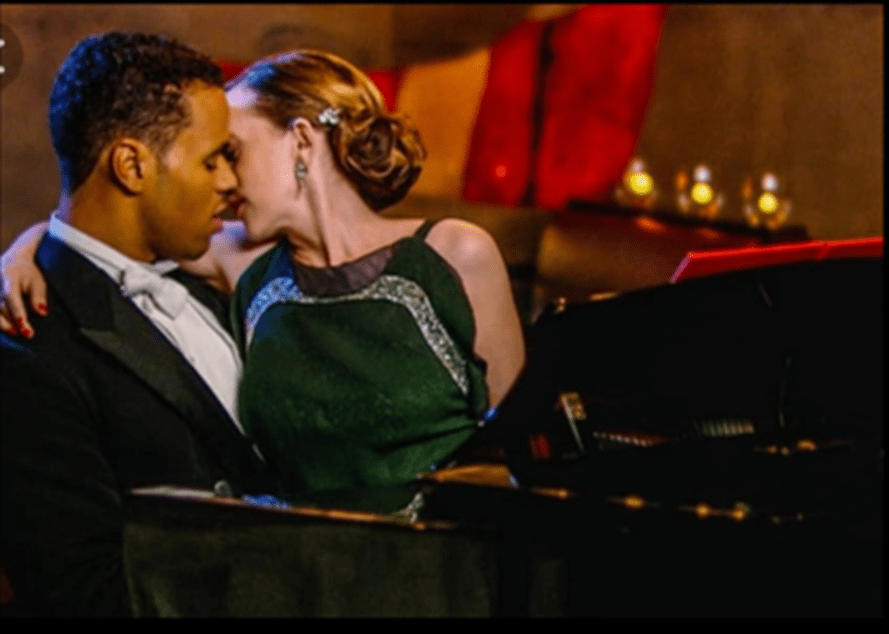
In this role however he ‘represented Blackness’ to white society, being ‘Black enough. Exotic enough’.[18] What he failed to see in the mixed emotions involved in this role, and knowing that even Hutch had to play this role rather than, as it were, be it, was that young Blak queer men faced oppressions often doubled those of straight Black men, or those prepared to enact only that role. The story of his failure to see the offensiveness of the homophobic lyrics to his friend, Duane, of a song about ‘burning gay people or “chi-chi men” to death in their cars’, just because he didn’t ’even know’ Duane was gay is confessional in the best sense, in a way that changes behaviour and effective insight.[19] Likewise his story of friend Anthony and other queer boys requiring a ‘safe space’ at school provided by the music department’s flamboyant personal style of teaching or the reason why Anthony identified as ‘bisexual’ rather than gay because he felt it would give him an easier time with Black male friends (it didn’t).[20]
The most moving story is that of Jimmy and the almost-closeness that was broken by the socialised drive in both boys to dramatise to each other their sexual success with girls. It is beautifully done. Obi is not saying this would ever have been a homo-romantic or homoerotic encounter but that it COULD never have been because of the mechanisms that expel fascination in boys with other male bodies so that they only against the pricks as it were transform admiration into love.[21] He is here as elsewhere examining the effect of ideological binaries not unlike those of Black and white and their link to toxic confabulations of distasteful character and story in the powerless pole of the binary.
Hence Obi’s turn to see other effects of intersection – the great oppressions faced by Black women for instance and the words of Audre Lorde that have inspired many of us. There is ‘No Hierarchy of Oppressions’, she argued because:
Any attack against Black people is a gay and lesbian issue, because I and thousands of other Black women are part of the lesbian community. Any attack on lesbians and gays is a Black issue, because thousands of lesbians and gay men are Black.
Nowadays we absolutely need the same view of trans issues. And such perspectives live on in the BLACK LIVES MATTER Movement (that means ‘Women, LGBTQ+, Disabled, EVERYONE’, as Onyinyechi said for the movement.[22] And in pursuing this Obi looks at how ancient African and pre-Colonial traditions did not exclude queer people (Edward Carpenter told us in the same in his language of ‘Intermediate Types’). White Colonists saw part of the ‘white man’s burden’ to be the eradication of such types, he tells us, citing Daniel Kumler Flickinger’s strictures against public nudity and cross-dressing. In the 1590s a British traveller, Andrew Batell said of his Angolan experience: “They are beastly in their living, for they have men in women’s apparel, whom they keep among their wives”.[23]
It is because this burden was so effectively applied, Obi tells us, that Black African Nationalists like Robert Mugabe could present queerness as a ‘white man’s disease’ and persecute communities, and hold the standard against gay marriage for instance against a softening centre of the Church of England.[24] I wished to write this blog to show gratitude for Obi’s clear expressions of ideas I also believe in if express less well. His book puts him in the tradition of Paul Robeson and Sidney Poitier (Obi writes only about the latter), standing up (with a penis that is in the statistically normal range – not monstrous – we should add after such an invitation to pun) for the beauty of a rational intersectional view of oppression and daring to do while speaking of self too, in a way that does not stand away from other groups of the stigmatised.
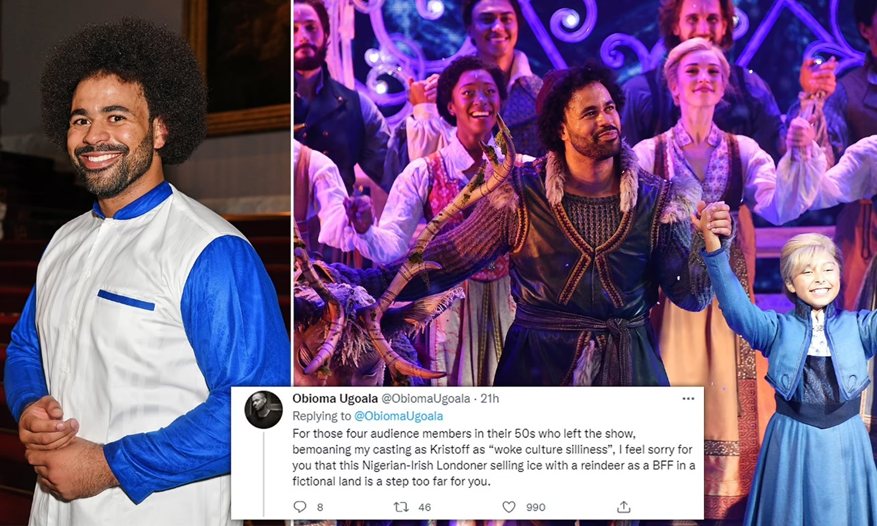
This book is a joy to read.
All my love
Steve
[1] Obioma Ugoala (2022: 242f.) The Problem With My Normal Penis: Myths of Race, Sex and Masculinity London, Scribner
[2] Ibid: 74f.
[3] See ibid: 36f. & 81 respectively.
[4] Ibid: 2
[5] Ibid: 4f., 28, 88f., 158
[6] Derek Owusu (ed.) (2019: 169 (Fanon), 6-67, 83 respectively) Safe: On British Black Men Reclaiming Space, London, Trapeze (Orion Publishing)
[7] Ugoala op.cit: 50
[8] Ibid: 144
[9] Ibid: 91
[10] Cited ibid: 29
[11] Ibid: 242
[12] Ibid: 207
[13] Ibid: 84
[14] Ibid: 74
[15] Ibid, 82, 14, 27, 13 respectively
[16] Ibid: 78
[17] Ibid: 175
[18] Ibid: 157
[19] Ibid: 179f.
[20] Ibid: 181, 195 respectively
[21] ibid: 189f.
[22] Cited ibid: 198f.
[23] Ibid: 184-6
[24] Ibid: 187f.
 Steve_Bamlett_blog
4 thoughts on “This blog looks at a popular version of an old trope of racist cultures in Obioma Ugoala (2022) ‘The Problem With My Normal Penis: Myths of Race, Sex and Masculinity’.”