


Below is a starter on our nostalgia trip. This is a brilliant photo-collage showing triggers to possible nostalgia and I suppose it is things like these pictures or the objects in them that this question looks for us to name – and what is amazing is that they all, as photographs at least, sort of work for me: I do remember wanting and then going to ask for a ’99’ (a flake stuck in bland Mr Whippy ice-cream) when was not tall enough to reach the counter of the ice-cream van in Bridlington on Halifax Wakes Week when I went with my grandmother, watching Andy-Pandy in monochrome TV, even Telly Salvalas in the evening too (Kojak) – reminding one of a time when male stars were not represented as objects of desire. I am largely indifferent to cat-longing but even the sleeping pussy as a photograph does it for me.
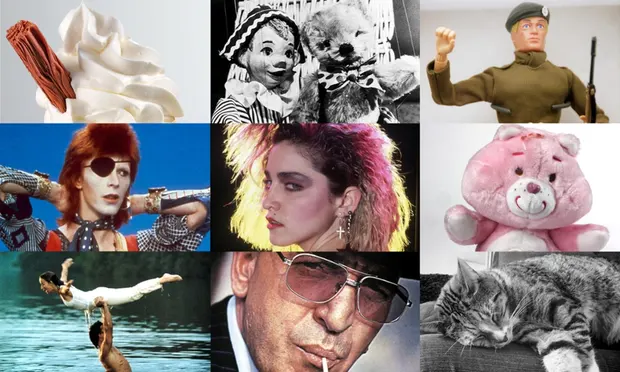
Images used in an article of 2014 in the Guardian, see: https://www.theguardian.com/society/2014/nov/09/look-back-in-joy-the-power-of-nostalgia.
The caption to that photograph is: ‘Remember when: which of these images gives you a warm glow? Photograph: Various‘. If, as I said, they all work with me, raising memories of the past that are affectionate and sad, which is roughly what we mean by nostalgia in contemporary usage, how can I write about what make me, specifically me that is, ‘feel nostalgic’. I wonder even if nostalgia has more to do with how expectations about memorials of a past life are constructed as social events and structures of feeling, which is I think what Tim Adams explores in the article in The Observer, to which I have already referred, with the help of an interview by researchers in social psychology, Docors (PhD doctoral graduates, not medical) Tim Wildschut and Constantine Sedikides. Adams even cites anecdotal evidence from the academic researchers of how some people are skilled in devising the stuff of what they call ‘anticipatory nostalgia’, where someone does something out of the norm of what usually happens at an event, like photocopying your bare bum at an office Christmas party. In fact for something surprising the good Doctors cite peeing in the sea rather than doing do whilst hidden behind a dune on a university colleagues outing to a beach but heh!, that doesn’t sound so out of the norm, if people are honest. But in fact, since nearly everyone, when office Christmas parties were more common (the researchers say we should have them back for their nostalgia making capacity) know someone who has a story of someone else photocopying their bum at a party – and sometimes they would show you the photocopy. However, let’s get serious about ‘anticipatory nostalgia’. Sedikides says, whilst defining ‘anticipatory nostalgia’ as the conscious construction of a ‘for-later’ memory in joy and sadness: “… If at a social event people do something crazy, with benevolent intent, then people will remember it. That is what is called having good anticipatory nostalgia skills. They know what they are doing”.[1]
That is all very ominous. That the good professors also see positivity in this says a lot about how the notion of counselling is constructed in discourse by social psychologists and it frightens me. Here is the paragraph that does that:
Some of this research is historical. Wildschut was intrigued, in this context, by the strong anecdotal evidence of women in concentration camps during the Holocaust who “responded to starvation by waxing nostalgic about shared meals with their families and arguing about recipes and so on”.
Wildschut speculated about this habit being an “as if” loop – a mechanism by which your mind can temporarily affect your perceived body state – linking it to research which showed that people were significantly more likely to generate nostalgic emotions in a cold room than a warm one – and that those emotions had the effect of making the room seem warmer. When he published these findings he was contacted by a concentration camp survivor who said he had been trying to explain this process to people ever since the war ended. “This is what we did,” the man said. “ We used our memories to temporarily alter our perception of the state we were in. It was not a solution, but the temporary change in perception allowed you to persevere just a bit longer. And that could be crucial.”
https://www.theguardian.com/society/2014/nov/09/look-back-in-joy-the-power-of-nostalgia
What chills is that the memories of these survivors can be used as means of getting us through adversities that should not exist and need not have done. It is as if it were the role of psychology merely to prompt a short-term resolution to ‘survive’, knowing even as we say that, that in most cases the people who felt this DID not SURVIVE, only those few who lived to remember it. The survivor says that is what ‘we’ did, indicating the widespread and communal effect but the phrase that ‘could be crucial’ is heavily conditional – only he, as a person in isolation from those others remembers it now and writes thus to Dr. Wildschut. I get the same feeling here as I do with the attempt to make an existential ‘living with adversity’ psychology out of concentration camp experience in the psychologist who did that: Viktor Frankl in his book Man’s Search for Meaning, based on his experiences in Nazi concentration camps.
Reading Frankl’s book is a totally different experience to that of reading Primo Levi, whose recounted experience feels less to be serving some other utility or end. There is something sacrosanct about NOT rescuing the memory of the concentration camps in a way that attempts to find use or good in them, other than in the virtue of raw survival as in Frankl who talks of the subterfuges his self-esteem had to suffer under as one of the cruellest of punishments, but preferable to death. We fall too easily into ‘blaming the victim’ for non-survival in Frankl’s mode. This is all the more telling in the light of the photograph in the article, offered in a different place in the article from the text quoted above, of the reality of Jewish women and many, many Jewish children in concentration camps:
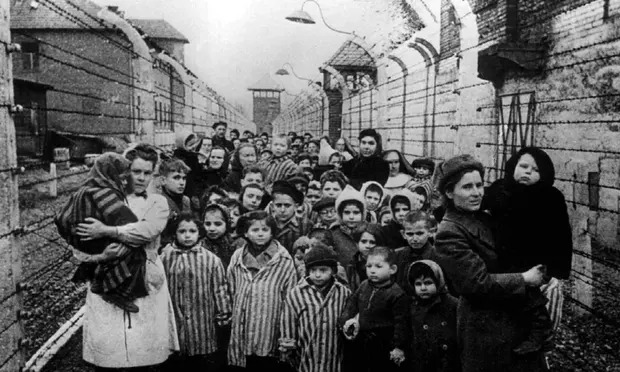
This photograph evokes feeling too, but it is not feeling that we can call ‘nostalgia’ perhaps, but of sheer and utter respect for lives that were in all likelihood lost soon after its record was taken and something like anticipartory fear for the children who now hold hands.
The term nostalgia derives from, in the words of Wikipedia:
νόστος (nóstos), meaning “homecoming”, a Homeric word, and ἄλγος (álgos), meaning “sorrow” or “despair”, and was coined by a 17th-century medical student to describe the anxieties displayed by Swiss mercenaries fighting away from home.
https://en.wikipedia.org/wiki/Nostalgia
It is strange but useful to know that the term was first defined as a medical condition to name feelings (that were not medical at all in fact but legitimate feelings) in an alienated fighting force in a foreign land. In the Homeric context, ‘nostos’ generated a genre of stories and dramas of the homecomings of ‘warriors’ and others – from Homer’s Odyssey, via Aeschylus’ Oresteia plays wherein two men return home to, I suppose James Joyce’s Ulysses, built on the model of the first example and relating to a Jewish Irishman’s sojourn away from his home and wife but still within the confines of Dublin. In these contexts,homecoming itself is an ambivalent experience – especially for Bloom in Ulysses and Agamemnon in his eponymous play in the Oresteia. Both of their wives have cooked up surprises that they won’t recall in parties (indeed Agamemnon won’t be able to, though his son could, once he shuts the Furies up). Tim Wildschut and Constantine Sedikides, in these days of that appalling thing, positive psychology, drag good out of the modern version of nostalgia giving it (although not in their own medically unqualified hands) medical application again but only on the basis of its observed utility in common experience, which they evoke in the article much more than they do the example of the concentration camps. However, even the fact that they have a nuanced idea of the phenomenon which show it has very socially undesirable negatives, doesn’t stop them wanting these ideas rolled out into therapeutic use. One such negative nuance is the link of nostalgia, especially in its cousin Heimweh.
In one study, Wildschut and Sedikides induced a nostalgic state in a group of Greek students at the university, using songs and so on. In this state the cohort’s love of all things Greek – food, art, music – was “measured as off the scale”. Somewhat more worryingly, however, the products and food of other countries were “also denigrated much more sharply than if a nostalgic state had not been induced”.
So nostalgia can be a nationalistic, chauvinistic tool?
“That is why we have to tread carefully if we use this as a group therapy,” Wildschut says. “Anything that increases the bonds within the group also has the power to increase the negativity towards other groups. …”
The psychologists twist and turn to show that groups can be persuaded more positively of things and persons usually denigrated, such as obese persons, but the show of science in their findings feels paper-thin and much subject to researcher-based bias, especially since the research was not, and could not be, conducted in double-blind experimental conditions. My own feeling is that nostalgia is not a sickness per se. It is too wide a term moreover to cover all of what these researchers see as nuances but which I see as mixed forms or structures of repertoires of feelings. Group identifications with past symbols – Nazism tell us this – can be used for state-organised hate, or by terrorist groups to commit horrific crimes such as the murderous Hamas incursions across the Gaza border. But no less does it operate in Israel, used by backward-looking forces to justify bloody and unequal war against all Gazan (and perhaps West Bank) Palestinians.
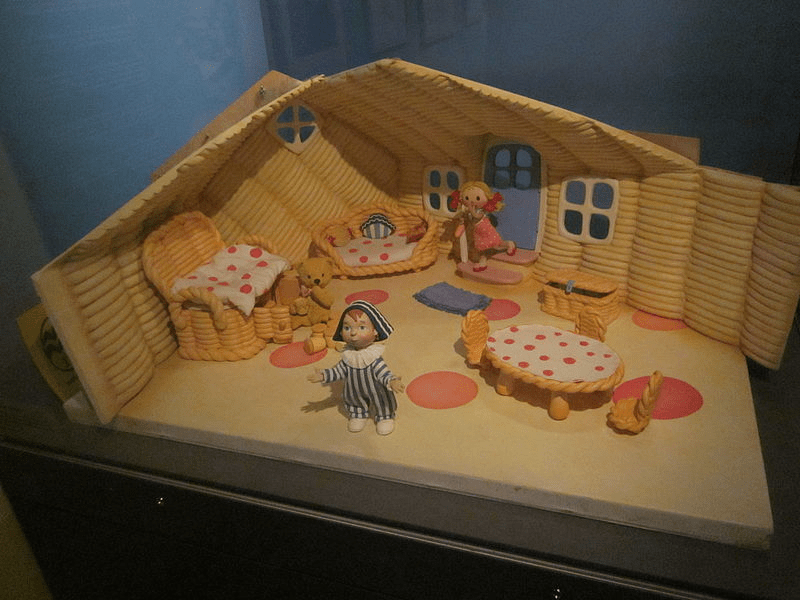
Stop motion set on display at the National Science and Media Museum, with Andy Pandy, Looby Loo and Teddy by Chemical Engineer – Own work, CC BY-SA 3.0, https://commons.wikimedia.org/w/index.php?curid=19731153
Even if I look at my nostalgia for Andy Pandy I see how that might associate with the ethnocentric assumptions that show inevitably by its cosy white childhood fantasies, the kind of nostalgia Tony Harrison saw in his poem V – a poem suffused with, and analytic of, that structured set of feelings – as being something consequent on change you don’t understand and that turned his loved father to an unloved and unlovely racism which blames foreign incursion for all change:
House after house FOR SALE where we’d played cricket
with white roses cut from flour-sacks on our caps,
with stumps chalked on the coal-grate for our wicket,
and every one bought now by ‘coloured chaps’,
dad’s most liberal label as he felt
squeezed by the unfamiliar, and fear
of foreign food and faces, when he smelt
curry in the shops where he bought beer,
Tony Harrison (1985) ‘V’ Newcastle-upon-Tyne, Bloodaxe Books.
The ‘white rose’ for Yorkshire cricket is tremendous but smells somewhat of flour gone stale in the light of the proven evidence of racism in Yorkshire Cricket Club that has begun to shake the whole heap of nostalgia fixed on that once ‘whited sepulchre’ of a sport. There is such danger in a simple evocation of ‘nostalgia’. It leads to the grotesque nationalism that sprays racist graffiti on the gravestone of the same dad captured above, associated like a twin with hatred of the Other in what other form – the thing you are ‘versus / v’. And, such feelings are more likely when people feel that are being swept away with change as no doubt too did the people of colour who bought shops already lost to history by the processes of a capitalism no-one amongst the MANY control, but the FEW, to their own interests, do. This speaks from the Graham Sykes photographs in Harrison’s book:

What we lose is Union, which is a diverse, dynamic and future-tending force of life, not a stilled and past object. It is only ever the latter when, because we interpret time through opposition and hate we feel justified in being ‘versus’ something conveniently apparent in, but not causal, of our present feelings. We feel too often that change is not on our side, but then it certainly isn’t on the side of people who face death in the English Channel on a crowded rubber dinghy. That is why Harrison uses foul-mouthed young racist young men who support a football team ‘UNITED’ (Leeds United) but only in its opposition to comers-in. We are in contradiction, Harrison says, and so was Dad, and so am I seeing racist graffiti in red on Dad’s grave. The poet wants home to his wife but he can’t cut himself from working class roots that made him more than did his fancy Grammar school education in Greek (Harrison was known as a Greek scholar and revived many classical poetic forms, amongst others with an ear for the contemporary struggle to make history matter). We can’t be versus nostalgia either, we have to work with it, transform it by ensuring time and (his/her/them)story are seen not as a plot against most of us but the opportunity of change we all have a hand in directing - united against diversities we love and rejoice therein. We are our future and love each of our pasts and venerate them, even the hard work of the working class who erected our educational opportunities. Harrison’s proposed epitaph in V is
Beneath your feet’s a poet, then a pit,
Poetry supporter, if you’re here to find
how poems can grow from (beat you to it!) SHIT
find the beef, the beer, the bread, then look behind.
We are based or rooted in things that are complex in our feelings, our history and in the formulation of sane and just futures.
With all my love, UNITED in it,
Steven xxx
[1] Tim Adams ‘Look back in joy: the power of nostalgia’ in The Guardian online (Sun 9 Nov 2014 08.30 GMT) Available at: https://www.theguardian.com/society/2014/nov/09/look-back-in-joy-the-power-of-nostalgia
 Steve_Bamlett_blog
Certain smells. Like this old musky scent at my grandma’s house it almost smelled like a library. Like the smell of old books or something. Anyways whenever I smell that scent somewhere else it makes me think of her and visiting and then I realize how much I miss her and how life sucks just a little bit more.
LikeLiked by 1 person
That is beautiful Eric. Keep well good man..
LikeLike