What’s your favorite month of the year? Why?
April is the cruellest month, breeding
Lilacs out of the dead land, mixing
Memory and desire, stirring
Dull roots with spring rain.
Winter kept us warm, covering
Earth in forgetful snow, feeding
A little life with dried tubers.
T.S. Eliot ‘The Waste Land’, lines 1ff. For whole poem see: https://www.poetryfoundation.org/poems/47311/the-waste-land
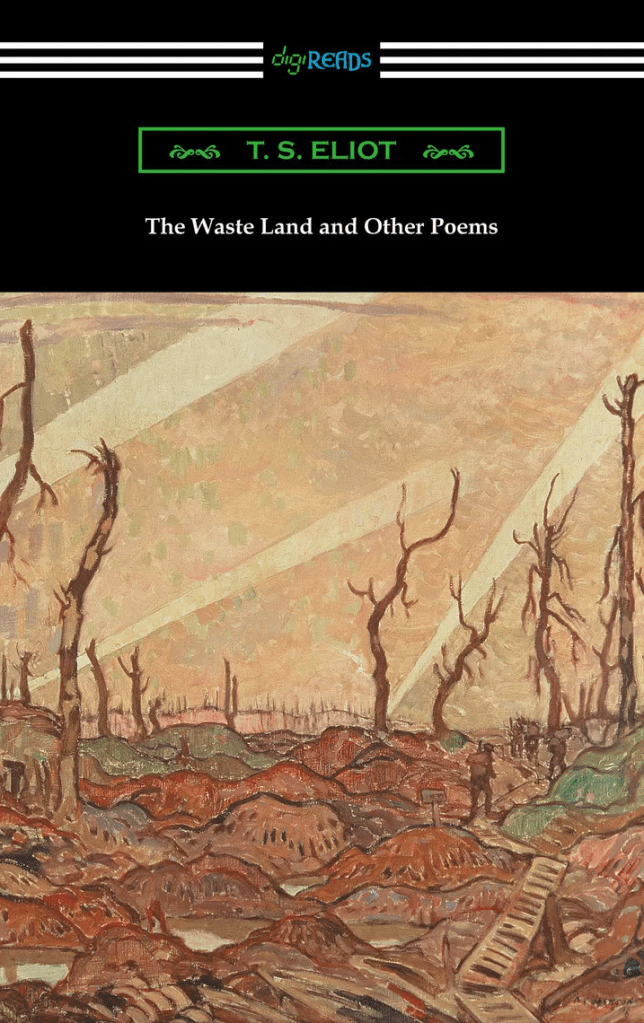
A cruel month ought not to be a favourite one, but T.S. Eliot was a dry stick, who in The Waste Land imagined a narrator who is even dryer than he. To be dry may be dull but it at least it is a state with few surprises or those ‘unseen ejaculations’ that ‘awe us’ that Thomas Hardy found so exciting in Pentargan Bay in Cornwall remembering a woman he once loved and desired:
Up the cliff, down, till I’m lonely, lost,
Thomas Hardy ‘After A journey’ for full poem see: https://www.victorianweb.org/authors/hardy/poems/journey.html
And the unseen waters’ ejaculations awe me.
Wetness is a nuisance to dry men, for at least when you are dry, even if you are cold and feel buried (where there is a little warmth, under a permafrost) nothing comes to excite you into more of life than it does to a tuber, bone dry on its thick outside with its parsimoniously slow distribution of moisture within to sustain a life that is stilled of motion over winter. In winter we at least have our memories and do not hanker after things that give us overt joy. A tuber remembers that to feel joy it first has to succumb to wetness and those internal promptings we might as well call desire; that find memories of past excitement in life wanting if that’s all there is available. Better to be dry, better to be dull and remain in those states. But April is so insistent. The poet Chaucer in a much earlier poetry welcomed ‘Aprille’ unlike Eliot his ‘cruellest month’, and for Eliot’s story-teller Chaucer is okay whilst he remains another memory.
Whan that Aprille with his shoures soote,
The droghte of March hath perced to the roote,
And bathed every veyne in swich licóur
Of which vertú engendred is the flour;
Whan Zephirus eek with his swete breeth
Inspired hath in every holt and heeth
The tendre croppes, and the yonge sonne
Hath in the Ram his halfe cours y-ronne,
And smale foweles maken melodye,
That slepen al the nyght with open ye,
So priketh hem Natúre in hir corages,
Geoffrey Chaucer ‘The General Prologue’ to ‘The Canterbury Tales’, available in full at: https://www.poetryfoundation.org/poems/43926/the-canterbury-tales-general-prologue
Of course poetry is a cruel thing too. Long dead though a poet may be, they can refuse to stay buried and we get awed by the sound of subterranean waves they create breaking in shore caves like Hardy remembers or the insistent ‘Natúre’ of Chaucer that will so ‘priketh’ us to remember that a dead Christ is also a live one in our ‘corages’ (our hearts). All this violence, that has the daring to call itself ‘natural’, is aimed at reminding us that we are alive in every viscera. Eliot feels the cold wet as a ‘breeding’, ‘mixing’ and ‘stirring’. We should even remember that Chaucer, though he welcomes the ‘sweet showers’ of April, thinks they violently pierce to your roots and forcibly bath you into life.

Desire is, after all a source of wet joy and what is wet must first disturb in order to invigorate us. And all desire is like that. While these poets both refer to something in April in that is more than just like the imagery of reproductive sexuality – the engendering of the young from the old, birds that sing to their mates through the night with their eyes fully open or simply, and horribly, that ‘breeding / Lilacs out of the dead land’, the aim of both seems a spiritual birth. Chaucer’s pilgrims have their hearts, or ‘corages’, pricked so that they go on a pilgrimage to holy Canterbury to honour Christ and his dead saint. Eliot will find every degree of spiritual ritual to wake him up in The Waste Land and make him feel that he is no longer wasted.
Yet even that kind of coming to life is a sticky wet business – as is baptism and all that. But it is sometimes a flood of redemptive sacrificial blood and damp flesh in the mouth:
the Lord Jesus, the same night in which He was betrayed, took bread;
24 and when He had given thanks, He broke it and said, “Take, eat; this is My body which is broken for you: this do in remembrance of Me.”
25 In the same manner also He took the cup when He had supped, saying, “This cup is the new testament in My blood: this do ye, as oft as ye drink it, in remembrance of Me.”
1 Corinthians 11:23-25 ,King James version of Bible.
We remember our Gods by consuming their sacrificial body and blood. We mix ‘memory and desire’ and we don’t always feel good about it, unless our unctuous self-satisfaction outweighs our ability to feel the ambivalence of all joy. Even as a non-religious atheist, I think these moments tell us something. What is valuable and sustains value is not what gives us simple joy. It has to take us somewhat by the scruff and make us feel alive, awe us as Hardy is awed. And love is like that, be it sacred or profane, or somewhere in between, which, in my reckoning, at its very best it is.
And for that mix and breed, we need April. It has to be our favourite month. Maybe Robert Frost needs the last word:

Yes. We know how it is! And it is life – mix, match and make anew for tomorrow …. For tomorrow and tomorrow and tomorrow may never come.
With love
Steve
 Steve_Bamlett_blog
👋NICE POST ❤️💯
I started following your blog.
I hope mine continues and so we grow together 🙏🌈
A cordial greeting from Spain 🇪🇦
Happy and blessed day 🌞
LikeLike