What is your favorite place to go in your city?
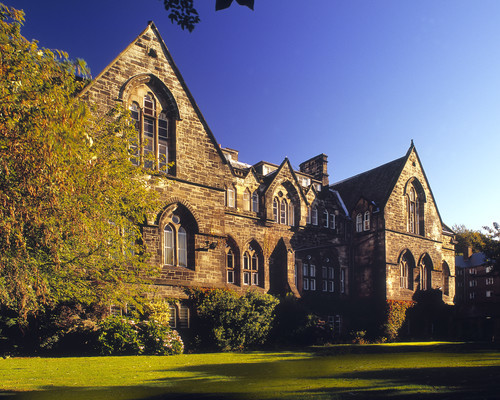
The front of the then School of Education, Durham University
Soon after I moved to County Durham I studied for a PGCE in teaching English and Drama. Those portals to teaching were taught in then School of Education in Durham University in the College of St. Hild and St. Bede, sitting on the hill above the River Wear on the entrance to the city from the A1. In an introductory lecture, someone (I believe it was the Dean of School) pointed out that from the window behind us – pause whilst we all turn and look – you see a Cathedral, a Castle and a prison, all famous versions of those institutions. The latter, for instance then housed Rosemary West. And, was Myra Hindley there too?
Those institutions explain, the lecturer went on to say, why you are here in order to learn how to be a teacher – for they respectively represent the pillars of our society – the spiritual, the political and society’s retribution for non-compliance or worse. We should see them, he continued, thus: ‘The first two represent the aspiration of teaching the creation of creative spirituality (the Cathedral that was the fruit of Romanesque Architecture and Anglo-Saxon faith embodied in the slow-to-decay corpse of St. Cuthbert), citizenship and the State and its legitimate power (even if this bent the true aspiration of Norman aristocratic rule) and the third represented the failure of the first two things (for crime sprang from, he said, the failure to educate both the human spirit and the greedy self into an active altruistic citizen)’.
Not much edified but intrigued by this rather institutionalised view of the purpose of life, after the lecture room dispersed, I walked down to the Wear to the footbridge that crossed from the college to the old Baths building – nowadays a decaying ruin – through various vennels (the Durham name for foot passages between buildings or land plots) into the road called Old Elvet. Later in my life, having learned I was not matched to secondary school teaching, I trained as a social worker trained in a grim eighteenth century crooked house holding the Durham University Department of Social Work on that very road. But at the present moment my gaze led behind those facades to where, behind a green crescent garden, an imposing mock-classical facade fronted Durham Prison’s main building (though I knew even then it was no longer its public entrance). You will see it on the collage below.
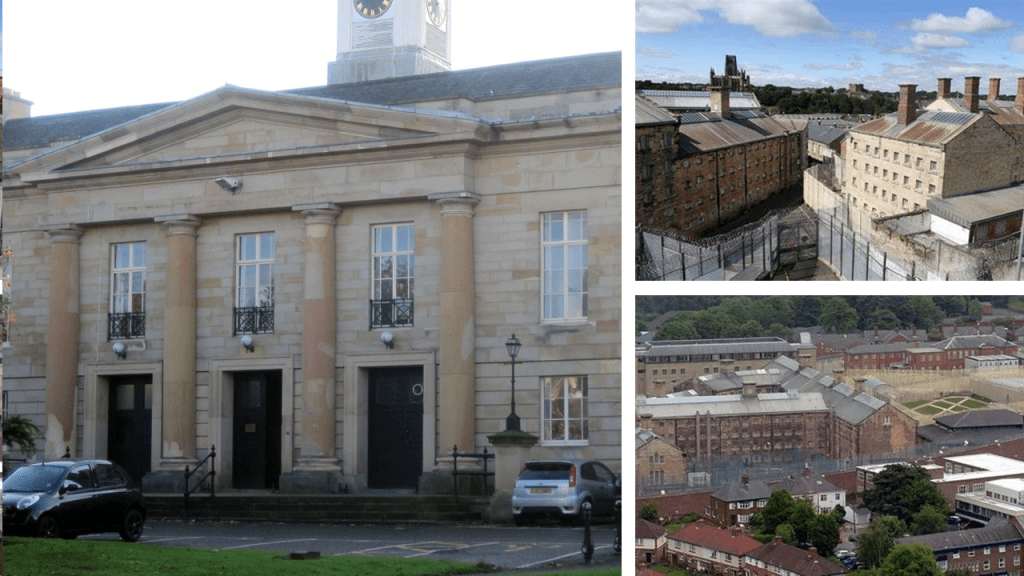
Durham prison
The frontage looks impressive if austere but it hides an extensive warren of old buildings of grim purpose and impressive Victorian-Gothic ugliness. It was not till much later in my life, that I entered into those grim buildings the front end of which was, years before that, I saw I. Front of me. On that later occasion, I saw inside that prison whilst visiting a man I worked with who had enduring severe mental health problems. Inside the people, the interview rooms, the story told by the inmate I visited opened up new grimness and lack of care behind the retribution I heard of in the lecture. None of Prison area, of course, is a part of the city oft spoken about in the city’s publicity.
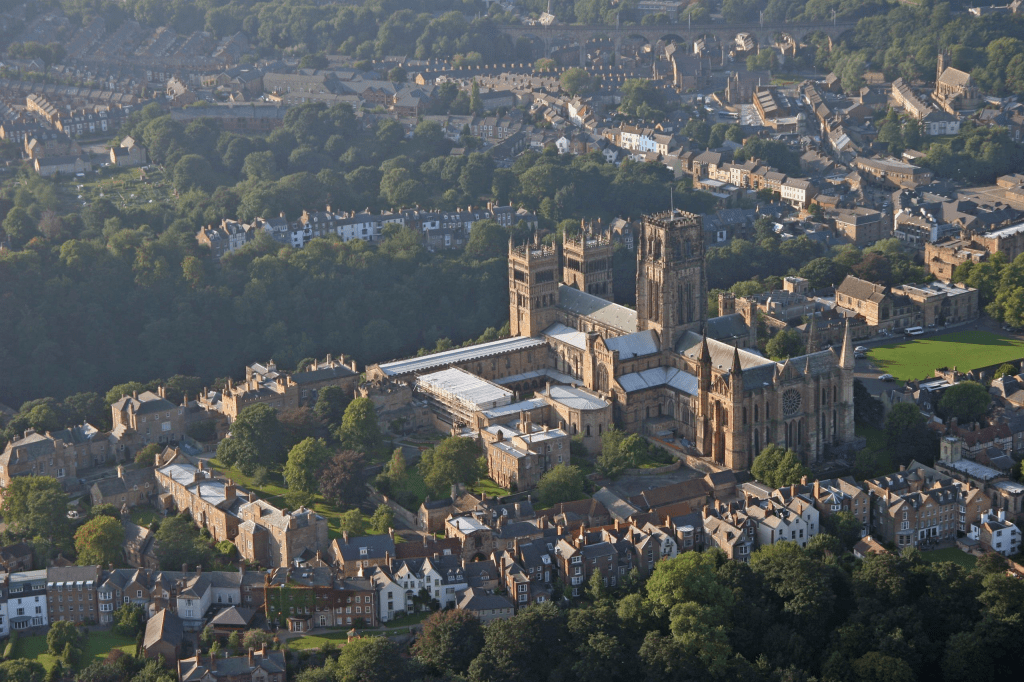
Rather we are expected to look up across the Wear south of the Cathedral – up the mount to that wonderful edifice at the top of it that is the Cathedral (with that beautiful old fulling mill at the cathedral end of the lesser of the two Durham city weirs, this one crossing the River Wear at that point). The cathedral itself looks grand from here without being dominated by later Gothic additions as it is in other views – strong in Romanesque features and pier buttresses are all we see. And at night it is romantic, even with the additions of its grand eighteenth century housing for the rich clerics serving the Prince Bishop that surrounds its base. Safe in his Castle and libraries the Prince Bishop sat at the hub of a web of power, riches and learning.
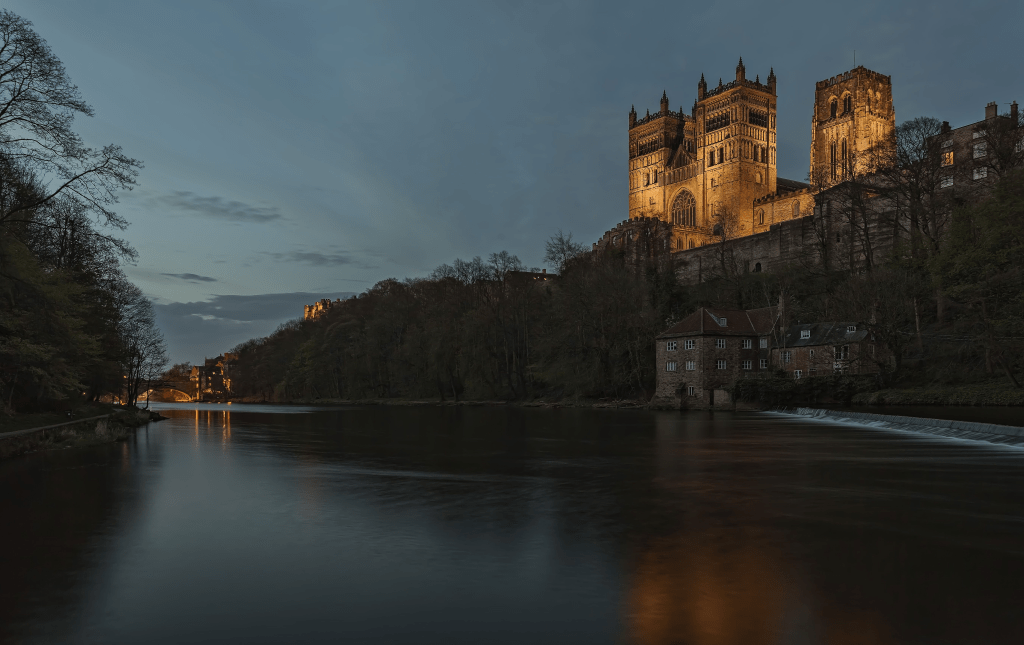
The story of that Cathedral and its mount is told in many places but I would recommend Benjamin Myers novel, Cuddy, as the best introduction, for it is an epic story that looks into all the issues raised so superficially in that introductory lecture at Hild and Bede. It dives deep beneath what we mean by creative spirit, citizenship and the underlying co-presence in both of imprisoning retribution, including a chapter from The English Republican period when the Cathedral itself was the cruellest of prisons for Scottish teenagers captured in battles in Scotland and led there by the Lord Protector Cromwell’s forces. See my blog on this wonderful novel at this link.
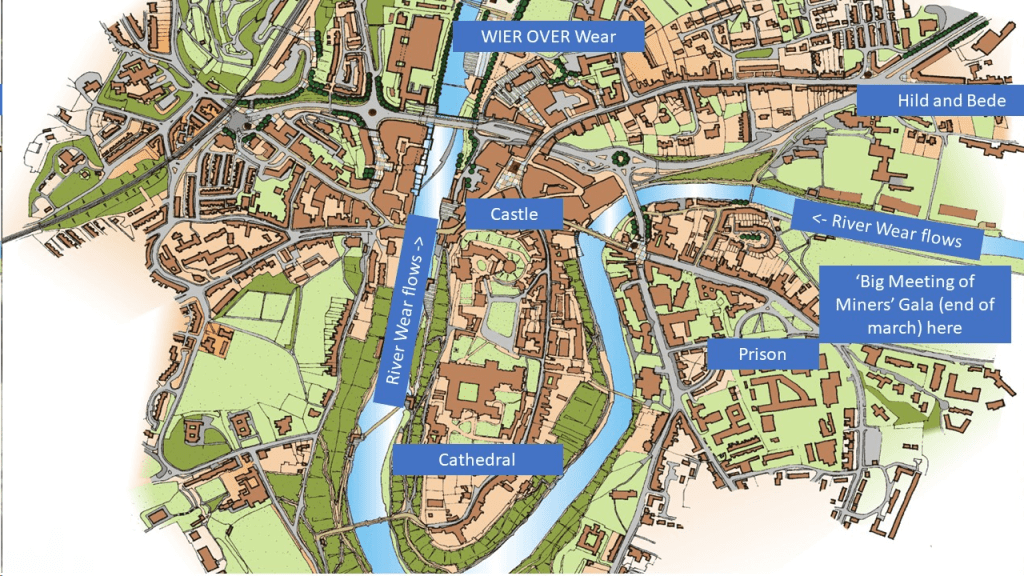
In book and reality, the Mount is contained tightly within a loop of the river Wear. The mount is a container indeed for on it stands Castle (now University College Durham) and Cathedral and the rambling streets that make up the centre of the old city with its newer parts. You can almost see how some parts of the map above works as real geography in the aerial photograph below, despite its biased angle to beauty rather than comprehensive views.
For it is not all beautiful – this city – in that distinctive way the English like their beauty to look rambling and antique. Just down the Mount to Elvet Bridge are hidden very new and identical streets which are in fact an open shopping centre. They look like they could be found in ANY modern city, as if history including its homogenisation of town architecture has been crushed within the isthmus of Durham central, under that new idea of a flimsy structures of umbrellas guarding passers by from exposure. Here is Umbrella Street. In many ways Durham city is contained – held in but full of content.
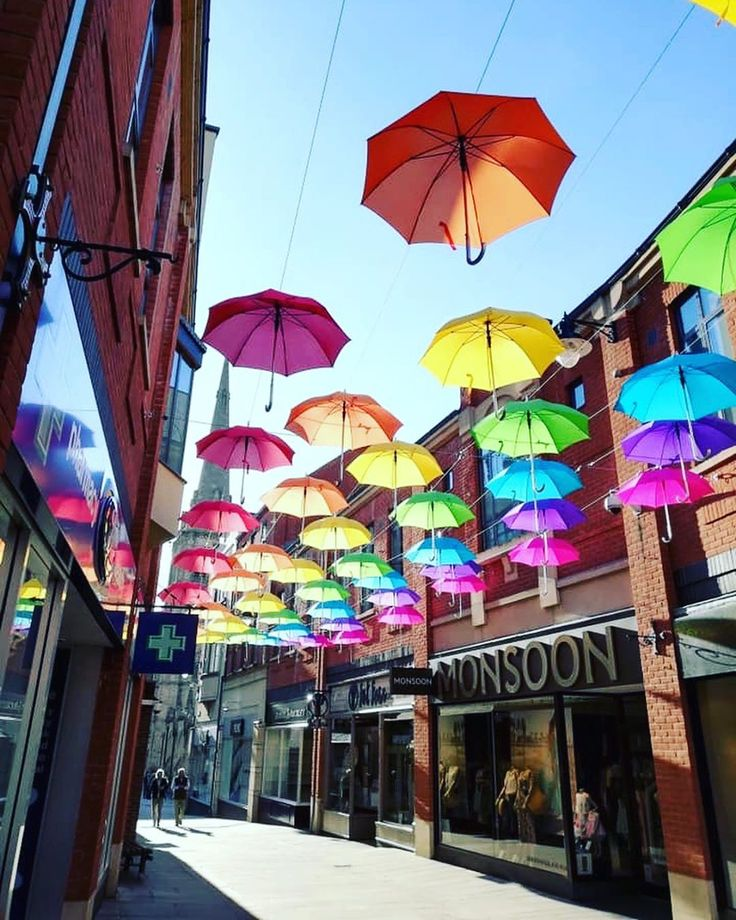
Some very new and identical to shopping centres found in ANY modern city, as if history has been crushed within it, under that new idea of openness under flimsy structures of umbrellas.
The old city then is my favourite part of the city. It is a palimpsest of impressions from history (as is Cuddy) and contained as if by the embrace of an arm (or the squeeze of a noose depending on my mood) by a bow of the River Wear. Yes – a river does run through it BUT only by running around the city Centre, and holding it in, with all its contradictions of church and state, left (in the traditions of the Miners Gala – see the Norman Cornish painting below) and right, history and its erasures.
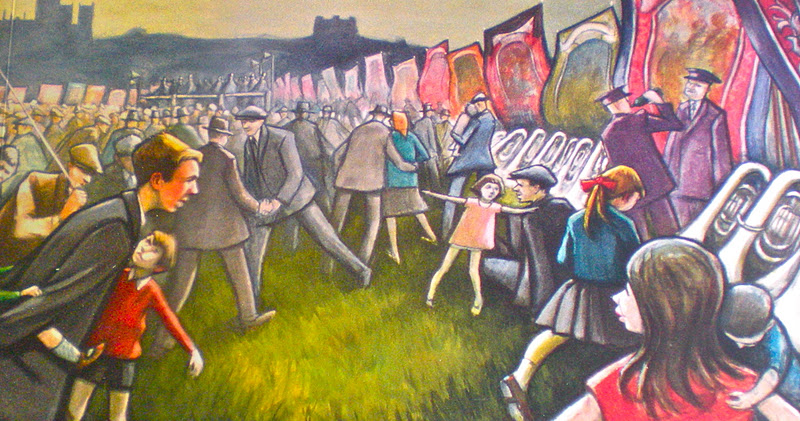
The Durham Miners’ Annual Gala March gathers south east of the Wear under prison and Cathedral and Castle on horizon.Norman Cornish (the painter of this tribute to the mines he hated to work in) and son at front.
The most dramatic of the Wear’s weirs (downriver slightly from the one spoken of before) is also a favoured spot for flattering photographs – though taken near a modern shopping centre whose river ramparts are not the prettiest and therefore occluded from full sight here. But we look here over the Norman Castle keep to the Cathedral Towers on the Mount.
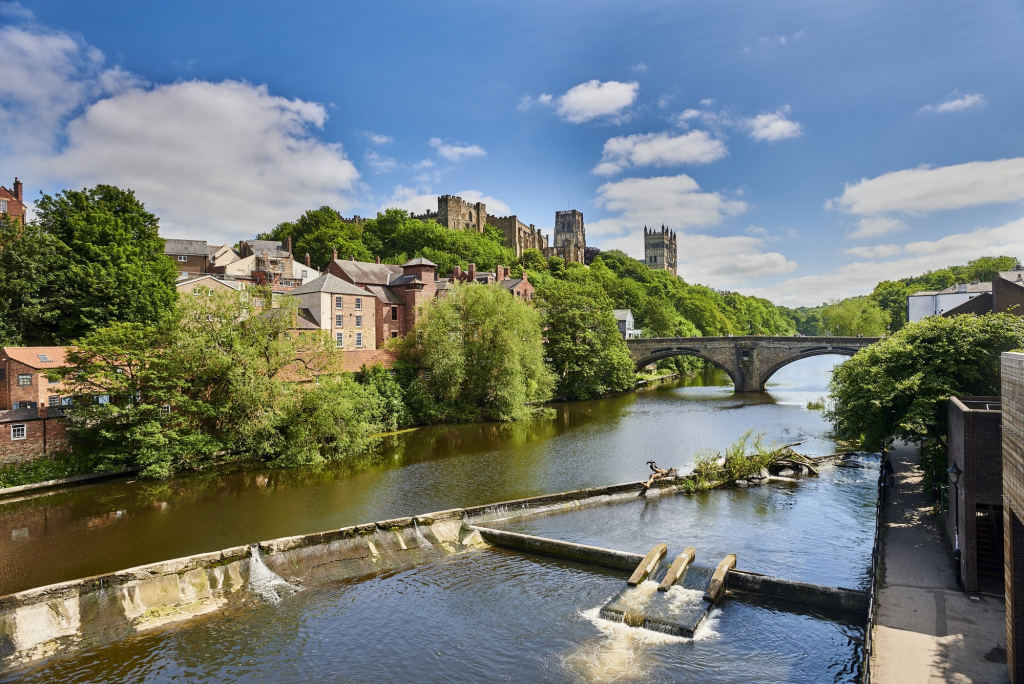
All said, I love living in Durham and in its contradictions. Indeed the modern section of Myers’ Cuddy, with its exposure of a city riven by the selfish capitalism unleashed by the Thatcher years, is really what makes the novel tick, despite the beauty of the book’s lyrical evocation of the Middle Ages and the history leading up to it, for by then everything has become a commercial enterprise – the Cathedral and the Castle University. No doubt, the Prison will follow in that entrepreneurial tradition with tours for the well-to-do arranged as they were at Bedlam in the eighteenth century. Durham Prison, like our prison system throughout, still contains (or tries to) people failed not only by education biased to privilege but both an entirely failed child and adult mental health system and state child-care system (see my blog on Jenni Fagan’s yet unpublished memoir at this link).
I do love Durham but it is a strange city – not large enough in fact to be considered a city at all compared to York or even more the modern metropolis of Manchester. Like Carlisle, it feels wrapped in its cusp status as a border city. On Prebends Bridge, leading to the Cathedral over the Wear, is carved a part of a poem by Walter Scott – a doggerel jingle really – that does say a lot about the ‘city’, such as it is in this role:
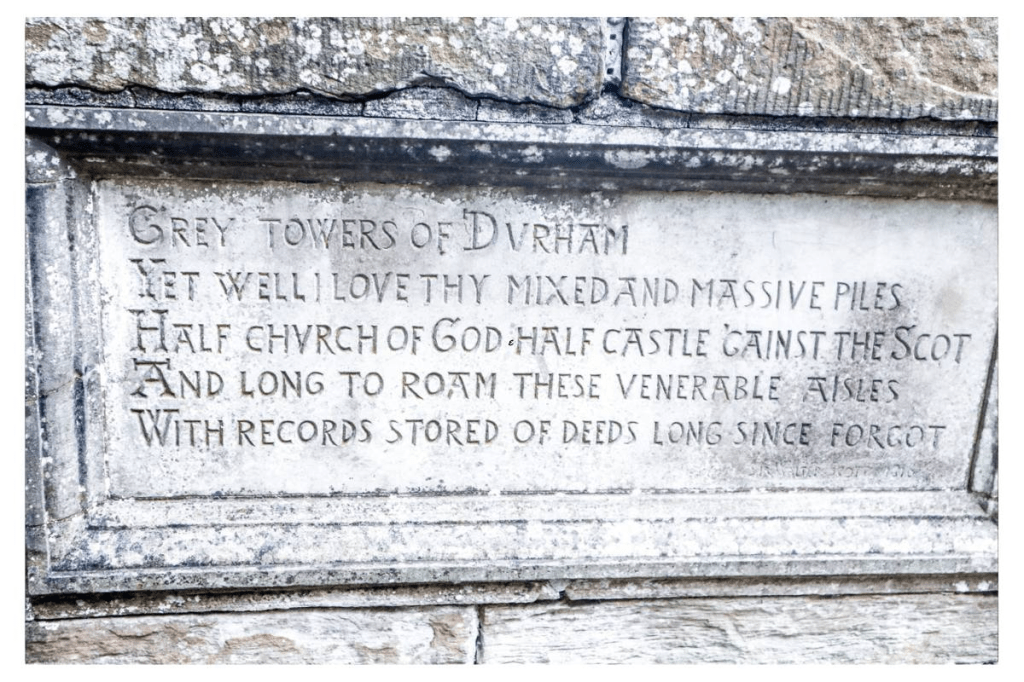
Here’s my version (and forgive the cynicism – one day libertarian green socialism may have its day):
Why should God desperately dump Durham –
A painful passage through his massive piles –
When much it meant to us feels half a sham
Now, habituated to shopping aisles.
A cathedral’s use is quite forgotten:
City ideal social lives gone rotten.
Despite the cynic’s eye-view above, I love Durham. I love showing it off to friends to whom it is a surprise. I love that Daisy, our dog, rolls in the garlic as frolicsome as the randy eighteenth century monks in Cuddy. I love its refusal to be other than contradictory. I don’t have a ‘favourite part’ of my city. My city’s size means it is a favourite in itself and entire – a lumpy package but an exciting one to open again on every Sunday walk with Geoff and Daisy.
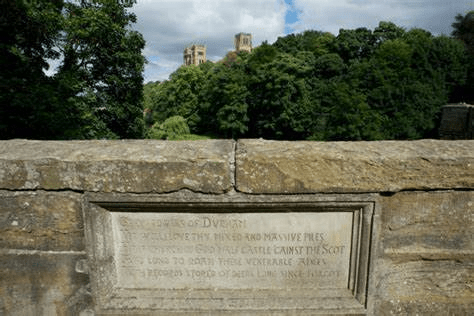
We start off, of course, at Prebends Bridge.
Love
Steve
 Steve_Bamlett_blog
The views look incredible, Steven. 🙂
LikeLiked by 1 person
It is a beautiful city, Rajan.
LikeLike